Kink vs Fetish: What's the Difference and Why It Matters | Second Banana
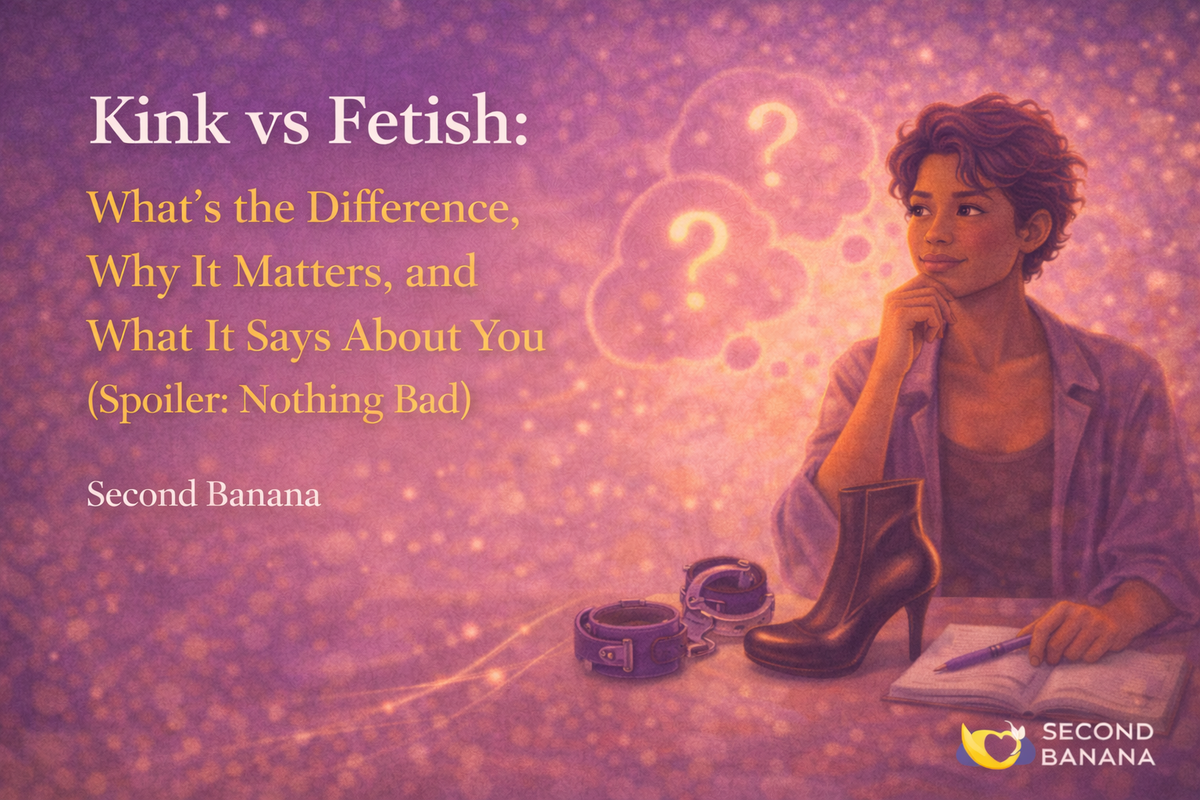
Kink vs Fetish:
What's the Difference, Why It Matters, and What It Says About You (Spoiler: Nothing Bad)
Everyone Uses These Words. Almost Nobody Means the Same Thing.
"Kink" and "fetish" are two of the most frequently used words in conversations about sex and desire, and two of the most consistently confused. They get used interchangeably in casual conversation, in dating profiles, in journalism, and often in clinical writing that should know better. The result is a widespread muddle in which people have difficulty describing their own desires precisely — which makes it considerably harder to communicate them honestly, find people who share them, or understand themselves with any real clarity.
This matters. Not in an academic way — not because there's an exam — but in the practical, everyday sense that knowing what you actually have makes you better able to name it, ask for it, and find the person who is genuinely interested in providing exactly that.
So let's draw the distinction properly. Then let's get into what a fetish actually is neurologically and psychologically, why the clinical history of the concept is a mess that doesn't help, what the most common ones are and why, and what all of this has to do with how you show up on Second Banana.
The Actual Distinction
Kink
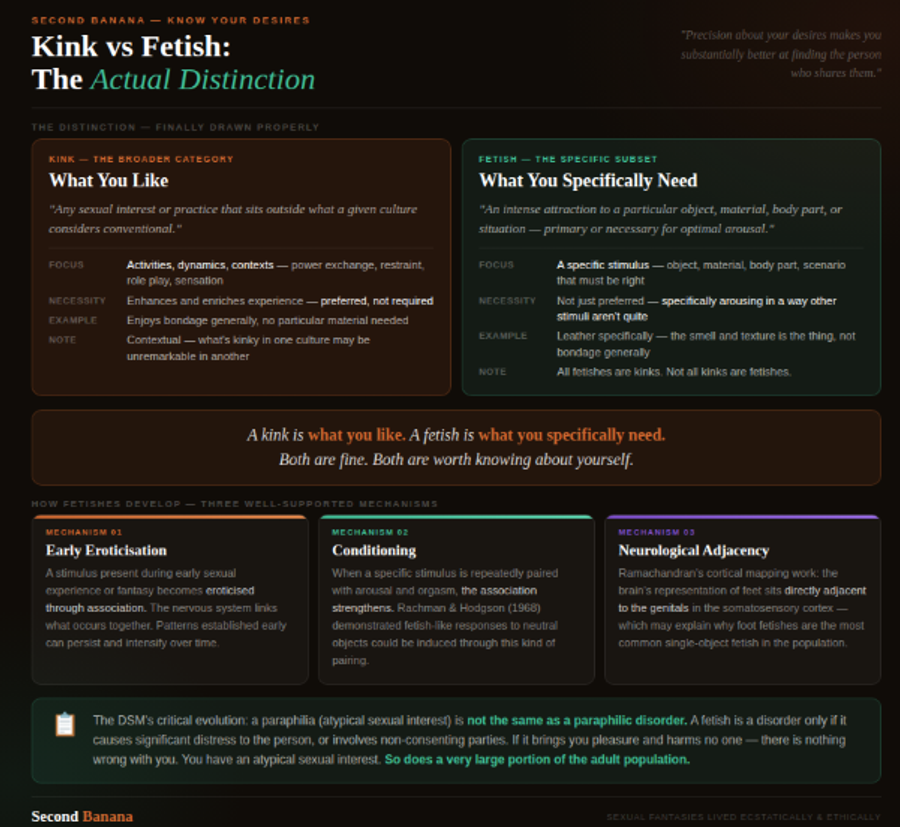
Kink is the broader category. It refers to any sexual interest or practice that sits outside what a given culture considers conventional — power exchange, restraint, role play, sensation play, voyeurism, exhibitionism, group sex, specific relational dynamics, and the enormous range of everything else that mainstream sexual culture doesn't centre. Kink is contextual: what counts as kinky in one cultural moment or place may be unremarkable in another. The word is fundamentally about deviation from a norm, not about any inherent quality of the interest itself.
Kink is primarily about activities, dynamics, and contexts. You can have a kink for power exchange without any particular object or body part being required — the interest is in the relational dynamic, not in a specific stimulus. You can have a kink for role play without it being triggered specifically by costumes — the fantasy is situational, not object-bound.
Fetish
A fetish is something more specific: an intense sexual attraction to a particular object, material, body part, or situation that functions as a primary or necessary condition for sexual arousal. The word comes from the Portuguese feitiço — a charm or talisman — via the early anthropological use of the term to describe objects believed to have magical power. In its sexual meaning, a fetish is an object or stimulus that has been, for this person, charged with erotic significance to the point where it functions as a kind of attractor — not just preferred, but specifically arousing in a way that other stimuli may not be.
The clinical definition adds that a fetish involves an inanimate object or a non-genital body part as the primary focus of sexual arousal. But the community usage is somewhat broader: people commonly describe a fetish as any sexual interest in a specific stimulus — a material (latex, leather, satin), a body part (feet, hands, hair), a type of clothing (heels, uniforms), a scenario (a specific role or situation that has to be exactly right to work for them).
The important distinguishing feature is the specificity and the centrality. A kink is an interest that enhances or enriches sexual experience. A fetish is a specific stimulus that is necessary or near-necessary for optimal arousal — not just "I enjoy this" but "without this, or something very close to it, the arousal isn't quite the same."
Where They Overlap and Where They Don't
All fetishes can be described as kinks — they're non-conventional interests. But not all kinks are fetishes — many kinks are about dynamics or contexts rather than specific objects. Someone who enjoys restraint might have a kink for bondage without any particular material or implement being the focus. Someone who needs to incorporate leather specifically — whose arousal is specifically tied to the material — has moved from kink into fetish territory.
In practice, many people have both: kinks that enrich the experience and fetishes that are more specifically necessary. And many people find that interests which began as kinks have intensified over time into something more fetish-like — the eroticisation of a specific stimulus that becomes more central rather than less. This is normal. The intensity and specificity of sexual interests exist on a spectrum, and where any individual sits on that spectrum can shift.
A kink is what you like. A fetish is what you specifically need. Both are fine. Both are worth knowing about yourself.
The Clinical History — Why It's a Mess and Why You Shouldn't Worry About It
The clinical history of fetishism is not a comfortable one, and it's worth knowing about if only so you can set it aside with clarity.
"Fetishism" entered psychiatric literature in the late nineteenth century — Krafft-Ebing's Psychopathia Sexualis (1886) catalogued it alongside an enormous range of other non-conventional sexual interests, all framed as pathologies, degeneracies, and symptoms of underlying disorder. The framing was explicitly moral as much as it was medical: these were interests that deviated from procreative, heterosexual, marital sex, and deviation was by definition pathological.
This framework persisted, in various forms, through most of the twentieth century. The DSM — the American Psychiatric Association's diagnostic manual — classified fetishism as a paraphilia (a category of atypical sexual interests) and treated it as a disorder. The most recent revisions (DSM-5 and its updates) introduced a critical distinction: a paraphilia is merely an atypical sexual interest, while a paraphilic disorder requires that the interest cause significant distress to the individual or harm to others. Fetishism, in the current clinical framework, is not inherently a disorder. It is a disorder only if it causes significant distress to the person who has it, or involves non-consenting parties.
That distinction is the right one. The clinical history is largely a history of pathologising difference — of treating any sexual interest that deviated from a narrow cultural norm as evidence of disorder. The people who suffered most from this framing were people who had no distress about their interests whatsoever, who were harming no one, and who were nevertheless told by medical authority that they were disordered. The DSM's evolution on this point is genuine progress, even if it came very late.
The practical upshot: if you have a fetish and it brings you pleasure, if the people involved consent, and if it causes you no significant distress — there is nothing wrong with you. You have an atypical sexual interest. So does a very large portion of the adult population.

How Fetishes Develop — What We Actually Know
The honest answer is that the developmental origins of fetishes are not fully understood, and anyone claiming otherwise is overstating the evidence. But there are several reasonably well-supported observations worth knowing.
Early Eroticisation
Many people with strong fetishes report that the object or stimulus in question was present during early sexual experiences or early sexual fantasy — sometimes as early as pre-pubescence. This is consistent with the broader understanding that sexual interests, like many other psychological patterns, are partly shaped by the experiences and stimuli associated with early arousal. The nervous system links things that occur together, and the eroticisation of a specific stimulus can begin in this associative way.
This doesn't mean fetishes are caused by a single formative experience in a deterministic way — the psychoanalytic narrative of the fetish as a specific response to a specific childhood event is largely unsupported. What it suggests is that early associations between arousal and specific stimuli can establish patterns that persist and sometimes intensify over time.
Conditioning
The behavioural explanation for fetish development draws on classical conditioning: if a specific stimulus is repeatedly paired with arousal and orgasm, the association strengthens. This is why early sexual experience and fantasy can shape the trajectory of adult sexual interest — the stimuli present during those experiences become linked with arousal through repeated association. Research by Rachman and Hodgson in the 1960s demonstrated that fetish-like responses to neutral objects could be induced in laboratory conditions through this kind of pairing, which provided some of the clearest empirical support for the conditioning model.
Neurological Adjacency
There is a neuroanatomical observation that has been advanced to explain the prevalence of foot fetishes specifically — and by extension, fetishes for adjacent body parts and materials. The somatosensory cortex, which maps the body's sensory experience, places the representation of the feet directly adjacent to the representation of the genitals. Ramachandran's work on phantom limb syndrome and cortical remapping suggested that this adjacency might account for some degree of cross-activation — the stimulation of one area potentially activating the adjacent one. This is speculative rather than definitive, but it provides a plausible neurological account for why foot fetishes are the most common single-object fetish in the population.
The Range and Prevalence
Fetishes are considerably more common than most people realise, partly because the shame and stigma around them ensure that most people never discuss theirs. Research consistently finds that significant minorities of the adult population have specific, intense erotic responses to particular objects, materials, or body parts. Feet are the most common single focus. Clothing and material fetishes (leather, latex, silk, heels) are extremely common. Specific body parts beyond the genitals — hands, hair, neck — are frequently reported. Situations and scenarios that must be specifically configured — particular power dynamics, specific roles, exact scenarios — are reported by many people who would describe these more as fetish than as mere preference.
The actual prevalence is difficult to establish because self-report is shaped by shame, and shame is shaped by the prevailing cultural attitude toward the interest. What is clear is that the person who has a specific, intense response to a particular stimulus is not a small or aberrant minority. They are, statistically speaking, a lot of people — most of whom have never told anyone.
Kinks: The Broader Landscape
Kink is so broad a category that attempting a comprehensive taxonomy is both impossible and unnecessary. But some observations about the landscape are useful.
Power Exchange
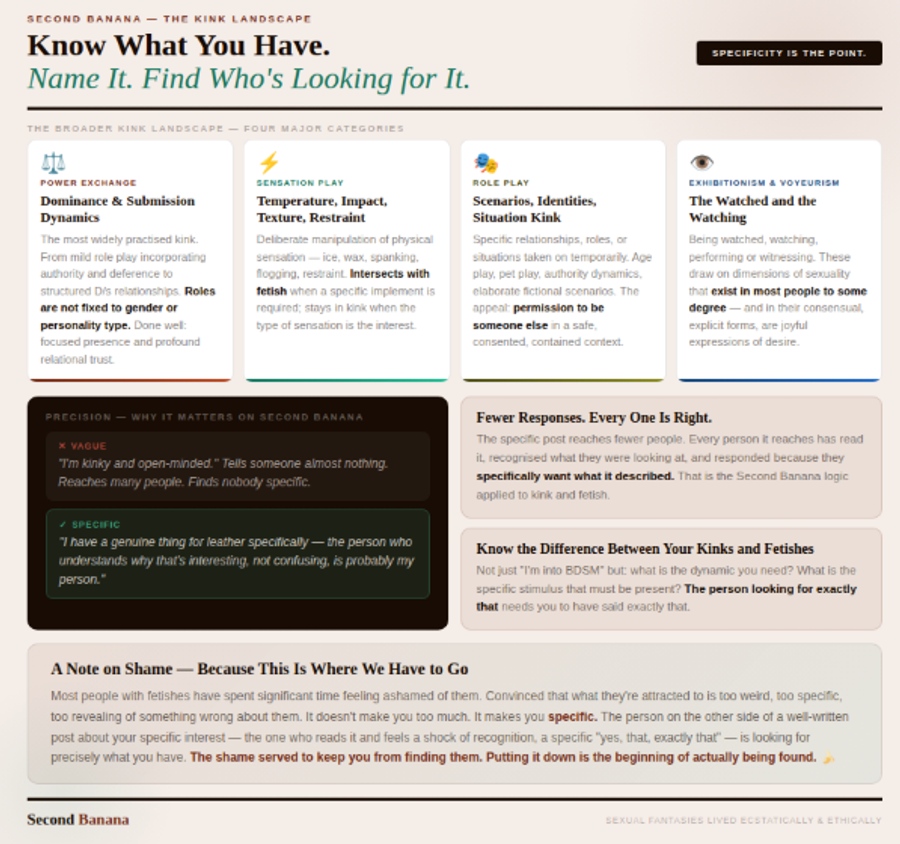
The most widely practised and most extensively studied form of kink is power exchange — the consensual, negotiated exploration of dominance and submission dynamics. This includes everything from mild role play that incorporates authority and deference to highly structured D/s relationships with explicit protocols and ongoing dynamics. The appeal of power exchange has been discussed in depth in the Psychology of Kink piece earlier in this series — the short version is that power exchange, done well, offers a specific kind of focused presence and relational trust that many people find deeply satisfying, and that the roles themselves (dominant and submissive) are not fixed to personality type, gender, or any other characteristic that people sometimes assume they are.
Sensation Play
A large category of kink is organised around the deliberate manipulation of physical sensation — the use of temperature (ice, wax), impact (spanking, flogging, caning), texture, restraint, and various other means to create intense physical experiences that are specifically sought and specifically pleasurable. Sensation play intersects with fetish in many cases — the person whose arousal specifically requires the sensation of a leather implement is in fetish territory; the person who enjoys impact play generally without any particular implement being necessary is more straightforwardly in the kink category.
Role Play and Scenario Kink
Many kinks are organised around scenarios rather than objects or dynamics: specific situations, relationships, or identities that the participants take on temporarily for the purpose of sexual or erotic exploration. Age play, pet play, specific authority dynamics (teacher/student, boss/employee, interrogator/subject), and elaborate fictional scenarios are all examples. The appeal of role play kink is partly about the specific content of the scenario and partly about the experience of consensually trying on a different identity — the permission to be someone else, or someone else's version of yourself, in a safe and contained context.
Exhibition, Voyeurism, and the Social Dimensions
A significant strand of kink is organised around the social and observed dimensions of sexuality — being watched, watching, being dressed or undressed in specific ways for an audience, performing or witnessing. These interests draw on the exhibitionistic and voyeuristic dimensions of human sexuality that exist in most people to some degree and that, in their consensual, explicit forms, can be genuinely joyful expressions of desire rather than the pathological categories they used to be classified as.
Knowing Your Own: Why Precision Matters
The reason for drawing these distinctions — between kink and fetish, between preference and necessity, between the contextual and the object-specific — is not taxonomic pedantry. It is that precision about your own desires makes you substantially better at communicating them, finding people who share them, and having the experiences you're actually looking for rather than approximations of them.
The person who knows they have a leather fetish — that leather specifically, the smell and texture of it, is a central part of what makes an encounter work for them — is in a very different position from the person who vaguely knows they're into BDSM. The first person can say, specifically, what they need. The second person has to hope that the general category will eventually produce the specific experience.
Second Banana's whole architecture is built on the premise that specificity is better. That the post describing exactly what you're looking for — including the specific interests and the specific context that makes them work for you — will reach the right people more effectively than the vague profile that gestures at general openness. This is as true for fetishes as it is for any other sexual interest.
There is a particular kind of Second Banana post that is worth writing. Not "I'm kinky and open-minded" — that tells someone almost nothing — but "I have a genuine thing for leather, specifically, and the person who understands why that's interesting rather than finding it confusing is probably my person." Or "I'm drawn to service dynamics, the specific satisfaction of care and deference in a negotiated structure, and I've been looking for someone who wants to be on the other side of that for years." These posts reach fewer people. Every person they reach is the right person. That's the Second Banana logic, applied to kink and fetish as much as to anything else.
A Note on Shame
There is no piece about kink and fetish that earns the right to skip this section.
Most people with specific fetishes have spent significant time feeling ashamed of them — convinced that what they're attracted to is too weird, too specific, too much to ask for, too revealing of something wrong about them. This shame is so common that it functions almost as a side effect of having an atypical sexual interest in a culture that has very fixed ideas about what sex is supposed to look like.
The shame typically arrives early — sometimes in adolescence, when the specificity of an interest first becomes apparent against the background of what peers seem to be interested in, and seems too strange to name. It persists through adulthood in many people as a kind of private carrying, a part of their desire they've learned not to show — not because anyone has explicitly told them to hide it, but because they've absorbed, through the texture of cultural messaging, that it makes them too much.
It doesn't make you too much. It makes you specific. Specific is exactly what Second Banana is for.
The person on the other side of a well-written post about your specific interest — the one who reads it and feels a shock of recognition, a specific "yes, that, exactly that" — is looking for precisely what you have. The shame served to keep you from finding them. Putting it down is not exposure. It is the beginning of actually being found.
Know what you have. Name it. Find the person who was already looking for it. 🍌