Solo Polyamory: The Radical Act of Choosing Yourself First | Second Banana
Solo Polyamory
The Radical Act of Choosing Yourself First
The Life That Doesn't Need Explaining
There is a particular kind of conversation that solo poly people know well. Someone asks about your relationships — a family member, a colleague, an acquaintance who has noticed that you seem to date, and seem to connect, and seem to have a full and engaged relational life, but never appear to be building toward the standard milestones. And you find yourself in the position of either giving a short answer that isn't quite true, or giving a long answer that prompts further questions, or deflecting entirely.
The culture has a name for the life you're living: it calls it "still single." As though the life you've deliberately constructed — with its multiple connections, its genuine intimacy, its rich erotic engagement, its careful preservation of your own autonomy and your own central authority over how you live — is merely a waiting room for the real thing.
Solo polyamory is not a waiting room. It is not a transitional phase between the single life and the coupled life. It is not loneliness with a better vocabulary, or commitment-avoidance with a political justification, or an inability to sustain closeness dressed up as a philosophical position. It is a deliberate, considered, fully realised way of living your relational and erotic life — one in which you are the primary character in your own story, in which connection is abundant and intentional, and in which the conventional architecture of the escalating coupled relationship is declined not from deficiency but from preference.
This piece is for the people who already know this and are looking for the language. It is also for the people who are encountering the concept for the first time and recognising something they have always been. And it is for anyone who has been told — by a culture that has very fixed ideas about what adult life should look like — that what they want is wrong.
It is not wrong. It is, for the people who want it, exactly right.
What Solo Polyamory Actually Is
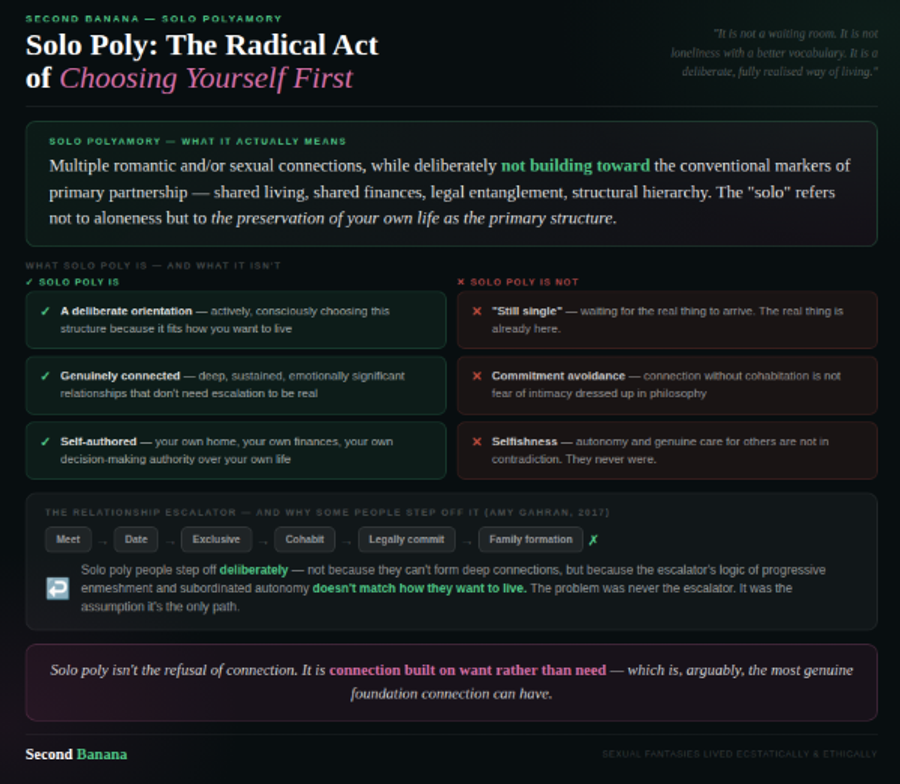
Solo polyamory describes a relationship orientation in which a person maintains multiple romantic and/or sexual connections while deliberately not building toward the conventional markers of a primary partnership: shared living, shared finances, legal entanglement, the assumption that one relationship will take structural priority over all others.
The "solo" in solo poly refers not to aloneness — solo poly people are often deeply connected to multiple people simultaneously — but to the preservation of one's own life as the primary structure. The solo poly person does not seek a "primary partner" in the hierarchical sense. They do not organise their life around the needs and expectations of a central dyad. They maintain their own home, their own finances, their own decision-making authority over the shape of their own life. And within that self-authored structure, they build connections that are genuine, caring, intimate, and sometimes deeply sustained over time.
What It Is Not
Solo polyamory is not the same as being single, though the external life may look similar to some observers. A single person who is looking for a committed partnership and hasn't found one yet is in a different position from a solo poly person who has actively, consciously decided that the committed cohabiting partnership is not the structure they want. One is waiting for something. The other has chosen something.
Solo polyamory is not the same as casual dating, though casual connections may be part of the picture. Solo poly people often have sustained, emotionally significant connections with multiple people — connections that involve genuine care, genuine intimacy, genuine investment in the other person's wellbeing. The absence of conventional commitment markers does not make these connections shallow.
Solo polyamory is not the same as relationship anarchy, though the two have significant philosophical overlap. Relationship anarchy is a broader framework that rejects the hierarchy of all relationship categories — romantic, platonic, sexual — and declines to treat any connection as automatically more important than any other. Solo poly is more specifically about maintaining one's own life structure as primary, which is consistent with relationship anarchy but doesn't require its full philosophical apparatus.
And solo polyamory is not, despite what a certain kind of critic will insist, emotional unavailability with a name. Solo poly people often report some of the deepest, most honest, most genuine connections of their lives — precisely because those connections exist on their own terms, not because they are required to fulfill the structural function of a primary partnership.
The Relationship Escalator — And Why Some People Get Off It
Amy Gahran, in her 2017 book Stepping Off the Relationship Escalator, named and described the cultural conveyor belt that most people ride without examining: the automatic, assumed progression of romantic relationships from meeting to dating to exclusivity to cohabitation to legal commitment to family formation, in roughly that order, with each step treated as a milestone that proves the relationship is working and the people involved are serious adults.
The escalator is not bad. For the people it fits, it is a genuinely satisfying structure — a legible path through adult life that provides companionship, stability, legal protections, and social recognition. The problem is not the escalator itself. The problem is the cultural insistence that it is the only valid path — that relationships not organised around it are either failed or immature or merely in transit toward it.
Solo poly people step off the escalator deliberately. They look at the conveyor belt, recognise that it is moving in a direction they haven't chosen, and decide to find a different path. Not because they can't form deep connections — but because the structure of the escalator, with its assumption of progressive enmeshment and its inevitable subordination of individual autonomy to partnership needs, doesn't match how they want to live.
What Getting Off the Escalator Looks Like
It looks different for different solo poly people. Some maintain several ongoing connections simultaneously, each on its own terms, with different levels of emotional investment, different frequencies of contact, different kinds of intimacy. Some have one or two deeper, longer-term connections alongside more casual connections. Some are not especially interested in romantic connection at all and organise their solo poly life primarily around sexual and erotic connection. Some are deeply romantic and have profound emotional relationships — they simply don't structure those relationships around cohabitation or the conventional commitment framework.
What they share is the absence of the escalator's logic. The connections don't have to go anywhere. They can deepen or lighten, expand or contract, evolve into something different or stay exactly what they are. They are not failing if they don't move toward the next conventional milestone. They are succeeding at being exactly what they are — connections built to serve the people in them, not to demonstrate the seriousness of those people to the outside world.
The Philosophy — Why Autonomy Is Not Selfishness
The charge most commonly levelled at solo poly people — by people who don't understand it, and occasionally by people who understand it and resent what it implicitly says about their own choices — is that it is selfish. That keeping yourself at the centre of your own life at the expense of deep mutual dependence is a refusal of the vulnerability that real intimacy requires.
This charge misunderstands several things simultaneously.
Autonomy Is Not the Absence of Care
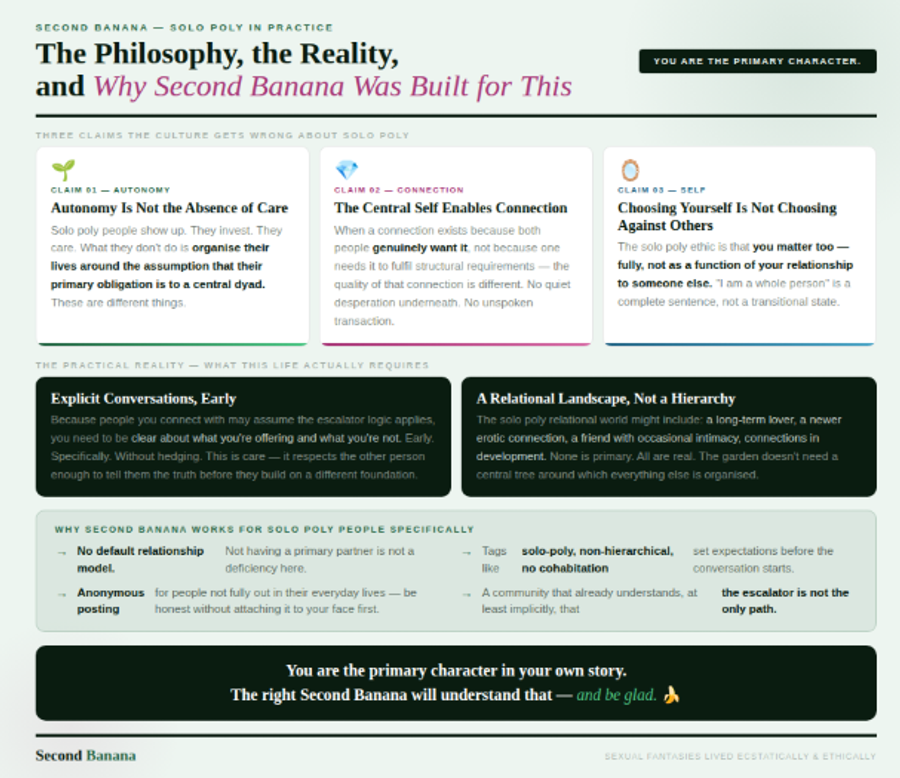
Solo poly people care deeply for the people they are connected with. They show up. They provide emotional support. They invest time and attention and genuine concern for their partners' wellbeing. What they don't do is organise their lives around the assumption that their primary obligation is to a central partnership rather than to their own integrity and their own carefully considered choices.
There is a version of intimacy that confuses enmeshment with closeness — that treats the surrendering of individual autonomy as the proof of love. Solo poly people decline this version. They believe, instead, that two people who each have a clear and grounded sense of themselves are better partners to each other than two people who have dissolved their individual selves into a shared identity. This is not a refusal of vulnerability. It is a different model of what genuine closeness looks like.
The Central Self Is Not an Obstacle to Connection
One of the most consistent things solo poly people report is that the deliberate maintenance of their own life as primary enables rather than prevents deep connection. When a connection exists because both people genuinely want it, not because one or both of them needs it to fulfil structural requirements, the quality of that connection is different. There is no quiet desperation underneath it. There is no unspoken transaction in which intimacy is exchanged for security. There is just two people who want to be together, together, for exactly as long as they both want that.
This is not a guarantee of ease. Relationships built on genuine desire rather than structural necessity can also be painful, complicated, and deeply challenging. But the pain and complication, when it comes, is honest — about what the people actually feel rather than about the gap between what they feel and what the structure requires them to perform.
Choosing Yourself Is Not the Same as Choosing Against Others
The solo poly ethic is not that other people don't matter. It is that you matter too — fully, not as a function of your relationship to someone else. It is the insistence that "I am a whole person" is a complete sentence, not a transitional state awaiting the completion of a partnership.
Solo poly isn't the refusal of connection. It is connection built on want rather than need — which is, arguably, the most genuine foundation connection can have.

The Practical Reality — What This Life Actually Looks Like
Multiple Connections, Each on Its Own Terms
A solo poly person's relational landscape might include: a lover they see monthly and have known for four years, with whom they share genuine emotional depth and neither wants more structural entanglement than they have; a newer connection that is primarily erotic and joyful and doesn't require elaboration; a close friend with whom there is occasional physical intimacy that enriches a friendship that doesn't need it but is better for it; and several connections in various stages of development.
None of these is the primary partnership. All of them are real. The solo poly person is not waiting for one of them to graduate into the main relationship. They are tending the garden of their relational life with deliberate care, and the garden doesn't need a central tree around which everything else is organised.
The Conversations That Are Required
Solo poly requires more explicit conversation than conventional relationship structures, not less. Because the people you connect with may have different expectations — may be on the escalator themselves and assuming that the escalating logic applies — you need to be clear about what you're offering and what you're not. Early, specifically, without hedging.
This is not comfortable. It is frequently the most difficult part of solo poly life: the moment where you tell someone who is clearly interested in more that what you can offer is genuinely significant and genuinely limited, and that the limits are not a temporary negotiating position but a considered orientation toward your own life. Some people receive this well. Some do not. Both reactions are valid.
The solo poly commitment to honesty in this moment — to not allowing the connection to drift toward expectations you can't meet, to not performing availability you don't have — is itself an expression of care. It respects the other person enough to tell them the truth about what they're signing up for, rather than letting them find out after they've already built hopes on a different foundation.
Managing the Social Surround
Solo poly people often navigate a social world that doesn't have a category for them. Family members who ask when they're going to settle down. Friends who see a succession of connections and feel concerned about what they perceive as inability to commit. Colleagues who assume that the absence of a primary partner means the presence of a problem to be solved.
The responses to this vary. Some solo poly people are fully out about their orientation and relational life. Some maintain careful privacy and offer partial truths to people who wouldn't understand the full picture. Some have done the work of finding community — through platforms like Second Banana, through ENM groups and events, through the growing public conversation about relationship diversity — and rely on that community for the kind of understanding that their broader social world can't always provide.
What is consistent is that the social navigation requires energy. It is one of the real costs of living outside the default template — not a fatal one, but a genuine one that deserves acknowledgment rather than minimisation.
Solo Poly and Second Banana
Second Banana was built without a default relationship model. This is not an accident. It is a structural choice that reflects a genuine belief that the full range of ways people want to connect and love and desire are equally valid — and that a platform organised around one model, like the escalator, would simply be another version of the culture telling people who don't fit that they should.
For solo poly people specifically, Second Banana offers something that most platforms don't: a space where not having a primary partner is not a deficiency. Where the explicit post about what you're looking for — "I am solo poly, I am not looking for a primary partnership, I am looking for a genuine connection that exists on its own terms" — is received as the clear and legitimate offering it is, not as a coded warning or a signal of emotional unavailability.
The tag system is particularly well-suited to solo poly. Tags like "solo poly," "non-hierarchical," "no cohabitation," "ongoing connection," "casual but genuine" — these give solo poly people the vocabulary to represent their actual situation before the conversation starts, which is exactly the condition that prevents the painful later conversations about mismatched expectations.
The anonymous posting option matters here too. Many solo poly people are not fully out in their everyday lives — they navigate families, workplaces, and social circles where their relational orientation would be misunderstood or judged. Being able to be honest about who you are and what you want without attaching that honesty to your face and full identity before you've assessed the safety of doing so is a meaningful protection.
Because the people who show up here already understand, at least implicitly, that the escalator is not the only path. That is, in itself, a significant head start.