Open Relationship vs Polyamory: What's Actually Different | Second Banana
Open Relationships vs Polyamory:
What's Actually Different, and How to Know Which One You Want
The Question Everyone Is Actually Asking
You've heard both terms. You may be using them interchangeably. You may have a vague sense that there's a difference but not a clear picture of what it is. You may be in a relationship that is, or is becoming, one or the other — and finding that the distinction matters more than you initially thought, because you and your partner have quietly assumed different things about which one you're doing.
That last scenario — two people who agreed to "open things up" and are now discovering they had entirely different models of what that meant — is one of the most common sources of difficulty in ENM relationships. Not because either person was dishonest, but because the vocabulary is genuinely imprecise, and because the culture uses "open relationship" and "polyamory" as rough synonyms when they are, in practice, built on meaningfully different assumptions about what connections are for and what the central relationship is supposed to be.
This piece draws the distinction clearly. It also does something that most similar pieces don't: it helps you figure out which structure actually fits you — not which one sounds more sophisticated, not which one your partner wants, not which one has the better cultural reputation — but which one matches what you actually want from your relational life.
Because getting that right is the foundation everything else is built on.
The Core Distinction
Open Relationships: One Central Unit, Open Edges
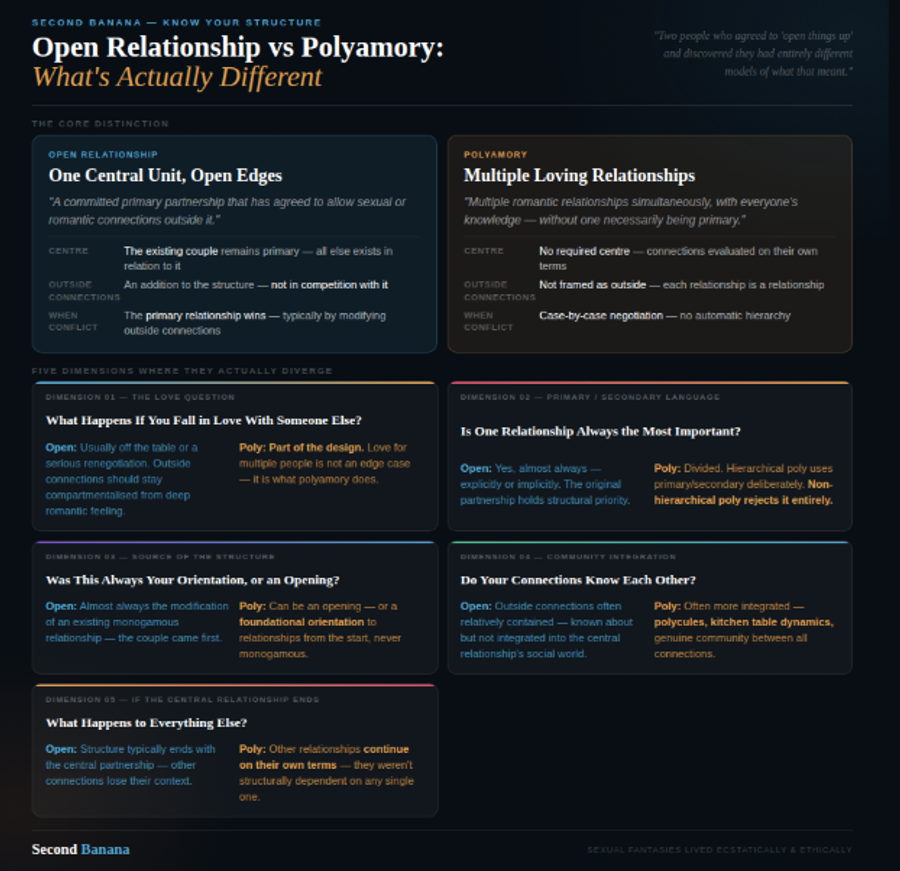
An open relationship is, at its structural core, a committed primary partnership that has agreed to allow sexual or romantic connections outside that partnership. The couple — or in some cases, a larger existing polycule — remains the central unit. The outside connections exist in relation to that central unit, typically with some degree of explicit or implicit secondary status.
The central partnership in an open relationship typically involves most or all of the conventional markers of primary commitment: shared living, shared finances, long-term planning together, the assumption that this relationship takes structural priority when priorities conflict. The openness is an addition to that structure, not a replacement of it.
Open relationships vary enormously in their specific architecture:
- Some allow sexual connections only — outside romance or emotional intimacy is excluded by explicit agreement
- Some are symmetrical — both partners have equal freedom to pursue outside connections
- Some are asymmetrical — one partner has more latitude than the other, by negotiated agreement
- Some have explicit rules about who can connect with whom, how often, under what circumstances
- Some are relatively free-form, with the only requirement being honesty and the maintenance of the primary partnership
What open relationships share, regardless of their specific architecture, is the primacy of the central dyad. The other connections exist within the frame of that dyad. If they threaten it, the threat is typically addressed by modifying the connections, not by questioning the primacy of the dyad.
Polyamory: Multiple Loving Relationships
Polyamory — literally "many loves" — refers to having multiple romantic relationships simultaneously, with the knowledge and agreement of everyone involved. The key distinction from open relationships is that polyamory explicitly includes the possibility of multiple deep romantic connections, and does not necessarily centre any one of them as primary.
A polyamorous person may have two or three ongoing romantic partnerships, each of which involves genuine emotional depth, regular contact, significant investment of time and care. None of these is necessarily the primary one. Or one may be somewhat more integrated in daily life (a nesting partner, perhaps), while others are deeply significant in different ways. The architecture is designed to fit the people in it, not to preserve the primacy of any particular dyad.
Polyamory also encompasses a range of specific structures:
- Non-hierarchical polyamory — no partner is designated primary; connections are evaluated on their own terms
- Hierarchical polyamory — an explicit primary partnership with other connections acknowledged as having different levels of integration
- Polycules — networks of people connected to each other in various configurations, often with multiple overlapping relationships
- Kitchen table polyamory — all members of the network are comfortable together, socialise, form genuine community
- Solo polyamory — multiple connections without seeking a nesting primary partner (covered in depth elsewhere in this series)
The distinction that matters: polyamory treats multiple romantic connections as potentially equally valid rather than as additions to a central structure. The love, investment, and care in a secondary polyamorous relationship is not diminished by its being a second or third relationship — it is what it is, on its own terms.
Where the Lines Blur
In practice, open relationships and polyamory exist on a spectrum rather than in two clean categories, and many people's lived experience falls somewhere in between or shifts over time. An open relationship that began as primarily sexual can develop emotional depth and come to look more like polyamory. A polyamorous structure that identifies one partnership as primary can look, from the outside, like an open relationship with unusually deep secondary connections.
The labels matter less than the underlying agreements and expectations. What does each person expect from the structure? What happens if a secondary connection deepens into something that feels more equal to the primary one? What are the actual rules, spoken and unspoken, about how connections can develop? These questions surface the real differences far more effectively than the terms alone.
The Five Dimensions Where They Diverge
1. The Role of the Central Dyad
Open relationships are built around preserving the central dyad. The dyad came first, the openness was added to it, and the implicit or explicit architecture of the structure is designed to protect and maintain the centrality of that dyad. When tensions arise between the outside connections and the central relationship, the central relationship typically wins.
Polyamory is not built around preserving any particular dyad. It is built around the principle that multiple loving relationships can coexist, and that the appropriate response to tension between connections is to negotiate thoughtfully — not to default to protecting whichever connection was first or most established.
2. The Possibility of Falling in Love
This is, practically speaking, the most important dimension of difference — and the one that causes the most difficulty when it isn't addressed clearly before the relationship structure is established.
In most open relationships, falling in love with an outside partner is understood to be off the table, or at least to be a problem that would require significant renegotiation of the structure. The openness is typically designed to allow sexual connection, perhaps some degree of ongoing connection, but not the deep romantic entanglement that would put an outside partner in genuine competition with the central one. When this happens — when an outside connection develops into something that feels like love — it is often experienced as a violation of the spirit of the arrangement, even if no explicit rule was broken.
Polyamory explicitly includes the possibility of falling in love with multiple people. This is not an edge case or an accident to be managed — it is the design. Someone who identifies as polyamorous and develops deep romantic feelings for a new partner is doing what polyamory does, not going outside its bounds. This is the central difference in practice.
3. The Language of Primary and Secondary
Open relationships almost always involve an implicit or explicit primary/secondary hierarchy, even when the terms aren't used. The original partnership is primary. The outside connections are secondary, however much they may be valued and cared for.
Polyamory is divided on this question. Hierarchical polyamory uses the primary/secondary distinction deliberately — it names the central partnership and is explicit about the fact that other connections have different levels of structural integration. Non-hierarchical polyamory deliberately rejects this language, arguing that calling a connection secondary devalues it and creates unfairness for the people who find themselves labelled as such. The debate between hierarchical and non-hierarchical polyamory is ongoing in ENM communities and reflects genuine values differences rather than mere terminology preference.
4. The Source of the Opening
Open relationships are almost always initiated by an existing couple who decide to open their previously closed structure. The motivation is typically one of: genuine desire for sexual variety, recognition that one partner has desires the other can't or doesn't want to meet, practical separation (long-distance relationships are commonly opened), or a mutual sense that exclusive monogamy doesn't fit them.
Polyamory may also be initiated as an opening of an existing monogamous relationship — but it may equally be a starting orientation: a way of approaching relationships from the beginning rather than a modification of a previous structure. Many polyamorous people have never been in an exclusive monogamous relationship and have no interest in being; polyamory is not an add-on for them but a fundamental aspect of how they understand relationships. This distinction matters because the person opening a relationship for the first time and the person who has always identified as polyamorous often have very different emotional landscapes and very different support needs.
5. What Happens If the Central Relationship Ends
In an open relationship, the architecture of the whole structure is built around the central partnership. If that partnership ends, the structure typically ends with it — the outside connections were understood to exist in relation to the central dyad, and without it they lose their context.
In polyamory, the end of one relationship doesn't necessarily affect others. Relationships exist on their own terms. If a polyamorous person's partnership with one person ends, their other partnerships continue, because they were not structurally dependent on the first one. This is one of the reasons polyamory, done well, can involve more robust long-term community building than open relationships — the connections persist even when individual partnerships evolve or close.

How to Figure Out Which One You Actually Want
The honest truth is that many people discover which structure fits them through experience rather than prior clarity — and that what fits you at one point in your life may not be what fits you at another. But there are some questions that tend to surface the distinction more reliably than abstract discussion.
The Love Question
The most direct question: how do you feel about the possibility of your partner falling in love with someone else? Or about falling in love with someone other than your primary partner yourself?
If the honest answer is "that's not what I want — the outside connections should be compartmentalised from the deep emotional stuff" — you're describing the open relationship orientation. If the honest answer is "that's fine, maybe even beautiful — love isn't a limited resource" — you're describing the polyamorous orientation. If the honest answer is "I don't know, and the uncertainty itself makes me anxious" — that's worth sitting with in therapy before building a structure on top of it.
The Primacy Question
Another direct question: do you want one relationship to be clearly the most important one — the one that wins when priorities conflict — or do you want all your relationships to be evaluated on their own terms, with conflicts resolved through case-by-case negotiation?
The first answer is the open relationship orientation. The second is the polyamorous one. Neither is more sophisticated or more evolved. They match different things that people actually want.
The Community Question
Do you want your outside connections to be relatively contained and separate from your central life — people your primary partner knows about but doesn't interact with closely? Or do you want to build something more integrated — a network or community in which all your significant connections know each other, socialise, and form genuine relationships with each other?
The first describes most open relationship structures. The second describes kitchen table polyamory and other more integrated forms. Both are valid orientations. Neither is required by either label.
The Origins Question
Are you approaching this as the modification of an existing committed structure, or as a way of understanding how you want to approach relationships from the ground up? If the former, open relationship frameworks are often more practically useful — they give an existing couple the tools to add connections without dismantling what they have. If the latter, polyamory's more fundamental reorientation of what relationships are for may fit better.
The terms matter less than the underlying agreements. What does each person expect from this structure? What happens when a connection deepens beyond what was anticipated? These questions reveal more than any label.
A Note on "Opening" an Existing Relationship
The majority of people who arrive at ENM do so through the opening of an existing monogamous relationship rather than through starting fresh with polyamory as a first orientation. This is the most common path — and it is also, statistically, the most difficult one.
Opening an established relationship carries specific challenges that beginning polyamory as a first structure does not. The existing relationship has expectations and dynamics built on a monogamous assumption. Both partners are navigating something new while the established connection is also being renegotiated. NRE for outside connections often runs directly into the existing relationship's vulnerabilities. The skills required for open relationships or polyamory — explicit communication, jealousy management, the capacity to hold multiple connections without prioritising poorly — are skills that have to be built while also navigating the transition.
None of this makes opening a relationship impossible or inadvisable. But it does make therapy — individually and as a couple — extremely valuable. And it makes the distinction between open relationship and polyamory particularly important to establish clearly before opening, because the two structures have different built-in expectations about what's allowed to develop, and discovering mid-stream that you and your partner had different expectations is considerably harder than establishing them in advance.
On Second Banana: What This Means for Your Post
On Second Banana, the distinction between open relationship and polyamory is practically significant because it shapes what you're offering and what you're looking for — and therefore who should respond to your post.
Someone in an open relationship who is looking for an ongoing sexual connection without romantic development should say so explicitly. Not because romantic interest is bad, but because the person whose posts describe something deeper deserves to know that what you're offering has specific limits — so they can decide whether that works for them before they've invested in the connection.
Someone who identifies as polyamorous and is genuinely open to the full range of how a connection might develop — including the possibility of genuine love — should say that too. It invites a different kind of person. It signals a different kind of availability. And it is a different and significant thing to offer.