
Spirituality & Sexual Sovereignty: All Beliefs Welcome | Second Banana
Spirituality and Sexual Sovereignty: Second Bananas of All Beliefs Play Together
The Oldest Conversation
Long before dating apps. Long before the particular modern anxieties about who we are and what we want and whether we're allowed to want it. Long before any of the cultural frameworks we now use to make sense of desire — there was the question itself.
What does it mean to want? What is the relationship between the body and the soul? Between pleasure and transcendence? Between the most intimate expressions of the self and whatever we understand to be sacred? These are some of the most important questions linking sexuality and spirituality, and often critical for demisexual Second Bananas.
These are not new questions. They are, arguably, among the oldest questions human beings have ever asked. And every spiritual tradition — every religious framework, every philosophical school, every mystical lineage — has grappled with them in some form. Often with great beauty. Sometimes with great difficulty. Almost always with the recognition that desire is not a trivial thing, that the erotic is not separate from the profound, that what happens between bodies in moments of genuine connection touches something that exceeds the merely physical.
Second Banana was built on exactly that recognition.
Not on any one tradition's answer to these questions. But on the premise that the questions themselves are serious — that desire deserves to be met with the same thoughtfulness, intentionality, and depth that any meaningful dimension of human life deserves. And that a community built around sexual authenticity is, in its own way, engaged in the same project that spiritual communities have always been engaged in: the project of knowing the self, and of finding genuine connection with others.
What Spirituality Actually Is (Broader Than You Think)
Before we go further, it's worth sitting with the word itself, because "spirituality" means something different to almost everyone who uses it.
For some people, spirituality is inseparable from religious practice — from the rituals, texts, communities, and doctrines of a specific tradition. It is prayer, observance, the lived experience of faith within a lineage that stretches back centuries or millennia. It is a way of understanding the cosmos and one's place within it that has been tested and refined across generations.
For others, spirituality has nothing to do with organized religion and everything to do with a felt sense of something larger — the numinous quality of certain experiences, the sense of connection that arises in moments of great beauty or presence or intimacy. It is secular in form but not in feeling. It is the experience of being fully, vividly alive to one's own existence and moved by it.
For still others, the spiritual is philosophical — an ongoing inquiry into what it means to be conscious, to desire, to suffer, to connect. Not a set of answers but a quality of attention. A willingness to take seriously the questions that don't have easy ones.
And for some people — growing numbers, in fact — the honest answer is: I don't know exactly what I believe, and I'm not sure the categories quite fit, and I'm doing my best to live thoughtfully in the uncertainty. In fact, for many, spirituality is deeply intertwined with kink.
All of these are genuine. All of them are welcome here.
Second Banana does not require a particular relationship with the sacred. It does not privilege the devout or the secular, the religious or the agnostic. What it holds space for is the seriousness with which people approach their own inner lives — and the recognition that this seriousness, whatever form it takes, is precisely what makes for honest, meaningful connection.
The Complicated History of Desire and the Sacred
It would be dishonest to write about spirituality and sexuality without acknowledging the complicated relationship between them.
Many of the world's religious traditions have, at various points in their histories, been deeply suspicious of desire. Some have cast the erotic as a distraction from spiritual development, or worse, as a source of corruption — something to be controlled, suppressed, channelled narrowly, or transcended altogether. The body, in some of these frameworks, becomes the antagonist of the soul. Pleasure becomes something to be justified, rationed, or apologised for.
This legacy is real, and its effects on individuals are real. Many people carry, often without fully recognising it, a deeply internalised suspicion of their own desires — a sense that wanting is somehow suspect, that pleasure requires justification, that the erotic self and the spiritual self are in fundamental tension.
This is worth naming because it is so common, and because understanding it is part of what Second Banana's philosophy of sexual sovereignty actually requires. Sexual sovereignty — the full, unapologetic ownership of your erotic identity — cannot coexist with the belief that desire is inherently shameful. And for people who have been shaped by traditions that communicated exactly that, the work of claiming sovereignty over one's own desires can be genuinely difficult, and genuinely important.
But the other side of this history is equally real, and considerably less often told.
Many of the world's spiritual traditions — including some of the same ones that have also, in their dominant forms, been suspicious of desire — contain rich currents of thought that treat the erotic not as the enemy of the sacred but as one of its most direct expressions. The mystical traditions of Christianity, Islam, Judaism, Hinduism, Buddhism, Taoism and many others have, at their edges and sometimes at their centres, found in the erotic a language for the transcendent. The Song of Songs. The Sufi poets. The Tantric traditions. The sacred sexuality practices of various indigenous and earth-based traditions. The phenomenologists and existentialists who found in embodied desire a path to understanding consciousness itself.
These are not marginal footnotes. They are deep wells of human wisdom about the relationship between desire and the sacred — wisdom that suggests the two are not opposites but are, in certain lights, the same thing viewed from different angles.
Sexual Sovereignty as Spiritual Practice
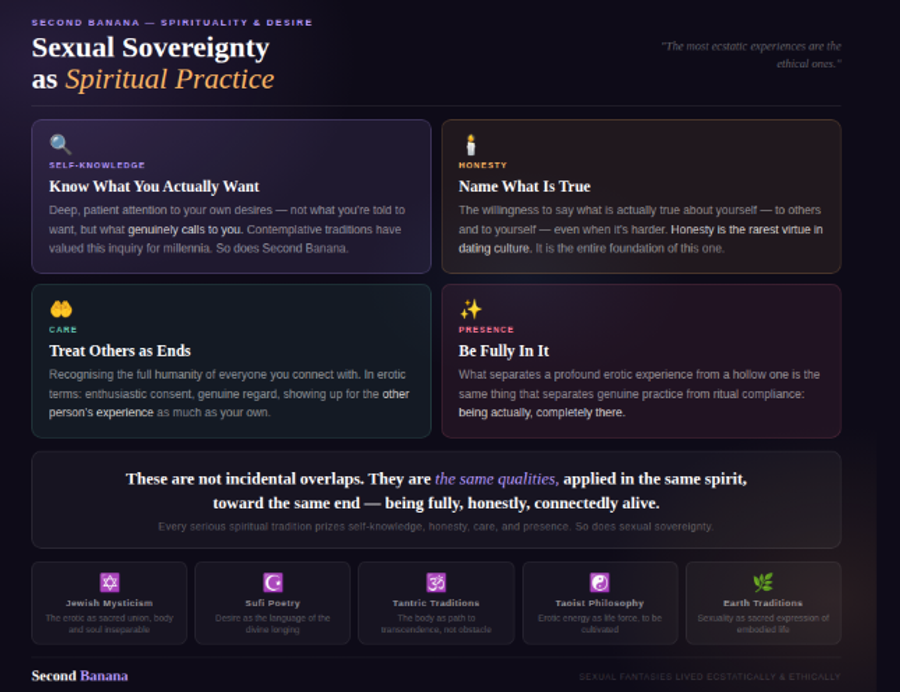
Here is a claim that might initially seem provocative but is, on reflection, quite straightforward: the practice of sexual sovereignty — of knowing your own desires clearly, naming them honestly, and seeking to have them met through connection grounded in mutual respect and enthusiastic consent — is a spiritual practice.
Not in the sense that it requires belief in anything supernatural. But in the sense that it requires exactly the qualities that every serious spiritual tradition holds in the highest regard: self-knowledge, honesty, presence, care for others, and the courage to be genuinely seen.
Consider what it actually takes to practise sexual sovereignty seriously.
It requires knowing yourself — the kind of deep, patient, sometimes uncomfortable attention to your own inner life that contemplative traditions have always valued. What do you actually desire? Not what you've been told to desire, not what seems acceptable or impressive or safe to want, but what genuinely, specifically, authentically calls to you? This is not a trivial question. It is the kind of question that monks and meditators and contemplatives of every tradition have been asking — in different forms — for millennia.
It requires honesty — the willingness to name what is true about yourself, to others and to yourself, even when it would be easier not to. Honesty of this kind is one of the most demanding and most valued virtues across virtually every ethical and spiritual tradition in human history. In the context of desire, it is also one of the rarest. The culture of dating — with its performances and its strategic presentations and its carefully managed impressions — does not encourage it. Second Banana does.
It requires care — the recognition that the people you connect with are full human beings whose desires and boundaries deserve exactly the same respect you'd want for your own. This is, in its essence, the ethical core of every major spiritual tradition: treat others as ends in themselves, not means. In the erotic context, this means enthusiastic consent. It means hearing "no" without bitterness and giving "yes" with presence. It means approaching connection with genuine regard for the other person's wellbeing, not just your own satisfaction.
And it requires presence — the capacity to be genuinely, fully in the experience you're having, rather than performing it or managing it from a distance. Presence is the thing that separates a profound erotic experience from a hollow one, just as it separates genuine spiritual practice from mere ritual compliance.
These are not incidental overlaps. They are the same qualities, applied in the same spirit, toward the same end: the project of being fully, honestly, connectedly alive.
How Second Banana Holds Space for All Beliefs
The question of how a platform holds space for people of genuinely different spiritual and religious backgrounds is not a trivial design challenge. The history of communities that claim to welcome everyone is full of examples that, on closer inspection, welcome everyone who shares a particular implicit set of assumptions about the universe.
Second Banana's approach is different because it starts from a different place.
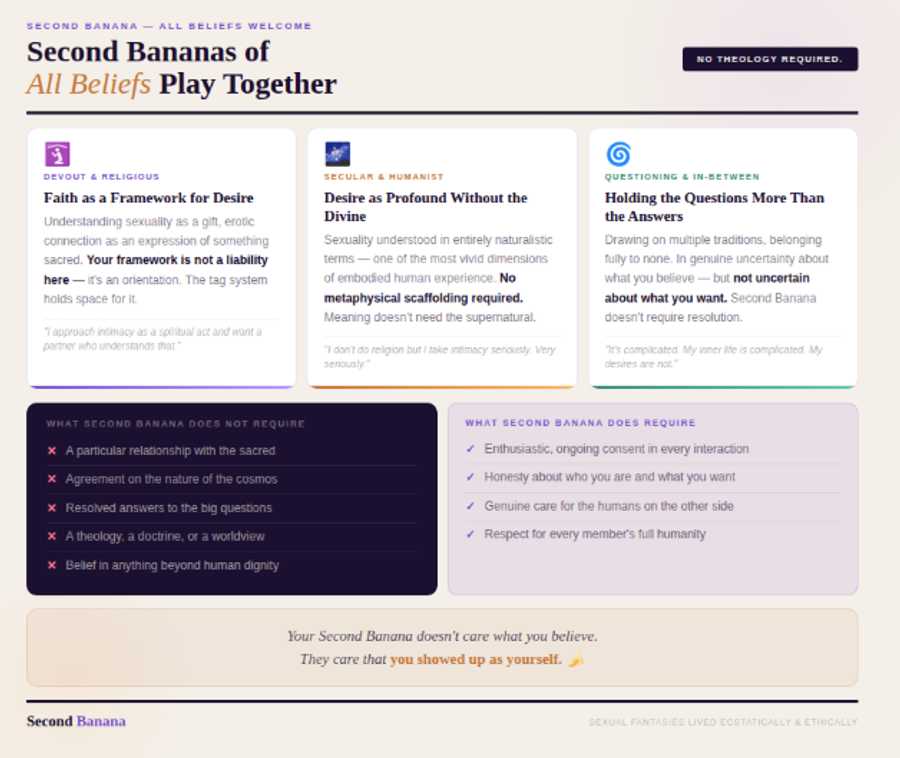
The platform does not make claims about the cosmos. It does not have a theology. It does not require participants to share a worldview beyond the foundational commitments that make genuine community possible at all: consent, honesty, care, and respect for every member's full humanity.
Within those commitments, the space is genuinely open.
A deeply religious person who understands their sexuality as a gift from the divine, and who approaches erotic connection as an expression of that gift, is fully at home here. Their framework — however it differs from someone else's — is not a liability on Second Banana. It is an orientation, a way of understanding themselves and what they're seeking, and the tag system gives them language to represent that orientation and find the person who shares it or who can meet it with respect.
A secular humanist for whom sexuality is understood in entirely naturalistic terms — as one of the most vivid dimensions of embodied human experience, without supernatural significance but not without profound meaning — is equally at home. Their lack of religious framework is not a deficit here. It is simply a different map of the same territory.
A person in genuine spiritual uncertainty — who holds the questions more lightly than any particular answers, who draws on multiple traditions without fully belonging to any of them — finds in Second Banana a community that does not require them to resolve that uncertainty before participating. They can be in the question. They can bring the complexity.
And a person for whom spirituality is entirely absent as a category — who simply knows what they want, and wants to find the person who wants the same thing, without any metaphysical scaffolding — is precisely as welcome as anyone else. The platform was not built for one kind of inner life. It was built for the honest expression of all of them.

On Finding Your Second Banana Across the Belief Divide
One thing worth considering: the tag system creates the possibility of connections that cross belief lines in ways that might surprise you.
There are devout people whose erotic lives are rich, specific, and seeking expression. There are secular people who bring extraordinary depth and intentionality to their sexual connections. There are people whose spiritual background has shaped their approach to intimacy in ways they can articulate beautifully and ways they're still discovering. There are people who have left the tradition they were raised in and are navigating the complicated business of what desire looks like on the other side of that.
Any of these people might be your Second Banana. Not in spite of their particular relationship with the sacred but, in some cases, because of it — because the seriousness with which they take their inner life translates into the seriousness with which they show up in connection.
The invitation, on Second Banana, is to represent yourself honestly — including the spiritual or philosophical dimensions of how you understand yourself and what you're looking for — and to let that honesty do the work of finding the right people. The tag system can hold all of this. The community is broad enough to contain it.
The Common Thread
Across every spiritual tradition, every philosophical framework, every way of understanding the relationship between desire and the sacred — one thing keeps appearing.
The most meaningful connections, the ones that reach into the depths of what it means to be human, are not the ones that happen by accident or default. They are the ones that are chosen — deliberately, honestly, with full presence and genuine regard for the other person.
This is true in the mystical traditions that speak of sacred union. It is true in the philosophical traditions that speak of authentic encounter. It is true in the secular humanist traditions that speak of human flourishing. And it is true in the Second Banana ethos, which speaks of sexual fantasies lived ecstatically and ethically — which is, when you look at it clearly, the same thing said in a different register.
The most ecstatic experiences are the ethical ones. The most profound connections are the honest ones. The most spiritual encounters — in whatever sense you give that word — are the ones where two people show up as themselves, fully, and find that the other person is genuinely, specifically, delightedly glad they did.
That's what Second Banana is here for. Whatever you believe, whatever your relationship with the sacred, whatever map you're using to navigate the territory of your own inner life — the invitation is the same.
Show up honestly. Name what you want. Find the person who was already looking for you.
Your Second Banana doesn't care what you believe. They care that you showed up as yourself. 🍌
Second Banana: Sexual Fantasies Lived Ecstatically and Ethically. An inclusive, sex-positive community for adults of every background, belief, and spiritual orientation — united by the commitment to honest, consensual, genuine connection.