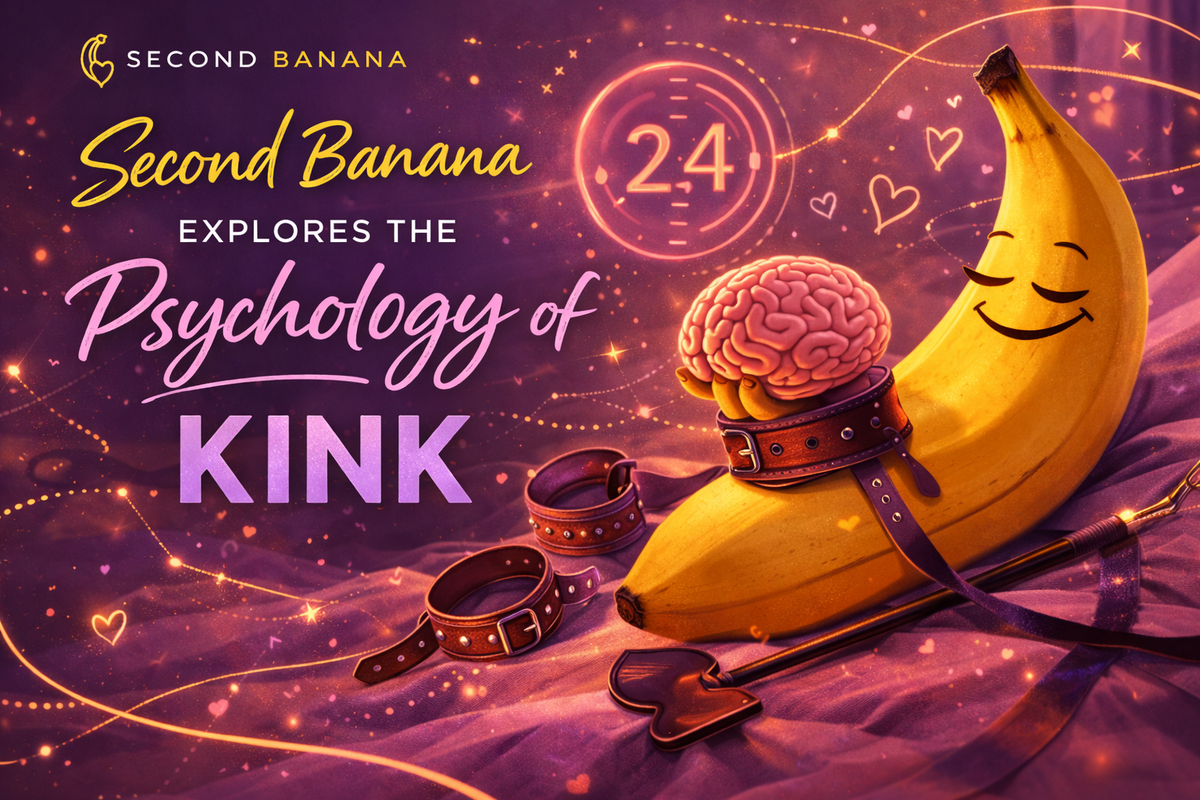
The Psychology of Kink: Why We Want What We Want (And Why It Makes Total Sense)
The Psychology of Kink: Why We Want What We Want (And Why It Makes Total Sense)
Your Brain Called. It Has Notes.
Let's start with a truth that mainstream dating culture has spent decades doing its absolute best to ignore: your desires make sense.
Not just in a "everyone's different, let's be accepting" kind of way — though yes, also that. But in a there is actual, fascinating, well-researched psychology behind why you want what you want kind of way. The things that light you up, that live rent-free in your imagination, that you've maybe never said out loud to another person — they didn't arrive randomly. They're not glitches in your programming. They are, in many cases, a remarkably coherent expression of your inner psychological landscape.
Kink, in other words, is not weird. Kink is interesting. And understanding why you're drawn to it might be one of the more illuminating things you ever do.
Welcome to Second Banana's deep dive into the psychology of kink — served with the curiosity it deserves and zero judgment attached.
First, Let's Define Our Terms (Without Killing the Mood)
"Kink" is a wonderfully broad umbrella. It covers everything from a mild preference for being pinned against a wall to elaborate scenes involving protocols, costumes, and carefully negotiated power dynamics. What unites all of it is that it falls outside what most people would call "vanilla" — conventional, low-choreography sex — and that it tends to involve some element of psychological charge beyond the purely physical.
That psychological charge is exactly what we're here to talk about.
Because here's the thing about kink that often gets lost in the cultural conversation: it is, at its core, a mental experience. The body is involved, absolutely. But what makes kink kink — what gives it its particular electricity, its ability to reach depths that more conventional experiences sometimes can't — is what's happening in the mind. The anticipation. The dynamic. The meaning that two (or more) people are co-creating together.
Understanding the psychology of kink isn't just intellectually interesting (though it is extremely intellectually interesting). It's actually useful. It helps you understand yourself. It helps you communicate what you want. It makes you a better partner — more self-aware, more articulate, more capable of creating experiences that actually deliver.
And on a platform like Second Banana, where self-knowledge is the entire foundation of connection, that matters.
The Research Is In: Kink Is Not a Red Flag
Before we go further, let's clear the air on something.
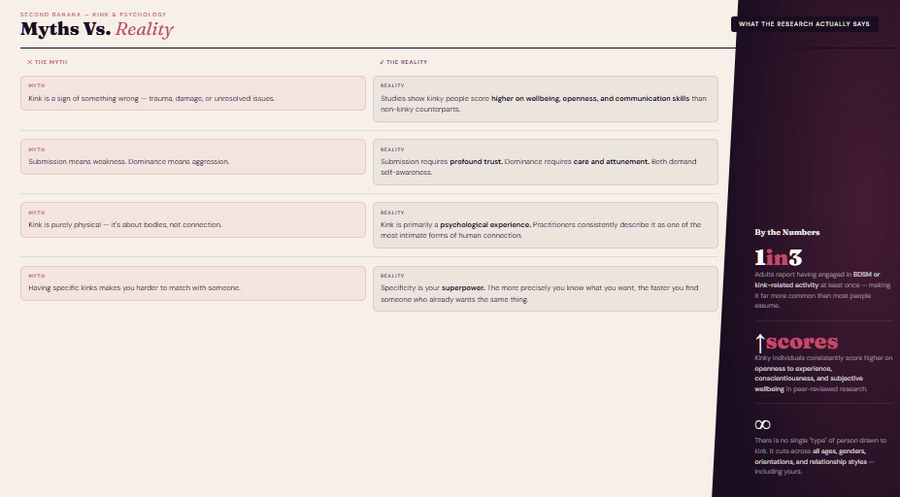
There is a persistent cultural assumption — stubborn as a bad ex — that interest in kink must be a symptom of something. Childhood stuff. Unresolved issues. Damage. The Freudian shadow looming over the whole enterprise, suggesting that if you really, truly dealt with your past, you'd probably lose interest in the rope.
The research does not support this.
Multiple peer-reviewed studies over the past two decades have found that people who engage in kink — particularly those who do so consensually and with self-awareness — tend to score higher on measures of psychological wellbeing, openness, and communication skills than their non-kinky counterparts. They're more likely to know what they want. More likely to be able to say it. More likely to have thought carefully about their own inner life and what they're actually seeking from intimacy.
This doesn't mean kink is for everyone, or that having a kink automatically makes you a well-adjusted human being. But it does mean that the assumption that kinky = broken is not just unkind — it's empirically wrong. And it's worth saying that clearly, out loud, before we dig into the psychology, so that the psychology can be explored with the curiosity it deserves rather than the defensiveness that tends to follow from shame.
Your kinks are not evidence of damage. They are, more likely, evidence of self-knowledge. Which is kind of the whole point.
So Why Are People Drawn to Kink? Let's Get Into It
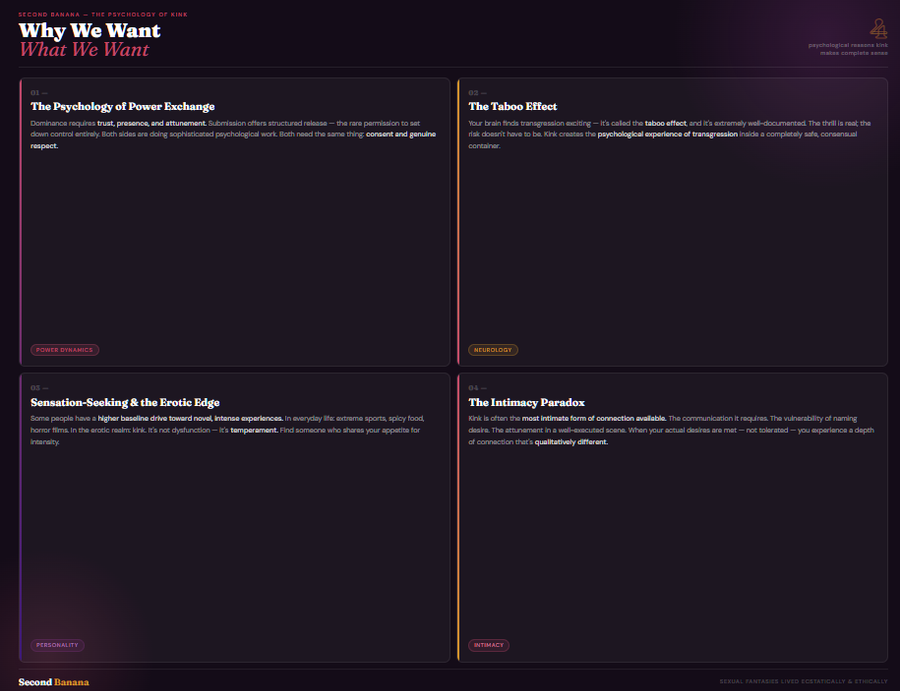
1. The Psychology of Power Exchange (And Why It's Everywhere)
One of the most common and widely studied forms of kink involves power — specifically, the consensual transfer, negotiation, or play with dominance and submission. And when you look at why people are drawn to this particular flavor of erotic experience, the psychology is genuinely fascinating.
For people who tend toward dominance: there's often a deep satisfaction in being trusted. When someone gives you authority over their experience — consensually, deliberately, with full awareness of what they're doing — that's not a small thing. It's an act of profound trust. Many people who enjoy dominance describe the responsibility of it as one of its most significant aspects. The care it requires. The attunement. The fact that being "in charge" in an erotic context demands more presence, not less.
For people who tend toward submission: the appeal is often about release. We live in a world that asks most of us to be in control, to be competent, to manage our own experience constantly. The erotic permission to set that down — to be held, directed, or taken care of by someone you trust completely — can be profoundly restorative. Psychologists sometimes describe this as "structured letting go": the feeling of safety that comes not from the absence of intensity but from the presence of trust and clear containment.
Both sides of this dynamic are doing sophisticated psychological work. And both require the same foundation: explicit consent, clear communication, and genuine respect for the person on the other side of the exchange.
Which, incidentally, is the foundation of everything Second Banana is built on.
2. The Role of Taboo (Your Brain Is Messing With You, Delightfully)
Here's something your brain does that it hasn't fully disclosed to you: it finds transgression exciting.
Not transgression in a harmful sense. But the psychological concept of "forbidden fruit" — the idea that something being marked as outside the norm, unusual, or even mildly transgressive increases its erotic charge — is extremely well-documented. There's even a name for it: arousal from transgression is sometimes called the "taboo effect," and it's been observed across cultures, orientations, and relationship styles.
The kicker? The taboo doesn't have to be real. In the context of consensual kink, people often create the feeling of transgression within a completely safe, agreed-upon container. The thrill is real; the risk isn't. This is part of why roleplay, fantasy scenarios, and power dynamics can be so potent even between people who know each other extremely well and have excellent, healthy relationships — they're creating a psychological experience that the brain finds genuinely stimulating, without any actual harm.
Your brain, in other words, is a bit of a drama queen. Kink is one of the ways we get to indulge that, safely and consensually, to spectacular effect.
3. Sensation-Seeking and the Erotic Edge
For some people, the draw to kink is partly about intensity. Not pain specifically (though for some people, that is part of it, and the psychology of why certain kinds of physical sensation become linked to pleasure is a whole fascinating rabbit hole of its own). But intensity — the heightening of sensation, the feeling of being pushed toward an edge, the altered state that comes from being completely absorbed in an experience.
Psychologists who study sensation-seeking describe it as a core personality trait: some people have a higher baseline drive toward novel, intense, and complex experiences. In everyday life, this might show up as a love of extreme sports, spicy food, or horror movies. In the erotic realm, it often shows up as an interest in kink — the hunger for experiences that are vividly, memorably felt, rather than quietly pleasant.
This is not dysfunction. It's temperament. And finding a partner who shares your appetite for intensity — who brings the same hunger to the experience that you do — is one of the things Second Banana's tag system was quite literally designed to help you find.
4. The Intimacy Paradox
Here's one that surprises people: kink is often described by those who practice it as one of the most intimate forms of human connection available.
This surprises people because popular culture tends to frame kink as either purely physical or somehow cold — transactional, detached, about bodies rather than souls. The actual lived experience of people who engage in kink, particularly those who've been doing it thoughtfully and consensually for a while, is often the complete opposite.
The level of communication required. The vulnerability involved in naming what you want and trusting someone else with it. The care required to hold someone else's desires with respect and skill. The attunement that happens in a well-executed scene, where two people are responding to each other in real time with total presence.
This is intimacy. Remarkably deep, honest, seen-in-full intimacy — often more so than what happens in encounters where desire is never discussed because it's assumed to be too delicate a topic.
The psychology here is straightforward: when we feel genuinely known — when our actual desires are not just tolerated but actively met and celebrated — we experience a depth of connection that is qualitatively different from being liked for a performance of ourselves. Kink, done well, is one of the most direct paths to that kind of knowing. Which is not a small thing.
Understanding Your Own Kinks: A Starting Point
If you're reading this and some of it resonates — or raises questions you've been sitting with for a while — here are some genuinely useful places to start.
Get curious, not clinical. Approaching your own desires with curiosity rather than interrogation is more productive and considerably more fun. Instead of "why do I want this and is it okay?" try "what does this give me, and what does that tell me about what I need?"
Notice the emotional texture. What draws you to a particular kink isn't always (or only) the physical content of it. Often, it's the emotional experience it creates — safety, power, release, intensity, trust, playfulness. Getting specific about the emotional texture of what you want helps enormously when it comes to both understanding yourself and communicating with partners.
Give your desires language. One of the most valuable things you can do with a kink — whether you've had it for years or just discovered it — is find words for it. This doesn't mean you have to share it with anyone immediately. But having language for your desires is the first step toward being able to seek out the people and experiences that will actually meet them.
Find your community. You are not as alone in this as you might think. Whatever your particular erotic world looks like, there are people who share it — who have the same curiosities, the same hungers, the same questions. Second Banana exists precisely because that community deserves a space to find each other, openly and without apology.
The Second Banana Angle: Knowledge Is Foreplay
Here's the thing about understanding the psychology of kink: it makes you better at it.
Not in a clinical, overthought way. But in the way that self-knowledge always makes you better at the things that matter to you. When you understand why you're drawn to what you're drawn to, you can seek it with more precision. You can communicate it with more confidence. You can find the people who are already dreaming of the same thing, rather than spending years hoping someone will stumble into your frequency by accident.
This is the Second Banana ethos in practice: know yourself, name it, find your match. The tag system exists for exactly this reason — not to reduce desire to a checkbox, but to give it enough specificity that the right people can actually find you.
Because the most ecstatic experiences — the ones that genuinely deliver, that stay with you as memories of being truly met — don't happen by accident. They happen when two people who know what they want find each other and say yes, together, with full presence and full consent.
That's not just good psychology. That's the whole point.
Your Kinks Are a Map. Let's Read It Together.
The psychology of kink is ultimately the psychology of desire — and desire, at its core, is the psychology of what it means to be human. What we want. What we need. What makes us feel alive, known, and genuinely ourselves.
You were never broken for wanting what you want. You were never too much, too strange, or too specific. You were, and are, a person with a rich inner erotic life that deserves to be understood — by you, first, and then by the person lucky enough to be your Second Banana.
That person is looking for you right now. They've got the same tags. They know exactly what you mean.
Go find them.