

Fluid Play, Watersports, and Scat: The Psychology of Taboo | Second Banana
The Kink That Lives at the Edge.
Fluid Play, Watersports,
and Scat: An Honest Account.
On the psychology of taboo transgression, the full range of body fluid and waste play, and the consent architecture that makes it possible
Why Taboo Is the Point
There is a kink that sits further from the mainstream than almost any other, that is rarely discussed honestly even in sex-positive communities, and that attracts a level of disgust response in people who don’t share it that makes candid writing about it genuinely difficult. Scat play — consensual erotic engagement with faeces — is the outermost edge of a broader territory that includes watersports (urine play), saliva and spit kinks, blood play, and various other engagements with the body’s fluids and waste products.
The difficulty of writing about this territory honestly is, in a specific sense, the subject of the piece. The disgust response that makes many people recoil from even reading about these practices is not incidental to their erotic charge for the people who have them. It is frequently central to it. Understanding why requires taking seriously a dimension of human sexuality that is almost never discussed: the erotics of transgression, and specifically the erotics of transgressing the body’s most powerful cultural taboos.
This piece covers the full range of fluid and waste play honestly: what each practice involves, what the psychology says about why it carries erotic charge for some people, what the safety considerations actually are (and they differ substantially across different practices), and what the consent architecture looks like for dynamics that require more explicit negotiation than most. It is not a piece for everyone. It is a piece for people who have these desires and have not found honest writing about them, and for people who are curious about the edges of erotic life without shame or condescension.
The Psychology of Abjection
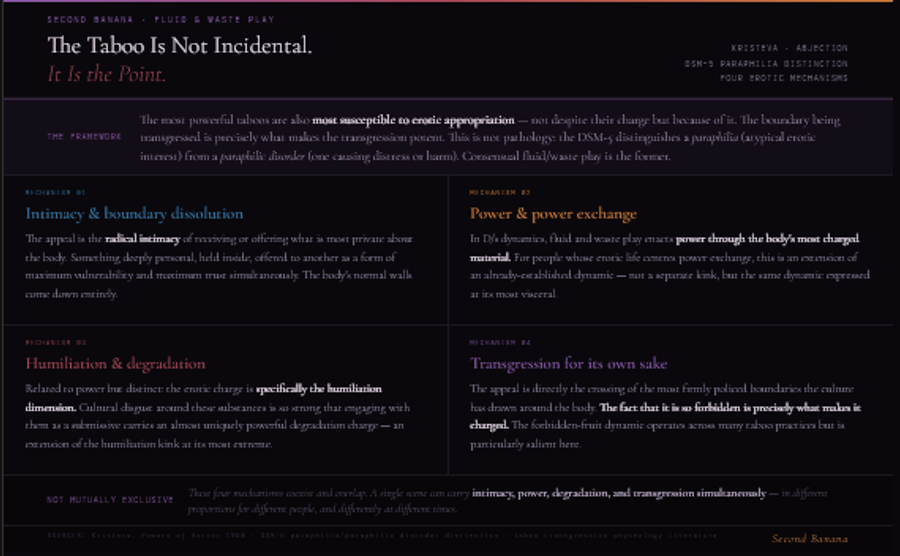
The psychoanalytic concept of abjection — developed most influentially by Julia Kristeva in her 1980 work Powers of Horror — describes the visceral repulsion humans feel toward substances that threaten the boundary between self and not-self, between the clean and the unclean, between the contained body and what it expels. Faeces, urine, blood, vomit, saliva, menstrual blood: these are the paradigm cases of the abject. The disgust they provoke is not merely cultural — it has evolutionary substrate in disease-avoidance — but the specific objects that trigger it and the intensity with which they do so are substantially culturally shaped.
What the psychology of taboo transgression adds to this picture is the observation that the same intensity of feeling that produces disgust in one direction can, for some people, produce erotic charge in the other. The anthropological and psychological literature on taboo consistently finds that the most powerful taboos are also those most susceptible to erotic appropriation — not despite their charge but because of it. The boundary being transgressed is precisely what makes the transgression potent.
This is not a pathology. The research on coprophilia and urophilia — sparse but consistent in its findings — does not show these to be markers of psychological disorder in people for whom they are consensually enacted. The DSM-5 distinguishes between a paraphilia (an atypical erotic interest) and a paraphilic disorder (a paraphilia that causes distress or harm). Consensual erotic interest in body waste and fluids is the former, not the latter, for the vast majority of people who have it.
Power, Intimacy, and the Body Without Borders
The erotic appeal of fluid and waste play is not reducible to a single psychological mechanism. Different practitioners describe different dimensions of what carries charge for them, and these are not mutually exclusive:
- Intimacy and boundary dissolution. For some people, the appeal is precisely the intimacy of receiving or offering what is most private about the body. Urine, in particular, is described in this register: something deeply personal, held inside the body, offered to another person as a form of radical intimacy. The body’s normal boundaries are relaxed in a way that feels like maximum vulnerability and maximum trust simultaneously.
- Power and power exchange. In D/s dynamics, fluid and waste play frequently carries an explicit power dimension. The submissive who receives their dominant’s urine, or who is required to engage with scat as a form of service, is in a dynamic where the power exchange is enacted through the body’s most charged material. The dominance is total; the submission is absolute. For people whose erotic life centres power exchange, this is an extension of an already-established dynamic rather than a separate kink.
- Humiliation and degradation. Related to power dynamics but distinct: for some people, the charge is specifically in the humiliation dimension of being the recipient of bodily waste. This intersects substantially with the humiliation kink covered elsewhere in this series — the erotic appetite for being made to feel abased or degraded in a consensual context. Waste play intensifies this because cultural disgust around these substances is so strong that engaging with them as a submissive carries an almost uniquely powerful degradation charge.
- Transgression for its own sake. For some practitioners, the appeal is less about power or intimacy and more directly about the transgression itself: the eroticisation of crossing the most firmly policed boundaries the culture has drawn around the body. The fact that it is so forbidden is precisely what makes it charged. This is sometimes called the “forbidden fruit” dynamic, and it is not unique to this kink — it operates across many taboo sexual practices — but it is particularly salient here.
Watersports (Urine Play)
Watersports — consensual erotic engagement with urine, also called golden showers or urophilia — is the most common practice in this territory and the one with the most accessible entry point. The squirting piece elsewhere in this series covered the physiology of urinary fluid in the context of female sexual response; watersports is a different context — consensual kink rather than involuntary physiological response — but some of the same destigmatising work applies.
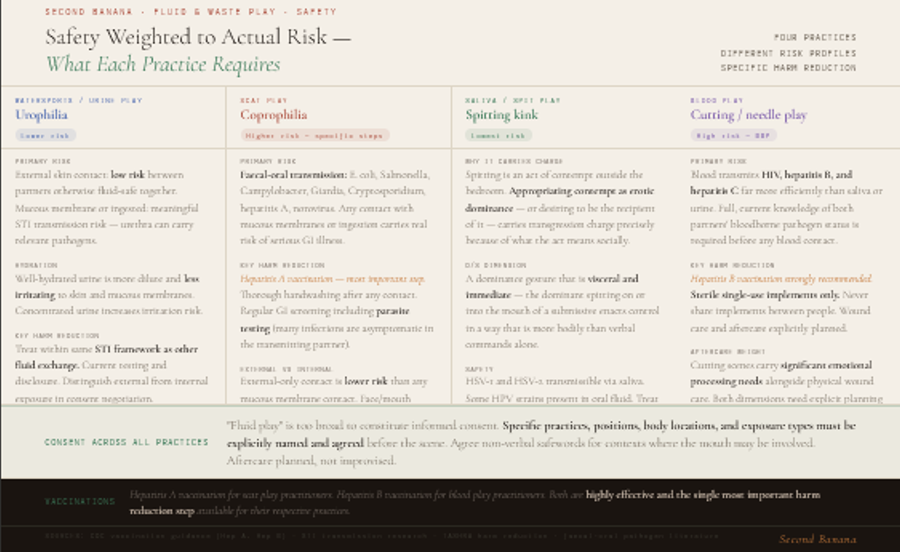
Urine from a healthy person is not sterile (the old dogma has been revised) but it is not a significant disease vector between people who are already in the kind of close contact that sexual activity involves. Urine that remains external — on skin, for example — presents minimal health risk. The risk profile changes for internal exposure: urine in the eyes, on mucous membranes, or ingested carries more meaningful risk, particularly in the context of STI transmission, because the urethra passes through the same anatomy as the genitals and urine can carry relevant pathogens if they are present.
Watersports: Safety Specifics
- Hydration matters. Concentrated urine — darker, stronger smelling, higher in waste compounds — is more irritating to skin and mucous membranes. Well-hydrated partners produce more dilute urine, which is less irritating in external contact.
- External vs internal exposure. On skin: low risk between partners who are otherwise fluid-safe together. On mucous membranes or ingested: meaningful STI transmission risk. If either partner has a urinary tract infection or any STI with urethral involvement, external exposure risk increases.
- Current STI status. Watersports should be negotiated within the same STI awareness framework as other fluid exchange. Testing and disclosure are part of the consent conversation, not an afterthought.
- Consent architecture. As with all kinks involving bodily fluids, the specific practices — who gives, who receives, where on the body, internal or external, spontaneous or scripted — need to be explicitly agreed before the scene rather than improvised within it.
Scat Play
Scat play — consensual erotic engagement with faeces — is the most stigmatised practice in this territory and the one that warrants the most direct treatment of both psychology and safety. It is also, likely, the least common of the practices covered here, though survey data on prevalence is thin because the stigma makes honest reporting difficult.
The psychological dimensions described above apply with particular force to scat play: the transgression is more extreme, the taboo more absolute, the disgust response more visceral. For the people for whom scat play carries erotic charge, these are features rather than incidental byproducts. The intensity of the cultural prohibition is precisely what produces the intensity of the transgression.
Direct and honest on safety: scat play carries meaningful health risks that are not present to the same degree in other fluid play, and these deserve honest treatment rather than dismissal.
Scat Play: Safety Specifics
- Faecal-oral transmission is the primary risk. Human faeces contain bacteria (including E. coli, Salmonella, Campylobacter), parasites (Giardia, Cryptosporidium, various helminths), and viruses (hepatitis A, norovirus) that are transmitted via the faecal-oral route. Any practice involving ingestion, or contact with mucous membranes (mouth, eyes, genitals) followed by inadvertent transfer to mouth, carries real risk of serious GI illness and some risk of hepatitis A.
- Vaccination. Hepatitis A vaccination is highly effective and strongly recommended for people who engage in scat play. This is the most important harm reduction step available.
- Reducing ingestion risk. External contact — on skin — is lower risk than internal contact. Thorough handwashing with soap after any contact is essential. Contact with the face, eyes, and mouth significantly increases risk and should be explicitly negotiated with full awareness of that risk.
- Parasite transmission. Many parasitic infections are asymptomatic in the transmitting partner, meaning STI testing that doesn’t include parasite screening won’t catch them. Regular GI screening — stool testing for parasites and pathogenic bacteria — is appropriate harm reduction for regular scat play practitioners.
- Diet and timing. Some practitioners manage risk partly through dietary practices in the period before scenes. This reduces the concentration of pathogenic load but does not eliminate it.
None of this is to say that scat play is not practised safely by informed practitioners. It is. The safety specifics here are not a reason to condemn the practice — they are information that enables people to engage with it as knowledgeably as they engage with every other kink in their repertoire.
Saliva, Spit, and Spitting
Spit play — consensual erotic engagement with saliva, including spitting on or into a partner — sits at the less stigmatised end of this territory but warrants its own treatment because it is common, often underestimated in its erotic charge, and has its own distinct psychological and safety dimensions.
Saliva is the most socially proximate of these substances — the most commonly exchanged in everyday life, through kissing and oral sex — and yet consensual spitting carries a distinct erotic charge for many people that exceeds the charge of kissing. The reason is the same transgression dynamic that operates more powerfully in scat and watersports: spitting at someone is an act of contempt in most social contexts, and appropriating an act of contempt as an act of erotic dominance or desired degradation carries charge precisely because of what that act means outside the bedroom.
In D/s contexts, spitting is frequently a dominance gesture: the dominant spitting on or into the mouth of a submissive enacts a relationship of control that is visceral and immediate in a way that verbal commands alone are not. For submissives who find charge in degradation, being spat upon carries a similar intensity to other humiliation practices.
Saliva: Safety Specifics
Saliva transmits a narrower range of pathogens than blood or genital fluids, but it is not without risk. Herpes simplex virus (both HSV-1 and HSV-2) can be transmitted via oral contact and saliva. Some respiratory viruses, including certain strains of HPV, are present in saliva. Spit play that involves direct contact with mucous membranes or is ingested should be considered within the same STI-awareness framework as other oral contact.
Blood Play
Blood play — consensual erotic engagement involving small quantities of blood, typically through cutting (edge play) or needle play — is adjacent to the fluid play territory but distinct from it in important ways. It is covered briefly here for completeness, with the safety considerations that make it genuinely higher-risk than watersports or saliva play.
The erotic charge of blood play typically involves its combination with pain, its visual intensity, and its status as the most literal enactment of the body being penetrated and marked. In D/s contexts it often carries an extreme intimacy dimension — blood as the most intimate substance the body contains — alongside whatever pain and marking dynamics are also in play.
Blood Play: Safety Specifics
- Bloodborne pathogen transmission. Blood transmits HIV, hepatitis B, and hepatitis C far more efficiently than saliva or urine. Any practice involving blood contact between partners should be conducted with full, current knowledge of both partners’ bloodborne pathogen status.
- Sterile implements only. Cutting or needle play should use sterile single-use implements. Implements should never be shared between people. Aftercare includes appropriate wound care.
- Hepatitis B vaccination. Like hepatitis A vaccination for scat play, hepatitis B vaccination is strongly recommended for people who engage in blood play and is highly effective.
- Aftercare and wound care. Cuts require proper cleaning and, where appropriate, bandaging. The aftercare dimension of cutting is significant both for physical wound management and for the emotional processing that follows scenes with this level of physical intensity.
The Consent Architecture for Fluid and Waste Play
All of the practices covered in this piece require more explicit pre-scene negotiation than most kink, for the simple reason that they are harder to pause and redirect mid-scene once they’ve begun, and because the specific elements — who, what, where on the body, how much, how often, in what context — are material to both the erotic experience and the safety considerations.
The consent framework that applies across this territory:
- Explicit, specific pre-scene negotiation. “Fluid play” is too broad to constitute informed consent. “You may urinate on my chest but not my face” is consent. The specificity that feels excessive in low-stakes kink is the minimum for high-stakes kink.
- Current health status disclosed. This means recent STI testing, current knowledge of any relevant infections (UTIs, active herpes outbreaks, etc.), and for scat play, GI health. Both partners.
- Safewords that work in context. Some fluid and waste play creates contexts in which verbal safewords are difficult to use — if someone’s mouth is involved, for example. Agree on a non-verbal signal before the scene begins and ensure both partners know how to use it.
- Aftercare explicitly planned. Scenes involving the most stigmatised practices often produce sub-drop and emotional processing needs that are as intense as the scene itself, or more so. Aftercare needs to be planned rather than improvised, and should include both the physical practicalities (cleaning, wound care where relevant) and the emotional settling.
Finding Each Other
The practices covered in this piece sit at the edge of what most people are willing to name in most contexts. The result, for people who have these desires, is often years of private wanting with no clear pathway toward finding partners who share them — or even toward knowing that other people share them at all.
Second Banana’s anonymous, post-first architecture is particularly suited to this territory. The person who wants to name watersports or scat play in their desires doesn’t have to assess whether a specific person is safe to tell before they say it. They can say it first, clearly, in a post, and let the matching work from there. The person who responds has already indicated they’re in the right territory.
The Second Banana tag system carries the specificity this requires. “Watersports — giving,” “watersports — receiving,” “scat — humiliation context,” “fluid play — intimacy focus”: these are tags that tell the reader immediately what kind of desire is in play and what orientation it has. The specificity that might feel exposing in another context is, here, the mechanism that finds the right person.
You’re not the only person who wants this. The person who wants it with you is out there. The post is the first step.
The edge of the map is where the interesting territory is. 🍌