Fantasy-Specific Hookups: How Second Banana Changes the Game | Second Banana
The Problem With "DTF"
There is a particular kind of disappointment that anyone who has used mainstream hookup apps knows intimately. You match. You chat. You meet. And then you discover, usually somewhere between the second drink and the moment where things get actually physical, that what you had in mind and what they had in mind are not the same thing.
Not wildly different. Not incompatible in any dramatic way. Just... not the same. You wanted something specific. They wanted something specific. Neither of you said what it was, because hookup culture has no good mechanism for saying what you actually want before you've already invested an evening in finding out whether you're compatible.
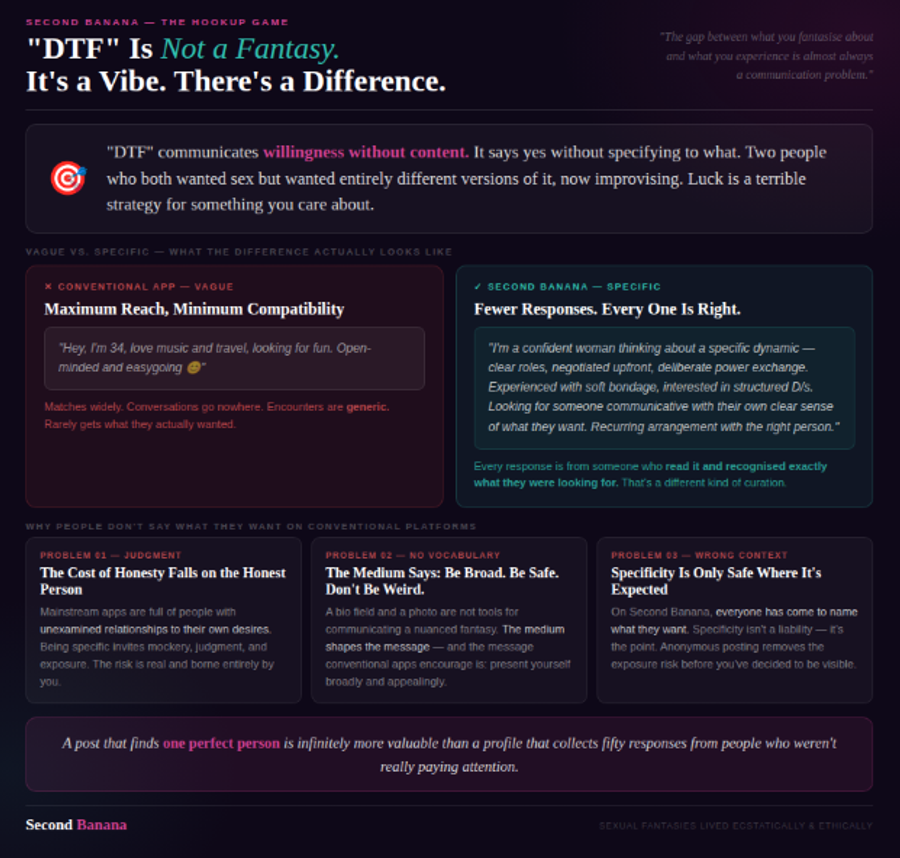
"DTF" — down to fuck — is the apotheosis of this problem. It communicates willingness without content. It says yes without specifying to what. And the result, reliably, is two people who were both interested in sex but may have been interested in entirely different versions of it, now in a room together, improvising.
Sometimes improvisation works. Sometimes you discover mid-encounter that your improvisations are beautifully compatible. But this is luck. And luck is a terrible strategy for something you care about.
The gap between what you fantasise about and what you actually experience in a hookup is almost always, at its core, a communication problem. Second Banana is a communication solution.
What Specificity Actually Does
Here is the fundamental insight that Second Banana is built on: the more specifically you can name what you want, the more likely you are to find the person who wants exactly that.
This sounds obvious. It is obvious. And yet it runs directly counter to how conventional dating and hookup platforms work, which is to encourage people to present broad, appealing, non-threatening versions of themselves in the hope of maximising matches, and then sort out the specifics later.
The problem with that approach is that specificity is exactly what makes a sexual encounter good. Not just acceptable, not just fine, not just "we both had a nice time" — but genuinely, specifically, memorably good. The encounter where someone met you exactly where you were. Where the thing you'd been wanting to try was actually tried. Where you didn't have to either explain yourself from scratch or quietly let the fantasy stay a fantasy for another night.
Vague vs. Specific: What the Difference Looks Like
Consider two versions of the same person looking for the same kind of encounter. Same desires. Same openness. Completely different approach.
The vague version posts a profile photo, lists a few generic interests, and puts something like "love to have fun, easygoing, up for anything" in their bio. They match widely. They have many conversations that go nowhere. They occasionally meet someone with whom the chemistry is fine but the encounter is generic. They rarely, if ever, get what they actually wanted.
The specific version — on Second Banana — writes a post. They describe the scenario they've been thinking about. They name the dynamic they're drawn to. They use the tag system to signal their experience level, their relationship structure, what they're looking for and what they're not. They find fewer people. But the people they find have read the post and responded because they specifically want what the post described.
The difference in experience between these two paths is not marginal. It is the difference between a generic encounter and one that was, at least in outline, already what you wanted before it happened.
VAGUE (conventional app):
"Hey, I'm 34, love music and travel, looking for fun. Open-minded and easygoing 😊"
SPECIFIC (Second Banana):
"I'm a confident woman who's been thinking about a particular dynamic for a while — something with clear roles, negotiated upfront, where the power exchange is deliberate and discussed rather than assumed. I'm experienced with soft bondage and interested in exploring more structured D/s. Looking for someone patient, communicative, and with their own clear sense of what they want. Not looking for a relationship — looking for a recurring arrangement with the right person."
The second post will reach fewer inboxes. Every single response it gets will be from someone who read it, recognised what they were looking at, and wanted exactly that. That is a fundamentally different kind of curation than anything a swipe-based platform can offer.
Why People Don't Say What They Want — And Why That Changes Here
If naming your specific fantasy is so clearly better, why don't people do it on conventional platforms? The answer is not complicated: because conventional platforms are not safe places to be specific.
The Judgment Problem
Mainstream dating apps are populated by people whose relationship with their own desires ranges from fully integrated and comfortable to actively suppressing things that feel shameful or risky to name. When you post a specific, honest description of a sexual fantasy on a platform full of people who didn't sign up for that, you risk judgment, mockery, screenshot-sharing, and the particular social exposure that comes from being seen wanting something that the people around you consider weird.
This is not a hypothetical risk. It is why people don't post specifically. The cost of honesty on a general-purpose platform is borne entirely by the honest person, and the benefit — finding someone who actually wants the same thing — is not guaranteed.
The Signal Problem
Even when someone is willing to be specific, conventional platforms don't have the vocabulary for it. A bio field, a handful of interest tags, and a photo — these are not tools for communicating a specific sexual fantasy with the nuance it deserves. The medium shapes the message, and the medium of mainstream hookup apps says: present yourself broadly, appealingly, safely. Don't be weird. Don't be specific. Don't be too much.
What Second Banana Changes
Second Banana changes the context in which specificity happens. On a platform where everyone has come precisely because they want to name what they want and find the person who wants that too, specificity is not a liability. It is the point.
The platform's anonymous posting option removes the exposure risk. You can describe exactly what you're looking for — including the things you've never said out loud in a dating context — before you've decided whether to be visible as yourself. The risk of being judged by someone who wasn't on that wavelength is dramatically reduced, because the post itself filters who responds.
The tag system gives you a structured vocabulary for the dimensions of specificity that matter most: your relationship structure, your experience level, your kink interests, your orientation, what you're looking for, what you're not looking for. Tags aren't a substitute for a well-written post — they're the shorthand that lets the right people find the post in the first place.
And the post-first model — leading with words rather than photos — changes what first impressions are made of. On Second Banana, the first thing someone knows about you is what you're actually thinking. Not what you look like. Not how well you photograph. What you want and how you articulate wanting it. This means the first filter is compatibility of desire, not physical attraction — which is exactly the right order of operations for finding someone who will meet your specific fantasy.
The Anatomy of a Good Second Banana Post
Writing a post that finds the right person is a skill. Not a complicated one — but one worth thinking about deliberately, because the difference between a post that gets no responses and one that gets exactly the right response is almost always in the specificity.
What to Include
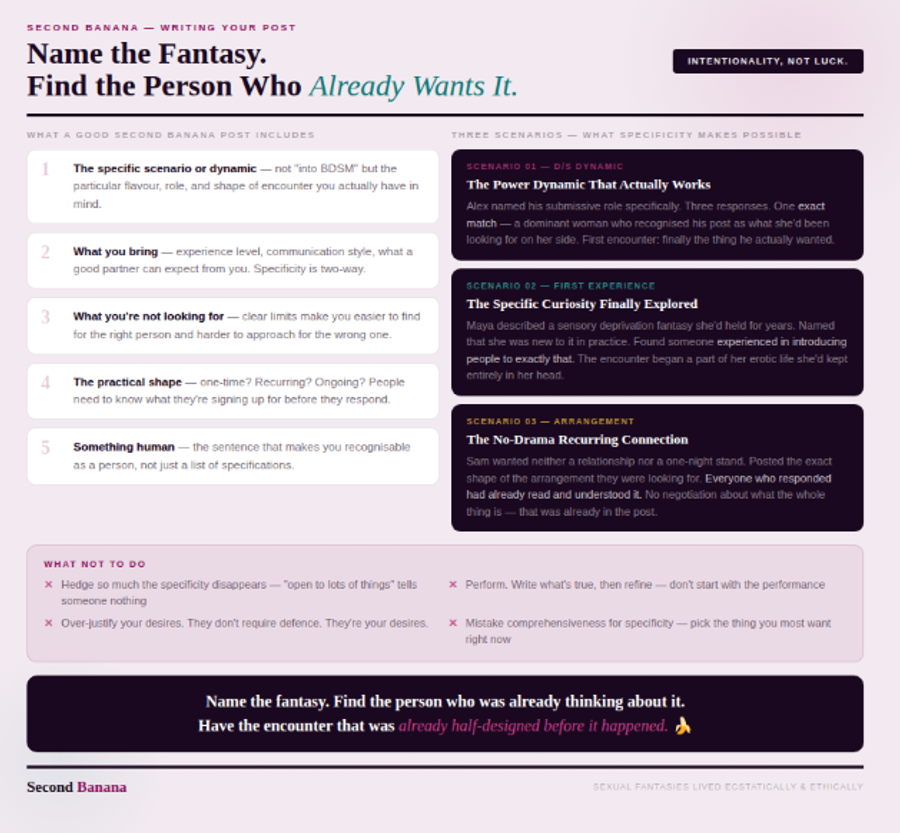
- The scenario or dynamic you're looking for — not in general terms, but specifically. Not 'into BDSM' but the particular flavour, role, and shape of encounter you have in mind.
- What you bring — your experience level, your communication style, what a good partner can expect from you. Specificity is a two-way street.
- What you're not looking for — clear limits make you easier to find for the right person and harder to approach for the wrong one.
- The practical shape of what you want — recurring arrangement? One-time? Ongoing connection that might include other things? People need to know what they're signing up for.
- Something that conveys who you are as a person, not just as a desiring body — the sentence or two that makes you recognisable as a human being rather than a list of specifications.
What Not to Do
- Don't hedge so much that the specificity disappears. 'Open to lots of things' tells someone nothing. 'Particularly interested in X, curious about Y, not into Z' tells them everything they need to know.
- Don't perform. Write the post you would write if you were completely honest about what you want, then refine it — don't start with the performing and add honesty later.
- Don't over-explain or over-justify. You don't need to provide a disclaimer about your desires. They are your desires. They don't require defence.
- Don't mistake comprehensiveness for specificity. A post that covers every possible thing you might ever want is not a specific post — it's a vague post with more words. Pick the thing you most want right now and write about that.
A post that finds one perfect person is infinitely more valuable than a profile that collects fifty responses from people who weren't really paying attention.
Real Encounters, Real Specificity
To make this concrete: here are three scenarios that illustrate the difference between the vague encounter and the specific one. These are composites — not real people — but they represent the pattern accurately.

Scenario One: The Power Dynamic That Actually Works
Alex has been on mainstream apps for three years. He knows he's drawn to submission — to a specific kind of dynamic where someone takes clear, confident, negotiated control. But he's never managed to find this on conventional apps, because naming it felt too risky, and because the few times he hinted at it, it either went nowhere or the person who responded had a very different idea of what "dominant" means.
On Second Banana, Alex writes a post. He describes the specific dynamic he's looking for: a dominant partner who negotiates explicitly, who is interested in a structured arrangement with real communication around limits, who approaches the dynamic with the seriousness he brings to it. He tags: submissive, D/s, experienced, looking for recurring arrangement.
Three people respond. One is not quite right but the conversation is interesting. One is exactly right — a dominant woman who read his post and recognised what he was describing as precisely what she's been looking for on her side. They negotiate before they meet. The first encounter is, for the first time in Alex's experience of hookup culture, the thing he actually wanted.
Scenario Two: The Specific Curiosity Finally Explored
Maya has a fantasy she's never acted on — a scenario involving sensory deprivation that she's thought about for years but never known how to raise with a partner without it coming out of nowhere and feeling awkward. She's not sure how experienced she is, exactly, because she's experienced in imagination and almost nowhere in practice.
She writes a post that names this directly: a specific first experience she's been thinking about, what she'd need to feel safe in exploring it, that she's new to this in practice, and that she's looking for someone patient and communicative who has done this before and would approach a first experience with care. She tags: beginner, sensory play, looking for experienced partner, one-time or ongoing.
The person who responds has done exactly this before, has experience introducing people to this particular kind of play, and is genuinely interested in the specific scenario she described. The encounter is careful, communicative, and — for Maya — the beginning of a part of her erotic life she'd kept entirely in her head for years.
Scenario Three: The No-Drama Recurring Arrangement
Sam doesn't want a relationship. Sam also doesn't want a one-night stand. Sam wants something that doesn't have a good name in mainstream hookup culture: a recurring, well-negotiated, specifically sexual arrangement with a person who is on the same page about what it is and what it isn't.
Every mainstream app either pushes toward relationship-formation or treats all sexual interest as equally transactional. Neither fits. Sam writes a post that names exactly what they're looking for: a recurring arrangement, specific in its sexual content, clear in its non-romantic nature, requiring ongoing communication and genuine care for both people's experience. They tag: friends with benefits, kink-friendly, non-romantic, ongoing arrangement.
Finding this on a conventional app would require a lengthy negotiation about what the whole thing is. On Second Banana, the people who respond have already read the post and understood the shape of what's being offered. The arrangement that develops is exactly what Sam described — because it was described specifically, before anyone had invested an evening in finding out whether they were compatible.
This Is What the Hookup Game Looks Like When It Works
Hookup culture has a bad reputation, and a lot of that reputation is deserved — but not because casual sex is inherently bad. Because the mechanisms mainstream culture has built for finding casual sex are bad. They're built for volume, not precision. For broad appeal, not specific compatibility. For maximising matches, not maximising the chance that any given encounter is actually what both people wanted.
Second Banana is built on a different premise: that the best casual encounter is a specific one. That naming what you want, finding the person who wants that too, and connecting with genuine mutual understanding of what you're both signing up for produces a qualitatively different experience than showing up broadly available and seeing what happens.
This is not a more conservative approach to casual sex. It is a more intentional one. And intentionality, it turns out, is the thing that separates a fantasy from an experience.
The gap between the encounter you've been imagining and the encounter you've been having is almost always, at its core, a gap in communication. Second Banana closes that gap — by building communication into the very beginning of the process, before anyone has met, before anyone has had a drink, before anyone is in a situation where naming what you want feels like too much to ask.
That's not luck. That's Second Banana. 🍌