
Aftercare: Not Just for BDSM. For Everyone. | Second Banana
Aftercare: Not Just for BDSM. For Everyone.
What the neuroscience of post-sex vulnerability actually says — and why the kink community figured it out first
The Moment Nobody Talks About
Sex ends. And then something happens — or doesn’t happen — and depending on what that something is, the whole experience either lands or doesn’t.
You know the version that doesn’t land. The partner who rolls over immediately. The one who checks their phone before the sweat has dried. The one who gets up, gets dressed, becomes entirely normal again with a speed that makes you feel faintly embarrassed about the fact that you haven’t yet. The slightly too-brisk kiss goodbye. The conversation that jumps straight from the intimate to the logistical without pausing in between.
You probably also know the version that does land, even if you’ve never had language for why. The staying. The quiet. The hand that doesn’t let go quite yet. The conversation that’s different from every other conversation — slower, more honest, less performed. The feeling of being held in something rather than released from it.
The difference between these two experiences is not a matter of preference or sentimentality. It is a matter of neuroscience. What happens in the body during sex creates a specific set of neurological conditions that persist after sex ends — conditions that make certain kinds of experience profoundly supportive and certain other kinds of experience quietly damaging. The kink community gave this a name decades ago. The research has been catching up ever since. And the implications extend well beyond the dungeon.
This is the piece about what aftercare actually is, why every body needs some version of it, what happens when it’s absent, and how to do it in a way that matches who you are and who you’re with.
Where Aftercare Came From
The term “aftercare” originated in BDSM communities, where it referred to the deliberate practice of tending to a partner — or being tended to — in the period immediately following an intense scene. In BDSM contexts, the need for aftercare is obvious and acute: the physiological and psychological states produced by intense power exchange, pain play, bondage, or emotional exposure are extreme, and the transition back to ordinary consciousness requires active support.
The BDSM community’s contribution here was not just naming the practice but taking the post-scene transition seriously as something that requires intentional care — rather than assuming the participants would simply be fine once the ropes came off. This was, in retrospect, a significant piece of collective wisdom about human neurology that mainstream sexual culture has been slow to absorb.
Because the insight is not BDSM-specific. The physiological conditions that make aftercare necessary in the aftermath of an intense scene are present, in attenuated form, after any sexually and emotionally significant encounter. The neurochemistry doesn’t check whether a safeword was used before deciding to do what it does.
The Neuroscience: What’s Actually Happening in Your Body
To understand why aftercare matters, you need to understand what sex does to the body chemically — not during, which is the part everyone knows about, but immediately after, which is the part almost nobody discusses.
The Oxytocin Surge and Its Aftermath
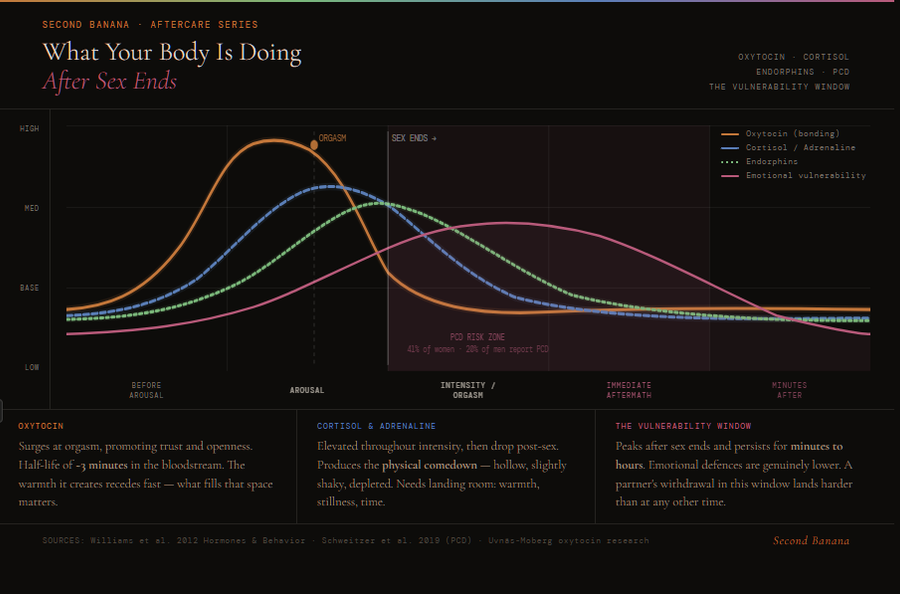
During sexual arousal and particularly during orgasm, the brain releases a significant surge of oxytocin from the hypothalamus. Oxytocin is sometimes called the “bonding hormone” or the “love hormone,” which undersells its actual complexity but captures something real about its function: it promotes feelings of trust, closeness, and attachment. It reduces the amygdala’s threat-detection sensitivity, meaning that people feel less guarded and more open to connection immediately following sex than they typically do in any other context. It promotes eye contact, touch-seeking, and emotional disclosure.
This surge is real and measurable. A 2012 study in Hormones and Behavior found significant oxytocin increases following sexual activity in both men and women, with the increases correlating with reports of feeling bonded and close to a partner. The oxytocin surge is, in part, why sex feels like it means something — because neurochemically, in that moment, it does.
Here is the part that matters for aftercare: the surge doesn’t last. Oxytocin has a half-life of approximately three minutes in the bloodstream, though its neurological effects persist longer than this. As levels drop, the protective warmth and lowered defences it produced begin to recede. If the person is held and supported during this transition — if the warmth of another person, the continuation of physical contact, and the presence of emotional safety fill the space the oxytocin is vacating — the landing is soft. If they are not — if they are suddenly alone, or faced with a partner who has emotionally disconnected — the drop can be genuinely destabilising.
Cortisol, Adrenaline, and the Comedown
Alongside oxytocin, intense sexual activity — and particularly intense BDSM scenes — produces significant releases of adrenaline and cortisol. These are stress hormones. The body treats the physiological intensity of sex and the physiological intensity of a stress response as involving overlapping systems, because they do. The elevated heart rate, the heightened sensory sensitivity, the altered state of consciousness that characterises intense sexual or BDSM experience all involve the same neurochemical machinery that the body uses to manage acute stress.
When the encounter ends, cortisol and adrenaline levels drop. This is the physical comedown, and it has a quality that anyone who has experienced it intensely will recognise: a kind of hollow, depleted, slightly shaky feeling that is the body returning to baseline from a significant physiological height. The drop is normal. It is not evidence that anything went wrong. But it requires landing room — time, warmth, stillness, physical contact — to move through without becoming destabilising.
Endorphins and the Vulnerability Window
Sex, and particularly intense or prolonged sex, also produces significant endorphin release. Endorphins are the body’s endogenous opioids — the same class of compounds as morphine and heroin, produced internally. They produce feelings of euphoria, pain reduction, and a floating, expansive sense of wellbeing. In the aftermath of intense BDSM play — particularly scenes involving pain, impact, or prolonged restraint — the endorphin component can be profound, producing the state known as “subspace” during the scene and a significant withdrawal-like comedown as levels drop afterward.
The endorphin drop is the primary mechanism behind “sub drop” — the emotional crash that some submissives experience hours or days after an intense scene, characterised by sadness, tearfulness, fatigue, and a generalised sense of fragility. But endorphin release occurs in any sexually significant encounter, not just BDSM scenes, and the mild version of this drop — attenuated, harder to name, but genuinely present — is part of what makes the post-sex period emotionally significant for most people.
Postcoital Dysphoria: When the Drop Has a Name
Postcoital dysphoria (PCD) is the clinical term for feelings of sadness, anxiety, tearfulness, or emotional distress following consensual, otherwise satisfying sex. It is more common than most people realise. A 2019 study by Robert Schweitzer and colleagues at Queensland University of Technology — the most methodologically rigorous survey of PCD to date — found that approximately 41% of women and 20% of men had experienced PCD at some point, with 5% of women reporting it occurring always or usually after sex.
PCD is not well understood mechanistically, but the leading hypotheses involve the neurochemical comedown following orgasm, the emotional vulnerability created by the oxytocin-mediated lowering of defences, and for some people, the surfacing of old material — shame, grief, or unprocessed experience — through the opening that intimacy creates. It is not a sign that something went wrong. It is not evidence that the person didn’t enjoy the sex or doesn’t care for their partner. It is the nervous system doing something entirely normal in the aftermath of a significant experience.
Crucially: aftercare is one of the most effective known mitigants for PCD. The Schweitzer research found that feeling emotionally supported in the post-sex period was significantly associated with lower rates of postcoital dysphoria. The body needs a landing. When it gets one, the drop is gentler.
Sub Drop and Dom Drop: The BDSM-Specific Versions
For people who engage in BDSM, the neurochemical dynamics above are amplified significantly — and the drop can be correspondingly more intense and more extended.
Sub Drop
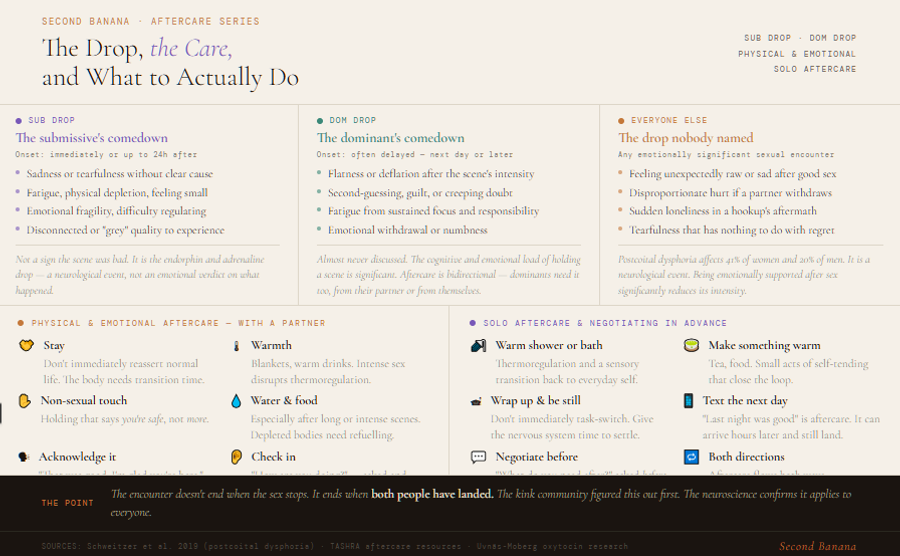
Sub drop is the period of emotional and physical depletion that can follow intense BDSM play, particularly scenes involving significant pain, fear, restraint, or emotional exposure. It can onset immediately after a scene or be delayed by hours, arriving the next day when the endorphin and adrenaline effects have fully cleared. Sub drop typically involves some combination of sadness or tearfulness, fatigue, feeling small or fragile, difficulty regulating emotions, and a disconnected or “grey” quality to experience.
Sub drop is not a sign that the scene was bad or that consent was violated. It is the body’s physiological response to a significant neurochemical event. Good aftercare — physical warmth, sustained contact, food and water, emotional presence, explicit reassurance — significantly reduces both the intensity and duration of sub drop. Poor or absent aftercare leaves the submissive to navigate the comedown alone, which amplifies its difficulty and, over time, can associate BDSM play with a particular kind of loneliness that has nothing to do with the play itself.
Dom Drop: The One Nobody Warns You About
Dom drop is considerably less discussed than sub drop, which is a significant gap in the BDSM community’s otherwise sophisticated literature on post-scene care. Dominant partners experience their own version of the neurochemical crash — often arriving later than sub drop, sometimes not until the day after a scene — and it has its own distinct character.
The dominant in a scene is carrying a substantial cognitive and emotional load: maintaining awareness of the submissive’s state, monitoring safety, making real-time decisions about intensity, holding the psychological architecture of the scene together. This is, in addition to being physically demanding, neurologically costly. The adrenaline that sustains it drops when the scene ends. And the emotional weight of having held power over another person’s experience — particularly the responsibility dimension of that — can produce a comedown that manifests as doubt, guilt, flatness, or a kind of hollow deflation that is easy to dismiss and important not to.
Good aftercare is bidirectional. The submissive needs care from the dominant. The dominant also needs care — from the submissive, from themselves, from the intentional practice of decompression and self-tending that the post-scene period requires. A dominant who consistently gives aftercare without receiving it will burn out. The dynamic requires attention in both directions.
Aftercare for Everyone: Why This Isn’t Just a Kink Thing
The neurochemistry above is not exclusive to BDSM. It occurs, in varying degrees of intensity, following any sexually and emotionally significant encounter. The oxytocin surge and drop, the adrenaline and cortisol comedown, the endorphin release and its aftermath, the temporary lowering of emotional defences — these are features of sex generally, not of kinky sex specifically.
What the BDSM community did was name the need and build a practice around it. The rest of sexual culture has the same need and, largely, no practice at all — which is why so many people have had the experience of feeling inexplicably sad, or suddenly lonely, or strangely raw after sex that was, by any objective measure, good. The feeling is real. The neuroscience explains it. The practice exists. It just hasn’t been transmitted.
After Casual Sex
The assumption that casual sex doesn’t require aftercare is one of the most common and most consequential mistakes in modern sexual culture. The neurochemical events of sex don’t consult the relationship context before deciding to occur. Oxytocin surges and drops regardless of whether the people involved are long-term partners or people who met this week. The vulnerability window opens in a hookup as surely as it does in a marriage.
This does not mean that casual sex is emotionally equivalent to partnered sex, or that everyone who has casual sex will feel the same degree of post-sex vulnerability. Individual variation is significant. But it does mean that the person who feels unexpectedly raw after a casual encounter is not being irrational or clingy or failing to manage their emotions correctly. They are having a normal neurological response that the cultural script for casual sex provides no support for.
Aftercare in a casual context doesn’t have to be elaborate or imply more than the encounter was. It can be as simple as staying for a few minutes rather than leaving immediately, asking how the person is, offering water, acknowledging what just happened rather than pretending it didn’t. These are small things that make a significant difference to how the neurochemical landing goes.
After First-Time Sex with a New Partner
First-time sex with someone new is one of the highest-vulnerability contexts for post-sex emotional difficulty, for reasons that are straightforwardly neurological. The novelty amplifies the oxytocin response. The uncertainty about how the other person feels amplifies the threat-detection that the oxytocin was suppressing. The combination produces a particular kind of post-sex fragility that is extremely common and almost never spoken about.
The person who feels disproportionately affected by a first-time sexual encounter — who finds themselves more attached, or more anxious, or more raw than they expected to be — is not weak or poorly boundaried. They are having the neurological experience that first-time sex reliably produces. Knowing this doesn’t eliminate the feeling, but it changes its meaning considerably.

After Emotionally Intense or Meaningful Sex
The intensity of the aftercare need scales with the intensity and emotional significance of the encounter. Sex that is particularly meaningful — first time with a significant partner, reunion sex after a long separation, sex following a difficult emotional conversation, sex that involves unusual vulnerability or exposure — produces a correspondingly more significant neurochemical event and a correspondingly greater need for intentional landing.
This is also true of particularly pleasurable sex: the higher the peak, the more significant the return to baseline. People sometimes notice that their best sexual experiences are followed by the most pronounced emotional drops, which seems counterintuitive until you understand the mechanism. The quality of the experience and the intensity of the drop are produced by the same neurochemical dynamics.
What Aftercare Actually Looks Like
Aftercare is not one thing. The form it takes varies enormously between people, between encounters, between relationship contexts, and between individuals’ specific needs. What follows is a map rather than a prescription.
Physical Aftercare
The most fundamental form of aftercare is physical: remaining present in the body together rather than immediately returning to cognitive or logistical mode. This can include:
- Sustained physical contact — holding, skin contact, not immediately separating bodies
- Warmth — blankets, warm drinks, the simple thermoregulation that intense physical activity disrupts
- Food and water — particularly after intense BDSM or prolonged sex, which is physically depleting
- Gentle touch that is not sexual — stroking, holding, the kind of contact that says you are safe rather than more
- Quiet — not the pressure to perform conversation or normalcy, but permission to simply be in the same space without demand
Emotional Aftercare
Beyond the physical, aftercare has an emotional dimension that matters at least as much:
- Verbal acknowledgment — something as simple as “that was good” or “I’m glad you’re here” can do significant work in the post-sex vulnerability window
- Checking in — “how are you doing?” asked and genuinely waited for, not as a formality
- Permission to feel whatever is present — including things that seem incongruous, like sadness or anxiety or sudden tearfulness, without either person pathologising them
- Explicit reassurance where it’s needed — particularly in new relationships, or following encounters that involved unusual vulnerability
- Staying emotionally available rather than retreating into phone or distraction immediately
Solo Aftercare
Aftercare doesn’t require a partner. Solo sex also produces neurochemical events that benefit from intentional tending, and people who are alone after a sexual encounter — whether because they had solo sex, because a partner left, or because the encounter was casual and brief — benefit from practicing aftercare for themselves.
Solo aftercare might include: a warm shower or bath, making food or tea, wrapping in something comfortable, consciously transitioning from the sexual state back to ordinary life rather than jumping immediately to the next thing, or journaling briefly if that’s a practice that works. The principle is the same as partner aftercare: the body has been through something and needs intentional support to land.
Negotiating Aftercare in Advance
In BDSM contexts, aftercare is typically negotiated before a scene begins, as part of the consent and communication process. This is one of the practices from kink culture that deserves wholesale adoption in all sexual contexts.
Knowing what a partner needs after sex — and communicating what you need — before the encounter begins removes the guesswork from a moment when guessing is exactly the wrong thing to be doing. Post-sex is not the time for negotiating needs, because the neurochemical state makes everyone more vulnerable and less able to advocate clearly for themselves. Pre-sex is the time. The conversation is simple: “what do you usually need after? what helps you land?” It can be had in two minutes. It changes everything.
When Aftercare Goes Wrong: Drop, Abandonment, and What Not to Do
The absence of aftercare is not neutral. It doesn’t simply leave the person to return to their baseline unaided. In some contexts and for some people, its absence constitutes an experience of abandonment — one that is disproportionately painful relative to its apparent size because the person is experiencing it in a state of neurological vulnerability.
The partner who leaves immediately after sex, the one who becomes emotionally cold or logistical the moment the encounter ends, the one who falls asleep without checking in — these are not necessarily acting with malice. They may not know that the moment requires anything. They may have their own avoidant responses to post-sex intimacy — the emotional closeness of the post-sex state can be threatening to people with anxious attachment histories, and withdrawal is a common response to threat. But the effect on the other person is real regardless of the intention behind it.
Recognising this matters for two reasons. The first is self-compassion: if you have had the experience of feeling disproportionately hurt by a partner’s post-sex withdrawal, you are not being oversensitive. The neurological context makes you genuinely more vulnerable in that moment than you are at other times. The hurt is proportionate to the state you were in, even if it seems disproportionate relative to the behaviour that caused it.
The second is accountability: if you have been the person who withdraws, who checks out, who returns to normal too quickly, learning about the post-sex vulnerability window is an invitation to do something different. Not because you were wrong before — you may not have known — but because you know now.
Aftercare and Attachment: Why Some People Find It Hard to Give
Post-sex intimacy is difficult for some people in ways that have nothing to do with affection for their partner. The vulnerability of the post-sex state — the openness, the emotional exposure, the lowered defences — can feel threatening to people whose attachment histories have associated intimacy with danger. For people with avoidant attachment styles, the post-sex period can trigger exactly the kind of closeness that their nervous system is organised to retreat from.
This is worth knowing because it means that a partner’s post-sex withdrawal is not always evidence that they don’t care. It can be evidence that they do care and are frightened by it. The distinction matters for how to respond and for what the conversation needs to be about.
Aftercare, like consent and communication, is a practice that can be learned. The person who has never given intentional aftercare because they didn’t know it was a thing can start. The person who finds the post-sex closeness threatening can work with that, can communicate about it, can find forms of aftercare that feel possible even while the fully open version feels like too much. Staying for an extra twenty minutes but keeping the conversation light is aftercare. A text the next morning that says “last night was good, I’m glad it happened” is aftercare. The form matters less than the intention: I see that this was something, and I’m not pretending it wasn’t.
Why Second Banana Treats This as Infrastructure, Not Nicety
That orientation — the willingness to think carefully and communicate specifically about what sex means and what it requires — is exactly the orientation that makes aftercare natural rather than awkward. Tags like “aftercare important,” “emotional availability,” “stay the night,” “no ghosting,” “post-scene care” let people find partners whose understanding of what sex includes matches their own.
Because aftercare is not a supplement to the sexual experience. It is part of it. The encounter doesn’t end when the sex stops. It ends when both people have landed. The Second Banana who is right for you already knows this, or is open to learning it. That’s not a small thing to share in advance.
The Landing Matters
There is a version of sexual culture that treats the post-sex period as logistical: the transition back to normal life, handled as efficiently as possible. It treats staying as a kindness rather than a need, departure as neutral rather than consequential, the emotional rawness of the aftermath as something to be managed rather than tended.
The neuroscience disagrees. The body, in the minutes and hours after significant sex, is in a specific state that is neither the aroused state that preceded it nor the ordinary state that will eventually return. It is open. It is vulnerable. It is, depending on the neurochemical specifics and the individual and the encounter, somewhere between tender and fragile. It has been through something.
What it needs in that state is not efficiency. It is not the performance of being fine. It is not the immediate reassertion of normal life as though the preceding hour didn’t happen. It is the simple, profound, entirely learnable practice of being present with another person — or with yourself — while the body finds its way back.
The kink community figured this out and gave it a name. The name is good. The practice is better. And it belongs to everyone.
Land well. Find someone who stays with the Second Banana Community. 🍌