Tantra: The Ancient Practice That Modern Sex Gets Wrong | Second Banana
Tantra: The Ancient Practice That Modern Sex Gets Wrong
The Word That Got Hijacked
There is a version of tantra you have definitely encountered. It involves rose petals. It involves a certain kind of spa music. It involves instructional videos narrated in hushed tones about “sacred union” and “divine masculine and feminine.” It may involve Sting.
This version of tantra is, at best, adjacent to the real thing. At worst, it’s a marketing category that shares a name with an elaborate and sophisticated body of practice without sharing much else. And it has been enormously successful at making people who might genuinely benefit from tantric practice feel like it’s not for them — because what they’ve seen looks like a particular brand of affluent, heteronormative, slightly precious spiritual wellness that has very little to do with their actual erotic lives.
The actual history of tantra — and the actual content of its practices — is considerably more interesting, considerably more radical, and considerably more relevant to the full range of people who might encounter it than its popular image suggests.
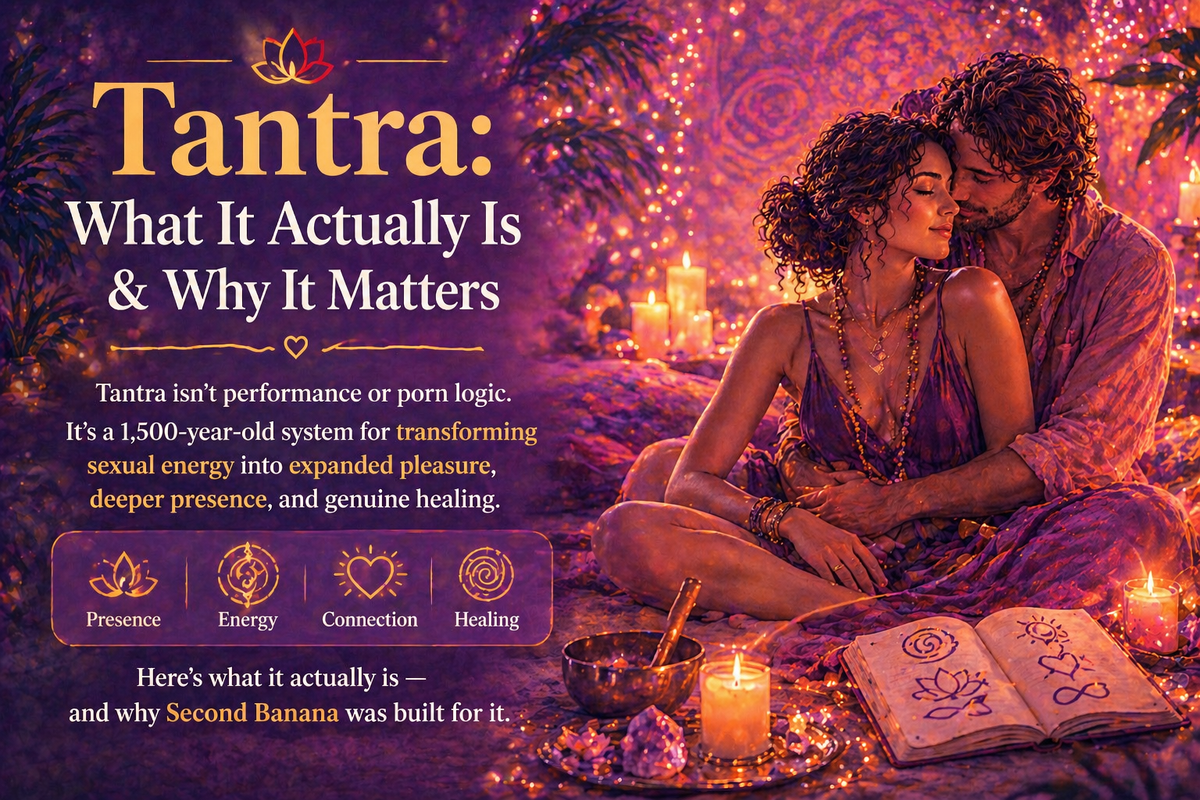
This piece is an attempt at the real thing: what tantra actually is, what it actually involves, what the genuine research says about its effects on sexual pleasure and psychological health, what distinguishes authentic practice from the spa-wellness imitation, and why Second Banana is a more natural home for tantric practitioners than any amount of rose petals would suggest.
What Tantra Actually Is
Tantra is a body of South Asian spiritual and philosophical traditions that emerged in approximately the 5th century CE and developed through the medieval period across Hindu and Buddhist lineages. The Sanskrit word “tantra” means, roughly, “to weave” or “to expand” — the root sense being of a loom, of threads being woven together into a larger pattern.
Classical tantra is not primarily a sexual practice. It is a broad philosophical and ritual framework that encompasses cosmology, deity yoga, mantra, breath, body, and the transformation of ordinary experience — including but not exclusively sexual experience — into a vehicle for expanded consciousness and liberation. The sexual dimension of tantra, while real and significant, represents one strand within a much larger system.
What distinguished tantra from other Hindu and Buddhist traditions of its time was a fundamental reversal of the usual renunciation model. Where mainstream ascetic traditions said the body and its pleasures were obstacles to spiritual development and had to be transcended or denied, tantra said the opposite: that the body, including its erotic energy, was precisely the vehicle through which liberation could be approached. Not despite pleasure, but through it. Not by denying desire but by transforming it.
This is the core insight — and it is genuinely radical. Desire is not the enemy of awakening. Skilfully engaged, it is one of its most direct routes.
Classical and Neo-Tantra: The Distinction That Matters
Contemporary Western tantra — sometimes called neo-tantra — is a 20th century synthesis that draws on classical tantric elements while departing significantly from their original context. Figures like Pierre Bernard, who brought tantric practices to the West in the early 20th century, and later Osho (Bhagwan Shree Rajneesh), who popularised what he called “tantric sexuality,” shaped a distinctly Western tradition that emphasises sexual practice, embodiment, and partner work in ways that classical tantra did not centre to the same degree.
This is not automatically a problem. Neo-tantra has developed genuine practices with genuine benefits. But it’s worth being clear about the distinction, because “tantric” in a contemporary Western context often means something quite different from “tantric” in the classical South Asian sense — and conflating them can produce both misunderstanding and, occasionally, cultural appropriation that deserves thoughtful handling.
What this piece is primarily about is the practices — both classical and contemporary — that fall under the broad tantra umbrella and that have demonstrable effects on sexual experience, embodiment, and psychological health. Whatever their origin, these practices are real, the effects are real, and the people who might benefit from them deserve an honest account of what they actually involve.
The Science of What Tantra Actually Does
The research on tantric practices is less extensive than the research on, say, mindfulness-based interventions — but it is more substantial than most people realise, and its findings are consistent enough to be worth taking seriously.
Presence, Attention, and the Erotic
The central mechanism of most tantric sexual practice is deceptively simple: slow down, pay attention, and stay with what is actually happening in the body rather than in the mind’s narrative about what is happening. This is, in formal terms, a somatic mindfulness practice applied to sexual experience.
The effects of this shift in attention are well-documented in the broader mindfulness literature. A 2017 meta-analysis in Mindfulness reviewing 44 studies found that mindfulness-based interventions significantly improved sexual function across multiple measures, including desire, arousal, satisfaction, and reduced sexual distress. The effects were particularly pronounced for women and for people with histories of anxiety or trauma.
What tantra adds to this mindfulness framework is structure: specific breath patterns, body awareness practices, eye contact protocols, and partner attunement exercises that create the conditions for sustained present-moment attention in erotic contexts. The practice, in other words, trains the capacity that the research identifies as therapeutic — rather than simply suggesting that it might help to be more present.
Breathwork and the Nervous System
Conscious connected breathing — sometimes called circular breathing or tantric breathwork — is one of the most widely used and best-studied elements of neo-tantric practice. It involves sustained, rhythmic breathing without the pause between inhale and exhale, typically done for extended periods — anywhere from ten minutes to several hours in intensive retreat contexts.
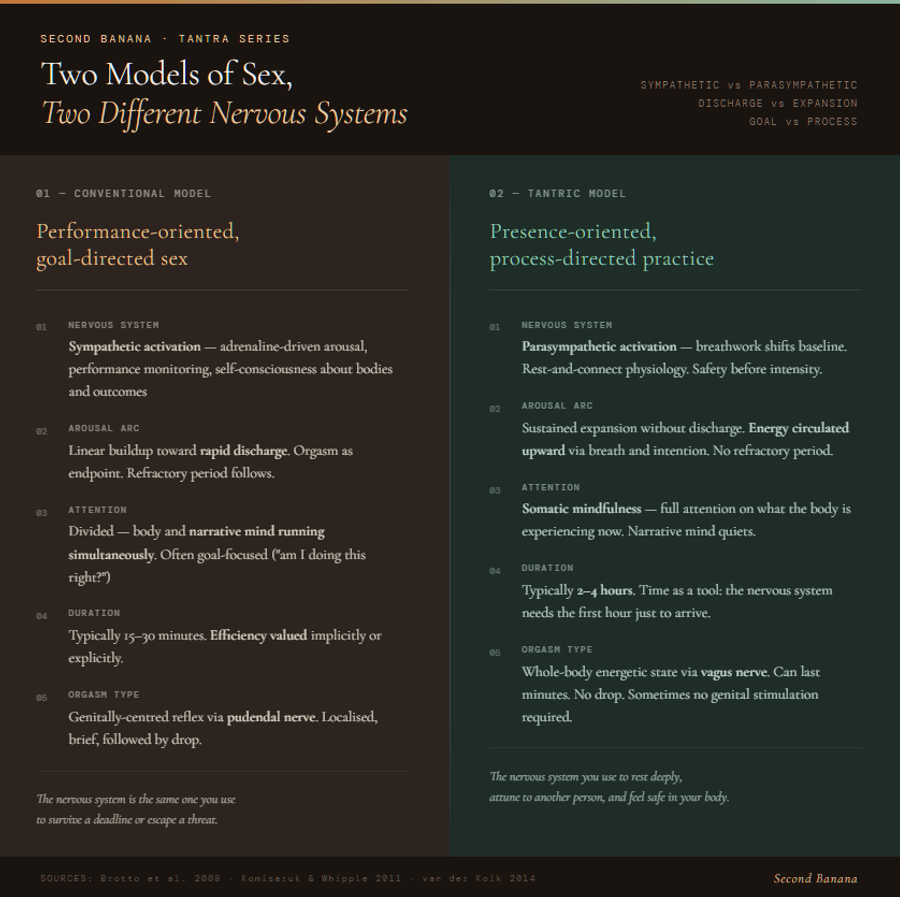
The physiological effects of this breathing pattern are significant. Prolonged conscious connected breathing alters carbon dioxide levels, activates the parasympathetic nervous system, and produces altered states of consciousness through a mechanism distinct from oxygen deprivation. A 2021 study in Frontiers in Human Neuroscience found that controlled hyperventilation techniques — of which conscious connected breathing is one form — produced measurable changes in neural oscillations associated with altered states and reduced self-referential processing.
In the context of sexual practice, this matters for two reasons. First, the parasympathetic activation that breathwork produces is physiologically the opposite of the sympathetic arousal that most contemporary sexual experience involves — the performance anxiety, the goal-orientation, the self-monitoring. Breathwork practice creates a different physiological baseline from which erotic experience unfolds. Second, the altered state properties of sustained breathwork can produce profound somatic experiences — tingling, warmth, emotional release, expanded body awareness — that constitute, for many practitioners, experiences of erotic intensity that don’t require physical stimulation to generate.
Orgasm, Energy, and the Research on Non-Ejaculatory States
One of the most striking — and most misunderstood — claims of tantric practice is that it can produce full-body orgasmic states that are distinct from the genitally-centred, discharge-model orgasm that most Western sexual culture treats as the goal and endpoint of sexual experience.
The research suggests this is not a claim that requires mystical explanation. The mechanism is neurological. Standard orgasm involves a reflex arc concentrated in the genitals and mediated by the pudendal nerve, resulting in a burst of dopamine, oxytocin, and endorphins followed by a refractory period. Tantric practice trains a different pathway: the suspension of ejaculation (in people with penises) combined with breathwork, pelvic floor engagement, and sustained arousal can redirect the orgasmic impulse up the spinal cord via the vagus nerve, producing a whole-body experience that doesn’t end in discharge and doesn’t trigger refractory shutdown.
A 2011 case study published in Sexual and Relationship Therapy documented this mechanism in a long-term tantric practitioner, describing sustained states of full-body orgasmic activation lasting several minutes without ejaculation — consistent with what practitioners describe as “energy orgasm” or “kundalini activation.” Subsequent neurological work on the vagus nerve’s role in sexual response, including research by Barry Komisaruk and Beverly Whipple at Rutgers, has provided the physiological framework that makes these accounts coherent rather than mystical.
For people with vulvas, the equivalent research is equally striking. Komisaruk and Whipple’s work documented women experiencing orgasm through thought alone, through stimulation of non-genital erogenous zones, and through vagus nerve stimulation — all consistent with the tantric model of sexuality as a whole-body energetic phenomenon rather than a genitally-centred reflex.

Tantra and Healing: What the Trauma Research Says
The healing dimension of tantric practice — its application not just to pleasure but to psychological recovery from sexual trauma, shame, and embodied distress — is the aspect of the tradition that has attracted the most serious clinical interest in recent years.
Trauma, the Body, and Why Talk Isn’t Always Enough
The starting point for understanding tantra’s therapeutic potential is the contemporary neuroscience of trauma, and in particular the work of Bessel van der Kolk, whose 2014 book The Body Keeps the Score synthesised decades of research on how trauma is stored somatically rather than narratively. Van der Kolk’s central argument — now widely accepted in trauma research — is that traumatic experience, particularly sexual trauma, is encoded in the body’s nervous system in ways that verbal processing alone cannot fully address.
This is the condition that somatic practices — including bodywork, breathwork, and mindful movement — are designed to reach. And tantra, as a practice built around sustained, deliberate body attention, conscious breath, and the careful regulation of arousal and nervous system state, addresses exactly the physiological substrate where trauma is stored.
A 2019 review in Frontiers in Psychology examining body-based interventions for sexual trauma found that somatic approaches consistently outperformed talk therapy alone on measures of body image, sexual function, and embodied self-acceptance — particularly for survivors of childhood sexual abuse. The mechanisms identified — nervous system regulation, increased interoceptive awareness, reduced hypervigilance — are precisely the mechanisms that tantric practice trains.
Shame, Disgust, and the Re-Eroticisation of the Body
Sexual shame — the felt sense that one’s body, desires, or responses are fundamentally wrong or disgusting — operates as a somatic experience, not just a cognitive one. It manifests as physical contraction, dissociation during sexual experience, the inability to stay present in the body during intimacy. Cognitive interventions address the thoughts associated with shame. Somatic interventions address the body’s conditioned responses.
Tantra’s approach to shame is distinctive. Rather than treating the body’s erotic responses as something to be managed or overcome, it treats them as the vehicle of practice — as sacred, in the traditional language; as worthy of close, respectful, non-judgmental attention in more secular framing. The sustained, deliberate attention to erotic sensation that tantric practice involves is itself a form of de-conditioning: it counters the habitual withdrawal from bodily experience that shame produces.
A 2022 qualitative study in Sexual and Relationship Therapy interviewing 18 practitioners who had engaged with tantric practice as part of their recovery from sexual trauma found consistent themes: increased capacity for embodied presence during sex, reduced shame responses, greater ability to communicate desires and boundaries, and — notably — the experience of erotic pleasure as something that had been reclaimed rather than merely returned to baseline.
Tantra for Gender Dysphoria and Body Dissociation
The tantric framework’s emphasis on energy and sensation rather than anatomy has made it particularly relevant for transgender and non-binary people navigating gender dysphoria in erotic contexts. When sexual practice is organised around what the body is doing energetically and sensationally rather than around what anatomy it has, the experience of the body in sex becomes less dependent on how the body looks and more available to be pleasurable regardless of dysphoric feelings about specific anatomical features.
This is not a formal clinical finding — the research in this specific area is still emerging — but it is consistent with a growing body of practitioner and clinical testimony, and with the broader somatic principle that shifting attention from the story about the body to the direct experience of the body can create therapeutic distance from shame-inducing narratives, including the narrative of gender mismatch.
Tantra and Kink: The Overlap No One Talks About
There is a curious parallel between tantric practice and BDSM that almost never gets discussed in either community — possibly because the aesthetic overlap is minimal (rose petals vs. leather), and possibly because both communities have some investment in being seen as distinct from the other.
But the structural similarities are striking:
- Both use altered states of consciousness as a primary vehicle of experience — tantra through breathwork and energy practices, BDSM through the neurochemical cascade of subspace and dominance states
- Both require explicit consent negotiation and ongoing communication before and during practice
- Both involve the deliberate regulation of arousal toward expanded or sustained states rather than rapid discharge
- Both use power dynamics — in BDSM explicitly, in tantra through the masculine/feminine polarity framework that some traditions use
- Both have significant overlap with trauma-informed practice and are used therapeutically by practitioners in both domains
The neurochemical overlap is especially notable. The endorphin and oxytocin release associated with BDSM play is the same neurochemical profile that tantra produces through its sustained practice. Subspace and tantric altered states are, functionally, related phenomena accessed through different means — both involving the parasympathetic system, both producing states of expansive, floating embodied pleasure, both associated with the kind of complete present-moment absorption that daily life rarely offers.
For practitioners of both, Second Banana is the natural home — because it doesn’t require you to choose between identities that have more in common than their aesthetics suggest.
What Genuine Tantric Practice Actually Involves
Given how distorted the public image of tantra is, it’s worth being specific about what authentic practice — whether in a classical or neo-tantric context — actually involves for most practitioners.
Solo Practice: Where It Usually Starts
Most serious tantric teachers begin with solo practice rather than partner work — for good reason. The skills tantra develops (sustained present-moment attention, breath regulation, awareness of body energy states, the ability to expand and hold arousal without discharge) are internal skills that need to be developed in one’s own body before they can be reliably brought into a shared erotic context.
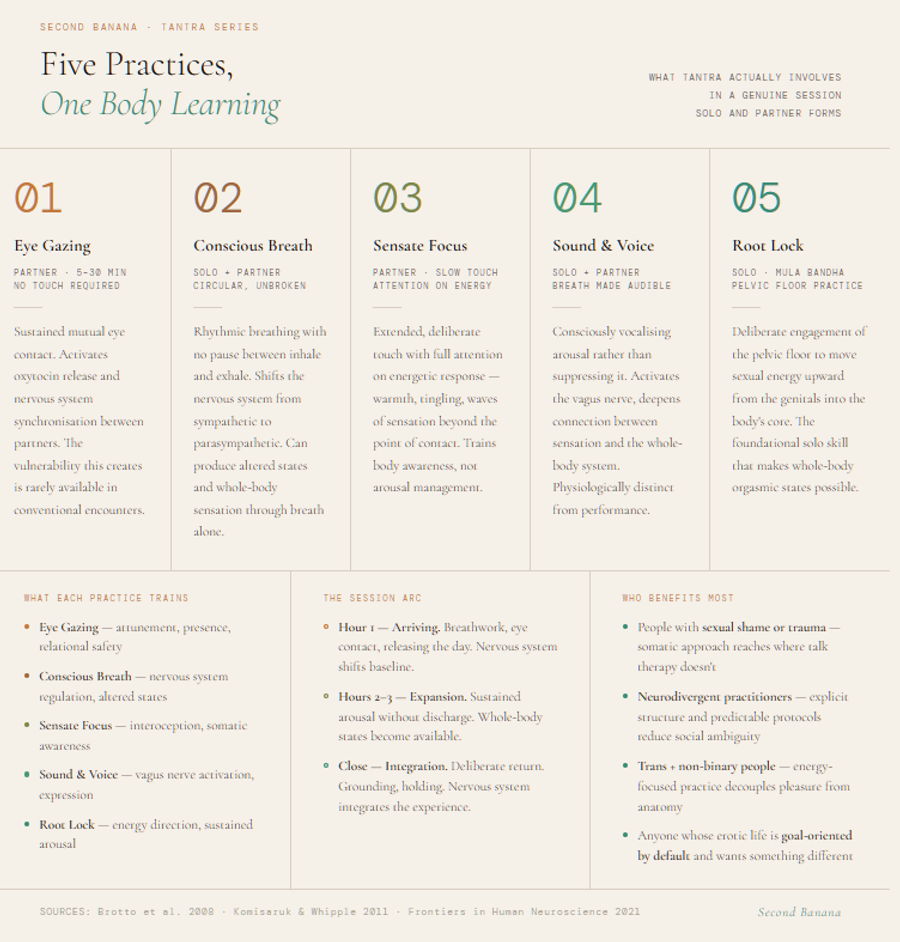
Solo tantric practice typically includes: conscious connected breathing done daily as a seated practice; deliberate self-pleasuring (“sexual meditation”) with attention on sensation rather than on reaching orgasm; pelvic floor practices (root lock, or mula bandha) that develop the ability to move sexual energy from the genitals into the wider body; and body scanning practices that develop interoceptive awareness of how energy moves through the system.
This is not as glamorous as the partner-practice imagery. It is also considerably more useful. The practitioner who has developed genuine internal capacity comes to partner practice from a fundamentally different place than one who has skipped this stage.
Partner Practice: What It Actually Looks Like
Partner tantric practice is best understood as a form of mutual attunement practice with an erotic dimension, rather than as an alternative form of sex.
The Role of Time
The single element that most distinguishes tantric sexual practice from conventional sex is time. A serious tantric session typically lasts several hours. This is not performance — it is the necessary minimum for the nervous system to complete the processes that the practice initiates.
The first hour of a tantric session is often spent arriving: becoming present, releasing the day’s accumulated sympathetic activation, synchronising with a partner, establishing the somatic baseline from which the deeper practice can unfold. This is the period that is most foreign to contemporary sexual culture and most resistant to the “just get to it” logic that modern sexuality often operates by.
The middle period — however long it runs — is when the distinctive states that tantra produces become available: sustained, whole-body arousal that doesn’t spike and discharge but expands and deepens; energetic experiences that move through the body in ways that feel less like the genitally-centred orgasm of conventional sex and more like a whole-body state that some practitioners describe as floating, luminous, or timeless.
The close of a session — which tantric tradition takes as seriously as its beginning — involves deliberate return: conscious breath, grounding, often extended holding or contact that allows the nervous system to integrate what it’s experienced before returning to ordinary state.
*Tantra doesn’t promise better orgasms. It offers a different relationship to time, attention, and the body — one in which pleasure is not a destination but a medium you learn to move through differently.*
What Tantra Is and Isn’t: Clearing the Field
Because tantra is so thoroughly distorted in popular representation, it’s worth being direct about what it is and is not.
What Tantra Is Not
- It is not a technique for making sex last longer in the conventional performance sense
- It is not exclusively heterosexual or built around masculine/feminine polarity — these are elements of some classical and neo-tantric traditions, not of the practice as a whole
- It is not safe for bypassing trauma without professional support — somatic practices that open nervous system experience can surface material that benefits from therapeutic holding
- It is not a spiritual requirement — many people practise tantric techniques in an entirely secular context with genuine benefit and without adopting the cosmological framework
- It is not passive or gentle by default — tantric tradition includes fierce, intense, and powerful practices; the association with softness and slowness is partly accurate and partly a neo-tantric aesthetic preference
What Tantra Is
- A set of practices for developing sustained, present, embodied attention to erotic experience
- A physiological training system for expanding the nervous system’s capacity for pleasure beyond its habitual range
- A genuine healing modality for people carrying somatic sequelae of sexual shame, trauma, or disconnection
- A framework for understanding erotic energy as something that can be cultivated, directed, and transformed rather than simply managed
- A practice that takes time, training, and genuine effort — not a shortcut, but a path
Why Second Banana Was Built for This
Tantric practice requires something that most dating and connection platforms are singularly bad at facilitating: the ability to communicate, before meeting, about what kind of erotic and relational experience you’re actually looking for.
The person who wants a conventional hookup and the person who wants a three-hour tantric session are not simply at different points on the same spectrum. They are looking for categorically different experiences that require different preparation, different time allocation, different emotional and physical availability. Discovering this mismatch after meeting is not just inefficient — it’s the source of the kind of disappointment and disconnection that sends people back to square one.
The tag system gives tantric practitioners the vocabulary to represent their actual orientation before the conversation starts. Tags like “tantra,” “slow sex,” “somatic,” “energetic connection,” “kundalini,” “breathwork,” “sacred sexuality” — these signal an orientation that the right person will immediately recognise and the wrong person will immediately self-select out of. This is efficient. It is also kind.
The post-first, photo-second structure is particularly well-suited to tantric connection, because what makes someone a compatible tantric partner is almost entirely invisible in a photograph. It is in how they think about their body. It is in whether they have done the internal work. It is in how they write about what they’re looking for and what they can offer. The things that matter show up in language.
The anonymous posting model matters for tantric practitioners who may be navigating mainstream social contexts where their practice would be misunderstood. The ability to be fully honest about what you practise before determining whether a specific person is safe to be honest with is meaningful protection for anyone whose erotic life exists outside the default template.
The Practice Is Not What You’ve Been Sold
Somewhere between the ancient Sanskrit texts and the wellness-industry aesthetic, tantra acquired an image that does it a disservice: too soft, too spiritual, too precious, too far from the messy, embodied, specific reality of actual erotic lives.
The actual practice is demanding. It requires sustained attention and genuine effort. It produces states that are unfamiliar and sometimes overwhelming. It surfaces material — emotional, somatic, relational — that takes courage to meet.
It also produces, for the people who do the work, a relationship with their own body and their own erotic energy that most people never encounter. A capacity for pleasure that extends beyond what conventional sex typically offers. A form of presence with another person that is, in the truest sense of a much-abused word, intimate.
The rose petals are optional. The willingness to actually show up in your body is not.