
Responsive vs Spontaneous Desire: Why You’re Not Broken | Second Banana
You’re Not Broken.
You’re Responsive.
What Emily Nagoski’s research actually says about desire — and why it changes everything
The Conversation That Goes Nowhere
It usually starts the same way. One person in a relationship wants sex more than the other. The one who wants it more feels rejected, confused, occasionally resentful. The one who wants it less feels guilty, pressured, and — crucially — confused in a different direction: why don’t I want this more? Something must be wrong with me.
Or it starts differently: you’re single, you’re on a dating app, and you read profiles of people who seem to think about sex constantly, who are always in the mood, for whom desire appears to arrive unbidden and persistent like an uninvited houseguest who never leaves. And you think: I don’t work like that. Maybe I’m not actually a very sexual person. Maybe I should recalibrate what I’m looking for.
Or it starts in a therapist’s office, or a GP’s surgery, or a whispered conversation with a close friend: I just don’t really think about sex unless something gets me in the mood. Is that normal?
In all of these conversations, the same mistake is being made. It is a mistake about what desire actually is, how it works, and what the presence or absence of it in any given moment actually means. It is a mistake that causes a significant amount of unnecessary suffering. And it is a mistake that a substantial body of research — and one genuinely important book — has already corrected.
This piece is the correction.

The Model Everyone Has Been Using (And Why It’s Wrong)
The cultural model of sexual desire goes something like this: desire arises spontaneously, from within, unprompted by external circumstances. You feel it, you pursue it, you act on it. The presence of desire means you want sex. The absence of desire means you don’t. A high-desire person is highly sexual. A low-desire person is less sexual, or has a problem, or is in the wrong relationship, or is on the wrong medication, or needs to be fixed in some specific way that will restore the spontaneous wanting.
This model is not entirely wrong. It accurately describes one style of desire. It is approximately correct for a significant minority of people. The problem is that it has been treated as the only model — as the default against which every other experience of desire is measured and, almost always, found wanting.
The research tells a different story.
Where the Model Came From
The spontaneous desire model has its roots in early 20th century sex research, which was conducted primarily on male subjects and which treated male sexual response as the template for human sexual response generally. Helen Singer Kaplan’s influential 1970s model of the sexual response cycle — desire, arousal, orgasm — placed spontaneous desire at the start of the sequence: desire comes first, then arousal follows.
For a significant proportion of people, particularly those with penises, this sequencing is roughly accurate. Desire does tend to arrive without much prompting. It does tend to precede arousal rather than following from it. The model fits.
For a significant proportion of other people — disproportionately but not exclusively people with vulvas — the model doesn’t fit at all. Desire doesn’t arrive first. Arousal comes first, from the right context, the right touch, the right partner in the right moment, and desire follows in its wake. Wanting arises from the experience of being turned on, not before it.
This is not a dysfunction. It is a different — and, as it turns out, extremely common — architecture of desire.
Emily Nagoski and the Science of Desire Styles
Emily Nagoski is a sex educator and researcher whose 2015 book Come As You Are synthesised the available research on sexual desire into the most accessible and clinically useful framework that has yet appeared for a general audience. The book’s central contribution was naming and explaining the distinction between spontaneous and responsive desire in terms that non-researchers could actually use.
Nagoski’s framework draws on the work of Erick Janssen and John Bancroft at the Kinsey Institute, whose dual control model of sexual response forms the theoretical foundation for understanding why desire works the way it does.
The Dual Control Model: Accelerator and Brakes
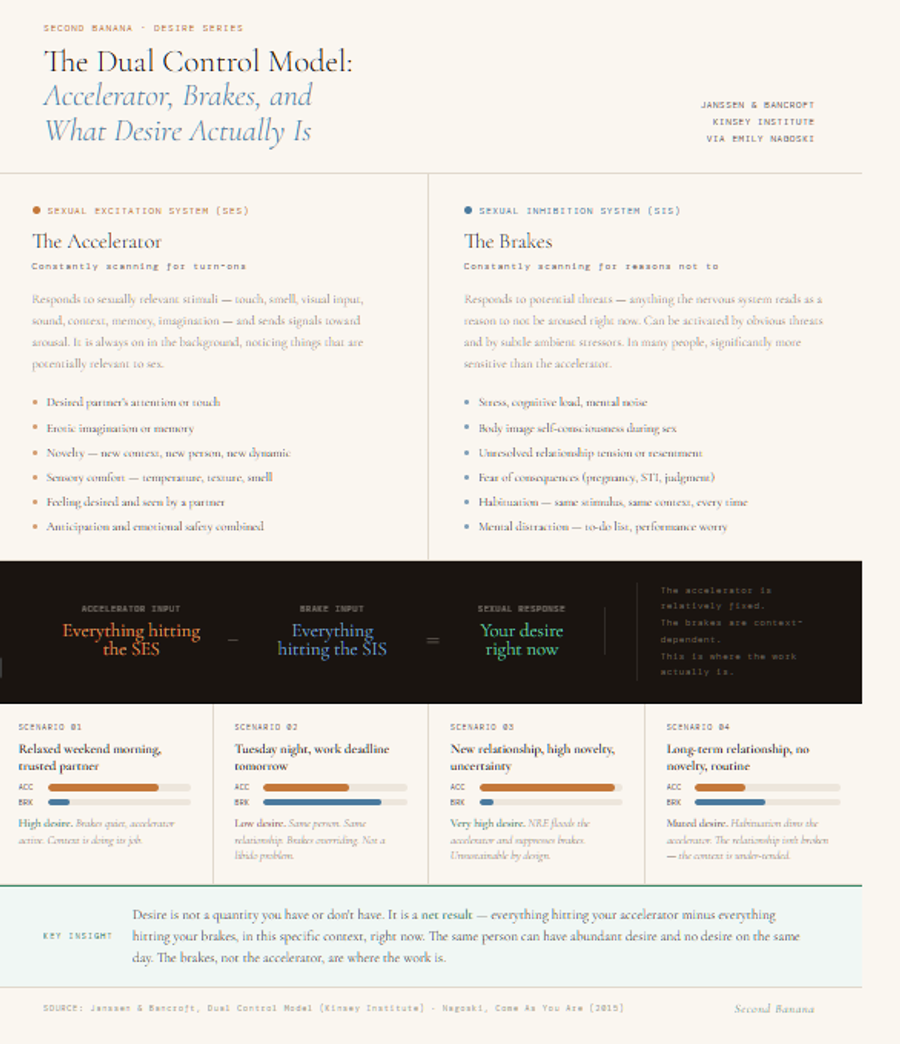
The dual control model proposes that sexual response is governed by two interacting systems: a Sexual Excitation System (SES) and a Sexual Inhibition System (SIS). Nagoski translates these, memorably, as the accelerator and the brakes.
The accelerator responds to sexually relevant stimuli — touch, visual input, smell, sound, context, imagination, memory — and sends signals toward sexual arousal. It is constantly scanning the environment for things that are potential turn-ons.
The brakes respond to potential threats — anything the nervous system reads as a reason not to be sexually aroused right now. This includes obvious things (stress, pain, feeling unsafe) and less obvious things (body image concerns, relationship tension, ambient worry about whether the children are asleep, the awareness that you haven’t replied to a work email). The brakes are also constantly scanning the environment, and they are, in many people, considerably more sensitive than the accelerator.
Sexual response, in this model, is not simply the presence or absence of stimulation. It is the net result of everything hitting the accelerator minus everything hitting the brakes. The same stimulus — a partner’s touch, say — can produce desire in one context and not in another, depending on what else is hitting the brakes at the same time. This is why the same person can be highly responsive on a relaxed weekend morning and completely unresponsive on a Tuesday night when they’re stressed about work, and why both of these responses are normal expressions of the same underlying system.
Spontaneous Desire: The Accelerator Fires First
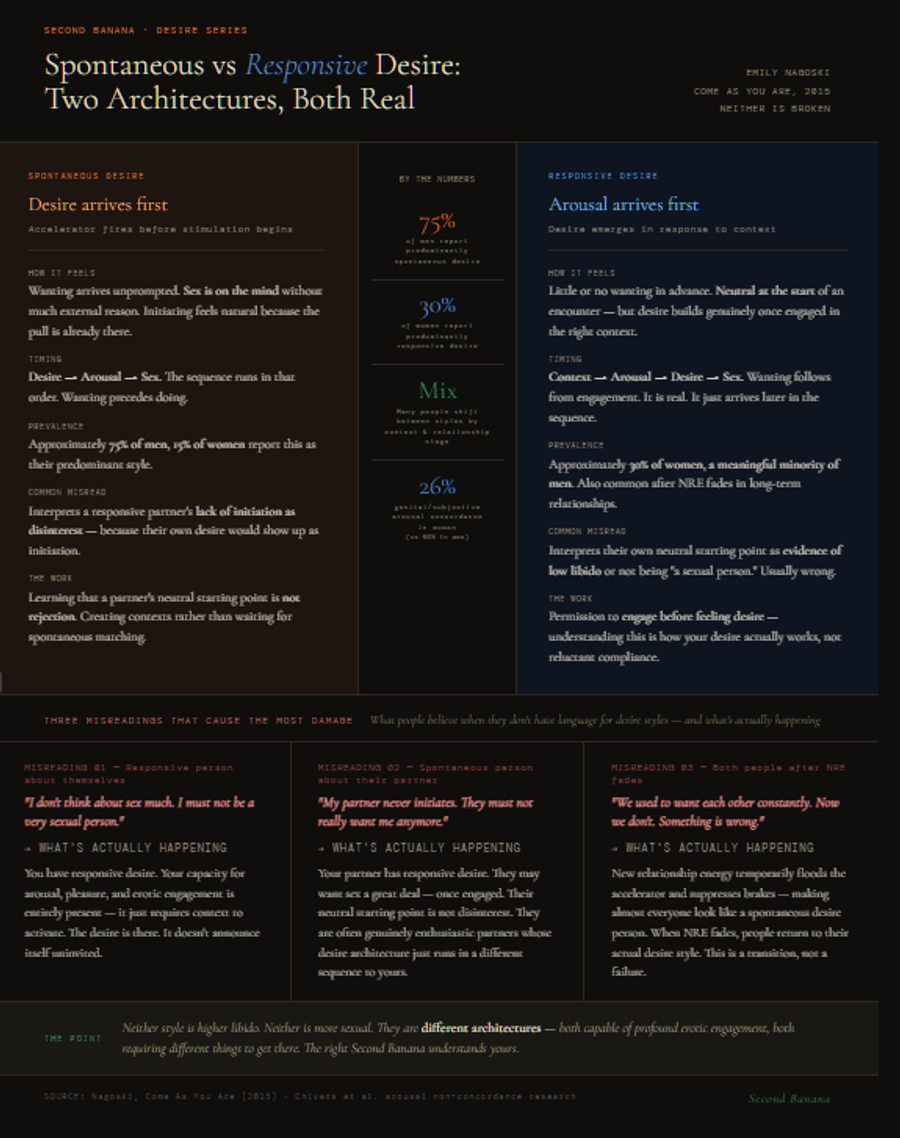
Spontaneous desire is what happens when the accelerator fires readily and the brakes are quiet. Desire arrives without much external prompting. The person notices they want sex — not because anything particular has happened, but because the excitation system is active and the inhibition system isn’t in the way.
People with predominantly spontaneous desire tend to think about sex regularly, to feel desire as a fairly constant background presence, and to initiate sex without much external context being required. This is the experience that most cultural narratives about desire describe. It is not the only experience, and it is not more ‘sexual’ than the alternative. It is a particular configuration of the two systems.
Research suggests spontaneous desire is more common in men than women — approximately 75% of men report predominantly spontaneous desire, compared to approximately 15% of women. But the variation within genders is substantial: a significant minority of men have predominantly responsive desire, and a significant minority of women have predominantly spontaneous desire. Gender is a predictor, not a determinant.
Responsive Desire: Arousal Before Wanting
Responsive desire is what happens when the excitation system responds to stimulation that is already occurring rather than firing in anticipation of it. The person doesn’t feel desire before sexual activity begins. They may feel neutral, or even mildly reluctant, when a partner initiates. But if they engage anyway — if the context is right, if the brakes aren’t overwhelming, if they give themselves permission to respond — arousal arrives, and desire follows from it.
This is not the same as reluctant compliance. This is not “I didn’t really want to but I went along with it.” Responsive desire, when it’s working as it should, produces genuine, enthusiastic wanting — it just produces it after engagement begins rather than before. The wanting is real. It’s just temporally organised differently from the spontaneous model.
Nagoski estimates that responsive desire is the predominant style for approximately 30% of women and a meaningful minority of men. A further substantial proportion of people experience a mix — spontaneous desire in some contexts or relationship stages, responsive desire in others. The idea that desire type is fixed and permanent is not supported by the evidence: the same person can shift between styles depending on relationship length, life circumstances, stress load, hormonal changes, and partner.
The Misreadings That Cause the Most Damage
The gap between how desire actually works and the cultural model of how it’s supposed to work produces several specific misreadings that cause a disproportionate amount of relational and personal suffering. These are worth naming precisely, because naming them is often the first step toward dissolving them.
Misreading 1: “I Don’t Want Sex, So I’m Not a Sexual Person”
This is the misreading that responsive desire people make about themselves. Because desire doesn’t arrive spontaneously, they conclude that they’re not very interested in sex, that something is missing, that their libido is low or broken or absent.
What’s actually happening is that they have a desire style that requires context to activate. The desire is there. The capacity for arousal, for pleasure, for profound erotic engagement is entirely present. It’s just not going to announce itself without an invitation. The mistake is evaluating the desire style as a quantity of desire rather than as an architecture of it.
The practical consequence of this misreading is enormous. People with responsive desire frequently avoid initiating sex because they don’t feel the pull toward it in advance, and they interpret their partners’ spontaneous initiations as evidence of a desire gap that probably can’t be bridged. They may be genuinely highly sexual people who have spent years believing they are not, because the desire they feel — which is real and sometimes intense — doesn’t look like the desire they’ve been told they should have.
Misreading 2: “My Partner Never Initiates, So They Don’t Really Want Me”
This is the misreading that spontaneous desire people make about responsive desire partners. Because they experience desire as a fairly constant pull, the absence of initiation from a partner reads as absence of desire. As rejection. As evidence that the partner has lost interest, has checked out of the relationship, is no longer attracted to them.
This misreading is particularly cruel because it is often the opposite of the truth. Responsive desire people frequently want sex a great deal — once it’s underway. They are often enthusiastic, present, genuinely engaged partners. They simply don’t feel the pull toward initiation in advance of it. Their desire is triggered by context rather than arising spontaneously, which means that from the outside — from the perspective of a spontaneous desire partner — they appear uninterested right up until the moment they are very interested.
The gap between these two experiences, when neither person has language for it, produces exactly the relational dynamic that sends couples to therapy convinced they have a compatibility problem. Often they don’t. They have a vocabulary problem.
Misreading 3: “I Used to Want It All the Time. Now I Don’t. Something Is Wrong.”
New relationship energy (NRE) — which we’ve written about elsewhere — is one of the most reliable desire accelerators known to neuroscience. The novelty, uncertainty, and intensity of early attraction hits the excitation system hard and typically suppresses the inhibition system in ways that even significant brakes can’t overcome. The result is that almost everyone, regardless of their underlying desire style, experiences something like spontaneous desire in the early stages of a relationship.
When NRE fades — as it always does, because it is neurochemically unsustainable — people return to their baseline desire style. For people with predominantly responsive desire, this means the spontaneous wanting that characterised the early months largely disappears. This is not a sign that the relationship has gone wrong. It is not evidence that they are no longer attracted to their partner. It is their actual desire style reasserting itself now that the NRE accelerator is no longer overriding everything else.
This is one of the most common and most damaging misreadings in long-term relationships, because it happens to almost every couple and is almost universally interpreted as a problem rather than a transition.
Arousal Non-Concordance: The Body Doesn’t Always Tell the Truth
Connected to but distinct from the spontaneous/responsive distinction is the phenomenon Nagoski calls arousal non-concordance: the frequent mismatch between genital response and subjective desire.
The research here is striking. Studies measuring both genital blood flow and subjective reports of arousal find that the two correspond reliably in men (approximately 66% concordance) and unreliably in women (approximately 26% concordance). This means that for people with vulvas, genital response — lubrication, engorgement — is a poor indicator of whether the person actually wants sexual activity. The body can respond genitally to sexually relevant stimuli without the person feeling desire, and can fail to respond genitally while the person feels strong subjective arousal.
This has two important implications.
The first is that genital response is not consent. A body that is genitally aroused has not consented to anything. Arousal is the nervous system recognising something as sexually relevant, not the person expressing a want. This is why sexual assault can produce involuntary physical response in victims — the body’s recognition system is not the person’s desire, and confusing the two has caused enormous harm.
The second is that the absence of genital response doesn’t mean desire is absent. A person can want sex, feel subjectively aroused and engaged, and not be genitally lubricated or engorged. Reading genital response as the measure of desire — “you’re not wet so you must not be into it” — is a category error that leaves a great deal of real desire unrecognised and a great deal of real pleasure unlubricatedly inaccessible.
The Brakes: What’s Actually Killing Your Desire
Understanding responsive desire and the dual control model reframes the question of “what do I do about low desire” entirely. The question is no longer “how do I turn up the accelerator?” It’s “what is hitting the brakes, and can any of it be removed or reduced?”
This is a more tractable question, and it has more tractable answers. The accelerator is relatively fixed. The brakes are context-dependent and often modifiable.
The Common Brakes
Research on the inhibition system has identified a fairly consistent set of brake-activators. They are worth listing not as a diagnostic checklist but as a map of the territory:
- Stress and cognitive load. The most consistent desire-killer in the research. The stressed brain is in threat-detection mode, and the inhibition system treats threat-detection mode as an extremely good reason not to be sexually aroused right now. Chronic stress doesn’t just reduce desire — it makes the brake system more sensitive overall, so that things that wouldn’t normally hit the brakes start to.
- Body image concerns. One of the most potent inhibitors for people of all genders but particularly women. Self-consciousness about physical appearance during sex activates the inhibition system directly — the person is monitoring their body as a potential source of threat rather than experiencing it as a source of pleasure. The monitoring and the pleasure are mutually exclusive.
- Relationship tension. Unresolved conflict, resentment, or disconnection from a partner is one of the most reliable brakes. The attachment system and the sexual system interact: feeling emotionally unsafe with a person typically makes the body reluctant to be sexually vulnerable with them.
- Fear of consequences. Unwanted pregnancy, STI transmission, partner reaction, social judgment. Any ambient worry about what sex might lead to hits the brakes.
- Habituation and predictability. The excitation system is novelty-sensitive. The same stimulus, repeated in the same context, produces diminishing response over time. Long-term relationships without intentional novelty tend to produce habituation that gradually quiets the accelerator without necessarily increasing the brakes — which can feel like desire declining when it’s actually the cost of familiarity.
- Mental distraction. Being unable to stay present during sex — mind wandering to the to-do list, to the argument you had yesterday, to whether you’re taking too long — is both a symptom of brake activation and a brake in itself. The person who is not present cannot respond to stimulation that’s occurring.
What Actually Helps
Given that responsive desire requires context to activate and that brakes are context-dependent, the interventions that actually help are not the ones that most people try. Trying harder to feel desire doesn’t work. Monitoring yourself for signs of desire doesn’t work — it adds a layer of self-consciousness that hits the brakes harder. Pressuring a responsive desire partner to initiate more doesn’t work — it adds the brake of performance anxiety on top of whatever else was already there.
What works is context. Specifically:
- Reducing known brakes before expecting desire to appear. Stress management, conflict resolution, body image work — these are not separate from the sex problem. They are the sex problem, or rather, they are the brakes that are making the sex problem look like a desire problem.
- Building erotic contexts rather than waiting for spontaneous wanting. For responsive desire people, the right context is the trigger — which means that intentionally creating contexts where desire is likely to emerge (sensory comfort, time, absence of ambient stressors, a partner who is present and attentive) is doing the actual work that waiting passively for desire does not do.
- Reframing initiation for responsive desire people. Agreeing to engage, to give yourself permission to respond, without the requirement that you feel desire first, is not compromising your desire — it is how your desire actually works. The desire arrives after engagement, not before. Acting on that knowledge is not reluctant compliance; it is working with your own architecture.
- Communicating desire style to partners, clearly and early. The spontaneous/responsive framework gives people language for a conversation that is otherwise conducted in misreadings. “I have responsive desire — I don’t tend to feel it in advance, but once we’re in the right context I’m genuinely very into it” is a sentence that can dissolve months of accumulated misunderstanding in a single conversation.
Desire Discrepancy: When You’re in the Same Relationship, Different Systems
Most long-term relationships involve some degree of desire discrepancy — one partner wanting sex more frequently or more spontaneously than the other. Research suggests this is the norm rather than the exception: a 2015 study found that the majority of couples in long-term relationships report some level of desire mismatch, and that desire discrepancy is one of the most common presenting issues in sex therapy.
The spontaneous/responsive framework doesn’t make desire discrepancy disappear. What it does is reframe it. Instead of a story about one partner being too sexual and the other not sexual enough — or one partner being in decline and the other holding steady — it becomes a story about two people with different desire architectures navigating a shared erotic life.
This reframe matters because it changes where the solution is sought. If the problem is one partner’s low desire, the solution is fixing that partner. If the problem is a mismatch between two different but equally valid desire styles, the solution is building a shared context that works for both — and that requires both people to understand how the other’s system works.
The Spontaneous Partner’s Work
For spontaneous desire partners, the work involves updating the model. Recognising that a responsive desire partner’s lack of initiation is not rejection. Understanding that the responsive partner’s neutrality at the start of an encounter can be genuine and can coexist with genuine enthusiasm once they’re engaged. Resisting the urge to read physical response — or its initial absence — as the measure of desire. Creating contexts where responsive desire has room to emerge, rather than pressuring for desire to appear spontaneously in advance of any context.
The Responsive Partner’s Work
For responsive desire partners, the work involves updating the story they tell about themselves. They are not low-libido, not broken, not insufficiently attracted to their partner. They have a desire style that requires context and engagement to activate, and the desire that emerges from that activation is real. The practical work is giving themselves permission to engage before feeling desire — understanding that desire is not a prerequisite for sex but a product of it, and that acting on that understanding is not compromising themselves but working with their own nature.
Why This Matters More Than Libido
The spontaneous/responsive distinction matters more than the conventional libido conversation because it shifts the unit of analysis from quantity to architecture. The libido conversation asks: how much desire do you have? The desire style conversation asks: how does your desire actually work?
These are very different questions with very different implications. A person can have abundant responsive desire and appear to have low libido when measured against the spontaneous model. A person can have spontaneous desire that arrives reliably but shallowly, producing frequent wanting but little depth of erotic engagement. Desire, like most things about human sexuality, is not one-dimensional.
What Nagoski’s work makes possible — and what the research it draws on supports — is a more honest and more useful conversation about what we actually want from our erotic lives, and what’s actually standing in the way of it. Not the absence of desire, in most cases. The presence of brakes. And brakes, unlike libido, are workable.
Why Second Banana Was Built for This Conversation
Second Banana’s post-first model is, structurally, a context-creation tool. When you write about what you’re looking for — your desires, your style, your needs in an erotic encounter — you are building the context in which responsive desire can emerge, before you’ve met anyone. You are telling potential partners how your desire actually works, so that they can meet it where it is rather than expecting something it isn’t.
The tag system extends this. Tags like “context-dependent,” “slow burn,” “needs warmup,” “responsive desire” — these communicate desire architecture before the first message. They let responsive desire people find partners who understand what that means and won’t interpret it as disinterest. They let spontaneous desire people know what to expect and how to create the conditions where a responsive partner can actually show up fully.
The right Second Banana isn’t the person who wants you to feel desire on their schedule. It’s the person who wants to build the context where you actually do.
The Thing You Were Never Told
You were never told that desire comes in different styles because the culture has only really acknowledged one of them. You were never told that the absence of spontaneous wanting is not the same as the absence of desire, because the model in circulation can’t hold that distinction. You were never told that the brakes are where the work is, because the entire conversation has been about the accelerator.
Here is what is actually true: if you have ever been turned on by something that happened — a touch, a look, a particular afternoon, a moment when everything was right — you have desire. It may not announce itself unprompted. It may require context to emerge. It may have been sitting quietly under years of accumulated brake pressure, waiting for conditions that rarely arrived.
That desire is not gone. It is not broken. It is responsive, and it is yours, and the right context will find it.
That context is what we’re here to help you build. You've Found Family. With Second Banana 🍌