The Butt: An Appreciation, a Guide, and a Very Good Case for Reconsidering | Second Banana
The Butt:
An Appreciation, a Guide, and a Very Good Case for Reconsidering
Let’s Start With the Thing Everyone Is Thinking
There is a moment in the life of almost every adult where someone — a partner, a piece of erotic writing, an increasingly candid conversation at a dinner party — raises the topic of anal play, and they have a reaction. The reaction varies. Some people are immediately interested. Some are immediately not. Some are immediately interested and immediately pretending to be not.
What almost nobody does in that moment is think: I wonder what the actual anatomy is here. I wonder what the nerve distribution looks like and why the body organised itself this way. I wonder whether the feeling I have about this is based on accurate information or on a cultural transmission of squeamishness that has nothing to do with whether this would, actually, feel good.
This piece is for the people who are willing to have that second set of thoughts.
It is not a piece about kink hierarchy or what “counts” or what you should want. It’s a piece about what the body is actually doing back there, why it does it, what the research says about pleasure and safety and the various configurations in which people enjoy this particular portion of themselves and their partners, and — because this is Second Banana and we don’t shy away from the specific — a section on all-day plug wear for people with ADHD and AuDHD who have discovered something interesting about nervous system regulation that the clinical literature is only beginning to catch up to.
We’ll start with the anatomy, because the anatomy is genuinely interesting and because almost everything that matters follows from it.
The Anatomy: More Going On Than You Probably Think
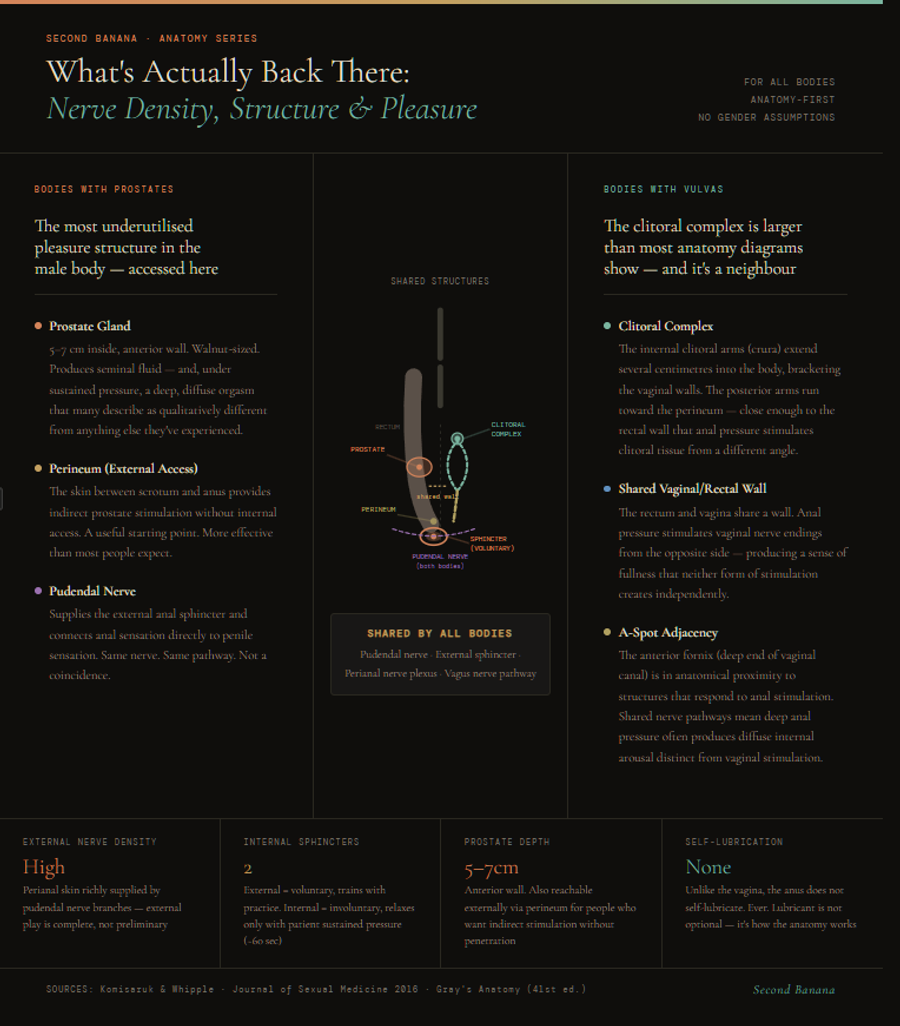
The anus and the surrounding tissue are, from a neurological standpoint, one of the more generously innervated regions of the human body. The pudendal nerve — the same nerve responsible for genital sensation — supplies the external anal sphincter and the perianal skin. The perineal branch of this nerve connects anal sensation to clitoral and penile sensation through shared pathways. The pelvic splanchnic nerves provide parasympathetic innervation to the internal structures. The hypogastric nerve provides sympathetic innervation. The vagus nerve, in some individuals, has been documented reaching the cervix and beyond — which is part of why, for some people with uteruses, anal stimulation produces sensations that feel deep, diffuse, and internally resonant in ways that are anatomically distinct from other kinds of touch.
The upshot of all this nerve traffic is simple: the anal region, including the external sphincter, the perianal skin, and the internal structures accessible through it, has the neurological infrastructure for significant pleasure. This is not a design quirk. The body did not accidentally put a high-density nerve cluster somewhere inconvenient. It is there because that’s where it is useful.
The External Anal Sphincter and Perianal Skin
The external anal sphincter is under voluntary control — unlike the internal sphincter, which is smooth muscle and operates involuntarily. This matters for anal play because voluntary muscle can be trained, consciously relaxed, and engaged with intention. The perianal skin — the area immediately surrounding the anus — is rich in nerve endings and highly responsive to light touch, pressure, temperature, and vibration.
External anal stimulation — without any penetration — is a complete erotic practice in its own right for many people. Rimming (oral stimulation of the anus), external massage, vibration, and temperature play can all be intensely pleasurable without anything entering the body. This is worth stating explicitly because the cultural conversation about anal play tends to skip straight to penetration, which means people miss what is, for many, the most reliably enjoyable part.
For People With Prostates
The prostate gland sits approximately 5–7 centimetres inside the rectum on the anterior wall — the wall facing the front of the body, toward the navel. It is a walnut-sized gland whose primary biological function is producing seminal fluid, but whose secondary — and, from a pleasure standpoint, considerably more interesting — function is being extremely sensitive to pressure.
Prostate stimulation produces a sensation that most people who have experienced it describe as distinct from other kinds of orgasm: deeper, more diffuse, sometimes described as a “full” or “warm” sensation that builds slowly and, when it peaks, involves the whole pelvic region rather than concentrating in the penis. Some people experience prostate orgasm without penile stimulation at all. Some experience both simultaneously and describe the combination as qualitatively different from either alone.
The prostate can be stimulated externally through the perineum — the area of skin between the scrotum and the anus — without any internal access. Perineal massage produces indirect prostate stimulation and is, for people who are curious but not yet ready for internal exploration, a useful and pleasurable place to start.
A 2016 review in the Journal of Sexual Medicine examining prostate stimulation found consistent reports of enhanced orgasmic intensity in men who included prostate stimulation, with a significant subset reporting orgasms they described as qualitatively superior to those without it. The researchers concluded that prostate stimulation represents an underutilised component of male sexual experience — underutilised primarily due to cultural factors rather than physiological ones. The anatomy has been there the whole time.
For People Without Prostates
The clitoris is considerably larger than most anatomy diagrams suggest. The external glans — the visible part — is the tip of a wishbone-shaped internal structure whose arms (crura) extend several centimetres into the body on either side of the vaginal canal, and whose bulbs bracket the vaginal walls. The posterior arms of the clitoral complex run along the vaginal walls toward the perineum and, importantly, toward the posterior vaginal wall in the vicinity of the rectum.
This is why anal penetration can produce what feels like vaginal or deep internal clitoral stimulation for people with vulvas: the clitoral complex is adjacent to the rectal wall, and pressure through it can stimulate clitoral tissue from a different angle than vaginal penetration does. The A-spot — the anterior fornix erogenous zone, located at the deep end of the vaginal canal near the cervix — is also in anatomical proximity to structures that respond to anal stimulation, and the shared nerve pathways mean that for many people, anal play produces a diffuse, deep arousal that feels different from but complementary to other kinds of internal stimulation.
Additionally, the rectum and vagina share a wall. For people with both, anal pressure can stimulate vaginal nerve endings from the opposite side. Some people find this produces a sensation of fullness and arousal that neither vaginal nor anal stimulation produces independently. The anatomical fact here is simply that these structures are neighbours, and neighbours sometimes affect each other.
Safety: The Part That Is Actually Simple Once You Know It
The safety basics of anal play are not complicated, but they do matter — and because the cultural conversation about this tends to skip them in favour of either squeamishness or bravado, a lot of people learn them slowly or badly. Here is the actual list.
Lubrication Is Not Optional
The anus, unlike the vagina, does not self-lubricate. Ever. Under any circumstances. This is not a failure; it’s anatomy. The rectal lining is delicate — thinner and less elastic than vaginal tissue — and friction without adequate lubrication can cause microtears that are uncomfortable and that increase infection risk. Use lubricant. Use more than you think you need. Use it on both the toy or finger and the external tissue. Reapply. Silicone-based lubricant lasts longer than water-based for most applications, but is incompatible with silicone toys (it degrades the material). Water-based works with everything.
Slow Is Not a Preference; It’s a Mechanism
The external anal sphincter can be consciously relaxed. The internal sphincter cannot. The internal sphincter relaxes reflexively in response to sustained, gentle pressure — it takes approximately 30–60 seconds of patient, consistent contact to do so. Rushing this does not work, produces discomfort, and is the primary reason people have negative first experiences. Slow, steady external pressure followed by gradual, patient progression is not a stylistic preference — it’s working with the physiology rather than against it.
The Flared Base Rule
The rectum does not have a natural stopping point the way the vagina does. Objects without a flared base or retrieval mechanism that are inserted anally can migrate internally. This is a medical situation. Every toy used anally must have a flared base wider than the widest part of the toy, a loop, or a string. This is non-negotiable. It is also why anal-specific toys exist as a category: they are designed with this requirement in mind. A toy that doesn’t specify it’s safe for anal use almost certainly isn’t.
Cleanliness: The Reality vs the Anxiety
The rectum, when not actively processing a bowel movement, contains very little fecal matter. Most people’s experience with anal play does not involve significant mess, particularly with a recent bowel movement and a brief external rinse. Douching (rectal irrigation) is widely used by people who want additional reassurance, but is not medically necessary for anal play and, if done excessively or with improper equipment, can disrupt the rectal microbiome and irritate the mucosal lining. A light external rinse and the knowledge that your own body is not actually that alarming covers most situations.
How People Actually Enjoy This: Configurations Worth Knowing
Anal play is not one thing. The range of activities that fall under the umbrella is broad, and different configurations suit different people, different bodies, and different contexts. The following is a practical map rather than a prescriptive menu.
External Only
Rimming, perineal massage, and external vibration are complete practices for a significant number of people. The nerve density of the perianal skin makes external stimulation intensely pleasurable without any penetration, and for people who are exploring or who simply prefer external sensation, this is not a consolation prize. It is, for many, the main event.
Fingers: The Underrated Starting Point
A well-lubricated finger is the most anatomically sensitive and controllable introduction to internal anal stimulation. Fingers can feel the internal sphincter relax in real time, can apply exactly the right pressure in exactly the right direction, and can reach the prostate or the posterior vaginal wall with a curved motion that most entry-level toys can’t replicate. If you are new to this and considering jumping straight to a toy: a finger first is not the beginner option, it’s the best option.
Plugs: Fullness, Presence, and the Pleasure of Staying Put
Butt plugs are designed not for thrusting but for wearing — for the sustained sensation of fullness and gentle internal pressure that comes from a toy that sits in place. The pleasure they produce is different from other kinds of stimulation: less acute, more ambient, a background sense of presence and pressure that for many people produces low-level continuous arousal, a feeling of being gently occupied, and — particularly with plugs that reach the prostate or press against the posterior vaginal wall — a diffuse internal sensitivity that enhances other stimulation considerably.
Plugs are worn during masturbation, during partner sex, and — as we’ll get to in some detail — during ordinary daily life by people who have discovered that the sustained sensory input has effects that go considerably beyond the erotic.
Prostate Massagers and Curved Toys
Toys specifically designed for prostate stimulation are curved to reach the anterior rectal wall without requiring awkward angles or sustained manual pressure. The best of them produce direct prostate contact that, with time and relaxation, can produce orgasm without any penile stimulation — the so-called “hands-free” prostate orgasm that has its own substantial enthusiast literature and that represents, for the people who experience it, a genuinely novel kind of sexual experience rather than a variation on a familiar one.
All-Day Plug Wear, ADHD, and the Nervous System: The Section You Didn’t Know You Needed
Here is something that circulates in ADHD and AuDHD communities with considerable consistency, has been largely ignored by clinical research, and deserves an honest account: a significant number of people with ADHD and autism spectrum traits have discovered that wearing a butt plug for extended periods — hours at a time, sometimes throughout a working day — has a regulatory effect on their nervous system that is distinct from, and in some cases superior to, other forms of sensory input they’ve tried.
This is not as strange as it might initially sound. Once you understand both the neuroscience of ADHD and the neuroscience of sustained anal stimulation, the overlap is almost predictable.
The ADHD Nervous System and Sensory Seeking
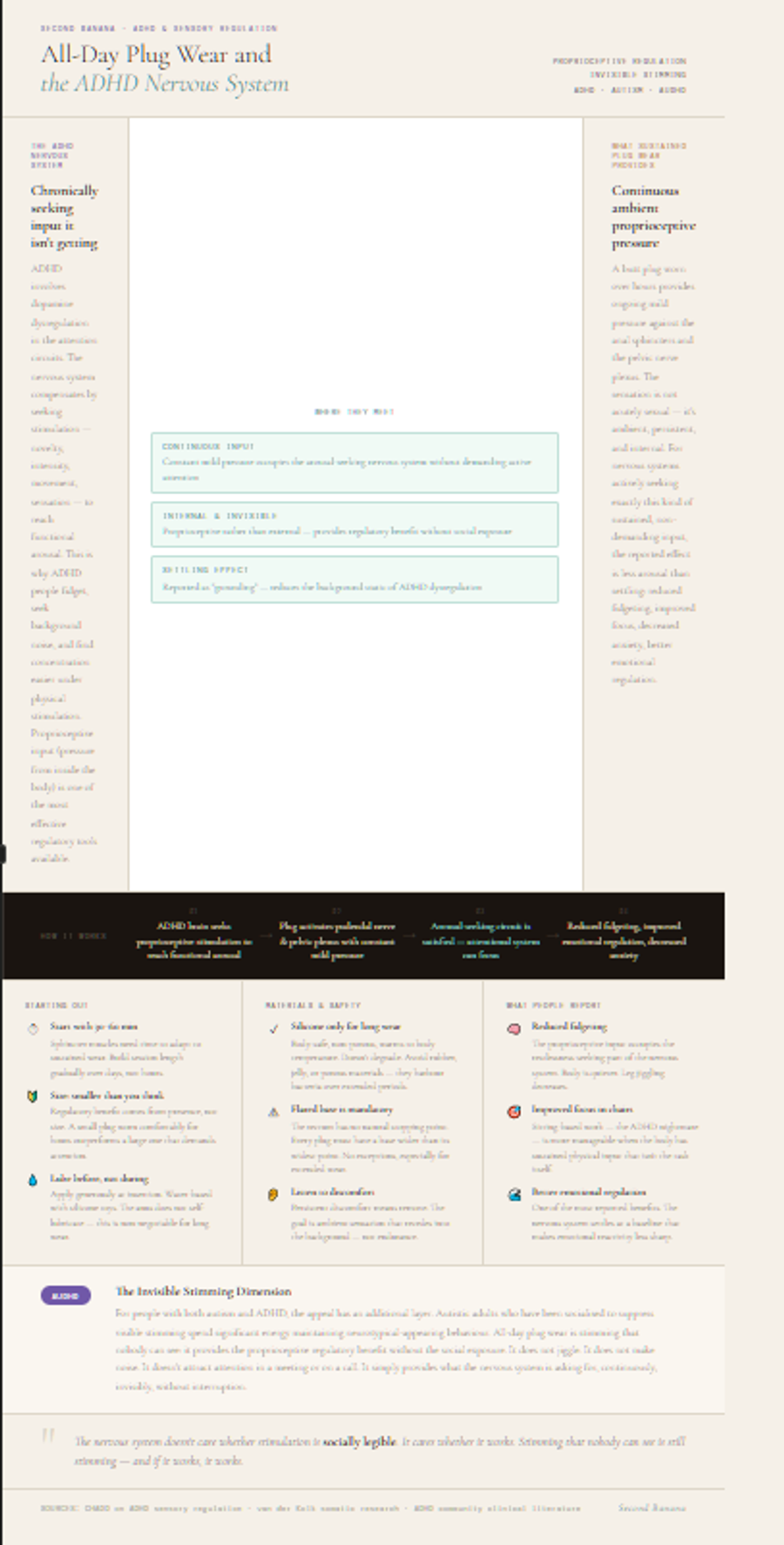
ADHD is not simply a deficit of attention. It is a difference in how the nervous system regulates arousal, maintains alertness, and responds to stimulation. The ADHD brain chronically underproduces dopamine in the circuits responsible for sustained attention and executive function, and compensates by seeking stimulation — novelty, intensity, movement, sensation — that will temporarily correct this deficit.
This is why ADHD is strongly associated with sensation seeking, with fidgeting, with the need for background noise or stimulation to concentrate, with hyperfocus on intensely engaging tasks. The nervous system is trying to get itself to a level of arousal where normal function is possible. Most of the strategies it uses are either socially visible (fidgeting, leg jiggling, pacing) or require active management (choosing the right music, timing tasks around interest cycles).
Proprioceptive and interoceptive stimulation — sensory input from inside the body — is one of the most effective regulatory tools for the ADHD nervous system. Deep pressure, weighted blankets, tight clothing, and physical compression all work through this mechanism: they provide continuous, non-demanding sensory input that occupies the arousal-seeking part of the nervous system at a level that allows the attentional part to focus on something else. This is the mechanism behind sensory tools, proprioceptive vests, and the well-documented phenomenon of ADHD people being able to concentrate far better while experiencing physical discomfort or stimulation than in comfortable, under-stimulating environments.
What a Plug Does, Neurologically
A butt plug, when worn, provides continuous mild pressure against the internal and external anal sphincters, the perianal nerve plexus, and — depending on design — the prostate or posterior vaginal wall. This pressure activates the pudendal nerve and, through it, the broader pelvic nerve network. The sensation is not acutely sexual in the way that active stimulation is; it is ambient, persistent, and — critically — it is internal, proprioceptive, and constant.
For people whose nervous systems are seeking exactly this kind of sustained, non-demanding input, the effect is often described not as arousal but as something more like settling. The background static of ADHD dysregulation — the restlessness, the difficulty staying present, the hyperstimulated-yet-bored quality of the underregulated ADHD nervous system — gets quieted by sensory input that is sufficiently present to register without demanding active processing.
People in ADHD and AuDHD communities who use plug wear for regulation describe effects including: reduced fidgeting, improved ability to stay in a chair and focus, decreased anxiety, a sense of being “groundd in their body” that ADHD often disrupts, and — notably — improved emotional regulation, which is one of the most debilitating and least-discussed dimensions of ADHD. Several describe it as more effective, for work contexts specifically, than stimulant medication alone.

The AuDHD Dimension
For people with both autism spectrum traits and ADHD (AuDHD — a combination that is considerably more common than either alone, given the high genetic overlap between autism and ADHD), the sensory regulation dimension is particularly significant. Autistic people are frequently engaged in active sensory management throughout their days: masking sensory hypersensitivity, managing sensory-seeking impulses in social contexts, maintaining the appearance of neurotypical sensory behaviour at significant energetic cost.
Stimming — self-stimulatory behaviour that provides sensory input and supports nervous system regulation — is a core autistic strategy that is persistently pathologised and suppressed in conventional settings. For autistic adults who have been socialised to suppress visible stimming, the appeal of stimming behaviour that is entirely internal and invisible — that provides the regulatory benefit without the social exposure — is practical and real. A plug does not jiggle visibly. It does not make noise. It does not attract attention in a meeting. It simply provides the proprioceptive input that the nervous system is asking for, continuously, without interruption.
Practical Notes for People Interested in This
If this is something you’re considering for regulatory purposes rather than exclusively erotic ones, a few practical points:
- Start small and work up slowly. The sphincter muscles need time to adapt to sustained wear. Beginning with short sessions — 30 minutes to an hour — and gradually extending over days or weeks prevents soreness and allows the body to find its equilibrium.
- Silicone is the material of choice for long wear. It’s body-safe, non-porous, warms to body temperature, and doesn’t degrade with extended use. Avoid porous materials like rubber or jelly, which can harbour bacteria over long wear periods.
- Lubrication is even more important for extended wear than for play. Reapplication before starting a long session — and water-based lubricant with a silicone toy — keeps tissue comfortable over several hours.
- The flared base requirement is especially critical for long wear, since you’re not maintaining constant attention to the toy’s position. A properly designed plug with a base wider than the widest point of the toy is mandatory, not optional.
- Listen to the body’s signals. Discomfort that persists is a signal to remove the toy. The goal is ambient sensation, not endurance. Some days the nervous system wants this; some days it doesn’t. Both are fine.
- The erotic dimension doesn’t disappear just because the context is regulatory. This is worth acknowledging rather than managing anxiously. Extended plug wear is, for most people, mildly arousing at some level. For some, that mild background arousal is part of what makes the day feel more alive. For others, it’s background. Either relationship to it is valid and worth being honest with yourself about.
Stimming that nobody can see is still stimming. If it works, it works.
The Thing About the Butt
Here is what is true: the anus is one of the most innervated regions of the human body. It shares nerve pathways with the genitals. It is, for people with prostates, the most direct route to the most significant and underutilised pleasure structure in the male body. It is, for people without prostates, a source of diffuse internal stimulation that the clitoral complex makes available through shared anatomy. It provides, for people whose nervous systems are seeking proprioceptive input, a kind of continuous regulatory grounding that is efficient, invisible, and effective.
What it is not is inherently transgressive, inherently kinky, inherently about any gender or orientation, or inherently anything except an anatomical region that most people have been culturally discouraged from paying attention to.
The cultural story about the butt — that it is dirty, that it is shameful, that it is for particular kinds of people in particular kinds of relationships — has very little to do with the body’s actual organisation. The nerve endings are there. The prostate is there. The clitoral complex is adjacent. The pudendal nerve does not care about the cultural story.
Find someone who’s curious in the same direction as you. Tell them specifically what you want to try. Make a lot of room for laughter, which is the correct response to the occasional awkwardness of being a body. The butt will reward your attention.
Every body. Every pleasure. Every possibility. Second Banana 🍌