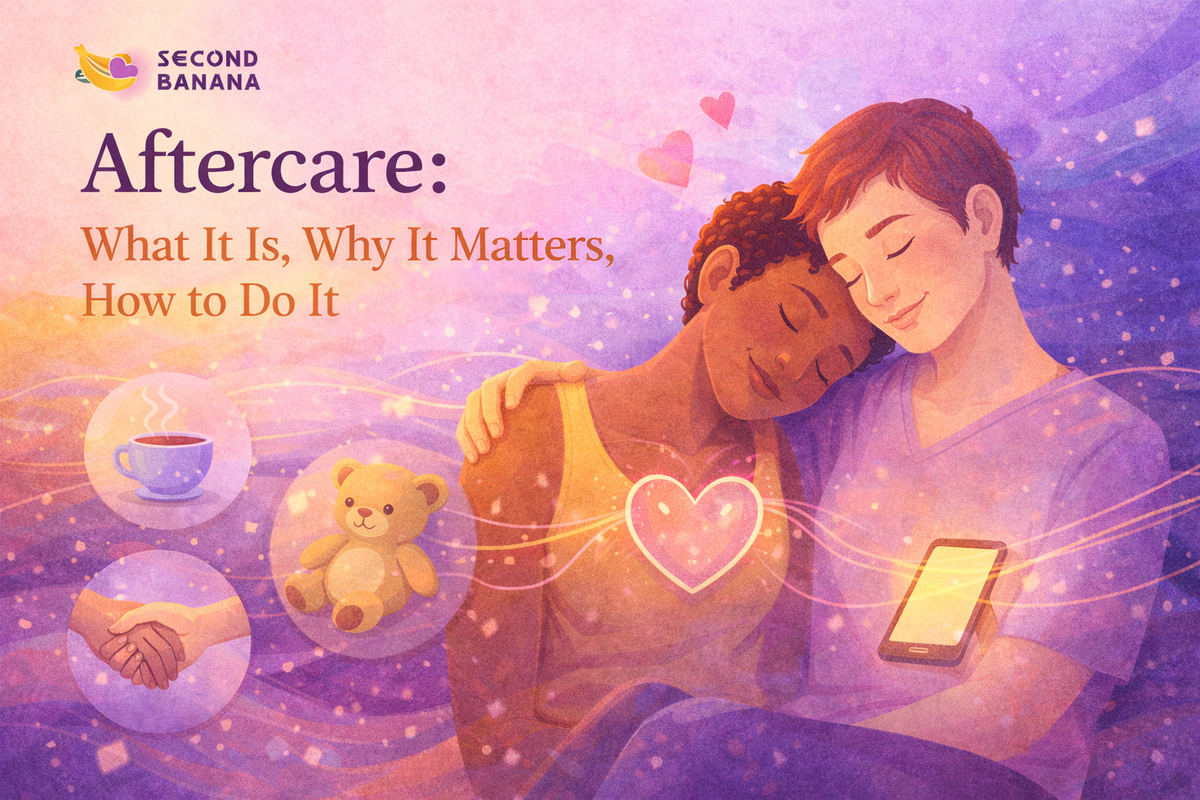
Aftercare: What It Is, Why It Matters, How to Do It | Second Banana
Aftercare:
The Most Intimate Part of Any Encounter Nobody Talks About
After the Fireworks
The scene ends. Or the sex ends. Or whatever you want to call the primary event — the thing you negotiated, the thing you showed up for, the thing that required trust and specificity and presence — it's over. And now there's a moment.
For some people, that moment is fine. They feel good. They feel themselves. They might want a glass of water and a laugh and then to get on with the evening. For other people, that moment is something else entirely: a sudden emotional vulnerability that arrived without warning, a physical trembling that has nothing to do with cold, a heaviness or a strange flatness or, occasionally, tears that feel weirdly disconnected from anything that actually happened.
Both of these are normal. The space after an intense or intimate encounter — particularly one involving significant power exchange, intense physical sensation, emotional exposure, or any combination of the above — is a physiological and psychological event in its own right. The body and mind have been somewhere. Coming back requires care.
Aftercare is that care. It is the practices, agreements, and attention that help both (or all) people in an encounter land safely after it ends. It is consent extended into the aftermath. It is the part of the experience that mainstream sexual culture almost never acknowledges — and that the kink community, which developed the concept out of hard-won practical necessity, understands better than almost anyone.
This piece is the full picture: what aftercare is, why it matters neurologically and emotionally, what drop is and why it happens, what people actually need (which varies enormously), how to negotiate it, and what it looks like in the kinds of specific, intentional connections that Second Banana facilitates.
What Aftercare Actually Is
Aftercare is, at its most basic, the care that happens after an intimate or intense encounter. In kink and BDSM communities where the term originated, it specifically refers to the period following a scene — the physical and emotional tending that helps participants transition from the heightened state of play back to ordinary baseline.
But aftercare is not only for kink. Any encounter that involves significant vulnerability — emotional exposure, physical intensity, power dynamics, first-time experiences, or simply a depth of connection that moves someone — can call for aftercare. The principles are the same whether the encounter was a rope bondage scene in a dungeon or a first sexual experience with someone new or an emotionally raw conversation that ended in sex.
The Physical Dimension
The body goes somewhere during intense sexual or kink experiences. Adrenaline spikes. Cortisol rises. Endorphins flood in. Heart rate elevates. Blood sugar shifts. In BDSM specifically, the neurochemistry can be dramatic: the endorphin release during pain play has been compared to a runner's high, and subspace — the altered, floaty state that many submissives report during deep scenes — involves a genuine neurochemical cascade that is real, measurable, and has a come-down.
Physically, aftercare addresses the body's needs in this transition: warmth (the body temperature often drops as adrenaline recedes), water and sometimes food (blood sugar regulation), physical contact if desired (which activates oxytocin and supports emotional grounding), and simply rest. None of this is complicated. All of it matters.
The Emotional Dimension
The emotional needs after an intense encounter can be considerably more complex than the physical ones, and considerably harder to predict in advance. An encounter that involves power exchange, vulnerability, deep trust, or emotional exposure activates parts of the self that don't necessarily pack themselves back up neatly when the scene ends.
People report a wide range of post-encounter emotional states: euphoria, tenderness, a craving for closeness and reassurance, a need for quiet and space, unexpected sadness, giddiness, disorientation, a sense of having been profoundly seen or of having revealed something that now needs to be acknowledged. None of these are problems. All of them are information about what the person needs in the aftermath.
Good aftercare meets the person where they actually are rather than where you expected them to be. Which means the first requirement of aftercare is paying attention.
Drop: When It Hits After You've Left
Drop is one of the most important things to understand about the aftermath of intense encounters — and one of the least discussed outside kink communities.
Sub drop (and its less commonly discussed counterpart, dom drop) refers to a crash in mood, energy, or emotional wellbeing that can occur hours or even days after an intense scene. The neurochemical explanation is relatively straightforward: the body produces extraordinary quantities of stress hormones and pleasure neurochemicals during intense play. When the scene ends and those chemicals metabolise, the system can overcorrect, leaving a person feeling flat, sad, irritable, anxious, or simply not themselves.
Sub drop can feel like a mild hangover, or it can feel like a significant depressive episode. It can arrive immediately after a scene or one to three days later — which is when it tends to be most confusing, because the connection to the scene is less obvious. Someone might spend Tuesday feeling genuinely wonderful after a Monday night encounter, and then wake up Wednesday feeling inexplicably terrible. This is drop. It has a cause. It passes.
Dom drop is real too, and rarer discussed. Dominant partners in a scene carry their own intense neurochemical load — the responsibility, the attention, the adrenaline of managing an intense experience for another person. When that responsibility releases, the dom can experience their own crash: a sense of flatness, a questioning of choices made, sometimes a disproportionate emotional response to small things. Aftercare is for dominants too, even if they are less likely to ask for it and less culturally supported in doing so.
Drop arrives when you least expect it — sometimes days later, when the connection to the scene is least obvious. Knowing it has a name, a cause, and an end is half the care.
The Aftercare Connection
Research on post-scene care in BDSM communities has found a consistent relationship: scenes that include thorough aftercare are associated with lower rates of drop and with higher rates of positive long-term responses to the experience. This isn't surprising once you understand the mechanism. Aftercare — physical warmth, reassurance, grounding contact, the explicit verbal acknowledgment that the scene is over and that both people are okay — helps the nervous system begin its regulated return to baseline. It doesn't eliminate drop, but it shortens it, softens it, and makes it less isolating.
The worst version of drop is the one that happens in private, without context, without anyone to check in with. The person who played hard on Saturday night and drove home alone and didn't hear from their partner on Sunday is the most vulnerable to the full force of drop with no support. This is why aftercare includes not just immediate post-scene care but also the agreement to check in later — a text on Sunday, a brief call the next day, some signal that the connection persists and that the person who was present with you during the intense thing is still present with you now.
What People Actually Need — Which Varies Enormously
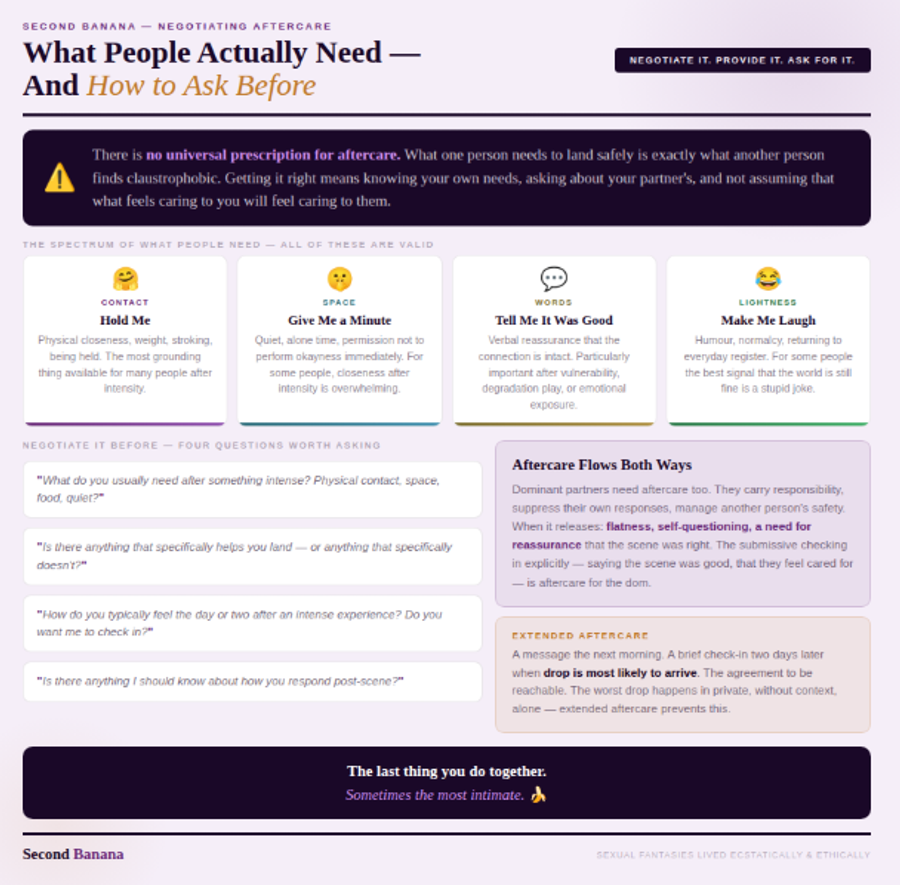
One of the important things to know about aftercare is that there is no universal prescription. What one person needs to land safely is exactly what another person finds claustrophobic. Getting aftercare right means knowing your own needs, asking about your partner's, and not assuming that what feels caring to you will feel caring to them.
Physical Needs
- Warmth: blankets, a warm shower, physical closeness — the body temperature drops as adrenaline recedes, and many people feel cold without expecting to
- Water: often urgently needed, especially after any physical intensity
- Food: blood sugar regulation, particularly after extended scenes — something simple and easy
- Physical contact: holding, stroking, having weight put on them, being held — for many people, this is the most grounding thing available; for others, physical touch after intensity can feel overwhelming
- Space: some people need the opposite of contact — a few minutes alone, quiet, the permission to not perform okayness immediately
Emotional and Relational Needs
- Verbal reassurance: hearing that the encounter was good, that the person is valued, that the connection is intact — this is particularly important after scenes involving degradation, vulnerability, or any dynamic in which someone's sense of self was engaged
- Being seen: a brief acknowledgment of what just happened, of what was shared, of the significance of the trust that was extended — not a long debrief necessarily, but some recognition that the encounter was real and mattered
- Lightness: for some people, the best aftercare is humour and normalcy — a good laugh, a stupid TV show, the return to everyday register as quickly as possible, as evidence that the world is still fine
- Processing space: for others, aftercare involves talking through the experience while it's still fresh — what worked, what surprised them, how they feel — not as a critique but as a way of integrating
- Time: some people need the physical and relational after-care to last an hour; others need five minutes and then they're genuinely ready to go
Extended Aftercare
For intense or particularly emotionally significant encounters, aftercare doesn't end when people part ways. Extended aftercare is the agreement to check in afterward — a message the next morning, a brief conversation two days later when drop is most likely to arrive. It is the extension of care beyond the immediate physical space of the encounter.
This matters especially in the kinds of connections Second Banana facilitates: often between people who know each other from specific written communication, who may not have a long established relationship, and where the encounter itself may have been significant precisely because it was specific and intentional. The person who wrote you a post about what they were looking for and who trusted you with the experience they described deserves to know, afterward, that they are still seen and valued as a person.
Negotiating Aftercare Before the Encounter
Aftercare should be negotiated before, not improvised after. This is one of the places where the BDSM community's practice is genuinely better than mainstream sexual culture's — in kink contexts, asking "what do you need after?" before a scene is entirely standard. In mainstream hookup culture, the question almost never gets asked.
It doesn't need to be a long conversation. It needs to be an honest one. Before an encounter, particularly one that involves power dynamics, physical intensity, or emotional exposure, the questions worth asking are:
- What do you usually need after something intense? Physical contact, space, food, quiet?
- Is there anything that specifically helps you land afterward, or anything that specifically doesn't help?
- How do you typically feel the day or two after an intense experience? Do you want me to check in?
- Is there anything I should know about how you respond post-scene?
These questions are not clinical. Asked with genuine curiosity, they are an expression of care — of the same quality of attention that makes the encounter itself feel safe and meaningful. They also protect both parties: knowing what someone needs means you can provide it, and knowing what you need means you can ask for it rather than hoping it arrives.
Second Banana's structure supports this. The conversations that happen before a connection — the messages that follow a specific post, the back-and-forth that establishes what both people are looking for — are the natural place to include aftercare in the negotiation. By the time two people meet who connected through Second Banana, they should already have some sense of what care looks like for each of them. That's not an accident of the platform. It's the point.
A Note on Both Sides of the Dynamic
Aftercare conversations in kink contexts tend to centre on the submissive partner's needs, which makes sense — the submissive role involves a particular kind of vulnerability that is recognised as requiring care. But dominant partners have aftercare needs too, and the cultural expectation that dominant partners are fine — that care flows in only one direction — is both inaccurate and unfair.
Dominant partners in intense scenes carry enormous responsibility. They hold the safety of another person. They make constant micro-decisions. They often suppress their own emotional responses in order to remain present and functional for their partner. When the scene ends and that responsibility releases, there can be a genuine crash. There can be a need for reassurance that the choices they made were right, that the person they played with is okay, that what happened was wanted and valued.
Dominant aftercare might look like the submissive partner checking in explicitly after — saying, out loud, that the scene was good, that they feel cared for, that the dom did well. It might look like a debrief that includes appreciation. It might just look like the submissive not immediately leaving — staying present, making the return to ordinary time a shared experience rather than an abrupt departure.
Neither role is exempt from needing care. And in the best encounters — the specific, intentional, well-negotiated ones that Second Banana is designed to facilitate — care flows in both directions, because both people showed up with their full humanity.

The Experience Doesn't End When It Ends
Mainstream culture treats sex as an event with a clear beginning and end. You arrive, things happen, you leave. The model doesn't leave much room for what comes after — for the physiological return to baseline, for the emotional integration, for the simple human need to be acknowledged and cared for in the aftermath of something that mattered.
The kink community figured this out through necessity. When encounters involve the kind of intensity that genuinely alters a person's neurochemical state and emotional landscape, the absence of aftercare has visible consequences. People leave feeling unmoored. Drop arrives unmuffled. The connection that was built with such care during the scene evaporates, and what remains is a strange kind of loneliness that makes the whole experience feel worse in retrospect than it felt in the moment.
Aftercare is the antidote to that loneliness. It is the acknowledgment that what happened between two people was real and significant and that both of them deserve to come back to themselves gently, with company.