Sexual Shame: Where It Comes From, What It Does, How It Ends | Second Banana
Sexual Shame:
Where It Comes From, What It Does,
How It Ends.
The neuroscience of desire’s oldest enemy — and the evidence that it’s not permanent
The Thing That Was There Before the Desire
Most people can remember the first time they felt it. Not desire — that arrives on its own schedule, without instruction. The shame. The heat in the face. The sudden certainty that whatever you just felt, or thought, or wanted, or did was wrong in a way that implicated not just your behaviour but your fundamental self. That you were not just doing something bad but being something bad.
It might have been a parent's reaction to a question. A religious teaching absorbed before you had the critical apparatus to question it. A partner's disgust, real or imagined. A joke at your expense about something you thought was private. The discovery that the thing you found arousing was something other people found laughable, or disturbing, or pitiable. The long cultural transmission of the idea that certain bodies, certain desires, certain configurations of wanting are acceptable and others are not — and that you, specifically, have ended up in the wrong category.
Sexual shame is one of the most common human experiences and one of the least discussed in any honest way. It shows up in almost every piece in this series — in the shame around squirting, around anal pleasure, around responsive desire, around neurodivergent sexuality, around the things people do quietly that they would never name in public. It has been the unspoken subject of every conversation about why people don’t ask for what they want, why they pretend to want what they don’t, why they shut down in exactly the moments that call for openness.
This is the piece that goes upstream. Where shame actually comes from. What it does to the body and the nervous system and the experience of desire. Why it is so resistant to the obvious interventions. And what the research suggests actually works to dissolve it — not manage it, not work around it, but genuinely loosen its grip.
Shame Is Not Guilt. The Distinction Matters Enormously.
Before the neuroscience, a conceptual distinction that changes everything: shame and guilt are not the same emotion, and the difference between them is not a matter of degree but of structure.
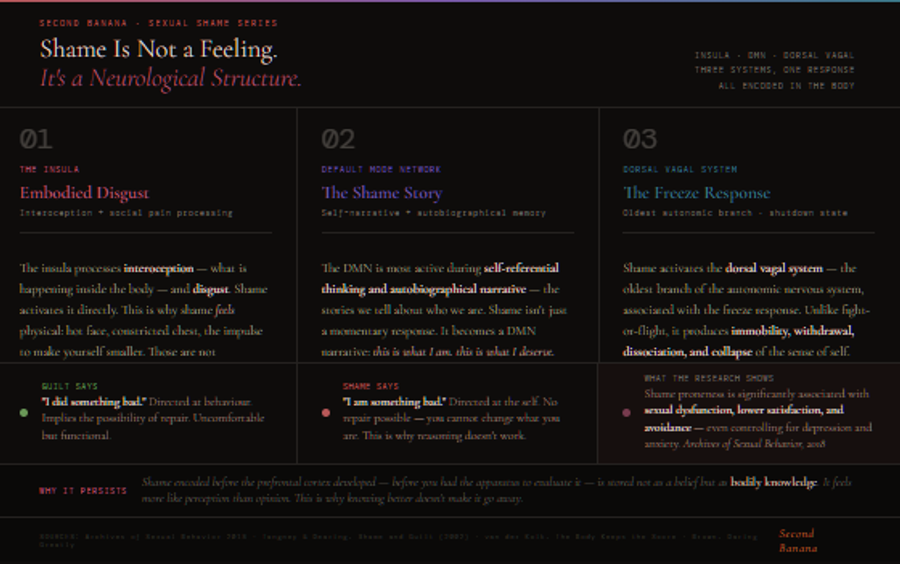
Guilt says: I did something bad. It is directed at a behaviour. It carries the implicit possibility of repair — of apologising, making amends, doing differently next time. Guilt is uncomfortable but it is functional. It is the conscience doing its job.
Shame says: I am something bad. It is directed at the self. It carries no implicit possibility of repair because there is nothing to repair — you are not a behaviour that can be changed, you are a person who is fundamentally defective. Shame is not the conscience doing its job. It is the self-concept collapsing.
This distinction, developed most influentially by researcher Brené Brown and grounded in the affect theory work of Silvan Tomkins, has significant practical implications. Guilt over a sexual behaviour can be addressed by examining the behaviour — was it actually harmful? to whom? what would have been better? Shame over a sexual desire, a sexual identity, or a sexual response cannot be addressed this way, because the desire is not a behaviour. You cannot change what you want by deciding it was wrong to want it. You can only make yourself smaller and more hidden.
Most sexual shame is shame rather than guilt. It is directed not at things people did but at things people want, feel, and are. Which is why the standard interventions — reason with yourself, decide to feel differently, just get over it — don’t work. You cannot think your way out of shame because shame is not a thought.
The Neuroscience: Where Shame Lives in the Body
Shame is a somatic experience. This is not a metaphor. The research on the neurobiology of shame identifies it as a whole-body response involving specific brain regions, specific physiological patterns, and specific effects on consciousness that are as measurable as hunger or pain.
The Insula and Embodied Disgust
The insula — a folded region of cortex buried within the lateral sulcus, involved in interoception, emotional processing, and the experience of disgust — is central to the shame response. Studies using fMRI have consistently identified insula activation during shame induction, alongside activation of the anterior cingulate cortex (which processes social pain) and the prefrontal cortex (which manages self-referential evaluation).
The insula’s role is significant because it is also the primary cortical region for interoception — the awareness of what is happening inside the body. This is why shame feels the way it does: hot face, constricted chest, the impulse to make the body smaller, to look away, to disappear. These are not metaphors for shame. They are shame. The insula is processing a signal that the self, as currently configured, is a threat — and the body is responding accordingly.
The disgust dimension is particularly relevant to sexual shame. Disgust is evolutionarily ancient — one of the earliest emotional systems, originally developed to keep animals away from things that would make them sick. In humans, disgust has been extended far beyond its original domain into the moral and social realm: we feel disgust at moral violations, at social taboos, at bodies and behaviours that violate cultural norms. Sexual shame frequently involves this extended disgust response — the feeling that one’s desire, or body, or behaviour is contaminating in some way that is more visceral than rational.
This matters because disgust responses are notoriously resistant to cognitive intervention. You cannot talk yourself out of disgust the way you can talk yourself out of mild anxiety. It requires a different kind of processing — which is exactly what makes sexual shame so frustratingly persistent in the face of intellectual understanding.
The Default Mode Network and the Shame Story
The default mode network (DMN) — the set of brain regions most active during self-referential thinking, mind-wandering, and the construction of autobiographical narrative — is also heavily implicated in shame. Shame is not just a momentary response. It is a story the DMN tells about the self: this is who I am. this is what I am worth. this is what I deserve.
The DMN consolidates these narratives during rest and sleep, which is partly why shame can persist for decades after the original shaming experience. The event that produced the shame may be long past, but the narrative the DMN built from it — I am too much. I am disgusting. My desire is wrong — keeps being rehearsed in the background of consciousness, reinforced each time something in the environment seems to confirm it.
This is also why shame is so entangled with memory. Shame experiences are encoded with exceptional vividness and retrieved easily — the moment of exposure, the look on someone’s face, the words that were used. The body re-experiences the original shame response during retrieval. This is not a character flaw or a failure of willpower. It is memory consolidation working exactly as it is designed to, applied to an experience it was never designed to handle well.
The Freeze Response: Why Shame Shuts People Down
Shame activates the dorsal vagal system — the oldest branch of the autonomic nervous system, associated with the freeze response. Unlike the fight-or-flight response (sympathetic activation) or the social engagement system (ventral vagal activation), the dorsal vagal freeze response produces immobility, dissociation, withdrawal, and a collapse of the sense of self. This is the physiological signature of shame: not anger, not anxiety, but shutdown.
In sexual contexts, this freeze response manifests as the inability to stay present in the body during intimacy, the disconnection from pleasure that makes sex feel like something happening to you rather than something you are participating in, the disappearance of desire not because it was never there but because the nervous system has associated sexual arousal with the threat of shame and is protecting itself by shutting arousal down.
A 2018 study in Archives of Sexual Behavior found that shame proneness — the tendency to respond to mistakes and perceived failures with global self-condemnation rather than specific guilt — was significantly associated with sexual dysfunction, lower sexual satisfaction, and avoidance of sexual intimacy, even controlling for depression and anxiety. The shame response is not a side effect of bad sex. In many cases, it is the cause.
Where It Comes From: The Transmission of Sexual Shame
Sexual shame is not innate. Infants have no shame about their bodies or their curiosity about sensation. Sexual shame is learned — transmitted through specific channels, by specific agents, in ways that are often entirely unintentional and none the less damaging for that.
Family and Early Messages
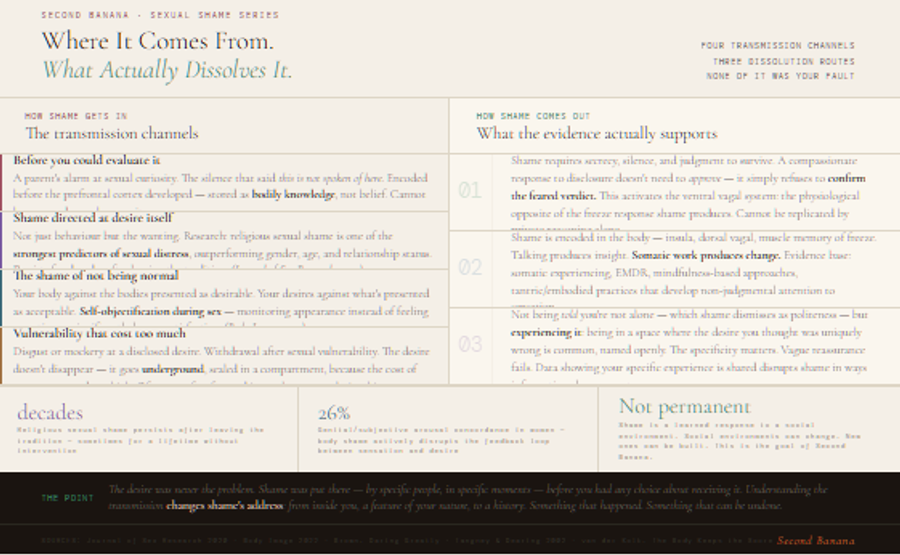
The earliest and most durable sexual shame is transmitted in childhood, typically before a child has language or critical thinking to evaluate what they are being taught. It is transmitted through reaction: the alarm on a parent’s face when a child touches their own genitals. The change in atmosphere when the child asks a question about bodies or reproduction. The silence that is itself a message — this is not talked about here. The words used: dirty, bad, wrong, disgusting, inappropriate.
Children are exquisitely attuned to the emotional states of their caregivers, and they read those states as information about the world and about themselves. A parent’s anxious or disgusted response to childhood sexual curiosity does not teach the child that bodies are complicated. It teaches the child that they are disgusting for being curious. The message is not about behaviour. It is about self.
These early messages are encoded before the prefrontal cortex is developed enough to evaluate them, which means they are stored not as beliefs that can be examined and revised but as something closer to bodily knowledge — felt certainties that feel more like perception than opinion. This is why intellectually understanding that your desire is normal does nothing to dissolve the felt sense that it isn’t.
Religion and Institutional Shame
Many major religious traditions have transmitted sexual shame as a feature rather than a bug — using shame to enforce sexual norms around gender, orientation, premarital sex, masturbation, non-procreative sex acts, and desire itself. The research on religion and sexual shame is consistent and substantial: higher religious conservatism is associated with higher sexual shame, more sexual dysfunction, lower sexual satisfaction, and greater difficulty integrating sexuality with selfhood.
A 2020 study in Journal of Sex Research found that religious sexual shame was one of the strongest predictors of sexual distress in a sample of over 3,000 adults, outperforming demographic variables including gender, age, and relationship status. The effect was not limited to people who currently identified as religious: people who had left conservative religious traditions continued to carry elevated sexual shame for years, sometimes decades, afterward.
The particular cruelty of religious sexual shame is that it is often directed at desire itself rather than at specific acts — at the wanting, not just the doing. Matthew 5:28, in the Christian tradition, locates sin not in the sexual act but in the lustful thought. For people raised with this framework, desire itself becomes evidence of moral failure. There is no behaviour to correct because the problem is not a behaviour. The problem is being human and wanting things.
Culture, Media, and the Shame of Not Being Normal
Beyond family and religion, sexual shame is transmitted culturally through the construction and enforcement of sexual norms — the constant, ambient message about what bodies should look like, what desires are acceptable, what configurations of wanting are normal and which are deviant.
Cultural sexual shame operates through comparison: your body against the bodies presented as desirable; your desires against the desires presented as normal; your relationships against the relationships presented as valid. The person whose body doesn’t conform to narrow beauty standards carries cultural shame about their body in sexual contexts. The person whose desires run to anything outside the narrow mainstream — kink, ENM, same-sex attraction, non-binary sexuality — carries cultural shame about their desire. The person who has too much desire, or too little desire, or desire that arrives in the wrong way at the wrong time, carries shame about that.
This is not abstract. A 2022 study in Body Image found that self-objectification during sex — monitoring one’s own appearance rather than attending to sensation — was associated with significantly lower sexual satisfaction and higher rates of sexual dysfunction in women. The shame about the body was literally preventing access to pleasure, in real time, during sex. The monitoring that shame produces is incompatible with the presence that pleasure requires.
Shaming by Partners
Sexual shame is also transmitted in adulthood by partners — through explicit disgust or mockery at a disclosed desire, through withdrawal of affection following sexual vulnerability, through the subtle communication that a partner finds something about your sexuality distasteful. Partner-transmitted shame is often particularly acute because it occurs in a context of deliberate vulnerability: you showed someone who you were sexually and they reacted in a way that made you wish you hadn’t.
People who have experienced partner-transmitted sexual shame frequently describe a specific aftermath: the desire that was shamed doesn’t disappear. It goes underground. It becomes something carried in secret, disclosed to no one, a part of the self that exists in a sealed compartment because the cost of exposure proved too high. The shame doesn’t remove the wanting. It removes the possibility of the wanting being met.
What Sexual Shame Does: The Costs
The research on the effects of sexual shame is consistent and dispiriting. It affects not just sexual experience but the broader architecture of how people relate to their bodies, to desire, and to intimacy.
To Sexual Experience Directly
- Reduced ability to stay present during sex — the monitoring and self-evaluation that shame produces is incompatible with the absorption that pleasure requires
- Lower rates of sexual satisfaction across multiple dimensions, including physical pleasure, emotional connection, and sense of authenticity
- Higher rates of sexual dysfunction, including desire disorders, arousal difficulties, and anorgasmia
- Avoidance of sexual activity that the person actually wants — refusing experiences out of shame rather than genuine disinterest
- Difficulty communicating sexual needs and desires to partners, producing a chronic gap between what is wanted and what is asked for
To Mental Health and Sense of Self
- Shame is one of the strongest predictors of depression and anxiety in the clinical literature — more reliably associated with psychological distress than guilt
- Sexual shame specifically is associated with lower self-esteem, higher rates of body dysmorphia, and a fragmented sense of identity for people whose sexual selves cannot be integrated with their public selves
- The secrecy that shame produces — the sealed compartment of the unacknowledged self — is itself psychologically costly, requiring ongoing energy to maintain and producing chronic low-grade anxiety about exposure
- For LGBTQ+ people, people with kink desires, and others whose sexuality is stigmatised, the accumulated weight of sexual shame contributes significantly to the mental health disparities documented in these populations
To Relationships and Intimacy
- Shame produces concealment, and concealment prevents the genuine intimacy that requires being known. People who carry significant sexual shame are often experienced by partners as emotionally unavailable in sexual contexts — present but not quite there
- The fear of shaming produces preemptive withdrawal: not disclosing desires, not initiating, not being fully present because full presence would expose the self to the risk of the response that shame has already imagined
- Partner-transmitted shame in one relationship frequently transfers forward — the person carries the imprint of the earlier shaming into subsequent relationships, approaching new intimacy already braced for judgment
What Actually Works: The Evidence for Shame Dissolution
Shame is not permanent. This is the most important thing to say after everything above, and it is easy to lose sight of in a piece about how deep and structural the problem is. The neuroscience that explains why shame is so persistent also points toward what can shift it. The interventions that work are specific, evidence-based, and in many cases counterintuitive.
Disclosure to a Non-Shaming Witness
The most consistently supported intervention for shame in the clinical literature is the one that shame most powerfully resists: telling someone. Brené Brown’s research, replicated across multiple studies, found that shame requires three things to survive — secrecy, silence, and judgment — and that it cannot survive being spoken in the presence of someone who responds with empathy rather than confirmation of the feared judgment.
This is not the same as talking about shame in the abstract. It is the specific act of disclosing the content of the shame — the desire, the behaviour, the aspect of the self that feels unacceptable — to someone whose response is compassionate. The compassionate response does not have to agree that the shameful thing is admirable. It simply has to refuse to confirm that the person is defective for having it.
The mechanism is neurological as well as relational. Disclosure activates the ventral vagal system — the social engagement system — which is the physiological opposite of the dorsal vagal freeze response that shame produces. When a shame disclosure is met with warmth and connection rather than rejection, the nervous system receives a direct counter-signal to the freeze: you are safe here. You are not contaminating. You are known and not abandoned.
This is why therapeutic relationships are so effective for sexual shame when they work well — and why community, whether in kink spaces, LGBTQ+ spaces, or forums where people discover that their desires are shared rather than unique, can dissolve shame that years of private reasoning have left intact. The healing agent is not information. It is witnessed belonging.
Somatic and Body-Based Approaches
Because shame is encoded in the body — in the insula, in the dorsal vagal system, in the muscle memory of the freeze response — approaches that work at the level of the body are often more effective than approaches that work at the level of cognition. Talking about shame can produce insight. Somatic work can produce change.
The body-based approaches with the strongest evidence base for shame include: somatic experiencing, which works with the nervous system’s stored shame responses through body awareness and titrated exposure; EMDR, which processes shame-encoded memories in ways that reduce their emotional charge without requiring full narrative re-experiencing; and mindfulness-based approaches, which develop the capacity to observe shame responses without being captured by them — to notice there is the heat in the face, there is the impulse to shrink without following those signals into the full shame collapse.
Tantric and somatic sexual practices — which we’ve written about in the tantra piece — are also relevant here. The deliberate, attentive, non-judgmental presence with one’s own body that these practices cultivate is a direct counter-practice to the monitoring and self-objectification that shame produces. You cannot simultaneously observe your own sensation with compassion and be in a shame response about having sensation.
Community and Witnessed Normalisation
One of the most consistent findings in the research on sexual shame reduction is the power of discovering that you are not alone. Not being told that you’re not alone — which the shame-voice can dismiss as politeness — but experiencing it: being in a space, physical or digital, where the desire you thought was uniquely wrong turns out to be common, discussed openly, even celebrated.
This is part of what kink communities offer to people who enter them carrying the shame of desires they thought were aberrant. The discovery that there are others — many others, thoughtful and articulate and not obviously damaged by their desires — is a specific and powerful form of shame disruption that information alone cannot replicate. You cannot read your way to the felt experience of belonging. You have to be witnessed.
It is also part of what pieces like this one are trying to do. When the research on squirting shows that 41% of women have experienced it, that information is not just interesting. It is a shame disruption: the thing you have been quietly mortified about is something almost half of women have in common with you. The specificity matters. Vague reassurance that “everyone has sexual stuff” lands differently from data showing that your specific thing is vastly more common than you thought.
The Long Work: Integration Rather Than Elimination
Sexual shame that was encoded early and reinforced over years does not disappear in a single disclosure, a single therapeutic encounter, or a single piece of writing. The goal that the research supports is not elimination — the complete removal of the shame response — but integration: the development of a relationship with one’s own sexuality in which shame is no longer the dominant organising principle.
Integration looks like being able to acknowledge a desire without it feeling like an indictment. Being able to stay present in the body during sex rather than monitoring from a distance. Being able to tell a partner what you want without the telling feeling like an act of dangerous exposure. Being able to feel the old shame signal — the heat, the impulse to shrink — and recognise it as a conditioned response rather than as truth.
This is a long project for most people. It does not proceed linearly. Shame that seemed dissolved can resurface under stress, in new relationships, in moments of particular vulnerability. This is not failure. It is the nature of deeply encoded material, and knowing to expect it changes the experience of it considerably.
Shame dissolves not when we decide it was wrong but when we are known despite it and not abandoned. The knowing is the medicine. The not-abandoning is the cure.
What Second Banana Is Actually For
Every piece in this series has been, in some sense, about sexual shame — about the gap between what people want and what they feel permitted to want, between the erotic life they have and the one they’ve been told they’re allowed to have. The squirting piece was about shame around a normal physiological response. The desire piece was about shame around a normal desire architecture. The anatomy pieces were about shame around normal bodies. The neurodivergence piece was about shame around normal neurological variation.
The right Second Banana is not someone who doesn’t trigger your shame. It is someone in whose presence the shame has less power — because they know what you want and they are still here.
The Desire Was Never the Problem
Here is the thing about sexual shame that the neuroscience makes clear and that the culture has resisted acknowledging: the desire was never the problem. The desire is the body doing what bodies do — seeking pleasure, connection, sensation, intensity, the specific experiences that make existence feel like something worth inhabiting. The desire is not defective. It is not evidence of damage. It is not a symptom that needs treating.
The shame is the problem. And the shame was put there — by specific people, in specific moments, through specific messages that were transmitted before you had any choice about receiving them. You did not choose to learn that your desire was wrong. You were taught it, in the most formative period of your development, by people and institutions who were themselves operating from shame they had inherited and never examined.
This does not mean the shame is your parents’ fault, or your religion’s fault, or your culture’s fault, in the sense of something to be prosecuted. It means it was a transmission — something passed along a chain, hand to hand, generation to generation, without anyone intending the harm it did. Understanding the transmission doesn’t erase the shame. But it changes its address. The shame stops being located inside you, a feature of your fundamental nature, and becomes located in a history — something that happened, something that was done, something that can in principle be undone.
That undoing is slow. It requires witnesses. It requires the body, not just the mind. It requires community and disclosure and the specific, irreplaceable experience of being known and not abandoned. It requires, probably, more compassion for yourself than shame has so far allowed.
But it happens. The research is clear on this. Shame is not a permanent condition. It is a learned response to a social environment, and social environments can change, and new ones can be built. This platform is an attempt to build one.
You were never the wrong kind of person. You were just in the wrong room. 🍌