Body Image and Sex: What’s Actually Happening (and What Actually Helps) | Second Banana
The Body You’re In.
How Body Image Affects Sex,
and What Actually Helps.
On self-objectification, spectatoring, the neuroscience of body shame, and why your partner’s desire for you doesn’t automatically fix anything
The Problem That Partners Can’t Solve
Here is something that happens in a lot of bedrooms and that almost nobody talks about honestly: a person whose partner genuinely, demonstrably finds them attractive is not having good sex, or is not having sex at all, because they cannot stop thinking about how their body looks while it’s happening.
This is not vanity. It is not a failure to accept compliments. It is not something that would be solved by a partner saying the right thing at the right moment. It is a well-documented psychological mechanism with a name — spectatoring — that operates largely outside conscious control, suppresses the physiological arousal response, and disrupts sexual experience in ways that are measurable, consistent, and independent of what the partner actually thinks or feels.
Body image is one of the most consistently documented predictors of sexual satisfaction in the research, and it operates in a direction that surprises most people: it is not primarily about whether a partner finds your body attractive. It is about whether you are able to be present in your body during sex rather than observing it from outside. A person with positive sexual body image in an objectively conventionally unattractive body will generally have better sex than a person with negative sexual body image in an objectively conventionally attractive one. The body the culture has taught you to be ashamed of is less relevant to the quality of your sexual experience than what that teaching has done to your capacity for presence.
This piece is the honest account of what body image actually does to sexual experience, why partner reassurance doesn’t fix it, and what the research shows actually helps. It is not a piece about body positivity as a destination to arrive at. It is a piece about what is actually happening and what you can do about it.
Spectatoring: The Mechanism
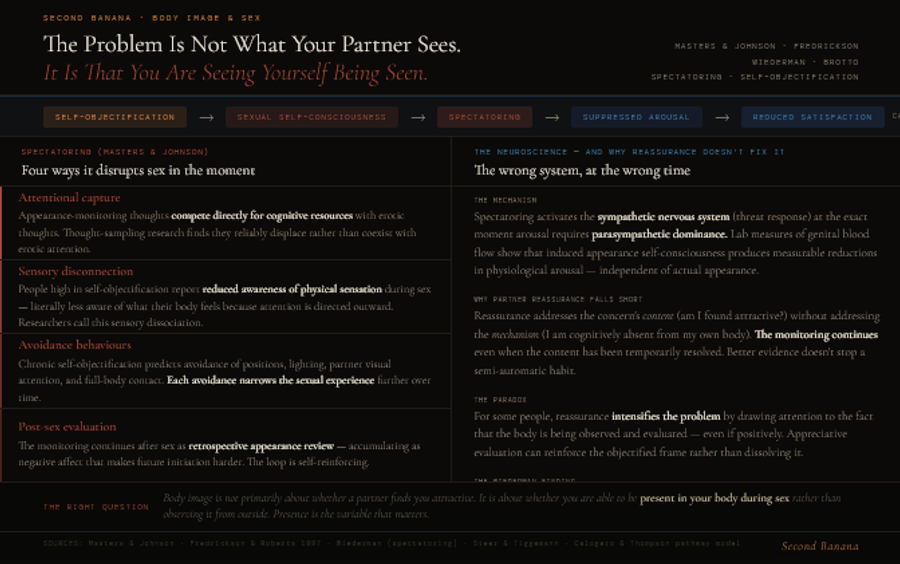
The concept of spectatoring was introduced by Masters and Johnson in their foundational sex therapy research in the 1960s and 1970s, where they identified it as one of the primary mechanisms by which anxiety disrupts sexual response. A spectator, in this context, is a person who observes their own sexual performance from an imagined external vantage point rather than being present in their own sensory experience.
Body-related spectatoring is the most common form: the person who is mentally checking how their stomach looks from this angle, whether their thighs are positioned in a way that looks acceptable, whether their face is making an unattractive expression, whether their partner is noticing the part of their body they find most difficult. This mental activity is not happening in addition to sexual arousal. It is happening instead of it, or in direct competition with it, because the cognitive and physiological resources that sexual arousal requires are being redirected toward self-monitoring.
The Neuroscience: Why This Suppresses Arousal
Spectatoring activates the sympathetic nervous system — the stress response system — at precisely the moment when sexual arousal requires parasympathetic dominance. We covered this mechanism in the orgasm piece: orgasm requires the rest-and-digest state, not the fight-or-flight state. Body-related anxiety during sex is a form of threat response, and the body responds accordingly.
Research using genital blood flow measures (plethysmography) has found that laboratory-induced self-consciousness about physical appearance produces measurable reductions in physiological arousal in women, even when the self-consciousness is induced by conditions unrelated to their actual appearance. The mechanism is not “I don’t feel attractive therefore I’m not aroused.” It is “I am monitoring my appearance therefore my nervous system is in the wrong state for arousal to develop.” The monitoring itself is the problem, independent of what is found.
This is why partner reassurance — “you look beautiful”, “I find you so attractive” — often doesn’t solve the problem, or solves it only temporarily. The reassurance addresses the content of the concern (am I attractive to this person?) without addressing the mechanism (I am cognitively absent from my own body). The monitoring continues even when the content of the concern has been temporarily resolved.
Self-Objectification: The Wider Context
Spectatoring is the in-the-moment expression of a broader phenomenon that the research calls self-objectification: the habitual adoption of an observer’s perspective on one’s own body, treating it as an object to be evaluated by external standards rather than as a subject to be inhabited and experienced from the inside.
The concept was developed most influentially by Barbara Fredrickson and Tomi-Ann Roberts in their 1997 objectification theory, which proposed that women in particular are socialised to monitor their own appearance as a chronic background activity — what Fredrickson and Roberts called “handling” — and that this chronic monitoring produces measurable consequences across multiple domains including mental health, cognitive performance, and sexual experience.
The sexual consequences are among the most consistently documented. Research by Steer and Tiggemann found that self-objectification was significantly associated with sexual self-consciousness, lower sexual satisfaction, and greater difficulty reaching orgasm. Wiederman’s work specifically on spectatoring found that women who more frequently engaged in appearance monitoring during sex reported significantly lower sexual satisfaction and lower orgasm frequency. The Calogero and Thompson model extended these findings to show the pathway: self-objectification leads to sexual self-consciousness which leads to spectatoring which suppresses arousal and satisfaction.
While objectification theory was initially developed and tested primarily with women, subsequent research has found analogous processes in men — particularly around body-related concerns like muscularity, penis size, and sexual performance — and in people of all genders. The specific content of the body concern varies; the mechanism is consistent.
What Self-Objectification Does During Sex, Specifically
- Attentional capture. Appearance-monitoring thoughts compete directly for cognitive resources with erotic thoughts. Research using thought-sampling methodology during sexual arousal tasks finds that self-objectifying thoughts reliably displace erotic thoughts rather than coexisting with them.
- Sensory disconnection. People high in self-objectification report reduced awareness of physical sensation during sex — they are literally less aware of what their body is feeling because their attention is directed outward rather than inward. The research uses the term “sensory dissociation.”
- Avoidance behaviours. Chronic self-objectification predicts avoidance of sexual situations, avoidance of certain positions or lighting conditions, avoidance of partner visual attention, and avoidance of full-body physical contact. Each avoidance narrows the sexual experience further.
- Post-sex evaluation. The monitoring continues after sex in the form of retrospective appearance evaluation — reviewing how the body looked and performed — which accumulates as negative affect that makes future sexual initiation harder.
The Partner Reassurance Problem
It is worth being direct about why partner reassurance — the most intuitive response to a partner’s body image concerns — is less effective than it feels like it should be, because understanding this helps both partners navigate it better.
Reassurance addresses the concern’s content (am I found attractive?) but does not address the concern’s mechanism (am I monitoring my body?). For someone with chronic self-objectification, the monitoring is a habit that operates semi-automatically, not a rational inference from evidence that can be corrected by better evidence. Telling someone who is spectatoring that they look beautiful gives them information that is processed by the monitoring system, not by the sensory system they need to be in to experience arousal.
Reassurance can also, paradoxically, intensify the problem. For some people with body image concerns, partner reassurance draws attention to the fact that their body is being observed and evaluated — even if positively — which reinforces the objectified frame rather than dissolving it. The focus on the body as an object of evaluation, even appreciative evaluation, can make the monitoring worse rather than better.
The problem is not what your partner sees. It is that you are seeing yourself being seen, and it is costing you your own experience.
What Partners Can Do Instead
The research on what partners can do to support someone with body image-related sexual difficulties points away from body-focused reassurance and toward attention-redirecting and presence-creating strategies:
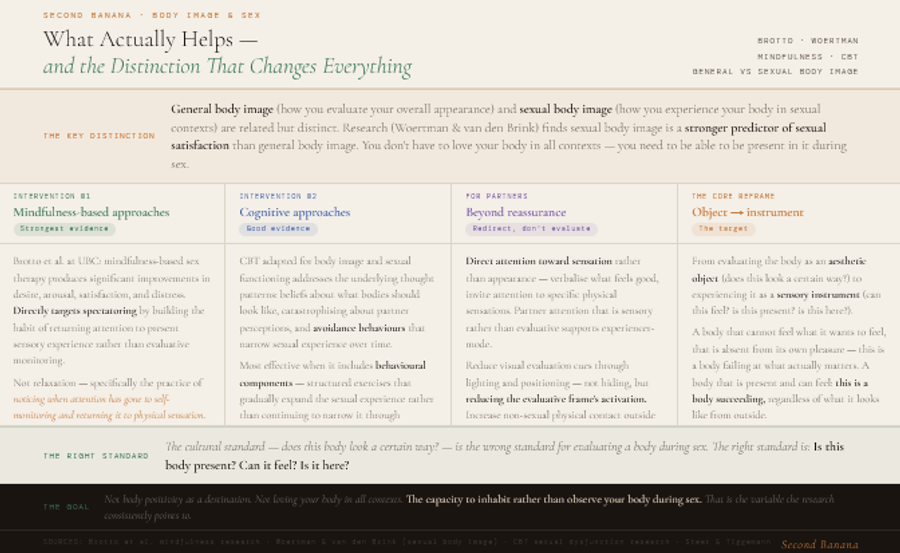
- Direct attention toward sensation rather than appearance. Verbalising what feels good, inviting attention to specific sensations, creating conditions where the partner’s attention to the body is sensory rather than evaluative, all support the shift from observer-mode to experiencer-mode.
- Reduce visual evaluation cues. Lighting, positioning, and context that reduce the sense of being visually assessed can reduce the monitoring trigger. This is not about hiding — it is about creating conditions where the evaluative frame is less activated.
- Increase non-sexual physical contact. Research consistently finds that regular affectionate physical contact outside sexual contexts — the kind that is not evaluative of appearance — reduces body self-consciousness over time by building a different relationship between the body and physical intimacy.
- Explicit communication outside the bedroom. The sexual communication piece covered this in detail: the conversation about body image concerns and what helps belongs in neutral-ground conversation, not during or immediately after sex.
What the Research Says Actually Helps
The evidence base for addressing body-image-related sexual difficulties is more specific than “learn to love your body”, and more actionable. Several interventions have research support:
Mindfulness-Based Approaches
The most consistently evidence-supported intervention for body-image-related sexual difficulties is mindfulness: the deliberate cultivation of present-moment sensory awareness during sexual activity, specifically as a counter to spectatoring.
Lori Brotto’s work at the University of British Columbia — the most rigorous research program on mindfulness and sexual functioning — has found that mindfulness-based sex therapy produces significant improvements in sexual desire, arousal, satisfaction, and distress across multiple populations, including people with body image-related difficulties. The mechanism is the one the research would predict: mindfulness training directly targets the spectatoring dynamic by cultivating the habit of returning attention to present sensory experience rather than evaluative monitoring.
Mindfulness in this context is not relaxation or meditation in the conventional sense. It is specifically the practice of noticing when attention has gone to self-monitoring and deliberately returning it to physical sensation — to what is being felt rather than what is being seen. This is a skill that develops with practice and that can be cultivated both in sexual contexts and in general daily life.
Cognitive Approaches
Cognitive approaches — specifically cognitive-behavioural therapy adapted for body image and sexual functioning — address the thought patterns that underlie spectatoring: the beliefs about what bodies should look like, the interpretations placed on a partner’s behaviour, the catastrophising about what a partner is thinking, and the avoidance behaviours that narrow the sexual experience over time.
Research on CBT for sexual dysfunction with a body image component finds it effective, particularly when it addresses both the cognitive patterns and includes behavioural components: structured exercises that gradually expand the range of sexual experience rather than continuing to narrow it through avoidance.
Sexual Body Image Specifically
An important distinction in the research: general body image and sexual body image are related but distinct constructs. General body image refers to how a person evaluates their overall appearance. Sexual body image refers specifically to how they experience their body in sexual contexts — whether they feel comfortable, attractive, and able to be present during sex.
Research by Woertman and van den Brink found that sexual body image is a stronger predictor of sexual satisfaction than general body image — meaning the relationship between appearance concern and sexual experience is more specific than appearance concern generally. A person can have mixed or negative feelings about their body in general and still develop a positive sexual body image: a sense that their body is a legitimate, desirable, capable vehicle for erotic experience regardless of what it looks like by external standards.
This distinction matters because it points toward a more specific target than “body positivity” generally. The goal is not necessarily to feel good about your body in all contexts and by all measures. It is to develop the capacity to be present in your body during sex — to inhabit rather than observe it.
Expanding the Frame: What the Body Is For
One of the most practically useful reframes the research points toward is the shift from evaluating the body as an aesthetic object to experiencing it as a sensory instrument. A body that is in pain during sex, that cannot feel what it wants to feel, that is absent from its own pleasure — this is a body failing at what actually matters in sexual experience. A body that is present, that can feel, that can communicate and respond — this is a body succeeding, regardless of what it looks like from the outside.
This is not a platitude. It is a genuine reorientation of what the relevant standard is. The cultural standard — does this body look a certain way? — is the wrong standard for evaluating a body during sex. The right standard is: is this body present? Can it feel? Is it here?
Second Banana and Body Image
Second Banana’s post-first, photo-second model is, among other things, a structural intervention in the body image dynamic. The first impression is made by what is written — by how someone thinks about their desires, by the honesty and specificity of their self-description, by the quality of their attention to what they want — not by how their body looks in a photograph taken in the best available light.
This matters for body image in a specific way: the matching happens before the visual evaluation. The person who responds to a post that resonates with them has already found something compelling about who the poster is. The photo comes after, into a context where connection has already begun to form. This does not eliminate the role of physical attraction in whether a connection develops, but it changes the order and therefore the weight.
The anonymous posting model has a related effect: the ability to write about desire and identity honestly, without the pressure of being visually evaluated in the same moment, is a lower-anxiety entry point for people whose body image concerns make conventional appearance-first dating feel impossible. You can be present in what you want before anyone has seen your body. The first experience of being responded to is a response to who you are, not how you look.
And the community that Second Banana builds — explicit communicators, people who take desire seriously, people who have chosen to be honest about what they want rather than performing an acceptable version of it — is disproportionately composed of people who are less invested in conventional appearance evaluation than the general population of dating app users. This is not incidental. It follows from what explicit desire communication selects for.
Your body is the one you have. It is the instrument through which every sexual experience you will ever have occurs. Being present in it is not a reward for earning the right to be there. It is what sex is.
Be in the body you’re in. It’s the only place the good stuff happens. 🍌