
Late Discovery: Coming Out to Yourself Later in Life | Second Banana
You Didn’t Miss It.
On Late Discovery,
Sexual Identity,
and Coming Out to Yourself.
Why sexual identity comes later for many people, what the research says about it, and why the discovery — whenever it arrives — is real
The Timeline That Isn’t Universal
The cultural story of sexual identity has a timeline. You discover who you are in adolescence, or early adulthood at the latest. You come out — to yourself first, then to others — in your twenties at the outside. What happens before and after is legible: confusion before, clarity after. The arc is developmental, linear, and — crucially — early. The implication is that if you arrive somewhere different, or later, you are either a late developer who was always going to get there, or you are reconsidering something you had settled.
This timeline is inaccurate for a larger proportion of people than is commonly acknowledged. Research on sexual identity development across the lifespan consistently finds that significant numbers of people come to a clear sense of their sexual orientation, their relationship orientation, or their erotic identity — as queer, as kinky, as non-monogamous, as something else entirely — in their thirties, forties, fifties, and beyond. Not as a correction to earlier certainty, but as a genuine first arrival.
This piece is for those people. It is also for the people who knew something earlier but couldn’t name it, couldn’t act on it, couldn’t find community for it — for whom the late arrival is not the discovery itself but the discovery’s context: finally having the language, the safety, or the circumstances to do something with what was always there. And it is for everyone for whom the cultural timeline has made their experience feel like a problem to be explained rather than a life to be lived.
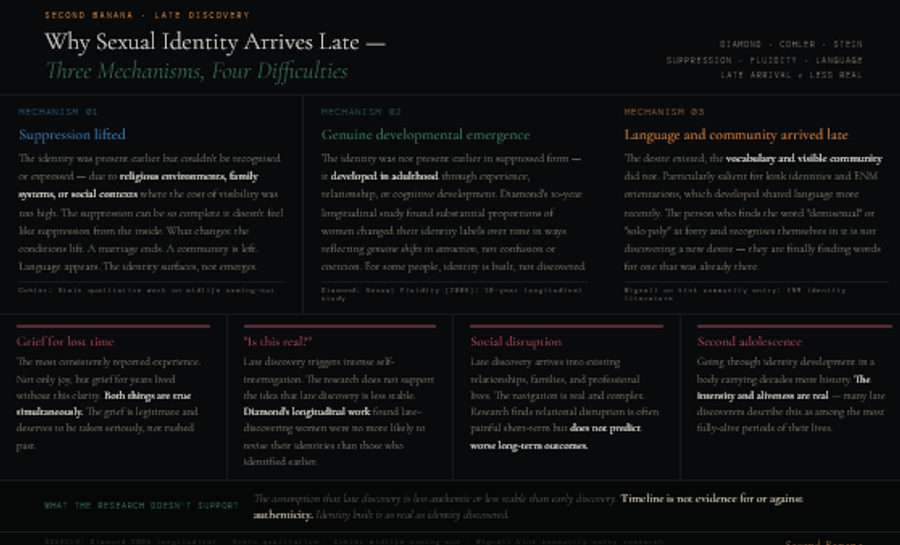
Why Identity Arrives Late: The Research
Late discovery is not one thing. The research on sexual identity development in adulthood identifies several distinct mechanisms that produce it, and understanding which one is operating changes both what the experience feels like and what it asks of the person going through it.
Suppression and the Conditions That Lift It
The most documented mechanism of late discovery is suppression: an identity that was present, in some form, earlier, but that could not be recognised or expressed because the conditions for doing so weren’t present. Religious environments that treated certain identities as sinful. Family systems that communicated, explicitly or implicitly, that certain desires were unacceptable. Social contexts where the cost of being seen as queer, kinky, or non-monogamous was too high — professionally, socially, or physically.
Research on late-discovering queer adults — including work by Deborah Cohler and studies on women who come out in midlife — consistently finds that for many people, the identity itself was not absent in earlier life. What was absent was the safety to recognise it, the language to name it, or the circumstances that made living it possible. The suppression can be so complete that it doesn’t even feel like suppression from the inside — it can feel like not having had the experience at all.
What changes: the conditions lift. A marriage ends, a religious community is left, a geographical move is made, children grow up and dependents become fewer, a therapist creates a context where honesty becomes possible, a chance encounter with a community or a piece of writing offers the first reflected image of a self that was always there. The discovery isn’t the emergence of something new. It is the surfacing of something that has been present but submerged.
Genuine Developmental Emergence
A second mechanism is more contested but equally documented: genuine developmental emergence, in which the identity was not present earlier in a suppressed form but develops in adulthood as a consequence of experience, relationship, cognitive development, or simply the accumulation of life that produces different access to one’s own interior.
The concept of sexual fluidity — developed most influentially by Lisa Diamond in her longitudinal research on women’s sexuality — establishes that for a meaningful proportion of people, sexual attraction is not a fixed orientation that is either recognised or suppressed, but a capacity that shifts across time and context. Diamond’s 10-year longitudinal study of women who identified as lesbian, bisexual, or unlabelled found that a substantial proportion changed their self-labels over the study period — and that these changes were not random or externally coerced but reflected genuine shifts in their experience of attraction.
Diamond’s work has been extended and critiqued in various directions, but its core insight holds: for some people, the question is not “why did I only discover this now?” but rather “why do we assume the answer has to have been available earlier?” Sexual identity, for some people, is something that develops rather than something that is discovered. Both things are true across the population. The research has not settled which mechanism predominates, because the mechanisms are not mutually exclusive and are difficult to distinguish from the inside.
Language and Community as Preconditions
A third mechanism deserves its own treatment: the role of language and community in making identity legible to the person who has it. Many people carry an experience of desire or relational orientation for years or decades without having words for it that fit — or without having encountered anyone else who seems to share it. The experience exists, the desire is present, but it floats without a name or a community, and nameless desires are harder to recognise, claim, and act on than named ones.
This is particularly salient for kink identities and ENM orientations, which have developed a shared vocabulary and visible community more recently than queer identities have. The person who discovered BDSM or polyamory in their forties was not necessarily someone for whom these desires emerged late. They may be someone who had these desires for decades but had no framework in which to understand them as a coherent orientation rather than an aberration. The language arrived late. The desire was already there.
The same applies to more recently named queer identities. Bisexuality as a clearly articulated orientation with community and literature has existed in popular discourse for several decades, but the word and its meaning were not universally available to all people at all times. Pansexuality, demisexuality, and other specific orientations are even more recently named. The person who finds these words in their forties and recognises themselves in them is not necessarily a late discoverer of a new desire. They may be recognising themselves in language that simply didn’t exist when they were younger.
What Makes Late Discovery Hard
Understanding why identity arrives late doesn’t immediately resolve what it asks of the person it arrives for. Late discovery comes with a specific set of difficulties that early discovery does not, and they deserve honest treatment.
Grief for the Lost Time
The most consistently reported emotional experience in late discovery accounts — across research interviews, community forums, and clinical literature on coming out in midlife — is grief. Not only joy at the discovery, though joy is frequently present too, but grief for the years lived without this clarity, the relationships that might have been different, the earlier self who carried the desire without being able to name or act on it.
This grief is legitimate and deserves to be taken seriously rather than rushed past. The reflexive “but you’re here now” response — however well-intentioned — doesn’t honour what the person is actually experiencing. Something was lost, even if what was found is real. The two things are true simultaneously.
You didn’t miss it. But you did miss some of it. Both things are true, and the grief doesn’t cancel the arrival.
The Question of Authenticity
Late discovery frequently triggers a specific and painful kind of self-interrogation: is this real? Am I actually queer, kinky, non-monogamous, or am I confused, going through something, performing an identity that belongs to someone else? The interrogation is more intense for late discoverers than for those who found their identity earlier, partly because the cultural narrative says identity should be stable and early, and partly because late discovery often comes with the feeling of having been wrong for a long time, which raises the question of whether one might be wrong again.
The research does not support the assumption that late discovery is less authentic or less stable than early discovery. Lisa Diamond’s longitudinal work found that women who came to lesbian or bisexual identities in adulthood were not more likely to subsequently revise those identities than those who had identified that way earlier. Arlene Stein’s qualitative work on lesbian identity development found similar stability. Late arrival does not predict instability. The two things are simply unrelated.
The question “is this real?” is also worth examining for what it assumes. Implicit in it is the idea that there is a true self that can be correctly or incorrectly identified, and that the evidence for correct identification is early arrival and stability over time. This is one model of identity, but it is not the only one, and it is not particularly well supported by the research on how sexual and relational identity actually develops for most people. Identity is often something that is built as much as it is discovered. The building is real. What gets built is real. The timeline is not evidence for or against the authenticity of either.
The Social and Relational Disruption
Late discovery rarely arrives in a context-free space. It arrives into existing relationships, existing social circles, existing professional lives and family systems that were built without it. The person who discovers they are queer in their forties may be in a long-term heterosexual marriage. The person who discovers they are kinky may have a partner who is not. The person who discovers they are non-monogamous may have built a monogamous life that they love in other respects.
The disruption this creates is real and its ethical dimensions are complex. None of those complexities disappear because the discovery is genuine and important. What late discovery often requires — more than early discovery, which arrives before most of these structures are built — is a sustained period of navigation: understanding what the discovery means for existing relationships, having honest conversations with partners and family members, making decisions about what to preserve and what must change.
Research on coming out in midlife consistently finds that the relational disruption of late discovery, while often painful in the short term, does not predict worse long-term outcomes. Many relationships survive and deepen through this navigation. Some don’t, and those endings are also real and significant. What the research doesn’t support is the assumption that late discovery is therefore a mistake or a crisis to be managed rather than an identity to be integrated.
The Adolescence-in-Middle-Age Experience
A specific and frequently reported experience in late discovery communities is what is sometimes called “second adolescence”: the sense of going through an identity developmental process — the excitement, the uncertainty, the intensity, the social navigation of a new self — in a body and life context that is nothing like adolescence. The forty-five-year-old who has just come out is having experiences that their peers had in their teens and twenties, with all the attendant intensity and awkwardness and joy, in a body that carries two decades more history.
This can feel disorienting. It can also feel revelatory. The research on late-coming-out experiences finds that many people describe the period immediately following discovery as among the most alive they have felt — a quality of presence and intensity that comes from finally being in contact with something true about themselves. The adolescence-in-middle-age experience is real; so is the aliveness that comes with it.
The Specific Terrain of Different Late Discoveries
Late Discovery of Queer Identity
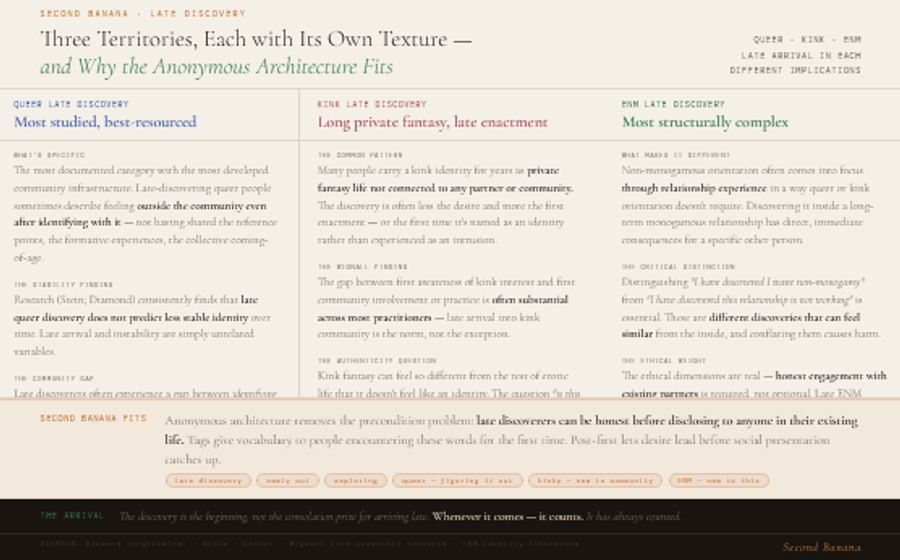
Queer late discovery is the most studied category in this territory, and the research is both the most developed and the most likely to be known to the person going through it. The community infrastructure for late-discovering queer people — support groups, online communities, clinical resources — is more developed than for other late discovery categories, though it remains unevenly distributed.
One dimension that is specific to queer late discovery and worth naming directly: the relationship to a queer community and history that the late discoverer did not participate in during the period when their peers were building those community ties. Late-discovering queer people sometimes describe a feeling of being outside the community even after identifying with it — of not having shared the reference points, the formative experiences, the collective coming-of-age that earlier discoverers share. This is a real experience and it is worth naming rather than minimising.
Late Discovery of Kink Identity
Kink late discovery has its own specific texture. Many people carry a kink identity for years or decades as a private fantasy life that is not connected to any partner, community, or practice. The discovery — or more accurately, the first enactment — may come significantly later than the desire itself. The question of authenticity is particularly acute here because kink fantasy can feel so different from the rest of one’s erotic and relational life that it doesn’t feel like an identity so much as an intrusion.
The research on kink identity development — including Wignall’s work on kink community entry and the BDSM identity literature — finds that the gap between first awareness of kink interest and first community involvement or practice is often substantial, and that this gap does not predict less authentic or less stable kink identity. Late arrival into kink community and practice is the norm rather than the exception.
Late Discovery of Non-Monogamous Orientation
ENM late discovery is the least studied but perhaps the most structurally complex, because non-monogamous orientation typically comes into focus through relationship experience in a way that queer orientation and kink orientation do not always require. The person who discovers in a long-term monogamous relationship that they may be constitutionally suited to non-monogamy is in a position that has no clean parallel in queer coming-out narratives: they are discovering something about themselves that has direct, immediate consequences for a specific other person who did not consent to be part of that discovery.
The ethical dimensions of this are real and deserve honest engagement. The series has covered solo polyamory, relationship anarchy, and ENM durability in other pieces; what is specific to late discovery in this context is the navigating of existing relationship structures during and after the discovery, and the importance of distinguishing between “I have discovered I want non-monogamy” and “I have discovered this relationship is not working for me in ways that are not specifically about monogamy.” These are different discoveries that can feel similar from the inside.
Second Banana and Late Discovery
Second Banana’s anonymous, post-first architecture was not designed specifically for late discoverers, but it maps onto their needs with unusual precision.
The person in late discovery is frequently navigating a complex social context in which their new identity cannot be disclosed to everyone who might otherwise be in the picture: family members, colleagues, partners who don’t yet know, communities where disclosure carries cost. Being able to be honest about who you are and what you want in a context where that honesty is not attached to your face, your name, or your existing social network is not an incidental feature. It is often the precondition for being honest at all.
The tag system gives late discoverers vocabulary they may be encountering for the first time. “Late discovery,” “newly out,” “exploring,” “queer — figuring it out,” “kinky — new to community”: these tags communicate orientation and context simultaneously, and they invite the specific kind of patient, context-aware response that late discovery often requires. They also connect late discoverers to others who have been where they are, which is often more valuable than any advice.
The post-first model is particularly suited to people for whom the erotic and relational identity is clearer than the social presentation: the person who knows what they want but is still working out what they are, or who they are in a social sense. Writing about desire before showing a face allows the desire to be the first thing — which is often, for late discoverers, the most important thing.
You didn’t miss it. The people who are living it now, or who have been where you are, are here. The discovery is the beginning, not the consolation prize for having arrived late.
Whatever you’re discovering: it counts. It has always counted. 🍌