
The Conversation Before — How to Negotiate What You Actually Want
The Conversation Before the Encounter
A practical guide to pre-negotiation and consent models — why most people do it wrong, and what good actually looks like
There is a version of the consent conversation that everyone has been told to have and almost no one enjoys: the clinical checklist delivered at an awkward moment, the stammered "is this okay?" after every escalation, the sense that desire and negotiation are fundamentally opposed and you can have one or the other but not both at the same time.
That version is not what this piece is about.
Pre-negotiation — the conversation that happens before an encounter, when nothing is happening yet and the stakes of saying the wrong thing are low — is one of the most underrated erotic tools available. Stefan and Moira, in the piece we published about their sex club first date, pre-negotiated for hours before they arrived. Not because they were following a protocol. Because knowing what they were walking into made the whole thing possible. It removed enough uncertainty that full presence became an option.
This piece is about how to do that — and why it works.
Why the Standard Consent Model Is Broken
The affirmative consent model — enthusiastic, ongoing, verbal — is better than what it replaced, which was effectively nothing. But it has a structural problem: it asks for consent at the moment of maximum ambiguity.
In the moment, people are aroused, which affects cognition. They are often uncertain about what they want. They may be with someone new whose reactions they cannot yet read. They are navigating social pressure, desire, nervousness, and the physical reality of what is happening to their body, all at the same time. Asking someone to give clear, considered consent in that state is asking them to do something cognitively demanding under exactly the conditions that make it hardest.
There is also the freeze response — the physiological state where neither fight nor flight nor verbal expression is available, and where someone may be going along with something without any of the enthusiasm or agency that the affirmative model assumes. Freeze is not consent. But it can look like it, and the in-the-moment model has no good way to tell the difference.
None of this is an argument against in-the-moment consent. It is an argument for moving the primary site of the consent conversation to before the moment — when both people are calm, clear-headed, not yet aroused, and can say what they actually want without the noise.
What Pre-Negotiation Actually Is
Pre-negotiation is not a consent form. It is a conversation — ideally a relaxed one, ideally not immediately before the encounter — in which two or more people establish: what each person wants to happen, what they definitely do not want to happen, what the ambiguous middle ground is, and what the process will be if something goes wrong.
It covers hard limits, soft limits, and desires. And crucially, it establishes a shared communication protocol for the encounter itself — so that both people know in advance what "stop" means, what "I need a minute" means, and what to do if someone goes quiet in a way that doesn't feel right.
A well-conducted pre-negotiation does something that no in-the-moment check-in can do: it removes the encounter from the realm of improvisation and puts it in the realm of co-design. You are not hoping things go well. You are building the conditions for them to go well, in advance.
This is, incidentally, what the BDSM community has known and practised for decades. The kink world developed negotiation frameworks long before mainstream dating culture started taking consent seriously — partly out of necessity, because the stakes of miscommunication are higher when physical intensity is involved, but partly because explicit communication is baked into the culture in a way it simply isn't elsewhere.
You don't have to be kinky to benefit from the same approach.
The Three Consent Models Worth Knowing
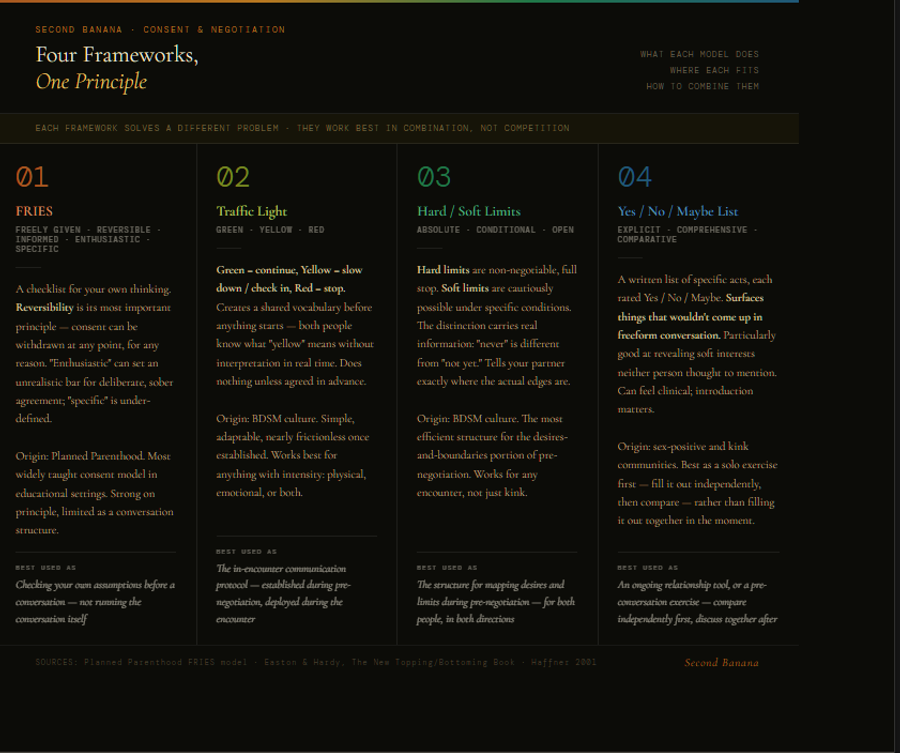
FRIES (Freely given, Reversible, Informed, Enthusiastic, Specific)
The Planned Parenthood framework, and the one most commonly taught in educational settings. Its strength is the reversibility principle — consent can be withdrawn at any point, for any reason, without explanation — which is often not understood even by people who think they understand consent. Its limitation is that "enthusiastic" can set an unrealistic standard for sober, deliberate agreement, and "specific" is under-operationalised: it rarely explains what specific means in practice.
Best used as: a teaching framework and a checklist for checking your own assumptions. Not a conversation structure.
The Traffic Light System
Green/yellow/red, adapted from kink culture. Straightforward: green means continue, yellow means slow down or check in, red means stop completely. Its strength is that it gives a common vocabulary before anything starts — both people know what "yellow" means and don't have to interpret ambiguous behaviour in real time. Its limitation is that it only works if you've agreed on the system in advance, which requires a pre-conversation.
Best used as: the in-encounter check-in protocol, established during pre-negotiation.
The Hard/Soft Limit Model
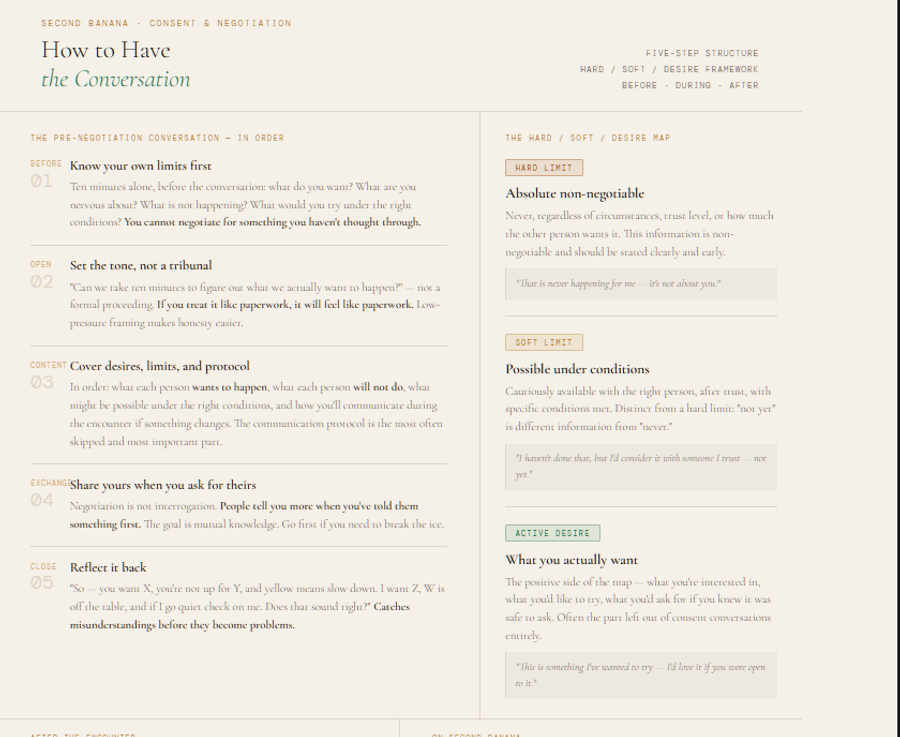
Also from BDSM culture. Hard limits are absolute non-negotiables: things that are never going to happen, full stop. Soft limits are things that are cautiously possible under specific conditions, with the right person, after trust is established. The distinction matters because it tells your partner something real: "I've never done this but I'm curious" is different information from "I have done this and it was bad for me and it is not happening."
Best used as: the structure for the desires-and-boundaries portion of pre-negotiation. Walking through hard and soft limits together — for both people — is one of the most efficient ways to establish the actual shape of an encounter.
The Yes/No/Maybe List
A longer-form tool — a list of specific acts or scenarios that each person rates as yes (interested), no (not doing this), or maybe (context-dependent). Many versions exist online. Its strength is comprehensiveness: it surfaces things that might not come up in a freeform conversation, including things one person wants that the other never thought to mention. Its limitation is that it can feel clinical if introduced wrong.
Best used as: a starting-point for an ongoing sexual relationship, or as a pre-conversation exercise you do independently and then compare, rather than something you fill out together in the moment.
How to Actually Have the Conversation
Most people who know they should pre-negotiate don't do it because they don't know how to start. Here is a structure that works:
Before the conversation: Know your own limits and desires before you try to negotiate them with someone else. This sounds obvious and is consistently not done. Spend ten minutes alone, before the conversation, asking: what do I want to happen? What am I nervous about? What am I not willing to do? What would I like to try if the conditions were right? You cannot negotiate well for something you haven't thought through.
The opener: Make it low-pressure. "I'd like to talk about what we're both looking for before we get into it — is now a good time?" or "Can we take ten minutes to figure out what we actually want to happen?" positions it as practical coordination rather than a formal proceeding. Tone matters. If you treat it as paperwork, it will feel like paperwork.
The content: Cover, in roughly this order: what each person wants to happen (desires), what each person is not willing to do (hard limits), what might be possible under the right conditions (soft limits), and how you'll communicate during the encounter if something changes. The communication protocol — "if I say stop, it means stop; if I go quiet and seem off, check in" — is the part most often skipped and the part that matters most when things get complicated.
Reciprocity: If you're asking for someone's limits, share yours. Negotiation is not interrogation. The goal is mutual knowledge, not a consent extraction. People will tell you more if you've told them something first.
Close the loop: At the end, briefly reflect back what you've both said: "So — you're interested in X, you're not up for Y, and if you need to slow down you'll say yellow. I want to try Z, I'm not comfortable with W, and if I go quiet check on me. Does that sound right?" This is not bureaucratic. It catches misunderstandings before they become problems.
The Things That Make It Hard
Shame about desires
The negotiation requires saying what you want, which is the thing many people find hardest. Years of messaging that specific desires are weird, too much, or unsexy have taught a lot of people to never say directly what they're interested in — to hint, to hope the other person figures it out, to accept whatever happens and not ask for anything specific.
Pre-negotiation requires overriding that. The practical help: you don't have to be eloquent. "I've always wanted to try being held down" or "I don't really like oral sex being done to me but I love giving it" are complete sentences. You do not need to justify, contextualise, or apologise for what you want.
The fear that it kills the mood
The most common objection: "If I talk about it beforehand, it ruins the spontaneity." This is worth examining because it contains a real concern embedded in a false conclusion.
The real concern is that desire can't survive being made explicit — that the moment you name what you want, some essential mystery is destroyed. Some people do have this experience, and it is worth knowing about yourself.
But for most people, what actually happens is the opposite. Knowing that your partner is interested in what you're interested in — that you're both going into an encounter with some shared sense of what it is — is not mood-killing. It's legitimately exciting. The conversation doesn't destroy anticipation; it creates it with a different texture. Stefan knew what was on the table before he and Moira arrived at the club. He did not seem to find this a problem.
Not knowing how to say no gracefully
People often avoid pre-negotiation because they're afraid they'll have to decline something their partner wants, and they don't know how to do that without damage. The answer is that a hard limit, stated during a pre-negotiation, is just information. "That's not something I'm into" before anything has started is almost never a relationship-ending statement. The same information, surfaced during an encounter, is much harder to navigate.
The pre-negotiation framework exists, in part, to make no easier to say — because it's said before anyone's invested, before anything has started, before the dynamics of in-the-moment pressure have had a chance to build.
After the Encounter: The Part Everyone Forgets
Consent and negotiation don't end when the encounter does. Post-encounter check-ins — sometimes called aftercare in kink contexts, but applicable much more broadly — are where both people process what happened, confirm that they're okay, and establish what, if anything, felt off.
This matters because people sometimes don't know how they feel until after. Something that seemed fine in the moment can land differently in the hour or day that follows — not because anything was done wrong, but because the body processes things on a delay. A check-in creates space for that: "How are you feeling about what happened?" is a question that costs nothing to ask and can catch something important.
It also matters because it closes the loop on the pre-negotiation. If something in the encounter didn't go as agreed, or something came up that wasn't anticipated, the post-encounter conversation is where you address it — calmly, after the fact, when both people are regulated. Not in the moment, when everything is raw.
And it creates the foundation for the next encounter. "That worked really well" and "next time I'd actually like to try X" are both useful things to know. The negotiation is a living document, not a one-time event.
Why This Matters on Second Banana Specifically
Second Banana is built on a different premise than most dating platforms: that the most efficient path to a genuine sexual connection is to be specific about what you want before you meet. The post-first format does exactly this — you're not leading with a photograph, you're leading with desire, expressed in words.
This is pre-negotiation in structural form. When you write your Second Banana post — when you articulate what you're looking for, what kind of connection you want, what your tags represent — you're doing the first phase of negotiation before anyone has even matched. The people who reply to your post have already read your desires and decided they're interested in what you're offering.
What that means in practice: the negotiation conversation, when you have it, is much easier. You're not starting from zero. You're refining, clarifying, and personalising something you've both already agreed to at a high level. The hard part — saying what you want to someone who might react badly — has already happened, and they replied.
The Second Banana tag system extends this further. Tags like "consent-focused," "pre-negotiation welcome," "communication-first," and "harm limits discussed" signal not just what someone wants but how they approach the conversation about what they want. Two people with those tags in common have already told each other something important about their process — before a single message has been sent.
The Short Version
Good sex is not spontaneous in the sense of unplanned. It is spontaneous in the sense of unimpeded — nothing in the way of full presence and full engagement. Pre-negotiation removes the impediments. It handles the logistics, the limits, the unknowns, and the communication protocols in advance, so that when the encounter begins, both people can be exactly where they are without half their attention elsewhere.
The conversation before is not the opposite of desire. It is how desire gets enough space to actually breathe.
The right person will welcome this conversation. That's how you know. 🍌