
Boytoy: The Psychology of Willing Availability, Enthusiastic Use, and Why Being Wanted for Pleasure Is Its Own Form of Power | Second Banana
Boytoy:
The Psychology of Willing Availability, Enthusiastic Use, and the Specific Power of Being Wanted for Pleasure
The Specific Charge of Being Used Well
There is a specific erotic experience that the word ‘boytoy’ names and that no other term in the kink vocabulary quite captures: the experience of being specifically, enthusiastically available for another person’s pleasure — of being the person they reach for, use, and want in a way that is about their desire rather than about any particular reciprocal dynamic. The boytoy is not a submissive in the formal D/s sense, not a service submissive performing tasks, not a bottom waiting for a scene to be negotiated. They are, in the specific register this term occupies, someone who brings a particular quality of willing, eager presence to an encounter in which they are primarily there to be wanted and used.
The ‘toy’ framing matters. Being a toy implies being something that exists for someone else’s pleasure, that is reached for and played with according to the other person’s desire, that is put down when the other person is done. This is the objectification dimension of the dynamic, and it is genuinely erotic for many practitioners — not because they are without subjectivity or genuinely reduced to an object, but because the specific fantasy of being used in this uncomplicated, pleasure-focused way activates a charge that more reciprocal dynamics do not.
This piece covers what that charge is, where it comes from psychologically, what the dynamic looks like from both sides, how it relates to submission and objectification while remaining distinct from both, and what the specific erotic register of the boytoy position offers practitioners who are drawn to it.
Being a boytoy is not about having no agency. It is about choosing to make your agency entirely available to another person’s pleasure — and finding that specific act of chosen availability is itself one of the most erotically charged things you can do.
What Boytoy Actually Is
The boytoy dynamic describes an erotic configuration in which one party — the boytoy — positions themselves as specifically and enthusiastically available for the other’s pleasure, bringing a quality of eager, willing presence to an encounter that is primarily organised around what the other person wants. The boytoy is not passive — they are intensely active in their availability, in their responsiveness, in their eagerness to be wanted and used. What they are not doing is directing the encounter or bringing their own agenda to it. Their agenda is to be specifically wanted and used well.
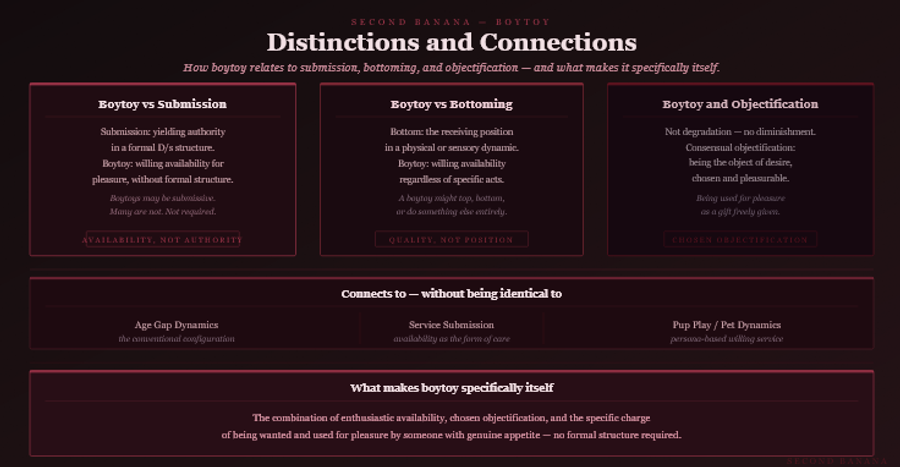
The dynamic is distinct from formal submission in that it does not require the apparatus of power exchange — the negotiated authority structure, the explicit protocols, the titled roles. It is more naturalistic and more specifically pleasure-focused. The boytoy is not in a relationship with a Dominant; they are with someone who wants them and takes what they want, and the charge is in that specific quality of being taken rather than in the relational structure that surrounds it.
It is distinct from simple bottoming in that the boytoy position is specifically about availability and willing use rather than about being the receiving party in a particular physical dynamic. A boytoy might top, might bottom, might do something else entirely — the defining feature is not which specific acts occur but the quality of enthusiastic, pleasure-focused availability that they bring to whatever does.
The Gender Dimension
Boytoy conventionally codes male, and often younger, in relation to an older or more powerful partner. This cultural coding is real and worth acknowledging: the term carries historical associations with a particular configuration in which an older woman keeps a younger man specifically for her pleasure, or in which a younger man makes himself specifically available to someone more powerful. The charge of this specific configuration — the experienced, powerful partner and the eager, available boytoy — has its own specific erotic texture.
But the dynamic has significantly wider application. The boytoy position can be occupied by people of any gender, in relation to partners of any gender, in any age configuration that produces the relevant erotic charge. What matters is the specific quality of willing availability and the specific pleasure of being wanted and used for pleasure — not the specific demographic configuration in which those qualities appear. The piece covers the broader dynamic while acknowledging the specific cultural weight of the term’s conventional usage.
The Psychology of Willing Availability
The Charge of Being Chosen
The boytoy position begins with being chosen — specifically, deliberately selected by someone who wants you for their pleasure. This is not the incidental selection of any sexual partner choosing another; it is the specific charge of being the person someone reaches for because they want you, in this way, for this purpose. The boytoy is not chosen despite their availability; they are chosen because of it — because the specific quality of their willing, eager presence is what their partner wants.
This specific quality of being chosen for what you are and what you bring — rather than in spite of it — is central to the erotic charge of the boytoy position. The boytoy who is reached for, taken, and used by someone who specifically wants that experience from this specific person is having a qualitatively different experience from someone who is merely available. They are being desired specifically, for the very thing that defines them in this dynamic.
Enthusiastic Availability as Active Erotic State
The most commonly misunderstood dimension of the boytoy position is the activity it requires. Willing availability is not passivity. The boytoy who is genuinely in their role — who is truly, enthusiastically available, who is present and responsive and eager — is engaging in an intensely active erotic state that requires presence, attention, and genuine investment.
The quality of a boytoy’s availability is the quality of the experience for both parties. A boytoy who is merely compliant gives their partner something fundamentally different from one who is genuinely, actively, enthusiastically there. The former produces an encounter; the latter produces the specific charge of the boytoy dynamic, in which the partner’s desire is met by genuine, eager availability rather than by performance or obligation.
This means the boytoy must be, in a specific sense, very present. Not directing, not managing, but genuinely there — fully in their availability, fully responsive to what their partner wants, fully bringing the eager, willing presence that is the defining quality of the position. This is not a state that happens automatically. It is an active erotic engagement that requires genuine investment.
The Objectification Dimension
Being a toy — being something that is used for another’s pleasure, that is reached for when wanted and set aside when not — carries a specific objectification charge that is central to the boytoy fantasy for many practitioners. This is not the degrading objectification of being treated as less than human; it is the consensual objectification of choosing to make oneself an object of pleasure for a partner who treats that objectification as a specific and valued gift.
The psychology of consensual objectification is related to but distinct from degradation kink. In degradation, the charge is in the reduction, in the specific pleasure of being diminished or spoken to or treated in ways that activate a particular erotic response. In the boytoy objectification, the charge is in the specific pleasure of being the object of desire — of being something that someone wants to use and does use, with the full knowledge that the wanting and the using are the things that make the experience erotically charged.
Many practitioners of the boytoy dynamic describe the experience of being an enthusiastic toy as one of the most present and engaged erotic states they access — precisely because the objectification focuses their experience entirely on the encounter itself, on being wanted and used in this specific way, without the cognitive layer of managing a mutual dynamic.
Both Sides: The Boytoy and the Partner
Being the Boytoy
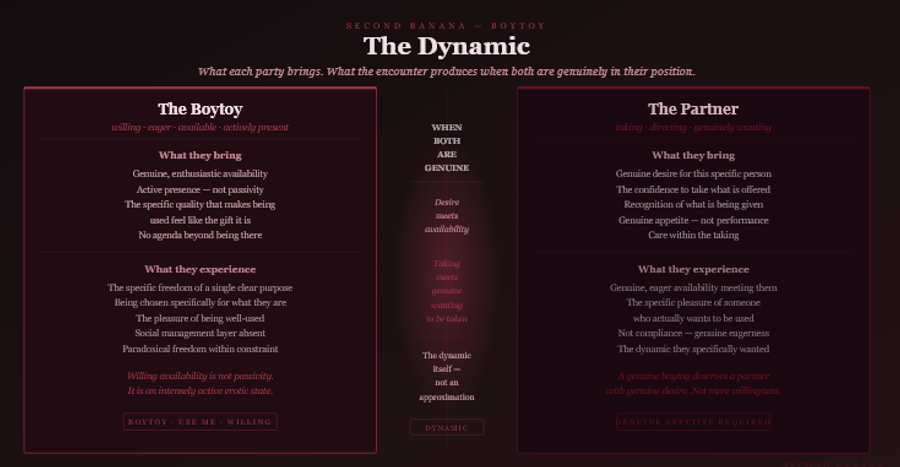
The boytoy’s experience is characterised by the specific relief and pleasure of having a single, clear purpose in an encounter: to be wanted and to make that wanting easy. There is no agenda to bring, no direction to provide, no mutual dynamic to manage. There is only the specific task of being there, being available, being eager — and the specific pleasure of doing this well for someone who genuinely wants it.
Many boytoys describe the state as among the most genuinely free erotic experiences available to them. The freedom is paradoxical: they are specifically constrained to being available, specifically positioned as the person being used rather than using — and within that constraint, they experience a quality of liberation from the ordinary social management layer that most encounters require. They are not managing anyone’s expectations or calibrating their own needs against their partner’s. They are simply, eagerly, there.
The specific pleasure of being well-used — of a partner who takes what they want with genuine desire and genuine confidence, who treats the boytoy’s availability as the gift it is and engages with it fully — is the boytoy’s primary erotic experience. Being wanted in this specific, uncomplicated, pleasure-focused way is an experience that more mutual dynamics, for all their value, do not provide.
Being the Partner Who Uses
The partner in a boytoy dynamic has a specific erotic experience that is also worth naming: the specific pleasure of having a person who is genuinely, enthusiastically available for their pleasure, who is not performing availability but actually bringing it. This is different from the experience of a formal dominant with a submissive. There is less structure, less protocol, more immediacy. The partner reaches for what they want and what they want is there, willing and eager.
The specific quality of a genuine boytoy’s availability — the eagerness, the genuine willingness to be used in whatever way the partner wants, the active presence that makes the availability real rather than merely nominal — produces an erotic experience for the partner that is distinct from other dynamics. They are not managing a power exchange or holding authority in a formal sense. They are simply taking what is offered, in the knowledge that the offering is genuine and that their taking is what their partner specifically wants.
The responsibility this places on the partner is worth naming: a boytoy who is genuinely, actively available deserves a partner who engages with that availability with genuine desire and genuine care. The partner who takes without genuine want, or who fails to recognise and appreciate the specific quality of what is being offered, is not in a boytoy dynamic — they are in something much less interesting.
Boytoy and Related Dynamics
The boytoy dynamic connects to and overlaps with several other orientations in this series, and understanding the connections helps practitioners locate their specific version of this orientation.
The relationship to submission is real but partial. Boytoys may be submissive in the D/s sense — many are — but the boytoy position does not require formal submission. The defining feature is not authority and deference but willing availability and enthusiastic use. Some boytoys are dominant in other contexts and bring the boytoy position specifically to certain encounters or partners.
The relationship to the age gap dynamic is close for many practitioners. The conventional boytoy configuration involves a younger person with an older, more powerful, more experienced partner, and the specific charge of that configuration — the experienced partner’s confidence and appetite, the boytoy’s eager availability — is a specific variant of the broader age gap appeal covered in that piece.
The relationship to the bottom fantasy is real but distinct. A boytoy is often also a bottom — but the defining feature of the boytoy position is the quality of availability and willing use rather than the receiving position per se. The distinction matters for practitioners trying to communicate what they specifically want.
What This Has to Do With Second Banana
The boytoy orientation is one of the more specific and also more difficult to communicate in conventional dating contexts. The specific charge of the position — willing, eager availability for another’s pleasure, enthusiastic use, being taken because someone specifically wants you in this way — requires a partner who understands and wants exactly this, not merely someone who is willing to be pleased.
A boytoy who connects with a partner who wants genuine reciprocity, or who is uncomfortable with taking what is offered, or who misreads the eager availability as manipulation or performance — this match does not produce the boytoy dynamic. It produces awkwardness at best and disappointment at worst. The orientation requires a specific counterpart, and finding that counterpart requires being specific about what one is offering.
The post-first model gives boytoy practitioners the ability to be exactly that specific before anyone responds. A post that describes the quality of availability one brings, the kind of partner one needs, the specific erotic register of the dynamic one is looking for — this post finds the people who already understand what is being offered and want it, rather than finding people who need to be educated about it mid-encounter.
The tag system gives boytoy practitioners specific vocabulary:
- Boytoy — the orientation itself
- Willing availability — the defining quality
- Use me — direct statement of the erotic offer
- Kept / available — for those whose dynamic includes sustained availability over time
- Enthusiastic — the specific quality of availability that makes the dynamic work
- Age gap welcome — for those drawn to the conventional configuration
- No agenda — for those signalling that they are bringing pure availability rather than a mutual dynamic
- Older partner preferred — for those specifically drawn to the experienced-partner configuration
- Discretion — for those whose dynamic involves availability that is not publicly acknowledged
The community on Second Banana — people who communicate specifically and honestly about what they want — includes the people who both want to be a boytoy and who want the specific experience of a genuine, eager, available boytoy. The post is the introduction. The Second Banana tag system signals the register. The right match recognises both immediately.