
Humiliation Kink: The Psychology of Consensual Shame, Why It Works, and What the Full Range Actually Covers | Second Banana
Humiliation:
The Psychology of Consensual Shame, Why It Works, and What the Full Range Actually Covers
Shame Sought: The Paradox and Why It Isn’t One
Humiliation kink — the consensual seeking of experiences that produce shame, embarrassment, or a sense of diminishment as an erotic experience — is one of the most genuinely interesting areas of kink psychology, in part because it seems on its face paradoxical. Shame usually produces avoidance. People go to considerable lengths not to feel embarrassed or diminished in ordinary life. Why would anyone seek experiences that deliberately produce these feelings, and why would seeking them be erotic?
The paradox dissolves when you attend to what humiliation kink actually involves, which is not an undifferentiated shame but a very specific version of it: shame that is controlled, bounded, consented to, and produced within a relationship of genuine trust. The feelings produced by humiliation play — real embarrassment, genuine diminishment, actual shame responses — occur in a context where the person producing them has been given explicit permission and trust to do so, where there is a clear exit available, and where the relationship outside the dynamic is one of genuine care and respect. This specific combination transforms the experience from something aversive into something that can be profoundly erotically charged.
Understanding this is not about explaining humiliation kink away or making it palatable by dressing it in more acceptable terms. The shame is real. The erotic charge is real. And they coexist precisely because of the specific conditions that consensual humiliation play creates.
The shame is real. The consent is what transforms it. Not by making the shame go away — but by making it possible to approach rather than avoid it, within a dynamic that holds both the shame and the person experiencing it safely.
The Psychological Mechanisms
Controlled Exposure and the Eroticisation of Vulnerability
One of the more persuasive psychological frameworks for understanding humiliation kink draws on the psychology of controlled exposure to feared or aversive experience. In ordinary life, shame and embarrassment produce avoidance because they signal social threat — the possibility of rejection, exclusion, or loss of status. In consensual humiliation play, the social threat is removed (the partner doing the humiliating is not actually rejecting or excluding — quite the opposite), but the physiological and emotional response is engaged. This produces a specific experience of going through the shame response in a safe context, with the arousal system engaged rather than the avoidance system.
This mechanism connects to the broader psychology of erotic intensity and arousal: the body’s stress and arousal systems are closely intertwined, and experiences that engage the emotional intensity associated with shame or vulnerability can activate the arousal system alongside rather than instead of the shame response. The result, for practitioners of humiliation kink, is not that shame feels good — it is that shame plus safety plus consent plus trust produces an experience that is erotically charged in a way that shame alone would not be.
The Trust Dimension
Humiliation kink requires, perhaps more than almost any other kink, a genuine and deep trust in the partner delivering the humiliation. The person doing the humiliating is being given specific permission to do something that the receiving partner would find genuinely aversive outside the dynamic. This trust — the specific act of permitting someone to produce shame in you, within a context of genuine care — is itself often described by practitioners as one of the most intimate and meaningful aspects of the dynamic.
The trust produces a specific quality of intimacy: the person being humiliated is genuinely vulnerable, genuinely exposed, genuinely experiencing the shame responses being produced. The fact that this is happening within a relationship of trust rather than in an ordinary social context where shame would signal real rejection gives the experience its specific character. The vulnerability is real; the safety is equally real; and the combination is what makes the dynamic possible.
Release and Relief
Many humiliation kink practitioners also describe a specific quality of release or relief in the experience — a sense in which having the shame produced and witnessed and survived within the dynamic deflates rather than inflates the shame’s power. The thing that is humiliating in daily life — a specific physical insecurity, a way of feeling inadequate, a sense of being lesser in some domain — is brought into the light, named, and engaged with directly in a context of genuine desire rather than rejection. For many practitioners, this produces a paradoxical reduction in the shame’s ordinary power rather than an amplification of it.
The Range: Mild to Intense
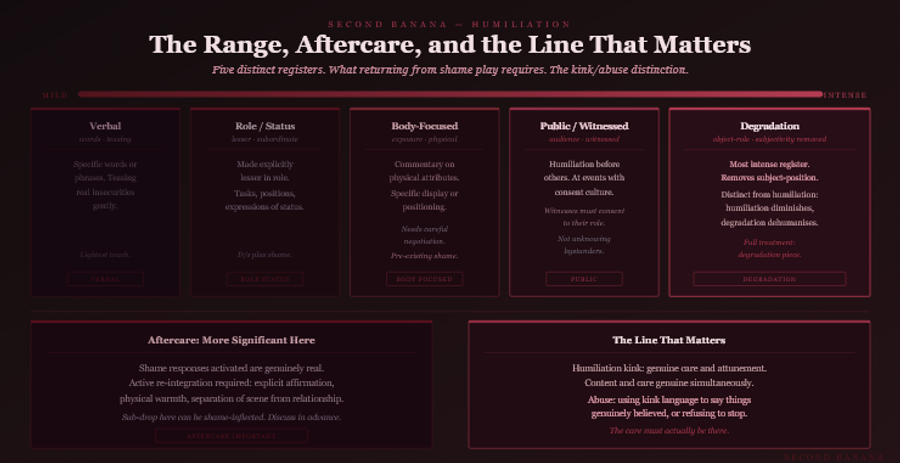
Verbal Humiliation and Embarrassment
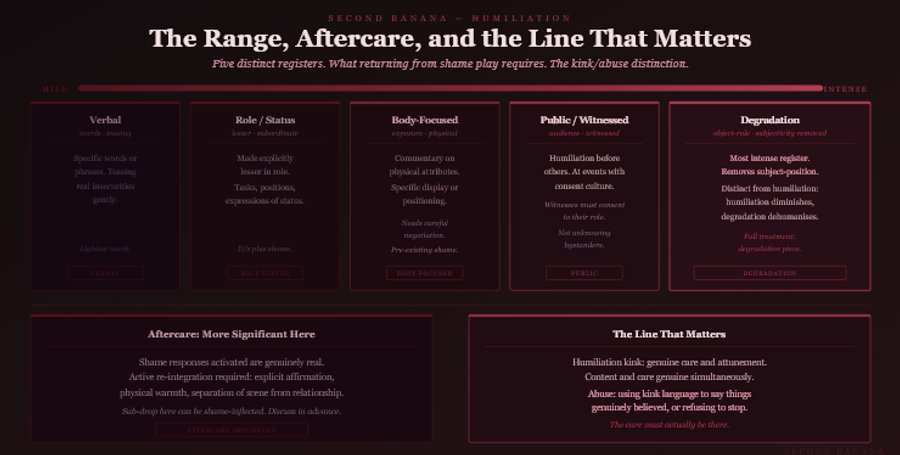
At the milder end of the range, humiliation kink manifests as verbal embarrassment — specific words or phrases that produce a mild flush of shame, teasing that touches real insecurities without going deeply into them, small acts of deliberate embarrassment within an otherwise equal dynamic. Many practitioners whose primary orientation is toward this end describe it as adding a specific edge to erotic encounters rather than as a deeply psychological D/s dynamic — the embarrassment is pleasurable in a relatively uncomplicated way and does not require the extensive negotiation and aftercare that more intense forms do.
Role and Status Humiliation
Further into the range, humiliation takes on a more specifically status-based character: being made to feel explicitly lesser in role or status, being treated as a subordinate in ways that carry genuine weight, being required to perform tasks or adopt positions that express a real differential in the dynamic. This territory overlaps significantly with the broader D/s psychology covered in the Dom piece, but humiliation adds a specific dimension that pure authority dynamics do not always include: the explicit production of shame alongside the power differential rather than simply the power differential itself.
Body Humiliation
Some humiliation kink is specifically focused on the body — commentary on physical attributes, specific ways of positioning or displaying the body that produce exposure and shame, objectification that carries a diminishing rather than simply neutral quality. This territory requires particular care in negotiation because it touches on areas where many people carry genuine and sometimes significant pre-existing shame, and the distinction between consensually engaging that shame within a trusted dynamic and having those insecurities genuinely attacked by a partner requires absolute clarity about what is wanted and what is not.
Public and Witnessed Humiliation
At the more intense end of the range, humiliation kink can extend to public or witnessed contexts — being humiliated in front of others, having the shame witnessed beyond the dyadic dynamic. This version requires significant additional negotiation: who is witnessing, what they know about the context, what is being revealed to them, and whether all parties including witnesses have consented to their role in the dynamic. Public humiliation play that occurs at organised kink events with established consent cultures is different from humiliation that involves unknowing witnesses who have not consented to participating.
Degradation as a Specific Register
Degradation — being treated as an object, as subhuman, as having no value — sits at the most intense end of the humiliation spectrum and has its own specific character distinct from embarrassment and status-based humiliation. Degradation is covered in more detail in the dedicated degradation and praise piece in this series. The distinction that matters here: humiliation produces shame through exposure, diminishment, and embarrassment; degradation more specifically removes the person from the subject-position entirely. Both are legitimate consensual dynamics; they are not the same experience and practitioners who want one may not want the other.
The Psychology of Delivering Humiliation
The person delivering humiliation in a consensual dynamic occupies a specific and demanding position that is different from other dominant roles in important ways.
Effective consensual humiliation requires genuine attunement to the receiving partner — an ability to read what is producing the right kind of shame response versus what has crossed into genuine distress, to calibrate the intensity of what is offered against what is actually wanted, to stop or shift course based on real-time feedback that may be subtle. The partner doing the humiliating must hold the frame of the dynamic firmly — delivering the humiliation with conviction, without apologising or softening it inappropriately — while simultaneously attending closely enough to the receiving partner to stop immediately if the signals indicate genuine distress rather than consensual discomfort.
Many practitioners who deliver humiliation describe a specific satisfaction in the precision this requires: not the crude satisfaction of simply diminishing someone, but the specific craft of finding exactly what produces the right response in this particular person, calibrating it carefully, and holding the dynamic in a way that produces the experience both people are seeking. The skill involved is real, and the care underneath the apparent cruelty is equally real.
What Humiliation Is Not
Consensual humiliation kink is not the same as abuse disguised as kink. The distinction is consent — genuine, specific, ongoing, and reversible consent — and the fundamental orientation of the delivering partner toward the receiving partner’s wellbeing. A partner who uses the language of humiliation kink to say things they actually believe about the person they are with, who delivers humiliation that goes beyond what was agreed, or who refuses to stop when signals indicate genuine distress, is not practicing humiliation kink. They are causing harm.
The presence of genuine care, genuine attunement, and genuine respect for the person outside the dynamic is what distinguishes consensual humiliation play from ordinary cruelty. These are not incompatible — the humiliation can be real and intense while the care is equally real. But the care must actually be there, not just claimed as a justification for behaviour that does not reflect it.
Aftercare: More Significant Here Than Most
Aftercare following humiliation play deserves specific attention because the shame responses activated during a scene are genuinely real emotional experiences, even when consensually produced. The return from a humiliation dynamic is not simply a matter of physical care — it requires active emotional re-integration: being explicitly reminded of one’s actual value and standing in the relationship, being reconnected to the dynamic’s frame of genuine care and respect, having the scene’s content explicitly separated from the relationship’s actual terms.
The specific content of good aftercare after humiliation play depends on the person and the specific dynamic, but commonly includes: explicit affirmation of the person’s value and desirability, physical warmth and closeness, time without the dynamic present before ordinary relational interaction resumes, and sometimes explicit processing of the emotional experience of the scene. Some practitioners also experience sub-drop — the emotional crash that can follow intense play — in a specifically shame-inflected form after humiliation scenes, and pre-discussing this possibility and how to address it is part of responsible preparation.
What This Has to Do With Second Banana
Humiliation kink’s range — from mild verbal embarrassment through to intense degradation-adjacent dynamics — means that the label tells a potential partner very little about what specific experience is being sought. Two people who both identify as drawn to humiliation kink may be seeking experiences that have almost nothing in common.
The post-first model lets practitioners be specific: the register of the humiliation wanted, the specific forms it involves, what the aftercare needs are, and what the dynamic’s emotional frame should be. This specificity protects both partners from significant mismatches that can cause real harm in this particular territory.
The Second Banana tag system gives humiliation kink practitioners specific vocabulary:
- Humiliation kink — the broad orientation
- Verbal humiliation — for those whose primary draw is words and framing
- Mild / embarrassment — for those at the lighter end of the range
- Degradation — for those seeking the full object-role intensity (see dedicated piece)
- Body-focused humiliation — for dynamics centred on physical exposure
- Public humiliation — for those wanting witnessed dynamics
- Humiliation giving / receiving — for position clarity
- Aftercare important — explicit signal about post-scene needs