
Glory Hole: The Psychology of Structural Anonymity, the Fantasy vs the Reality, and What the Wall Actually Does | Second Banana
Glory Hole:
The Psychology of Structural Anonymity, the Fantasy vs the Reality, and What the Wall Actually Does
What the Wall Does
A glory hole is a hole in a partition through which sexual acts — typically but not exclusively oral sex — can be performed or received, with the partition preventing the participants from seeing each other fully. The wall is the defining feature of the practice, and understanding what the wall actually does psychologically is the key to understanding why the glory hole has both a long real-world history and a powerful place in erotic fantasy for people who have never encountered a literal one.
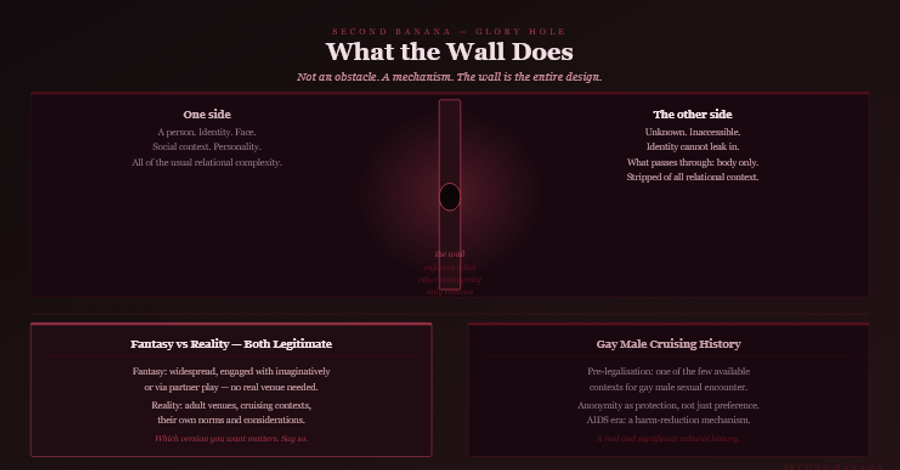
The wall creates structural anonymity — anonymity that is not chosen or maintained through effort but enforced by the physical architecture of the encounter. On the other side of that wall is a person whose face, body, and identity are inaccessible. What passes through the hole is a body part, stripped of the relational and social context that normally accompanies any sexual encounter. The encounter cannot develop into anything recognisably social. It cannot be complicated by personality, by the ordinary negotiations of attraction and communication, by the relational dimension that attaches to any encounter in which both parties are fully present and mutually visible.
This stripping away is not an accident or a limitation of the glory hole — it is its entire design. The wall is not an obstacle to connection; it is the mechanism through which a very specific kind of encounter becomes possible. Understanding this is the foundation of understanding the practice’s psychology.
The wall doesn’t prevent connection. It produces a specific kind of encounter that cannot exist without it — pure, context-free, identity-stripped sexual contact between two people who will remain unknown to each other. That specificity is the point.
The Fantasy and the Reality
Before going further, the fantasy/reality distinction that runs through this practice deserves explicit acknowledgment, because it is more significant here than for most other kinks in this series.
Glory hole fantasy — the erotic imagination of the structural anonymity, the disembodied encounter, the context-stripped sexual act — is widespread and is engaged with by many people who have no desire to encounter a literal glory hole. The fantasy version is available through pornographic content, through erotic writing and roleplay, and through domestically constructed versions involving a partner and a purpose-built or improvised partition. These are genuine expressions of the glory hole as an erotic concept rather than as a physical venue.
Real-world glory holes exist in adult bookstores, bathhouses, cruising parks, and other venues that have historically accommodated anonymous sexual encounter. These involve genuinely different considerations — consent and communication norms, STI risk, the specific social and subcultural context of cruising, and the legal landscape which varies considerably by jurisdiction. A person who is drawn to the fantasy version may or may not be drawn to the real thing, and the piece treats these as distinct rather than assuming the fantasy is merely a step toward the reality.
The History: Gay Male Cruising Culture
The glory hole has its most significant historical home in gay male cruising culture, and this history deserves treatment with genuine respect rather than as background trivia.
Before the legalisation of gay sex in most Western countries, anonymous sexual encounter in semi-public or private spaces — public toilets, parks, bathhouses, adult bookstores — was one of the few available ways for gay men to meet for sex. The glory hole, as a specific architectural feature of the booths in adult bookstores and the stalls of cruising toilets, provided a mechanism for sexual encounter that offered a specific form of discretion and anonymity. The person on the other side of the wall was unknown, which provided protection: if discovered, the encounter was harder to attribute to specific identities than a face-to-face meeting.
This history shaped the glory hole’s specific cultural meanings within gay male sexuality in ways that persist long after legalisation. The cruising context — with its own codes, protocols, and community norms — is a distinct sexual subculture that values the specific quality of anonymous encounter as something in itself rather than as a substitute for something more desirable. For many gay men who participate in cruising culture, the anonymity is not a compromise but the specifically wanted thing.
The AIDS crisis also shaped this history in significant ways: the glory hole became, in some contexts, a harm-reduction mechanism, allowing sexual contact with reduced fluid exchange and therefore reduced transmission risk. The community’s relationship with anonymous sex, glory holes, and risk is complex and historically layered in ways that the piece acknowledges without requiring lengthy elaboration here.
The Psychology of Structural Anonymity
Anonymity Made Physical
The anonymity kink piece in this series covers the psychology of choosing not to reveal identity as an erotic act. Glory hole anonymity is different in a specific and important way: it is not chosen moment by moment but enforced structurally by the physical architecture. There is no decision to maintain anonymity; the wall maintains it without any effort or ongoing choice. This structural quality gives the anonymity a different character — more total, less fragile, impossible to accidentally breach.
For practitioners drawn specifically to this structural quality, the glory hole’s appeal is in the specific completeness of its anonymity. Identity cannot leak in. The person on the other side cannot become someone you know in the ordinary sense — not because you have chosen not to know them but because the architecture makes it impossible. This completeness is what distinguishes glory hole anonymity from other forms of anonymous encounter.
The Disembodied Encounter
What passes through a glory hole is a body part without a person attached to it in the usual relational sense. This disembodied quality — the specific experience of encountering body rather than person, of pure sexual contact without the social context that usually surrounds it — has its own erotic register that connects to the objectification territory covered in the boytoy and fuckdoll pieces but from a different position.
For the person on the giving side (the one presenting through the hole), the specific charge is often in being received, used, attended to in a purely physical way by someone unknown. The anonymity removes the performance layer of a face-to-face encounter — there is no one to impress, no expression to read, no relational dynamic to manage. Just the physical act.
For the person on the receiving side, the experience of a disembodied body part — something offered without the usual social negotiation that precedes sexual encounter — is a specific register of encounter. Many practitioners describe it in terms of pure presence: an offer of physical pleasure from which all the usual social complexity has been stripped.
Surrender of Selection
A specific dimension of glory hole psychology that is less often named but consistently appears in practitioners’ accounts is what might be called the surrender of selection — the specific appeal of not choosing, of receiving what appears rather than selecting from a field of options. Most sexual encounter involves selection: choosing a partner, assessing attraction, negotiating. The glory hole removes selection entirely for the receiving partner. What arrives is unknown and unchosen. For some practitioners, this surrender of control — specifically the control of selection and approval — is a significant dimension of the appeal, connecting to the broader submission psychology covered elsewhere in the series.

Domestic and Partner Versions
The glory hole dynamic is accessible outside of real-world cruising venues through domestically constructed versions that allow the psychological experience to be explored within an established relationship or a specifically arranged encounter.
A purpose-built partition — a screen with an appropriately positioned opening, a door with a hole, or purpose-built products designed for this use — can recreate the structural anonymity within a private setting between partners who have negotiated the encounter fully. In this version, both parties know exactly who is on the other side of the wall, but the wall still creates the specific physical dynamic of the disembodied encounter: the psychological experience of giving or receiving through a partition, of encountering a body part rather than a fully visible person, is available even when the identity anonymity is not complete.
Many practitioners describe the partner version as primarily engaging the fantasy rather than the literal anonymity — the wall as a prop that creates a specific physical and psychological dynamic rather than actual unknown encounter. This is a legitimate and common form of glory hole play that sits squarely in the fantasy rather than the reality column.
Consent and Safety in Real-World Practice
Real-world glory hole encounters operate within specific consent norms that deserve honest treatment rather than being skipped over.
In established cruising contexts — adult bookstores, bathhouses — the consent norms are generally understood within the community and operate through non-verbal signals: the presentation through the hole is an offer; accepting or engaging is consent; declining or moving away is refusal. These signals are real and meaningful within their context. They are not equivalent to the explicit verbal negotiation that this series advocates for most kink practice, and practitioners should be honest with themselves about what they are and are not consenting to.
STI considerations are real and specific. Glory hole encounters that involve oral contact carry STI transmission risk, and the anonymity of the encounter means testing status of the other party is unknown. This is a genuine consideration that practitioners should navigate consciously rather than ignoring.
- Barrier methods significantly reduce but do not eliminate risk in oral encounters.
- PrEP, regular testing, and open communication with healthcare providers are the relevant harm-reduction tools for practitioners who engage in real-world glory hole encounters.
- In domestic/partner versions with known partners of known status, these considerations are different and should be addressed based on that specific relationship context.
What This Has to Do With Second Banana
The fantasy dimension of glory hole kink is probably the most relevant territory for Second Banana’s context — finding partners who share the specific erotic orientation, who want to construct a glory hole dynamic within a negotiated encounter, or who are drawn to the anonymity and disembodied encounter psychology in other forms.
The post-first model allows practitioners to describe specifically what they are looking for: the fantasy version with a partner, real-world cruising, or the specific psychological dimensions of structural anonymity and surrender of selection. This specificity prevents the significant mismatch between someone looking for a fantasy exploration with an established partner and someone looking for a referral to a real-world venue.
The tag system gives glory hole practitioners specific vocabulary:
- Glory hole — the practice and fantasy
- Anonymity kink — for those whose primary draw is the structural anonymity
- Domestic / partner setup — for those wanting to explore the dynamic with an established partner
- Disembodied encounter — for those drawn to the specific register of body-without-person
- Cruising — for those engaged with real-world cruising contexts
- Glory hole giving / receiving — for position specificity
The community Second Banana attracts — people who are specific about what they want and honest about the version of it they are seeking — is the right place to find partners who share the specific texture of this orientation rather than a loose alignment around a label.