Celibacy, Chastity, and Involuntary Celibacy: The Full Honest Picture | Second Banana
Not Having Sex.
The Full Spectrum:
Chosen, Circumstantial,
and Involuntary.
On celibacy, chastity, the genuine suffering of involuntary celibacy, and what the research says helps
The State Nobody Discusses Honestly
Not having sex is one of the most common human experiences and one of the least honestly discussed. It happens for reasons that span almost the entire range of human motivation: religious conviction, personal values, grief, circumstance, disability, recovery, self-discovery, trauma, chronic illness, and — for a population larger than most social commentary acknowledges — simply not finding a willing partner despite genuinely wanting one.
The cultural conversation around celibacy and sexual abstinence tends to flatten this range into two inadequate framings: either the celibate person is admirably virtuous (the religious or intentional celibacy framing) or pitiably deficient (the involuntary celibacy framing). Both framings miss almost everything interesting about what it actually means to not be having sex, what that experience is like across its different forms, and what the research says about the psychological dimensions of sexual abstinence.
This piece covers the full spectrum honestly. Chosen celibacy and chastity in their various forms. The psychology of temporary abstinence as self-care or self-regulation. Asexuality and its relationship to celibacy. And the experience of involuntary celibacy — including the online communities and ideological frameworks that have grown up around it — with the same honesty and directness the rest of this series has brought to every other aspect of human sexuality.
Celibacy and Chastity: The Vocabulary First
Celibacy and chastity are frequently used interchangeably but they are not the same thing, and the distinction matters.
Celibacy refers to the state of not having sexual relations, typically over an extended period. It describes a condition or practice. In religious contexts it often implies a permanent vow; in secular contexts it can be temporary or ongoing without formal commitment.
Chastity is a moral or ethical concept that varies considerably across traditions and contexts. In religious frameworks, chastity typically refers to the virtue of sexual restraint — which for unmarried people means abstinence and for married people means fidelity within the marriage. In secular contexts, chastity is sometimes used to refer to deliberate choice-based abstinence, though the word carries enough religious connotation that many secular practitioners prefer “celibacy” or “abstinence.”
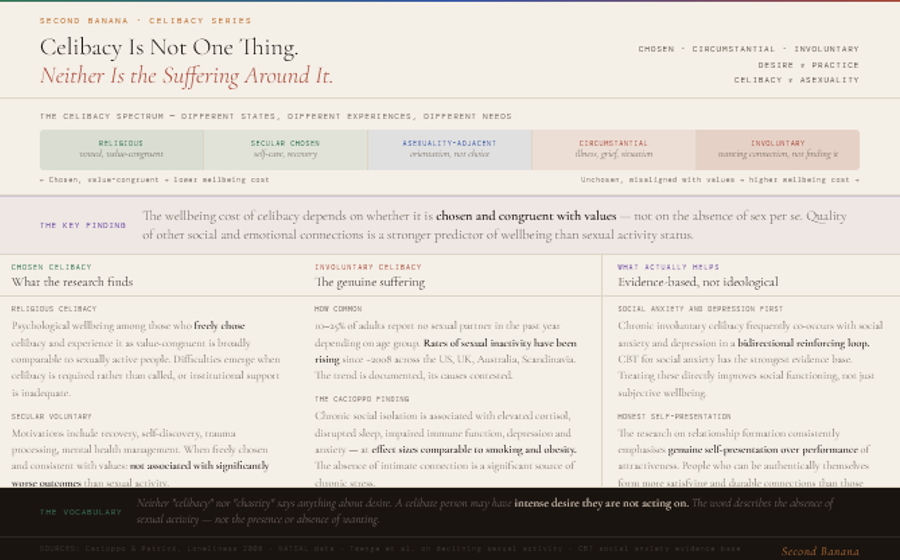
Neither word says anything about desire. A celibate person may experience intense sexual desire that they are choosing not to act on. They may experience minimal desire. They may experience desire that is not directed at available or willing partners. The word describes the absence of sexual activity, not the presence or absence of wanting.
Chosen Celibacy: The R0ange of Practice
Voluntary celibacy — the deliberate choice not to engage in sexual activity for a defined or indefinite period — is practised across a wider range of contexts and motivations than its cultural treatment suggests.
Religious and Traditional Celibacy
The most historically documented form of voluntary celibacy is religious. Catholic priests, Buddhist monks, Hindu sadhus, and practitioners across multiple other traditions have practised formal celibacy as a spiritual discipline, understood within those traditions as a form of renunciation that redirects energy otherwise spent on sexual and relational life toward spiritual practice or service.
The psychological research on long-term religious celibacy is more nuanced than the popular framing (either admirable sacrifice or repressed pathology) suggests. Studies of Catholic clergy and religious orders have found that psychological wellbeing among those who have freely chosen celibacy and who experience it as congruent with their values is broadly comparable to that of sexually active people. The difficulties that emerge in the literature tend to be associated with celibacy that was not freely chosen, that is experienced as a requirement rather than a calling, or that occurs within institutional contexts that provide inadequate emotional support.
This finding — that the wellbeing cost of celibacy depends heavily on whether it is chosen and congruent with values, rather than on the absence of sex per se — holds across multiple forms of voluntary celibacy and is one of the most consistent findings in the literature.
Secular and Intentional Celibacy
Growing alongside traditional religious celibacy is a contemporary secular version: people who choose periods of celibacy outside any religious framework, typically for reasons of self-care, self-discovery, or intentional regulation of their relational and emotional life.
Motivations in this group include: recovering from a difficult relationship or heartbreak; taking time to understand one’s own desire more clearly before re-engaging with partners; managing mental health conditions that sexual relationships complicate; processing trauma with or without formal therapeutic support; or simply experiencing a period without the demands and pleasures of sexual relationships as a form of rest.
Research on this population is sparser than on religious celibacy, but what exists suggests similar dynamics: voluntary secular celibacy, when freely chosen and consistent with personal values, is not associated with significantly worse psychological outcomes than sexual activity. The quality of one’s other social and emotional connections — friendship, community, intimacy that is not sexual — is a stronger predictor of wellbeing than sexual activity status.
Celibacy, Asexuality, and the Distinction That Matters
Celibacy and asexuality are related but distinct. Celibacy is a practice — a choice or circumstance of not having sex. Asexuality is a sexual orientation characterised by low or absent sexual attraction to others.
An asexual person may or may not be celibate. Some asexual people have partnered sex that they enjoy for reasons of intimacy, physical pleasure, or partner connection, even without experiencing sexual attraction in the conventional sense. Some choose not to have sex, which produces celibacy, but the celibacy is a consequence of orientation rather than an independent choice.
A celibate person may or may not be asexual. Most people who choose celibacy for religious or secular reasons experience sexual attraction — the choice is to not act on it. The celibacy is the choice; the desire is not chosen or unchosen.
The conflation of the two — the assumption that celibate people must not experience much desire, or that asexual people must be celibate — is inaccurate in both directions and worth correcting. Desire and practice are separate dimensions.
Involuntary Celibacy: The Honest Account
Involuntary celibacy — the state of not having sexual or romantic connections despite wanting them — is a genuine experience of suffering that a significant number of people have and that the culture does not discuss with anything approaching the honesty it deserves.
Survey data consistently finds that a meaningful minority of the adult population — estimates range from around 10-25% depending on age group and definition — reports not having had a sexual partner in the past year. Among young adults, rates of sexual inactivity have been rising across most Western countries since approximately 2008, a trend documented across the US, UK, Australia, and Scandinavia. The causes of this trend are contested, but its reality is not.
The experience of wanting sexual and romantic connection and not finding it is painful. Not in a trivial or embarrassing way. In the way that genuine loneliness is painful — which the research on social isolation shows is processed by some of the same neural systems as physical pain, with comparable effects on health and wellbeing over time. Taking involuntary celibacy seriously as an experience of suffering is not the same as endorsing any particular explanation of why it happens or any particular response to it.
What the Research Shows About the Experience
Research on loneliness and social isolation is more developed than research specifically on involuntary celibacy, but the two overlap significantly. Work by John Cacioppo and colleagues on the neuroscience of loneliness found that chronic social isolation is associated with elevated cortisol, disrupted sleep, impaired immune function, and increased risk of depression and anxiety — at effect sizes comparable to smoking and obesity. The absence of intimate connection is not a minor inconvenience. It is a significant source of chronic stress with measurable physiological consequences.
What the research also consistently finds is that the subjective experience of loneliness — the felt sense of disconnection — is a stronger predictor of these outcomes than objective social contact frequency. A person who has limited social contact but does not experience this as loneliness has better outcomes than a person who has more contact but still feels isolated. This matters because involuntary celibacy is not only about the absence of sex. It is about the felt sense of being outside the relational world that most people around you are inhabiting.
The Incel Community: The Experience and the Ideology
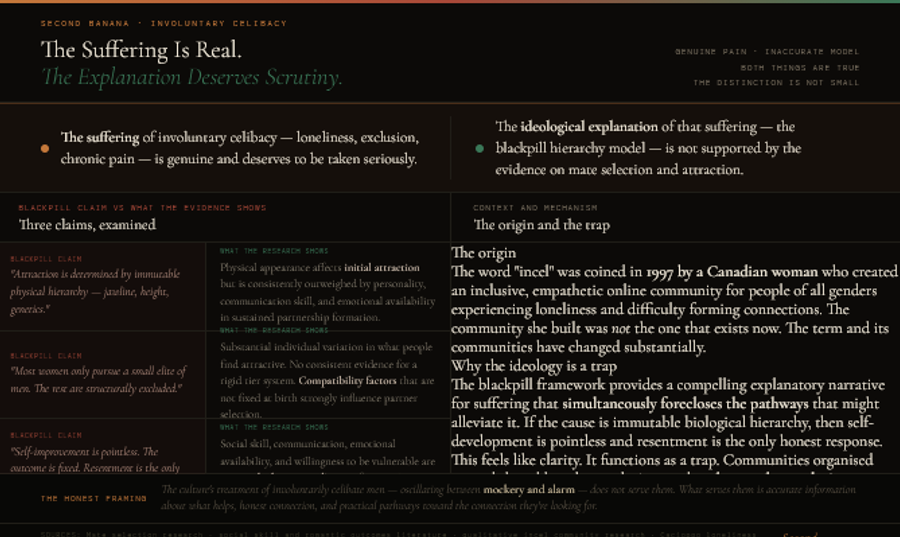
The word “incel” — involuntary celibate — was coined in 1997 by a Canadian woman who created an online community for people of all genders experiencing loneliness and difficulty forming romantic connections. The community she created was inclusive, empathetic, and primarily focused on mutual support.
The term and the community it now describes have changed substantially. The incel community as it exists in its most prominent online forms is now predominantly male, structured around a specific ideological framework — often called the “blackpill” — that explains involuntary celibacy through a hierarchical model of sexual attractiveness in which most women are attracted to a small minority of highly attractive men, and men outside this elite are structurally excluded from romantic and sexual relationships by forces outside their control. Within this framework, the appropriate response to involuntary celibacy is not self-improvement or community-building but “blackpilling” — accepting the impossibility of change and adopting a posture of nihilism and resentment toward the sexual marketplace and the women who, in this framework, are responsible for exclusion from it.
This piece will not adjudicate the blackpill framework in detail. What is worth saying clearly is what the evidence shows:
- The hierarchical sexual marketplace model is not supported by the research on mate selection and attraction, which shows substantial individual variation in what people find attractive, strong influence of personality and compatibility factors that are not fixed at birth, and no consistent evidence for the kind of rigid tier system the blackpill model proposes.
- Factors that the blackpill framework treats as immutable determinants of romantic success — physical appearance, height, jawline structure — are real factors in initial attraction but are consistently outweighed by personality, communication skill, emotional availability, and relationship-building capacity in the formation of sustained partnerships.
- The research on what actually predicts romantic connection and relationship formation consistently emphasises factors that are changeable: social skill, communication, willingness to be vulnerable, the capacity to create conditions in which other people feel comfortable and interested. These are not small factors. They are among the largest predictors in the literature.
- The community dynamics of online incel spaces have been documented in qualitative research as actively reinforcing the beliefs that produce the most suffering — the nihilism, the resentment, the conviction that change is impossible. Communities organised around the shared identity of hopeless exclusion tend to deepen that exclusion, not alleviate it.
The Suffering Is Real. The Explanation Deserves Scrutiny.
The most important thing to hold simultaneously about the incel experience is this: the suffering is genuine and deserves to be taken seriously, and the ideological explanation of that suffering is not accurate and deserves to be questioned.
Loneliness and the absence of romantic and sexual connection are real sources of pain. People in this situation are not weak or ridiculous for finding it hard. The culture’s treatment of involuntarily celibate men — which oscillates between mockery and alarm — does not serve them well. What serves them better is the same thing that serves people suffering from any other source of chronic loneliness: accurate information about what actually helps, honest connection with people who understand the experience without reinforcing its worst interpretations, and practical pathways toward the connection they’re looking for.
The blackpill framework does not provide this. It provides a compelling explanatory narrative for suffering that simultaneously forecloses the pathways that might alleviate it. If the reason you can’t form connections is immutable biological hierarchy, then self-development is pointless, communication skills are irrelevant, and the only honest response is resentment. This is a framework that feels like clarity but functions as a trap.
The research on what actually helps people who are experiencing chronic loneliness and difficulty forming romantic connections is consistent and points in a different direction: social skill development, therapeutic support for the anxiety and depression that frequently accompany chronic loneliness, gradual exposure to social contexts that create opportunities for connection, and — perhaps most importantly — honest examination of the beliefs and patterns that may be contributing to the difficulty.
The suffering of involuntary celibacy is real. The explanation that makes it feel permanent is not the accurate one. This distinction is not small.
What Actually Helps: The Evidence
For people experiencing involuntary celibacy — whatever the cause and whatever ideological framework they’ve used to understand it — the research on loneliness, social skill development, and romantic relationship formation points toward several consistent interventions.
Social Anxiety and Depression Come First
Chronic involuntary celibacy is frequently accompanied by social anxiety and depression — sometimes as a cause of the isolation, sometimes as a consequence of it, usually in a bidirectional relationship where each reinforces the other. Research consistently finds that addressing these directly — through cognitive-behavioural therapy, which has the strongest evidence base for social anxiety, and through whatever combination of therapy and medication is appropriate for depression — improves not just subjective wellbeing but also social functioning and the capacity to form connections.
This is worth stating directly because the blackpill framework treats depression and social anxiety as rational responses to an accurate perception of reality rather than as treatable conditions that distort the perception of social possibility. The research does not support this framing. Social anxiety in particular produces systematic cognitive distortions about how one is perceived by others and about the probability of social success — distortions that make the environment seem more hostile and less navigable than it actually is.
Honest Self-Presentation Over Performance
The research on what actually works in romantic relationship formation emphasises genuine self-presentation over performance of an attractive persona. This is counterintuitive for people who have absorbed the blackpill framework, in which attraction is a function of fixed characteristics rather than of authentic connection. But the evidence is consistent: the people who form the most satisfying and durable romantic connections are not those who most successfully project desirability, but those who are most able to be genuinely themselves in ways that allow others to connect with them authentically.
This is where Second Banana’s architecture becomes directly relevant. The post-first, anonymous model removes the performance pressure that makes authentic self-presentation hardest and replaces it with a context in which the first impression is made by the quality of honest writing about who you are and what you want. The person who can write honestly about themselves — including the difficult things, the vulnerabilities, the specific and unusual desires — has already done the most important thing.
Expanding the Social Context
Research on loneliness consistently finds that people who are chronically isolated have reduced their social exposure in ways that limit the opportunities for connection — sometimes as a consequence of past rejection, sometimes as a protective strategy, sometimes as a symptom of the depression that accompanies isolation. Expanding social exposure — through community involvement, hobby groups, volunteering, classes, shared-interest communities — increases the pool of potential connections and provides practice in the social interaction that makes romantic connection more likely.
The mechanism here is not simply “more chances to meet someone.” It is that social skill — the capacity to engage comfortably, to be genuinely curious about other people, to tolerate the small failures and awkwardnesses of social interaction — is developed through practice and atrophies through avoidance. The person who has been socially isolated for years has, through no fault of their own, had less practice than their peers. The path back is graduated exposure, not waiting for confidence to arrive before attempting connection.
Second Banana and the Full Spectrum
The anonymous, post-first model is particularly well-suited to people who have been outside the dating world for an extended period — whether by choice or circumstance. It allows a first presentation that is about honest desire and honest self-description rather than about projecting a persona that has been validated by recent romantic success. It is, in this sense, an equalisier that makes what you say and how you say it more important than what your dating profile historically looked like.
And the community’s orientation — toward explicit communication, genuine self-disclosure, and the understanding that desire is complicated and worth naming honestly — is precisely the orientation that the research on involuntary celibacy and loneliness identifies as most likely to produce the connections people are looking for. Not performance of attractiveness. Honest communication about who you are and what you want.
If you’ve been outside this for a while, for whatever reason: this is a reasonable place to come back.
Whatever has kept you from it: you’re allowed to want connection. And you’re allowed to look for it. 🍌