Chastity Kink: The Psychology of Denial, the Keyholder Dynamic, and Why Withholding Builds What Giving Cannot | Second Banana
Chastity:
The Psychology of Denial, the Keyholder Dynamic, and Why Withholding Builds What Giving Cannot
The Inverted Pleasure Architecture
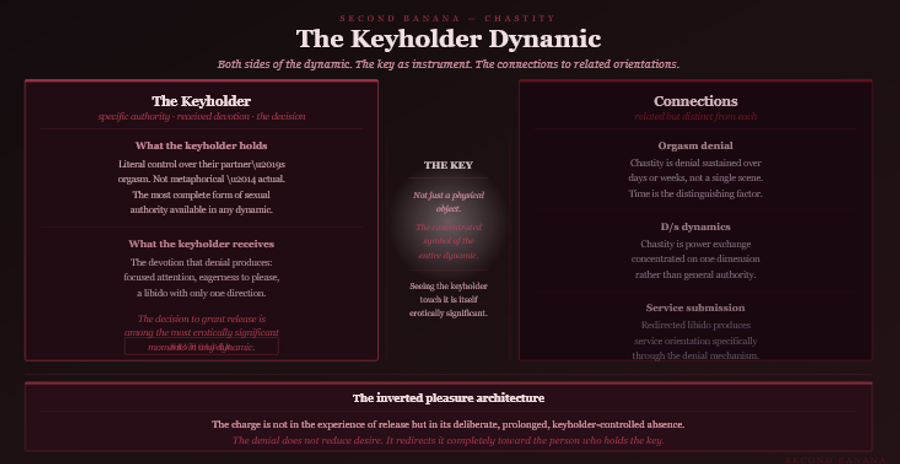
Most erotic dynamics are organised around the pursuit and experience of pleasure — sensation sought, arousal built, release achieved. Chastity kink operates on an entirely different logic. The charge is not in the experience of release but in its deliberate, prolonged, keyholder-controlled absence. The erotic architecture is inverted: what builds is not the approach to orgasm but the sustained state of denial, and what is most erotically significant is not the moment of release but the accumulating quality of wanting that cannot be satisfied.
This inversion produces a specific psychological experience that no other kink in this series quite replicates. The locked partner’s sexuality becomes redirected — not eliminated but channelled. The libido that cannot be released through orgasm becomes directed elsewhere: toward the keyholder, toward service, toward a quality of focused attention and devotion that the absence of release specifically produces. The chastity device is, in this sense, not a lock on sexuality but a redirect of it.
Understanding chastity kink requires sitting with this inverted logic rather than trying to fit it into the usual framework of kink as an intensified form of ordinary sexual pleasure. Chastity is not more orgasm. It is no orgasm, and what that absence builds is the kink itself.
The key is not a lock on desire. It is the instrument through which desire is redirected toward the person who holds it. The denial does not reduce the locked partner’s sexuality — it focuses it completely.
The Locked Partner’s Experience
The Initial Phase: Acuity
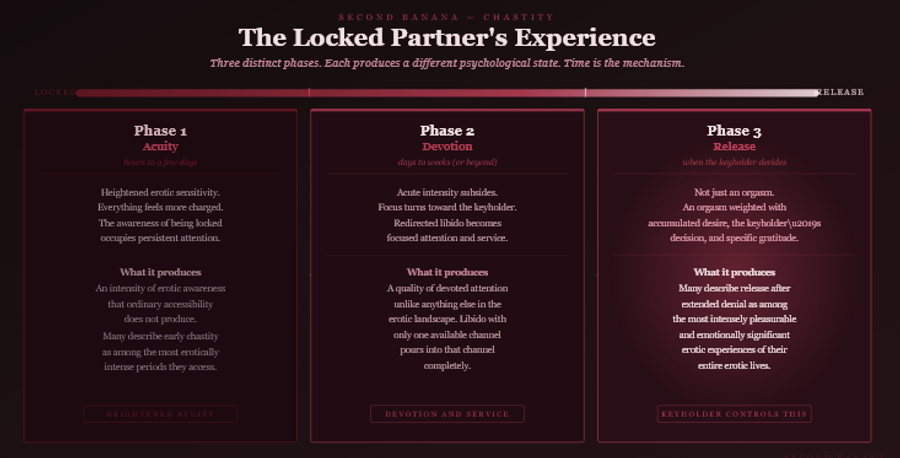
The earliest phase of chastity — from the first hours to the first few days — is characterised by a specific quality of heightened erotic acuity. Everything feels more charged. Touch, attention, the keyholder’s presence — all of these register with an intensity that ordinary sexual availability does not produce. The awareness of being locked, of being denied, of the key’s existence and location, occupies a specific and persistent place in the locked partner’s attention.
This heightened acuity is one of the primary pleasures of chastity for practitioners in the early phase. Many locked partners describe the first days of chastity as among the most erotically intense experiences they access — not because anything intensely pleasurable is happening to their body but because the awareness of being denied has made everything else feel specifically charged in a way that ordinary accessibility does not produce.
The Extended Phase: Devotion
As chastity extends beyond the first few days, the experience shifts. The acute heightened intensity of the initial phase gives way to a more sustained, diffuse quality of devoted attention. The locked partner’s focus turns increasingly toward the keyholder — toward pleasing them, attending to their needs and desires, being of service in ways that feel specifically meaningful because they are the available channel for the redirected libido.
Many practitioners who have extended experience with chastity describe this phase as the kink’s most psychologically distinctive and most valued dimension. The quality of devotion that sustained denial produces — the specific attentiveness, the desire to please that is not transactional but genuinely felt, the way the keyholder’s satisfaction becomes the primary erotic focus — is an experience that many describe as unlike anything else available to them. It is not submission in the formal D/s sense, though it connects to submission psychology. It is something more specifically focused: a libido that has only one available channel and pours into that channel completely.
The Release: When It Finally Comes
The moment of release — when the keyholder decides the locked period is over and unlocks their partner — carries a specific charge that is constituted by everything that preceded it. The orgasm that ends a period of sustained chastity is not simply an orgasm; it is an orgasm that is weighted with the accumulated desire of the denial period, with the specific intimacy of the keyholder’s decision to grant it, and with the specific quality of the locked partner’s gratitude and relief. Many chastity practitioners describe release after extended denial as among the most intensely pleasurable and emotionally significant erotic experiences available to them.
The keyholder’s control of the release is itself part of the erotic architecture. The locked partner does not decide when they come; the keyholder does. This specific form of authority — control not over acts or position or sensation but over orgasm itself — is for many practitioners the most complete form of power exchange available.
The Chastity Device
Physical chastity devices — cages that enclose the penis, preventing erection and orgasm — are a significant element of chastity kink for many practitioners, though not all chastity play involves a device. Understanding what the device does, physically and psychologically, is important for understanding why it is valued.
What the Device Does Physically
A well-fitted chastity device prevents full erection and direct penile stimulation, making orgasm extremely difficult or impossible without removal. The device allows urination and basic hygiene while maintaining the lock. Modern devices range from relatively comfortable silicone cages suitable for extended wear to more elaborate metal designs. Proper fit is essential for extended wear — a poorly fitted device is both uncomfortable and potentially harmful, and significant time is typically required to find the right device for extended chastity practice.
The physical experience of wearing a device is itself part of the kink for many practitioners — the awareness of the device’s presence, the specific sensation of being enclosed and constrained, the persistent physical reminder of the locked state. The device makes the chastity concrete and physical in a way that psychological chastity without a device does not.
What the Device Does Psychologically
The device’s psychological function is arguably more significant than its physical function. The device is a constant, tangible reminder of the chastity agreement, of the keyholder’s authority, of the locked state. It cannot be forgotten or ignored. Even in non-sexual contexts — at work, in public, doing ordinary daily activities — the device is present, and its presence is a persistent low-level erotic reminder of the dynamic.
The key is an equally important psychological object. Where the key is, who holds it, what the keyholder does with it — these become erotically significant in ways that are entirely out of proportion to the key’s physical significance. Many chastity practitioners describe the first time their keyholder visibly holds or touches the key as one of the most immediately erotically charged moments in their chastity experience. The key is not just a physical object; it is the concentrated symbol of the entire dynamic.
Keyholding Without a Device
Not all chastity kink involves a physical device. Psychological or honour-based chastity — in which the locked partner commits to not achieving orgasm without the keyholder’s permission, and maintains this through self-discipline rather than physical constraint — is practiced by many chastity kink participants. For some, the honour-based version is preferred because it places the control clearly in the locked partner’s own commitment rather than in a physical object. For others, the device is essential because its physical presence is itself a significant element of the erotic experience.
The Keyholder’s Experience
The keyholder’s position in a chastity dynamic is one of the most distinctive forms of erotic authority available in the kink landscape — and one of the least examined in popular content, which tends to focus almost entirely on the locked partner’s experience.
The keyholder holds something that is genuinely significant: the key to their partner’s orgasm. This is not metaphorical authority. It is literal, concrete, specific control over one of the most fundamental physical experiences available to their partner. The awareness of this control — that their partner cannot come without their decision, that their partner’s entire sexuality is currently directed toward them by the architecture of the dynamic — produces a specific quality of erotic authority that is unlike the authority of a dominant in other D/s dynamics.
The keyholder also receives the devotion that the locked partner’s redirected libido produces. The quality of attention and service that extended chastity produces in a locked partner is experienced from the keyholder’s side as a specific and particularly pleasurable form of being attended to. The locked partner’s desire, denied its usual outlet, flows toward the keyholder in the form of focused attention, eagerness to please, and a quality of devotion that many keyholders describe as among the most genuinely pleasurable dimensions of the dynamic.
The Decision to Release
Among the most specifically pleasurable experiences in the keyholder position is the decision about when to grant release. The locked partner wants to be released; the keyholder controls whether and when that happens. The pleasure of this decision is not sadistic — it is not about enjoying the locked partner’s frustration per se — but about the specific quality of authority that the decision represents and the specific response that release produces.
When the keyholder decides to grant release, what they receive is not merely a partner who has an orgasm. They receive the expression of accumulated desire, the specific intimacy of a partner who has been building toward this moment for however long the denial period lasted, and the specific quality of gratitude and relief that release after denial produces. Many keyholders describe the moment of granting release as among the most erotically significant experiences available to them in any dynamic.
Chastity and the Broader Dynamic
Chastity kink connects to several other dynamics in this series while remaining distinct from all of them.
It connects most closely to orgasm control and denial, which covers the broader landscape of controlled orgasm in a single-scene or shorter-term context. Chastity is distinguished from general orgasm denial by its temporal scale and by the typical presence of the device — it is denial sustained over days, weeks, or months rather than over a scene.
It connects to D/s dynamics in the sense that the keyholder/locked dynamic is a form of power exchange. But chastity D/s is more specific than general submission: the control is concentrated on one specific dimension (orgasm) rather than being a general authority relationship, and the specific effect on the locked partner’s behaviour and attention is a distinctive product of this specific form of control.
It connects to the service submission dynamic in the devotion and service that extended chastity produces. The locked partner who channels their redirected libido into focused service and attention is expressing their chastity through service in a way that connects to service submission psychology — but is produced specifically by the denial mechanism rather than by a general service orientation.
What This Has to Do With Second Banana
Chastity kink has specific matching requirements that make the post-first model particularly valuable. The locked partner needs a keyholder who understands and genuinely wants this specific authority — not someone who is willing to hold a key as a favour, but someone who is genuinely drawn to the specific control and the specific devotion it produces. The keyholder needs a locked partner who is genuinely committed to the dynamic rather than merely curious about it. The mismatch between these is significant enough that explicit pre-matching matters considerably.
The temporal dimension of chastity also makes explicit communication essential. What counts as a successful chastity dynamic — the duration, the conditions for release, what the locked period involves in terms of service and attention — varies considerably between practitioners, and these details are best established before any specific dynamic begins rather than mid-practice.
The Second Banana tag system gives chastity kink practitioners specific vocabulary:
- Chastity kink — the orientation itself
- Keyholder — for those who want to hold the key
- Locked / chaste — for those who want to be the locked partner
- Device preferred / device optional / no device — the physical dimension
- Short-term / long-term chastity — duration preference
- Devotion and service — for those drawn to the redirected libido dimension
- Orgasm control — for those whose orientation includes the broader denial dynamic
- Honour-based chastity — for those who practice without a device
- Chastity within D/s — for those who want chastity as part of a broader power exchange
The community on Second Banana — people who communicate specifically about what they want and who approach their erotic lives with genuine self-knowledge — is the community where both keyholders and locked partners are most likely to find the specifically compatible partner that chastity kink requires. The post that describes the dynamic clearly, names what one brings and what one needs, and gives the other party enough information to know whether this is the specific dynamic they want — this is what makes a chastity match work.