Compersion: The Other Side of Jealousy | Second Banana
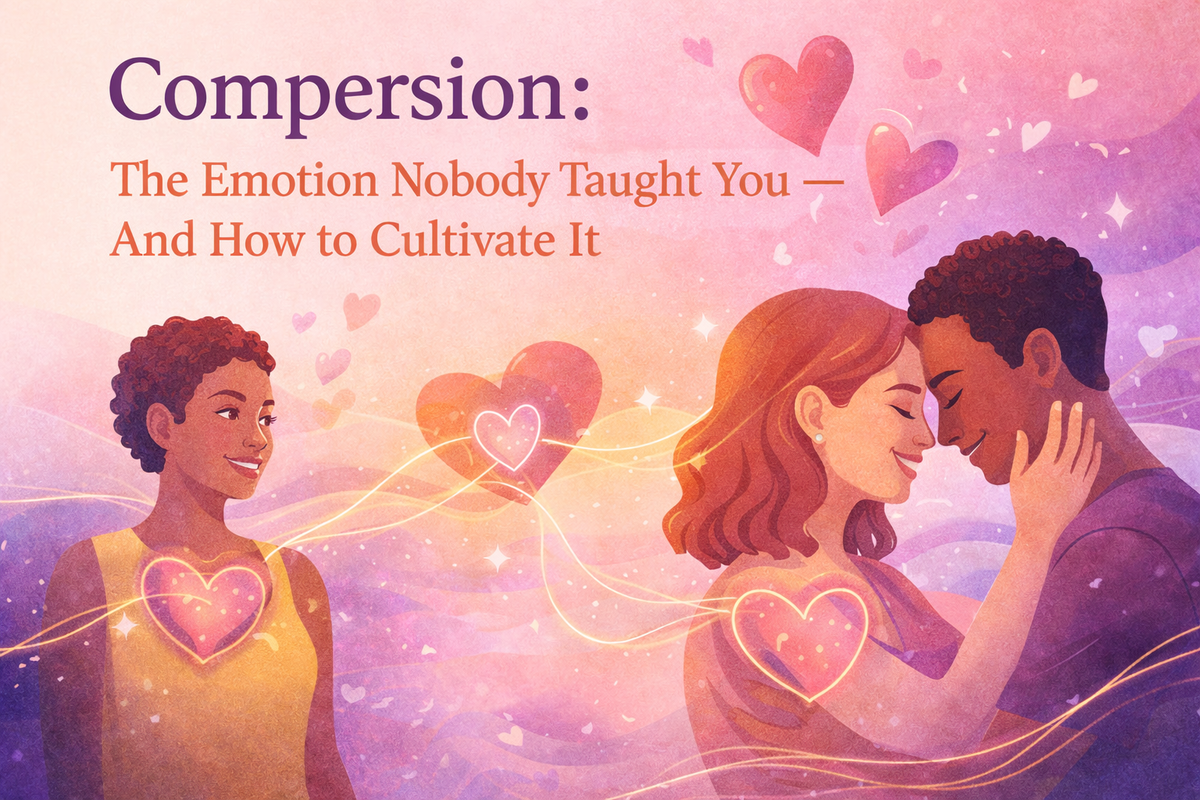
Compersion:
The Emotion Nobody Taught You — And How to Cultivate It
There's a Word for That Feeling
You know jealousy. You've known it since before you had the word for it — that particular tightening in the chest, the calculus of threat, the way attention becomes a resource you're suddenly worried is being directed somewhere you don't control. Jealousy has a long cultural history. It has songs. It has plays. It has an entire architecture of social permission around it: the jealous partner is understood, even expected, even romantic in certain lights.
Compersion has none of that. Most people have never heard the word. It has no songs. It has no cultural shorthand. And yet it describes something entirely real — a feeling that many people in ethical non-monogamy communities report experiencing regularly, and that challenges some of the deepest assumptions our culture makes about love, desire, and what we owe each other.
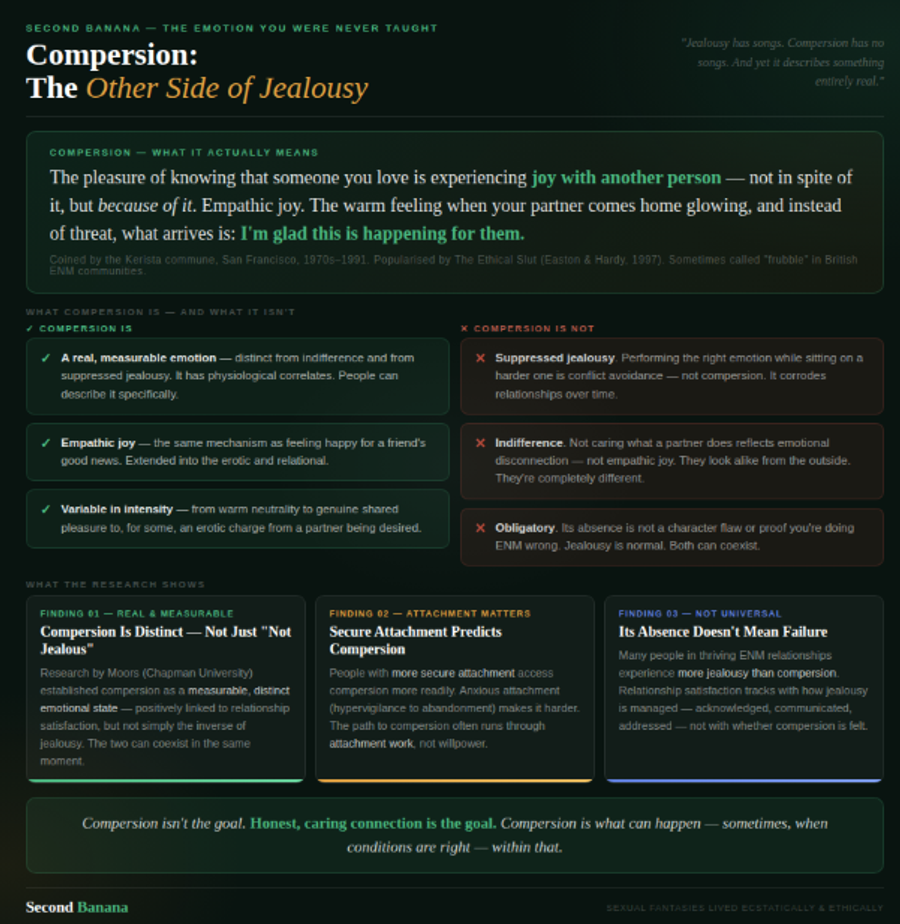
Compersion is, at its most direct: the pleasure of knowing that someone you love is experiencing joy with another person. Not in spite of that other person's involvement. Because of it. The feeling that arises when your partner comes home glowing from a date, and instead of the chest-tightening calculus of threat, what you feel is — warm. Happy for them. Glad.
It is sometimes described as the opposite of jealousy, though that framing undersells it. Jealousy is a response to perceived threat or loss. Compersion is not merely the absence of that threat — it's a positive emotional experience in its own right. It is a form of empathic joy: feeling good because someone you love is feeling good, and finding that the source of their joy doesn't subtract from yours.
This piece is about what compersion actually is, where it comes from (and doesn't come from), why it's harder for some people than others, what the research says about it, and how to cultivate it — including within the kind of intentional, specific, communication-forward connections that Second Banana is designed to facilitate.
Where the Word Came From
Compersion emerged from the Kerista commune in San Francisco — a utopian community that existed from the 1970s through 1991 and practised a form of group marriage they called polyfidelity. The Keristans coined a range of neologisms to describe experiences for which mainstream culture had no language. Compersion was one of them: the positive emotional counterpart to jealousy, specifically in the context of a partner experiencing love or intimacy with another person.
The word didn't leave much of a trace in mainstream culture, but it took root in the polyamory community that emerged through the 1990s and 2000s, partly through The Ethical Slut — Easton and Hardy described compersion as a feeling to be cultivated, as evidence that the abundance model of love could be lived rather than merely theorised. From there it spread into ENM discourse broadly, and more recently into adjacent communities: relationship anarchists, solo poly people, people in open relationships of all kinds.
It occasionally gets called "frubble" in some British ENM communities — a portmanteau of "friend" and "bubble" that captures the warmth of the feeling, if not its full relational complexity. Either word will do. What matters is that there is now a word for a feeling that many people have had without being able to name it, which is itself a significant step toward being able to cultivate it deliberately.
What Compersion Is — And What It Isn't
What It Is
Compersion is an empathic emotional response. It operates through the same basic mechanism as other forms of empathic joy — the capacity to feel pleasure vicariously through someone else's pleasure. Parents often experience a version of this watching their children thrive. Friends experience it when someone they care about gets good news. It's the feeling of a success landing as shared rather than competitive.
In the relational context of ENM, compersion typically arises when a partner's connection with another person — their NRE (new relationship energy) with someone new, a particularly joyful encounter, or simply the visible happiness of being well-loved — registers emotionally as positive rather than threatening. The partner comes home happy. And the feeling that arrives is not jealousy's inventory of what might be slipping away, but something closer to: I love that they're happy. I'm glad this is happening for them.
Compersion can range in intensity. At its mildest it's simply the absence of jealousy plus a kind of warm neutrality: they're happy, that's nice, moving on. At its more pronounced end it's genuinely warm and pleasurable — a felt sense of shared happiness. Some people describe something even stronger: a kind of erotic charge that arises specifically from knowing a partner is desired and desiring, which the community sometimes calls a specific variant of compersion and which shades into what's been called a "cuckold" or "hotwife" dynamic at more explicit levels. These are related but distinct phenomena along a spectrum.
What It Isn't
Compersion is not the suppression of jealousy. This is worth saying clearly, because in ENM communities there can be a social pressure to perform compersion — to present the correct emotional response rather than the actual one. Performed compersion, where jealousy is present but pushed down and a show of happiness is offered in its place, is not compersion. It is conflict avoidance dressed up in the right vocabulary, and it tends to corrode both the individual and the relationship over time.
Compersion is also not indifference. Not caring what your partner does with whom is not the same as feeling positive about it. Indifference can look like compersion from the outside while reflecting emotional disconnection or avoidant attachment rather than genuine empathic joy.
And compersion is not something you are obligated to feel, or something whose absence indicates a character flaw. Many people in otherwise healthy ENM relationships experience more jealousy than compersion, particularly early in their practice, particularly with certain relationship configurations, particularly under certain circumstances. The absence of compersion does not mean you're doing polyamory wrong. It means you're a human being with an attachment system that developed in a particular context and is responding to something new.
Compersion isn't the goal. Honest, caring connection is the goal. Compersion is what can happen — sometimes, when conditions are right — within that.
What the Research Actually Says
Compersion is a relatively new subject for academic research, but the body of work is growing. A few key findings are worth knowing.
Compersion Is Real and Measurable
Research by Jillian Morin and colleagues, as well as work by Amy Moors at Chapman University, has established that compersion is a distinct emotional experience that can be reliably measured and that differs meaningfully from related states like indifference or the suppression of jealousy. People can describe it specifically. It has physiological correlates. It is not merely a theoretical ideal.
A 2021 study published in the Journal of Social and Personal Relationships found that compersion was positively associated with relationship satisfaction and negatively associated with jealousy — but the relationship was not simply that more compersion means less jealousy. The two can coexist. Someone can feel both jealous and compersive about the same situation at different moments, or even simultaneously. Emotional reality is not a zero-sum system.
Compersion Is Associated With Secure Attachment
Multiple studies have found that people with more secure attachment styles tend to experience compersion more readily than those with anxious or avoidant attachment. This is not surprising, if you think about it: compersion requires enough of a felt sense of security in your own connection that a partner's other connections don't register as existential threats. Anxious attachment, which involves hypervigilance around abandonment and rejection, makes this considerably harder. Avoidant attachment, which involves emotional distance as a self-protective strategy, makes compersion less relevant because the underlying intimacy that compersion feeds on is more limited.
This finding has practical implications. It suggests that for people who find compersion elusive, the path to it may run through attachment work — developing a more secure base in themselves and in their relationships — rather than through sheer willpower or ideological commitment to ENM principles.
Compersion Is More Accessible When Communication Is Strong
Research consistently finds that compersion is easier to access in relationships characterised by high levels of open communication, mutual trust, and explicit agreements about structure and expectations. This is the structural logic that Second Banana is built on: when people have communicated specifically and honestly about what they're doing and why, when agreements are clear, when there is genuine care on all sides — the conditions for compersion are considerably more favourable than when things are vague, assumed, or negotiated under pressure.
Compersion Is Not Universal in ENM — And That's Fine
A 2022 study surveying people across relationship structures found that while compersion was common among ENM practitioners, it was far from universal, and that many people in otherwise thriving non-monogamous relationships experienced jealousy more consistently than compersion. The absence of compersion was not associated with relationship dissatisfaction when the management of jealousy was healthy — that is, when jealousy was acknowledged, communicated about, and addressed rather than suppressed or weaponised. Compersion is one positive outcome of ethical non-monogamy done well. It is not the only outcome, and its absence is not a verdict.
Jealousy and Compersion: Not Opposites, More Like Neighbours
A lot of ENM discourse positions jealousy as the problem to be solved and compersion as the solution. This framing is understandable but not quite right, and it sets up an unhelpful dynamic in which jealousy is pathologised and people feel ashamed of experiencing a normal human emotion.
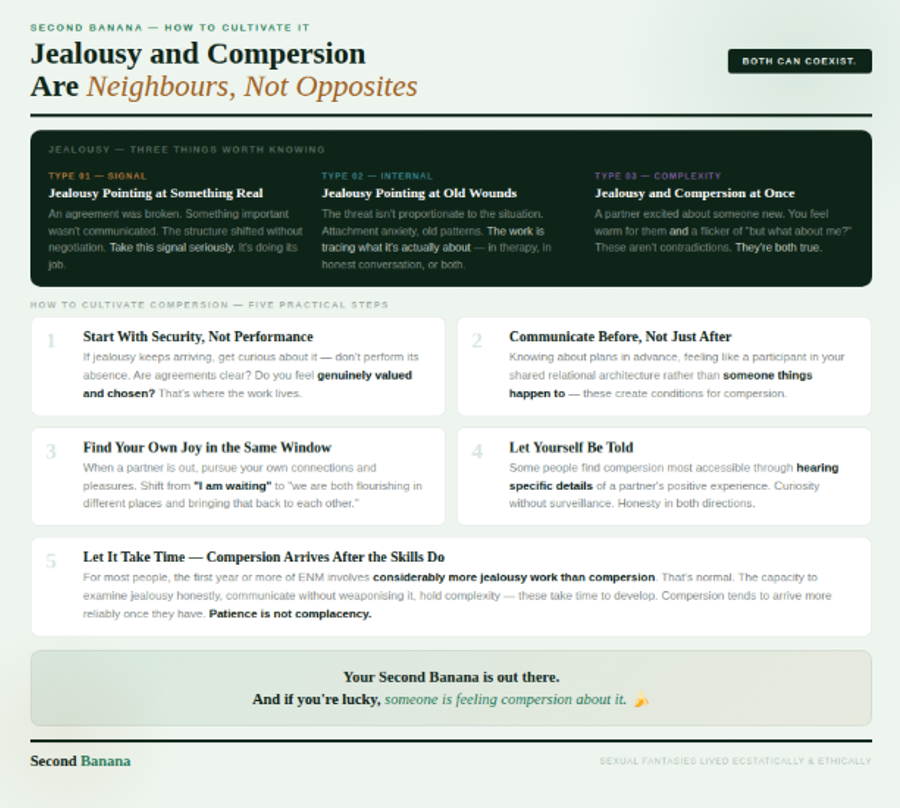
Jealousy is not evidence of failure. It is a signal — one that deserves examination rather than suppression. Sometimes jealousy is signalling genuine threat: an agreement has been broken, something important wasn't communicated, the structure of a relationship has shifted in ways that weren't negotiated. In these cases, jealousy is doing its job, and the right response is to take the signal seriously.
Sometimes jealousy is signalling something more internal: insecurity, attachment anxiety, old wounds being activated by new circumstances. In these cases, the jealousy is real but the threat it's responding to is not proportionate to the actual situation. The work here is not to eliminate the jealousy but to trace what it's actually about and address that — usually in therapy, in honest conversation with a partner, or both.
And sometimes jealousy and compersion coexist. The same situation — a partner excited about a new connection — can produce both a warm feeling of vicarious happiness and a simultaneous flicker of "but what about me?" These are not contradictions. They are complexity. The emotional life of a person who loves and is loved is not required to be simple.
The AFOG framework from The Ethical Slut — Another F***ing Opportunity for Growth — is useful here, not as an excuse to dismiss jealousy but as an invitation to be curious about it. What specifically is this jealousy about? What need is it pointing to? What would make this feel different? These questions, asked honestly and answered honestly, tend to produce more compersion over time than any amount of ideological commitment to feeling the right emotions.
How to Cultivate Compersion — Practically
Start With Security, Not Performance
If you're trying to feel compersion and finding that jealousy keeps arriving instead, the least helpful response is to perform compersion while suppressing jealousy. The most helpful response is to get curious about what's fuelling the jealousy and to address that directly.
What does security feel like in this relationship? Are the agreements clear? Do you feel genuinely valued and chosen? Is there enough connection, attention, and care flowing toward you that a partner's other connections feel like additions rather than subtractions? If the answer to any of these is uncertain, that's where the work lives — not in trying to feel an emotion you're not feeling yet.
Communicate Before, Not Just After
One of the most consistent findings in ENM research is that compersion is easier when communication happens proactively rather than reactively. Knowing in advance about a partner's plans, having expressed and heard agreements about what the encounter might involve, feeling like a full participant in the construction of your shared relational architecture rather than someone things happen to — all of these create the conditions for compersion to arise naturally.
Second Banana's structure supports this. When connections start with specific, honest posts and continue through genuine conversation about what each person is looking for, the context for any subsequent encounter is already built on mutual understanding. The partner who comes home glowing from a Second Banana connection had, in all likelihood, already communicated quite a lot about what that connection was and what it meant. That context makes compersion easier.

Find Your Own Joy in the Same Window
One practical approach that many ENM people find helpful: when a partner is out with someone else, treat that time as an opportunity for your own flourishing rather than an occasion for monitoring your feelings about their absence. Pursue your own connections, your own interests, your own pleasures. Let the parallel be generative rather than competitive.
This doesn't resolve attachment anxiety through sheer distraction. But it does shift the frame from "I am waiting while they are having a good time" to "we are both having a good time, in different places, and we will bring that richness back to each other." The latter frame is considerably more conducive to compersion.
Let Yourself Be Told
Some people find compersion most accessible not in the abstract but in the specific: being told by a partner, in some detail, about a positive experience with someone else. This isn't universal — for some people, detail activates jealousy rather than compersion — but for others, hearing that a partner was genuinely happy, genuinely connected, genuinely seen by someone else produces exactly the warm empathic response that compersion describes.
This requires honesty in both directions: the telling partner needs to be willing to share without performing happiness that wasn't real, and the listening partner needs to have genuine curiosity rather than a surveillance agenda. When both conditions are met, the conversation can be one of the most intimacy-building things that happens in an ENM relationship.
Let It Take Time
Compersion is not typically the immediate emotional response to the early stages of ENM. For most people, the first year or more of navigating multiple connections involves considerably more jealousy work than compersion. That's normal. The emotional skills required for ethical non-monogamy — the capacity to examine jealousy honestly, to communicate difficult feelings without weaponising them, to hold complexity without collapsing it — take time to develop, and compersion tends to arrive more reliably once those skills are more established.
Patience with yourself in this process is not complacency. It's the realistic understanding that growing a new emotional capacity takes longer than reading about it.
Compersion and Second Banana
Second Banana is a community of people who take their erotic and relational lives seriously. That seriousness — the specificity of the posts, the honesty of the tags, the care with which people communicate what they're looking for — creates an environment that is structurally conducive to compersion in ways that mainstream hookup culture simply isn't.
When connections are built on honesty from the beginning. When the person someone connects with through Second Banana was specifically sought, specifically communicated with, specifically consented to. When a partner's good experience is the product of their own clear-eyed pursuit of something specific they wanted — rather than an accident or a deception — the conditions for compersion are considerably more favourable.
This doesn't mean every Second Banana connection is accompanied by compersion in every partner involved. Emotional reality is messier than that. But it does mean that the communication structures that support compersion — specificity, honesty, prior agreement, genuine care on all sides — are built into how the platform works rather than being extras that some people get around to.
The people on Second Banana are, by and large, the kind of people who have thought about what they want, who communicate honestly about it, and who take their partners' experiences seriously. These are exactly the people with whom compersion is most likely to arise — and to be felt, rather than performed.
Your Second Banana is out there. And if you're lucky, so is someone feeling compersion about it. 🍌