Leather: The Material, the Culture, the Identity, and Why This Is More Than a Fetish for the People Who Wear It | Second Banana
Leather:
The Material, the Culture, the Identity, and Why This Is More Than a Fetish for the People Who Wear It
Not Just a Material
Leather fetishism occupies different ground from most other material fetishes covered in this series, including the latex piece immediately preceding it. Where latex is primarily a material experience — the specific tactile, olfactory, and enclosure properties of the substance itself — leather carries something additional: a cultural history, a community, a set of codes and meanings and identity markers that have accumulated over decades and that give leather a weight and significance beyond what any material produces on its own.
This does not mean leather fetishism requires engagement with leather culture. Many people are drawn to leather for its material properties alone — the smell, the weight, the feel, the specific aesthetic quality of real leather — without any connection to or interest in the subculture that has grown around it. Both orientations are real and legitimate. What distinguishes leather from latex in this series is that the cultural dimension is substantial enough to deserve its own treatment alongside the material properties, because for many practitioners the two are inseparable.
This piece covers both: the material properties that make leather specifically and genuinely compelling, and the cultural context that gives those properties additional layers of meaning for practitioners who are engaged with leather as identity and community as well as material.
Leather ages. It marks. It smells differently worn than new. It holds the shape of the body that has worn it. No other fetish material does what leather does over time — and for the people for whom this matters, that quality is the whole point.
The Material Properties
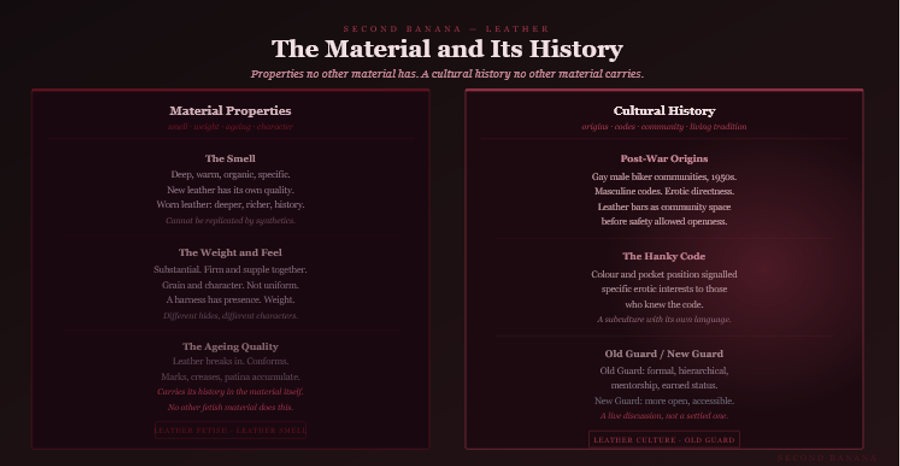
The Smell
Leather’s olfactory profile is among the most distinctive and immediately recognisable of any material, and for many leather fetishists it is the primary or most powerful sensory trigger. Real leather — particularly well-worn leather — has a specific smell produced by the tanning process, by the organic compounds in animal hide, and by the accumulation of use: body heat, oils, the particular history of the garment. This smell is described by practitioners as deep, warm, organic, and specifically itself — unmistakable in a way that is immediately and powerfully connected to their erotic response.
The distinction between the smell of new leather and worn leather is significant for many practitioners. New leather has its own specific quality, but leather that has been worn, broken in, and accumulated history has a depth and specificity that many practitioners describe as categorically more compelling. This time-dimension of leather’s olfactory profile — the way the smell deepens and develops with wear — is one of the properties that most clearly distinguishes leather from synthetic alternatives that may approximate the visual or tactile properties but cannot replicate this dimension.
The Weight and Feel
Real leather has a substantial weight and a specific tactile quality that synthetic alternatives do not replicate. The feel of quality leather against skin or in the hands — the particular combination of firmness, suppleness, and warmth — is distinctly its own. Where latex is smooth and uniform, leather has grain and character: different hides, different tanning processes, different weights and thicknesses all produce genuinely different tactile experiences. A well-crafted leather harness has a quality of presence — weight, substance, the specific feeling of the material against skin — that practitioners describe as significantly different from equivalent items in other materials.
The Ageing and Breaking-In Quality
Perhaps the most distinctive property of leather as a fetish material is the way it changes over time. Leather breaks in: it softens with wear, conforms to the body that wears it, develops creases and marks specific to use. A piece of leather that has been worn regularly develops a character that new leather doesn’t have — the creases at specific fold points, the shine that develops on high-contact surfaces, the patina that accumulates with time and care. This ageing quality is, for many leather practitioners, among the most specifically valued properties of the material. A well-worn piece of leather gear carries its history in a way no other fetish material does.
The Cultural History
The Origins in Post-War Gay Male Biker Culture
Modern leather culture has its roots primarily in post-World War II gay male biker communities in the United States, particularly in cities like San Francisco, Chicago, and New York. Veterans returning from war, accustomed to the masculine codes and camaraderie of military culture, and navigating a society that criminalised their sexuality, found in biker culture and its associated aesthetics — leather jackets, boots, the iconography of the road — a way to express both their masculinity and their erotic orientation in a coded, semi-public way.
The leather bars that emerged from the 1950s onward were spaces that combined the social function of gay bars with a specific aesthetic and erotic culture organised around leather and the values it represented: toughness, masculine solidarity, erotic directness. The community that developed in these spaces elaborated its own codes, hierarchies, and practices over the following decades, producing what is now known as leather culture.
The Hanky Code and Leather Signalling
Leather culture developed an elaborate system of signalling that allowed practitioners to communicate their erotic interests and orientations without explicit speech — necessary in an era when explicit communication was legally dangerous and socially impossible in most contexts. The handkerchief code — hanky code — in which different coloured handkerchiefs worn in different pockets communicated specific erotic interests to those who knew the code, is the most well-known element of this signalling system.
The specific pieces of leather gear worn and how they were worn carried their own meanings within leather community: left versus right positioning, the presence or absence of specific items, the specific style and cut of gear all communicated orientation and interest within the community. This codified communication system reflects the depth of leather culture as a genuine subculture with its own language rather than simply an aesthetic preference.
Old Guard and New Guard
The terms Old Guard and New Guard describe, roughly, the distinction between the more formal, hierarchical, protocol-oriented leather culture that developed in the 1950s through 1970s and the more relaxed, accessible approach to leather that emerged from the 1980s onward. Old Guard leather culture emphasised mentorship, earned status, formal protocols around dominant and submissive roles, and a specific set of values around what leather meant and how it was properly expressed. New Guard leather culture is generally more inclusive, less hierarchical, and more open to practitioners outside the specific demographic (gay male, often working-class) that Old Guard culture centred.
Both traditions continue to exist and overlap. The tension between them — about authenticity, about who leather culture is for, about what the values of the community are — is a live discussion within the leather community rather than a settled question. New practitioners entering leather culture often find themselves navigating this history whether or not they are aware of it, and having some awareness of it is part of engaging respectfully with a community that takes its own history seriously.
Leather as Identity
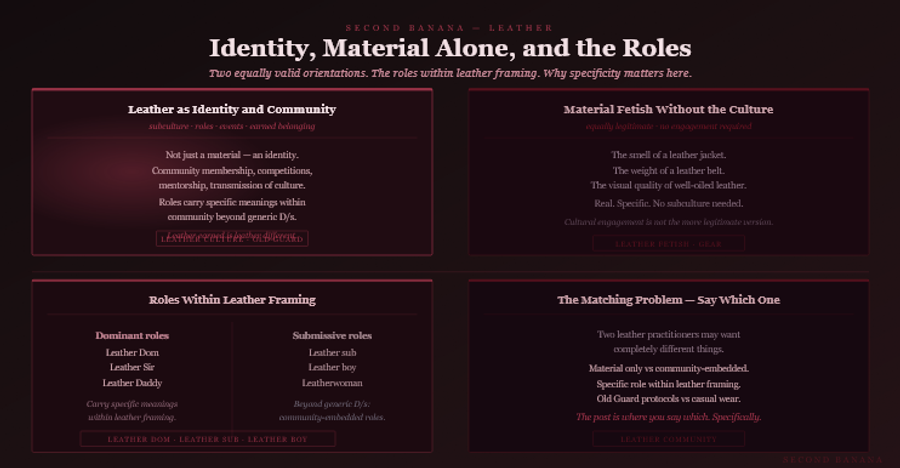
For many leather practitioners, leather is not primarily an erotic accessory or a material fetish but an identity: a way of understanding and expressing who one is erotically, relationally, and sometimes more broadly. The leather community provides a social context in which this identity is recognised, shared, and given meaning through community membership, events, competitions (Mr Leather contests and their equivalents), and the ongoing transmission of culture from more experienced practitioners to newer ones.
Leather identity often involves a relationship to specific roles — leather Dominant, leather submissive, leatherwoman, leatherman — that carry specific meanings within the community beyond their generic D/s equivalents. These roles come with their own specific aesthetics, behaviours, and community expectations that practitioners who engage deeply with leather culture take seriously and invest real effort in embodying.
The Material Fetish Without the Culture
It is equally important to say clearly that leather’s cultural history and community are not prerequisites for having a genuine erotic orientation toward leather as a material. Many people are drawn to leather — its smell, its weight, its feel, its visual quality — entirely outside any engagement with leather culture, and this orientation is fully legitimate on its own terms.
The smell of a leather jacket. The weight of a leather belt. The specific visual quality of well-oiled leather. These are real and specific erotic triggers for practitioners whose draw to leather is primarily or entirely material rather than cultural. The piece acknowledges both dimensions without treating cultural engagement as the more legitimate version.
What This Has to Do With Second Banana
Leather’s dual nature — material fetish and cultural identity — creates a matching challenge that is more complex than most other kinks in this series. Two people who both identify with leather may be oriented toward it in completely different ways: one primarily seeking the material properties in an otherwise uncoded erotic context, another deeply engaged with leather culture and its protocols and looking for a partner who shares that engagement.
The post-first model lets leather practitioners be specific about which dimension they are expressing and which they are seeking — material orientation, cultural community engagement, specific leather roles, or some combination of these.
The tag system gives leather practitioners specific vocabulary:
- Leather — the broad orientation
- Leather culture / leather community — for those engaged with leather as subculture
- Leather Dom / leather Sir / leather Daddy — for dominant roles within leather framing
- Leather sub / leather boy — for submissive roles within leather framing
- Leather fetish — for those primarily oriented toward the material properties
- Gear — for those whose primary draw is leather equipment specifically
- Old Guard — for those engaged with the more formal leather culture tradition
- Leather smell — for those for whom the olfactory dimension is primary
The community Second Banana builds — people who can be specific about what they want and who take their erotic identities seriously enough to represent them accurately — is the right place for leather practitioners of all orientations to find the partners and connections that match what they are actually looking for.