Muscle Worship: The Psychology of Strength as an Erotic Category — Attraction, Devotion, and the Power That Flows Through Being Seen | Second Banana
Muscle Worship:
The Psychology of Strength as an Erotic Category — Attraction, Devotion, and the Power That Flows Through Being Seen
Attraction Is Not the Same as Worship
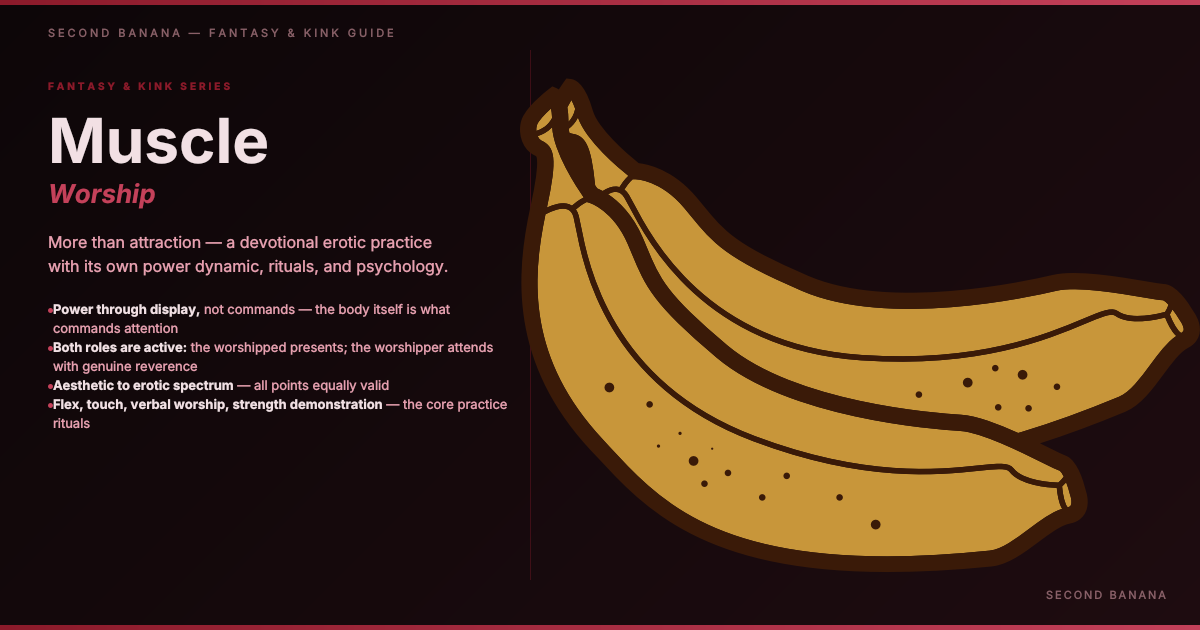
Finding muscular bodies attractive is common — widespread enough to be unremarkable, built into mainstream aesthetic standards, present across orientation and gender in various forms. Muscle worship is something different. The ‘worship’ in the name is doing real work: it names a specific erotic practice characterised by devotion, ritual, and a power dynamic that does not reduce to simple attraction. The difference is between appreciating a painting and approaching it with reverence.
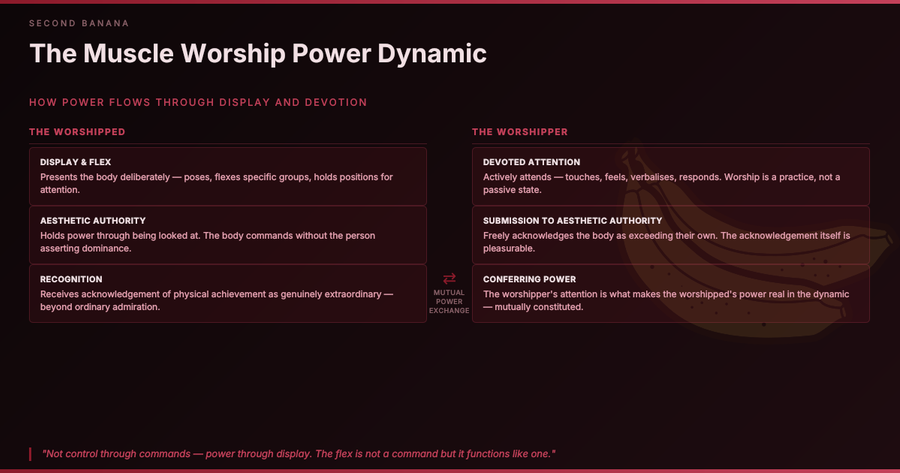
Muscle worship involves the deliberate, focused attention of one person to the body of another — touching, examining, admiring, often performing specific rituals like feeling the flex of a muscle under the hand, tracing definition with fingers, expressing verbal or physical awe. The muscular person displays, flexes, presents their body for this attention. The worshipper receives it with an attitude that is closer to devotional than to merely appreciative. This specific dynamic — the worshipped and the worshipper in their distinct roles — is what makes muscle worship its own erotic category rather than simply a preference for a body type.
You’re not just attracted to the muscle. You’re in relationship with it — attending to it, making something of it, giving it an audience it knows how to receive.
The Power Dynamic: How It Actually Works
Power Through Display
The power structure in muscle worship is unusual and worth naming clearly. In many kink dynamics, power flows from one person to another through control, restraint, or explicit authority. In muscle worship, power flows through display and the submission of attention. The muscular person holds erotic power by virtue of being looked at, touched, admired — by being the object of focused devotional attention. The worshipper submits not to commands but to aesthetic authority: the body itself is what commands.
This is a genuinely distinct power structure. The person being worshipped does not need to assert dominance in the conventional sense — their body does it for them. The flex is not a command but it functions like one: it directs the worshipper’s attention, sets the terms of the interaction, structures what happens next. And the worshipper, in attending closely, in expressing genuine awe or reverence, confers the power they are also responding to. The dynamic is mutually constitutive in a way that few other kink structures are.
The Worshipper’s Position
The worshipper’s role is active, not passive. Worship requires engagement, attention, responsiveness — it is a practice, not merely a state of being attracted. The specific pleasures of the worshipper’s position include the focused permission to attend closely to a body that commands attention, the specific tactile experience of feeling muscle definition and density under the hands, the psychological pleasure of being in the presence of physical power, and the relational dynamic of being received as the person whose attention is worth having.
There is also a submission dimension that many muscle worship practitioners name explicitly: the specific pleasure of acknowledging that another person’s body exceeds one’s own, of orienting oneself as smaller or less powerful in relation to it, of finding that acknowledgement pleasurable rather than threatening. This submission is freely given and specifically pleasurable — it is not humiliation in the conventional sense, though it shares some structural features with it.
The Worshipped Position
Being worshipped is its own distinct erotic experience, and the psychology of it is more complex than simply enjoying admiration. The person being worshipped has typically invested enormous effort in their body — years of training, diet discipline, specific physical development. Muscle worship offers a form of recognition that goes beyond the social acknowledgement that a fit body attracts: it names the body as genuinely extraordinary, as worth devotional attention, as an erotic and aesthetic achievement that commands reverence.
The flexing and display dimension of the worshipped role has its own specific quality. Flexing is a performance: it requires deliberate presentation, the knowledge of one’s body’s best angles and most impressive configurations, the ability to hold a pose while being attended to. Many practitioners in the worshipped role describe flexing for a worshipper as one of the most specifically pleasurable experiences available to them — the combination of physical sensation, the worshipper’s response, and the performative pleasure of showing what the body can do.
The Aesthetic-Erotic Spectrum
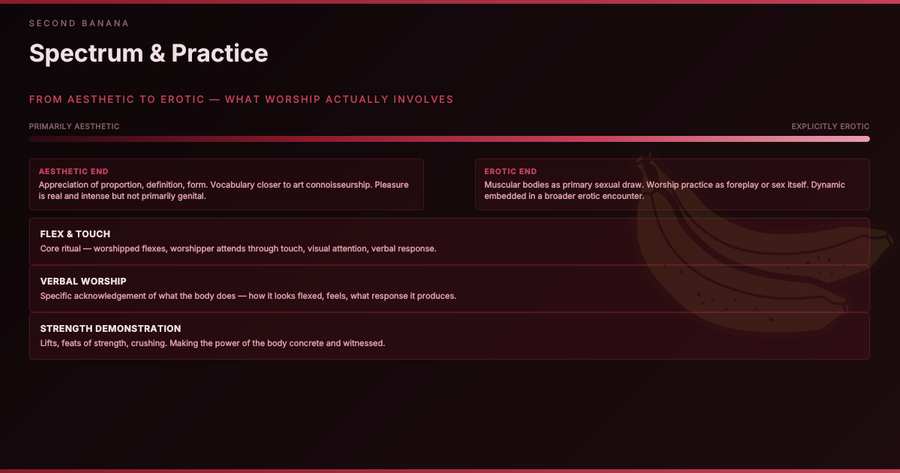
Muscle worship practitioners span a wide range in terms of how explicitly erotic the practice is for them. At one end, the experience is primarily aesthetic: the muscular body is apprehended as a work of art, as an achievement of form, and the worship practice is closer to connoisseurship than to sexuality in the conventional sense. The pleasure is real and intense but not specifically genital, and many practitioners in this range describe the experience using the vocabulary of art appreciation — proportion, definition, symmetry, form.
At the other end of the spectrum, muscle worship is explicitly and centrally erotic: the attraction to muscular bodies is a primary sexual draw, the worship practice is foreplay or is itself sexual, and the dynamic is embedded in a broader erotic encounter. Most practitioners are somewhere in between, and many experience the aesthetic and erotic dimensions as genuinely difficult to separate — the beauty of the body and its erotic charge are intertwined rather than distinct.
Both ends of this spectrum, and everything in between, are equally valid as erotic orientations. The person for whom muscle appreciation is primarily aesthetic is not experiencing something lesser or sublimated; the person for whom it is explicitly sexual is not experiencing something crass or reductive. The spectrum simply maps the range of ways that the specific erotic category of muscle worship manifests across practitioners.
Cultural Roots and Community
Gay Male Bodybuilding Culture
Muscle worship has deep roots in gay male culture, particularly in the bodybuilding and physique communities that developed from the mid-twentieth century onward. The physique photography tradition of the 1950s and 1960s — nominally produced as health and fitness material but understood by its audience as something more — was one of the earliest venues for the public circulation of images whose function was the admiration of muscular male bodies. The gay bodybuilding scene that developed from the 1970s onward created communities in which muscle worship was named explicitly and practiced openly.
This history is worth knowing because it shaped the vocabulary, the rituals, and many of the conventions that muscle worship practice still draws on. The specific aesthetics of the tradition — the flexing poses, the stages and competitions, the emphasis on definition and proportion over raw size — are cultural products with a history, not simply natural expressions of attraction.
Beyond Gay Male Culture
While the gay male tradition is the most historically visible and culturally developed, muscle worship is not confined to it. Women who worship muscular bodies — male, female, or non-binary — have their own communities and traditions. Non-binary and trans practitioners are present across all roles. Straight men who worship muscular women, or who seek to be worshipped by women, form their own distinct subcommunity. And the growing visibility and cultural acceptance of female bodybuilding has created new venues for muscle worship dynamics that the earlier tradition did not accommodate.
The piece treats all of these as equally legitimate expressions of the same underlying dynamic. Muscle worship is a practice, not a demographic, and it belongs to anyone for whom the specific combination of strength, display, and devotional attention constitutes a genuine erotic category.
What Muscle Worship Involves in Practice
The Flex and Touch Rituals
The most common practical elements of muscle worship sessions are flexing and touch. The worshipped person flexes specific muscle groups — biceps, chest, back, legs, abdomen — and the worshipper attends to each flex through touch, verbal response, visual attention, or some combination. The flex-and-feel sequence is the core ritual of most muscle worship practice: the presentation and the reception, repeated across different muscle groups with varying intensity.
Touch in muscle worship is specific and purposeful: feeling the hardness of a flexed bicep, the density of a developed back, the definition of abdominal muscles. Many worshippers describe the tactile experience of muscular density as one of the most specific and important pleasures of the practice — not just visual admiration but physical contact with something that feels genuinely different from other bodies.
Verbal Worship
Verbal expression of admiration, awe, or reverence is a significant component for many practitioners. This ranges from straightforward compliments to more elaborate verbal devotion — describing what the worshipper sees and feels, expressing the specific quality of their response to the body they are attending to. For the worshipped person, specific verbal acknowledgement of what their body does — how it looks flexed, how it feels, what response it produces — is often as important as the physical attention.
Strength Demonstrations
Some muscle worship practice extends beyond the body itself to demonstrations of what the body can do: lifting the worshipper, performing feats of strength, crushing or bending objects. These demonstrations are not primarily about practical utility but about making the power of the body concrete and witnessed. The worshipper’s experience of being lifted — of having their weight treated as trivial by the worshipped person’s strength — is a specific and frequently cited dimension of the practice.
What This Looks Like on Second Banana
Second Banana’s post-first model is specifically suited to muscle worship, because this is a kink where showing rather than telling does most of the communication work. A practitioner who posts authentically about what specifically draws them — the flex, the density, the specific muscle groups, the devotional dynamic — communicates something that a profile-first system would not easily convey.
The Second Banana tag system gives practitioners the vocabulary to find each other across both roles and orientations:
- Muscle worship — the primary identifier for practitioners on either side of the dynamic
- Flex worship — for those whose practice centres specifically on the flexing and display ritual
- Strength worship — for those whose focus is on demonstrations of physical power
- Bodybuilder / physique — for those specifically drawn to competitive bodybuilding aesthetics
- Worshipper / worshipped — role identification for those who want to be explicit about where they sit in the dynamic
- Size difference — for those for whom physical disparity is a specific draw within the broader dynamic
- Muscle goddess / muscle god — for those whose practice involves the more explicitly devotional register