Master: The Identity, the Dynamic, and the Difference Between Holding Authority and Exercising It Occasionally | Second Banana
Master:
The Identity, the Dynamic, and the Difference Between Holding Authority and Exercising It Occasionally
Not Just a Title
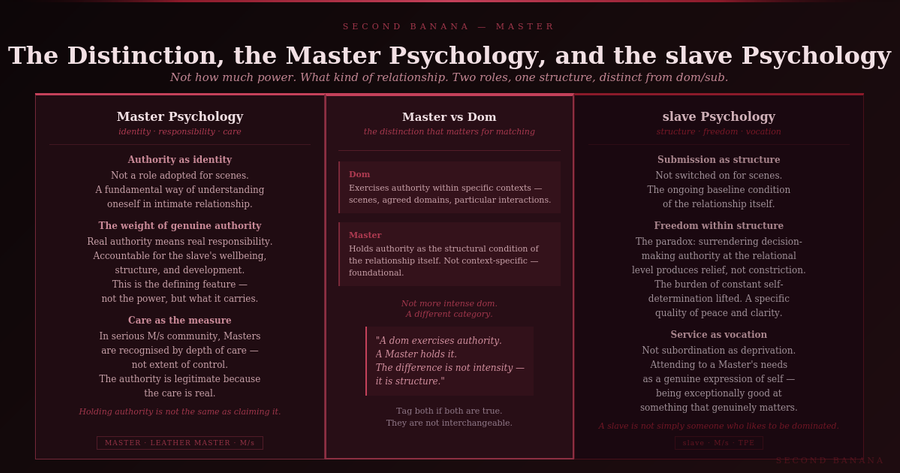
Master is not a synonym for dominant, and the distinction matters in ways that are practically significant for matching. A dominant exercises authority within specific contexts — in a scene, during particular interactions, in domains that have been negotiated and agreed. A Master holds authority as a structural feature of the relationship itself: the title describes not what happens during specific encounters but the fundamental character of the relational architecture between two people.
This distinction of scope and depth is the defining feature of the Master dynamic. It is not more extreme dominance in the same category — it is a different category. Master/slave dynamics involve a relational structure in which one person’s authority and the other person’s submission are not limited to scenes or agreed contexts but extend into the broader texture of how the relationship is organised, how decisions are made, and how the two people understand their positions relative to each other.
This piece examines the genuine psychology of Master dynamics from both sides, the specific character of Total Power Exchange, what distinguishes this dynamic from dominant/submissive dynamics more broadly, and the specific trust and consent architecture that a relational structure of this depth and scope requires.
A dom exercises authority. A Master holds it. The difference is not intensity — it is structure. Not how much power is exercised in a scene, but what the relationship is, at its foundation.
The Psychology of the Master Role
Authority as Identity, Not Performance
For practitioners who identify as Masters, the title describes something they understand as genuinely constitutive of who they are in intimate relationships rather than a role they adopt for specific encounters. The Master identity involves a specific way of understanding oneself in relation to a partner: as the person who holds authority, who bears responsibility for the dynamic and for the partner’s wellbeing within it, and who understands this position as a fundamental feature of the relationship rather than a temporary or context-specific one.
This identity dimension distinguishes Master from dom in important psychological ways. A person can be a skilled and genuinely dominant partner in specific contexts while having no interest in or identification with the Master identity. And a person who identifies as a Master may not be what an outside observer would recognise as conventionally dominant in everyday behaviour — the authority is relational and structural rather than necessarily expressed through overt dominance in every interaction.
The Weight of Genuine Authority
Masters in established Master/slave dynamics consistently describe the specific weight of the responsibility that holding genuine authority over another person involves. This is not the power-as-pleasure framing that characterises some dominant psychology — it is the specific experience of being genuinely accountable for the wellbeing, structure, and development of a person who has placed themselves in your care at a fundamental level.
This responsibility dimension is central to how most serious Master practitioners understand their role. The authority is real, which means the responsibility is real. Decisions made within a Master/slave dynamic — about how the slave’s time is structured, about what protocols govern the dynamic, about how the slave’s development and wellbeing are tended to — have real consequences, and Masters who take the role seriously understand this as the defining feature of what they hold rather than as an incidental cost of the position.
Care and Investment
The most experienced and most respected Masters in the kink community are defined, in community understanding, not primarily by the extent of their authority but by the depth of their care for and investment in the people who serve them. The Master role is not simply the position of power in a power exchange — it is the position of responsibility for the whole person on the other side of the dynamic, including their growth, their safety, their fulfilment, and their thriving within the structure the relationship creates.
This care dimension is what distinguishes genuine Master identity from its counterfeit: the person who uses the language of Master to extract compliance without the commensurate responsibility, who treats the authority as a privilege without the care that makes it legitimate. In serious Master/slave communities, this distinction is well understood and forms the basis of how practitioners assess each other.
The Psychology of the Slave Role
Submission as Structure, Not Episode
The slave role in a Master/slave dynamic involves a fundamentally different relationship to submission than the submissive role in dom/sub dynamics. Where a submissive enters and exits submission in specific contexts, a slave’s submission is the structural condition of the relationship itself — not something switched on for particular encounters but the ongoing basis on which the dynamic operates.
For practitioners who identify as slaves, this totalising structure is often described as one of the most profoundly appealing and most specifically satisfying aspects of the dynamic. The specific relief of having surrendered not just within a scene but at the level of relational structure — of knowing that the framework of authority and submission is the baseline condition rather than something that must be re-established in each encounter — is described by slaves as qualitatively different from episodic submission, and as something that produces a specific quality of peace and groundedness that episodic submission does not.
The Freedom Within Structure
A recurring theme in slave psychology is the experience of freedom within the structure of submission — the paradox that surrendering decision-making authority at a fundamental level produces not constriction but a specific kind of liberation. The constant cognitive and emotional load of self-determination — of managing one’s own choices, priorities, and direction across all domains of life — is, for many slaves, experienced as a burden rather than simply as ordinary existence. The consensual surrender of that burden to a trusted Master produces a specific quality of relief and clarity that practitioners in this role consistently describe as one of the primary appeals of the dynamic.
This freedom-within-structure psychology connects to the submissive territory covered in the Dom piece but operates at a deeper register: it is not the specific relief of surrendering control in a scene but the broader relief of having a relational structure in which one’s position and responsibilities are clearly defined at a fundamental level.
Identity and Service
Many slaves describe their orientation toward service — toward the fulfilment of attending to a Master’s needs, preferences, and directions — as a genuine and deep expression of who they are rather than simply a dynamic they enter. Service, in this understanding, is not subordination as deprivation but subordination as vocation: the specific satisfaction of being exceptionally good at something that genuinely matters, in a context where that excellence is genuinely received and valued.
The slave identity, like the Master identity, is often understood by practitioners as genuinely constitutive of who they are in intimate relationships rather than as a role they perform. This identity dimension is part of what distinguishes the slave orientation from general submissive preference: a slave is not primarily someone who likes to be dominated but someone whose deepest relational orientation is toward service, structure, and the specific kind of belonging that comes from being genuinely claimed and cared for within a totalising relational structure.
Total Power Exchange
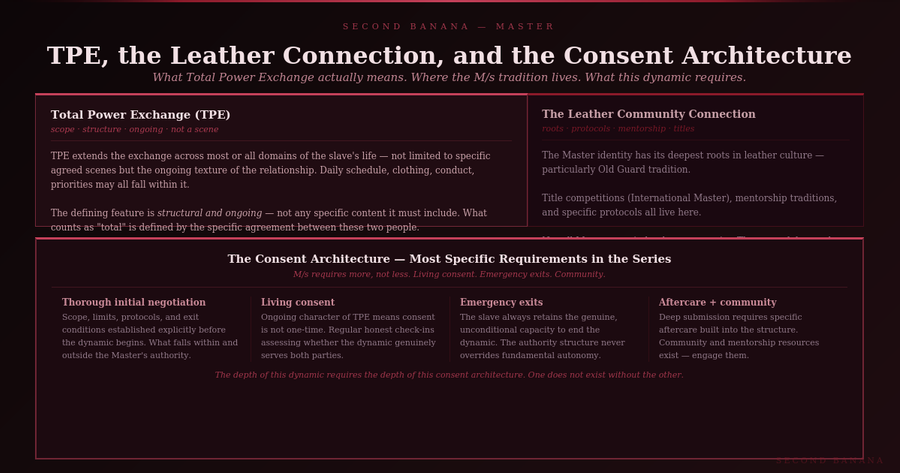
Total Power Exchange — TPE — is the term used to describe Master/slave dynamics in which the scope of the power exchange extends across most or all domains of the slave’s life rather than being limited to specific agreed contexts. TPE is the most intensive end of the power exchange spectrum and is what many people think of when they hear the term Master/slave dynamic, though not all M/s relationships involve full TPE.
What TPE involves in practice varies significantly between relationships, because both what counts as ‘total’ and what specific domains fall within the exchange are defined by the specific agreement between the Master and slave involved. In some TPE relationships, the exchange covers daily schedule, clothing, diet, social engagements, and other life domains. In others, it is more focused but still extends beyond specific scenes into the ongoing texture of the relationship. The defining feature is the structural and ongoing character of the exchange rather than any specific content it must include.
TPE requires the most extensive and most carefully maintained trust and consent architecture of any dynamic in this series. The ongoing character of the exchange means that the consent which establishes it is not a one-time negotiation but a living agreement that requires regular reaffirmation, honest ongoing communication about whether the structure is serving both parties, and genuine mutual investment in the dynamic’s health over time.
The Trust and Consent Architecture
Master/slave dynamics, and particularly TPE relationships, require a specific and extensive consent and communication framework that exceeds what most other dynamics in this series require. Several specific elements deserve naming:
- Thorough initial negotiation: the scope, content, and limits of the exchange must be established explicitly and comprehensively before the dynamic begins. What falls within the Master’s authority and what does not, what protocols govern the slave’s conduct, what the slave’s hard limits are and how they will be honoured within the structure, and what the exit conditions and process look like if either party needs to step back.
- Living consent: the ongoing character of TPE means that consent is not a one-time act but a continuing condition. Regular honest check-ins — whether formal or informal — that assess whether the dynamic is genuinely serving both parties are an ethical requirement of the structure, not an optional add-on.
- Emergency exits: every slave in a TPE relationship must retain the genuine and unconditional capacity to end the dynamic. The authority structure of M/s does not override a slave’s fundamental autonomy as a person — the submission is consensual and its consensual character must be actively maintained, which requires that ending it always remain genuinely possible.
- Aftercare: the specific emotional and psychological experience of deep submission within an M/s dynamic requires specific aftercare when the dynamic’s intensity is high or when the slave has given something particularly significant. Masters who take the role seriously build aftercare into the structure of the dynamic rather than treating it as optional.
- Community and mentorship: the M/s community has developed extensive ethical frameworks and experienced practitioners who serve as mentors and resources for those entering this territory. Engaging with these resources — through leather community events, M/s community organisations, experienced practitioners willing to share knowledge — is strongly supported by serious practitioners in this space.
The Leather Community Connection
The Master identity and Master/slave dynamics have their deepest roots in the leather community covered in the leather piece in this series. The Old Guard leather tradition in particular has historically been the primary cultural context in which the Master title was earned, recognised, and given specific meaning within a community framework. The specific protocols, the mentorship tradition, the title competitions (International Master and its regional equivalents) — these exist within leather community and give the Master identity a cultural grounding that many practitioners in this space find meaningful.
Not all Master practitioners are embedded in leather community, and the Master identity and M/s dynamics have spread into kink communities well beyond leather culture. But the leather community’s frameworks and its ethical traditions remain the most elaborated cultural context for M/s practice, and practitioners seeking community and mentorship in this space will most often find it there.
What This Has to Do With Second Banana
Finding a genuine match for Master/slave dynamics is one of the most demanding matching problems in kink — more demanding than most because the dynamic’s depth and scope means that compatibility requirements are correspondingly more extensive. A Master and slave must be compatible not just in their kink interests but in their values, their communication styles, their life circumstances, and their understanding of what the dynamic involves and what it is for. This is closer to the compatibility requirements of a life partnership than of a casual encounter.
The post-first model gives Master and slave practitioners the space to represent themselves and what they are looking for with the specificity this matching problem requires: the scope of the dynamic they are seeking, their experience level, their values and approach to the relationship, and what they understand themselves to be offering and looking for.
The tag system gives M/s practitioners specific vocabulary:
- Master — for those who hold the Master identity
- slave — for those whose orientation is toward the slave role (typically lowercased in community convention)
- M/s dynamic — for the broad relational structure
- TPE — for those seeking or offering Total Power Exchange
- Leather Master — for those whose M/s identity is embedded in leather culture and community
- M/s experienced — for practitioners with established M/s history
- M/s exploring — for those newer to the territory
- Protocol-based — for dynamics with specific formal protocols
The community Second Banana builds — people who communicate with specificity and seriousness about what they want and who take consent and care as foundational rather than optional — is the right environment for Master and slave practitioners to find each other honestly rather than through the gradual and often painful discovery that a partner’s understanding of what these terms mean differs fundamentally from their own.