Fem Dom: The Psychology of Female Dominance, What It Actually Is, and Why the Cliché Gets Almost Everything Wrong | Second Banana
Fem Dom:
The Psychology of Female Dominance, What It Actually Is, and Why the Cliché Gets Almost Everything Wrong
Not the Cliché
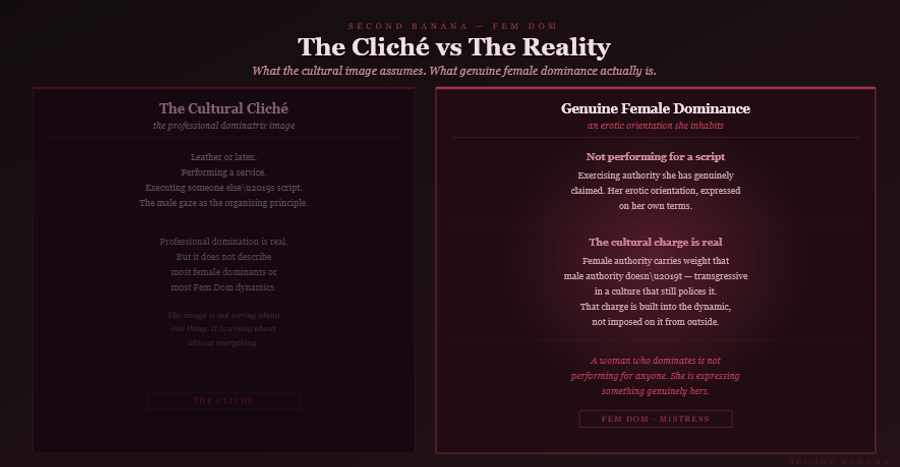
The dominant cultural image of female domination is the professional dominatrix: leather or latex, spike heels, whip or crop in hand, performing a service for a paying male submissive who has scripted exactly what he wants her to do. This image is not imaginary — professional domination is a real and legitimate practice — but it has come to stand in for the entire concept of female dominance in ways that misrepresent almost everything about how Fem Dom actually operates in the lives of people for whom it is a genuine erotic orientation.
Most Fem Dom is not professional. Most female dominants are not performing for anyone’s script. Most Fem Dom dynamics are not primarily about leather or implements. And the specific psychology of female authority in a D/s context is genuinely distinct from the psychology of male dominance — not because women and men are essentially different as dominants, but because female authority carries specific cultural weight, specific historical baggage, and specific erotic charge that the cliché both depends on and obscures.
This piece covers what Fem Dom actually is: the psychology of genuine female authority, what distinguishes it from its cultural caricature, what the submissive’s experience of yielding to female authority specifically involves, the range of dynamics that fall under the Fem Dom umbrella, and what Second Banana offers practitioners on both sides of this dynamic.
A woman who dominates is not performing for anyone. She is exercising an erotic orientation that is genuinely hers — which is exactly what makes it compelling to the person yielding to it.
The Cultural Context: Why Female Authority Is Charged
Female dominance carries a specific cultural charge that male dominance does not, and understanding this charge is part of understanding why Fem Dom is its own specific erotic territory rather than simply ‘dominance but with a woman doing it.’
The culture in which most Western kink practice is embedded positions women as the subordinate sex in most social, professional, and relational contexts. A woman exercising genuine authority — not performative authority staged for someone else’s gratification, but real, confident, inhabited authority — is therefore doing something culturally transgressive in a way that a man exercising equivalent authority is not. This transgression has its own specific erotic charge, one that is not separate from the power exchange dynamic but is built into its very structure.
For submissives who are drawn to female authority specifically, this transgressive dimension is often part of what makes the dynamic specifically compelling. Yielding to authority that the surrounding culture does not endorse in the same way — that has to be claimed and exercised rather than simply assumed — carries a different weight than yielding to authority that culture broadly ratifies. Neither is more or less valid as a D/s orientation; they are genuinely different experiences.
This does not mean that Fem Dom is primarily political in its practitioners’ minds, or that the specific erotic charge can be reduced to cultural transgression. For most practitioners, the appeal is more immediate and more visceral than any political analysis suggests. But the cultural context is real, and it shapes the specific texture of the dynamic in ways that are worth naming rather than pretending don’t exist.
The Female Dominant’s Guide and Experience
Authority as Genuinely Hers
The most important single thing to say about the female dominant’s experience is that genuine Fem Dom is an erotic orientation she inhabits, not a service she provides. The female dominant who is genuinely drawn to this dynamic — who finds real erotic and psychological satisfaction in exercising authority, in having someone yield to her specifically, in the particular dynamic that her dominance produces — is not performing for her submissive’s fantasy. She is expressing something genuinely her own.
This distinction matters enormously in practice because it determines the entire quality of the dynamic. A female dominant who is performing a role because her partner has requested it produces a fundamentally different experience from one who is exercising genuine authority she has claimed for herself. Submissives who are drawn to Fem Dom specifically — rather than to D/s dynamics generally — are typically drawn to the real thing rather than the performed version, and they usually know the difference immediately.
What Female Dominants Find Compelling
Female dominants describe their draw to this orientation in terms consistent with what male dominants describe in the Dom piece elsewhere in this series — the satisfaction of genuine authority exercised well, the specific pleasure of a partner who yields authentically, the attunement and skill required to hold this position effectively. But they also frequently describe elements that are more specific to their position: the particular satisfaction of exercising authority in a domain where women are not culturally expected to hold it, the specific quality of a partner who has chosen to yield to female authority in a culture that doesn’t take female authority for granted, and sometimes the pleasure of inverting specific gendered dynamics from the rest of their lives.
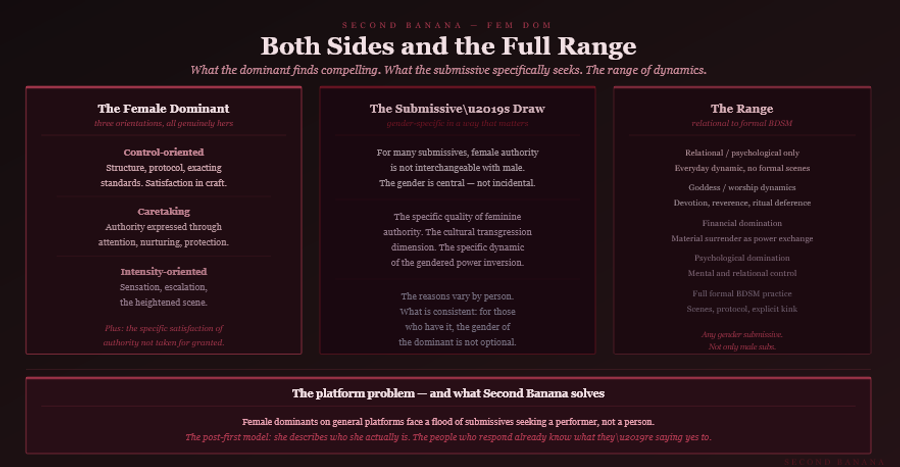
Female dominants are not a monolithic type. They range from women who approach dominance with the warmth and care of the caretaking Dom to women who prefer formal, exacting authority dynamics to women whose primary draw is sensation and intensity. The same three-profile taxonomy that applies to male and nonbinary dominants — control-oriented, caretaking, intensity-oriented — applies here, with the additional specific texture that female authority adds to each.
Submitting to Female Authority: The Submissive’s Experience
For submissives who are specifically drawn to female dominance - for example through sissification — rather than to D/s dynamics regardless of their dominant’s gender — the specific charge of yielding to female authority deserves its own examination.
The Specificity of the Draw
Many submissives who are specifically drawn to female dominants describe their orientation in terms that explicitly invoke the gender specificity — it is not simply that they want to submit, but that submitting to a woman is a categorically different and more compelling experience for them than submitting to a man. The reasons for this vary: some describe the specific quality of feminine authority as more attuned, more psychologically engaged, more perceptive than the authority styles they associate with male dominants. Some describe the culturally transgressive dimension as part of what charges the dynamic for them. Some describe a specific dynamic around the gendered power inversion itself.
None of these is the correct explanation universally — the specificity of the draw to female dominance is as individual as any other highly specific erotic orientation. What is consistent is that for the people who have it, the gender of the dominant is not incidental to the dynamic but central to it.
Worship and Devotion Dynamics
A significant subset of Fem Dom dynamics involves a specific quality of worship and devotion — the submissive’s orientation toward the dominant as genuinely elevated, deserving of reverence, positioned as superior in ways that carry genuine weight within the dynamic. This worship dimension can manifest as goddess dynamics, as specific rituals of deference and attendance, as the financial domination dynamic in which the submissive’s material resources are surrendered as an expression of the power exchange.
Financial domination — the practice in which a submissive provides financial tributes or gifts as part of the power dynamic, sometimes without any physical component to the relationship at all — occupies a specific and sometimes controversial place within Fem Dom. For practitioners for whom it is genuine, financial domination is a real power exchange dynamic in which the surrender of material resources is an expression of the same yielding of control that other forms of submission involve. For practitioners and observers who are sceptical, it raises questions about exploitation that deserve honest rather than defensive engagement. Like any dynamic, financial domination is legitimate when it is genuinely consensual and genuinely wanted by both parties — including the giving party.
The Range of Fem Dom Dynamics
Fem Dom spans a genuinely wide range of specific dynamics, and matching within this range requires the same specificity that matching within any broad kink category requires.
At one end, some Fem Dom dynamics are primarily relational and psychological — the authority is held in the dynamic between the people, in the specific quality of deference and care and direction that structures their interaction, without necessarily involving formal scenes or explicit kink activity. Some practitioners describe their Fem Dom dynamic as simply how their relationship works, with the dominance expressed in everyday interaction rather than in designated sessions.
At the other end, some Fem Dom dynamics involve all the apparatus of formal BDSM practice — explicit negotiation, scenes with specific activities, protocols and rituals, formal titles. Between these poles is the full range of what D/s practice generally covers, with the specific texture that female authority adds to each.
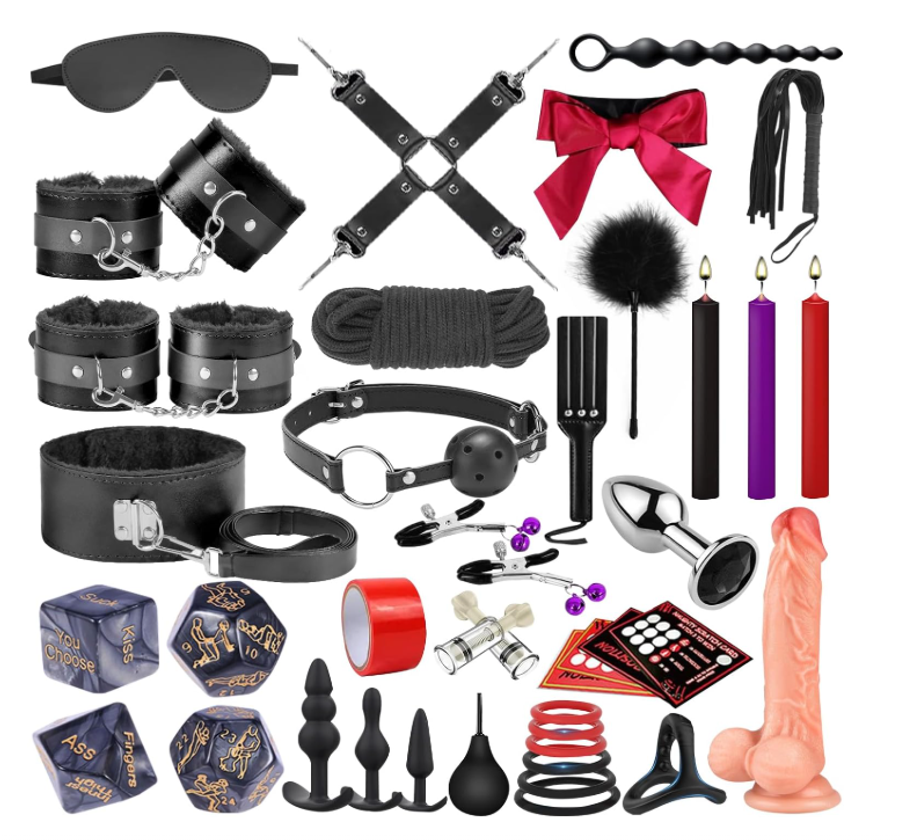
A picture of a fully-stocked BDSM Kit
Some Fem Dom dynamics are exclusively heterosexual in their structure; others involve female dominants with submissives of any gender; others involve dynamics between women. The assumption that Fem Dom is primarily about a dominant woman and a male submissive is a product of the cliché’s cultural dominance rather than of the actual range of practice, and Second Banana’s tag system is built to accommodate the full range rather than defaulting to the most stereotyped configuration.
What This Has to Do With Second Banana
Fem Dom is consistently one of the most difficult dynamics to represent accurately on general dating platforms, for exactly the reasons the cultural cliché creates. A female dominant who describes herself as a Fem Dom on a general platform encounters an enormous volume of submissive men who have a specific scripted fantasy — derived from professional domination and pornographic representation — and who are seeking a performer rather than a person. Filtering for genuine compatibility, at scale, is exhausting in a way that male dominants rarely experience.
The post-first model gives female dominants the ability to represent their actual orientation — specifically, honestly, with the kind of detail that communicates who they actually are rather than what a script expects them to be — before anyone responds. The people who respond have already engaged with that specific representation rather than projecting a generic fantasy onto a label.
For submissives seeking female dominance specifically, the same model allows them to articulate the specificity of their draw — not just D/s, but Fem Dom specifically, and within that, what kind of Fem Dom dynamic they are actually drawn to.
The Second Banana tag system gives Fem Dom practitioners specific vocabulary:
- Fem Dom / Female dominant — the orientation itself
- Mistress — the traditional title used within Fem Dom dynamics
- Goddess dynamic — for worship and devotion-oriented practice
- Financial domination — for dynamics with a financial component
- Psychological domination — for dominants whose primary mode is mental and relational
- Seeking female dominant — for submissives who are specifically drawn to female authority
- Fem Dom curious — for submissives exploring this orientation
- Any gender submissive welcome — for female dominants open to submissives of all genders