
Gagging: The Psychology of Oral Control, Involuntary Response, and Why This Is Not the Same as Breath Play | Second Banana
Gagging:
The Psychology of Oral Control, Involuntary Response, and Why This Is Not the Same as Breath Play
The First Distinction: Not Breath Play
Gagging and breath play are frequently mentioned together or conflated in kink discussions, and the conflation does a disservice to practitioners of both because the two involve genuinely different physiology, different risk profiles, and often different psychological appeals.
Breath play involves the deliberate restriction of airflow — choking, hand-on-throat pressure, or other mechanisms that reduce or interrupt breathing. It carries specific and significant physiological risks connected to oxygen deprivation and is one of the more genuinely dangerous kink practices when not approached with real knowledge and care.
Gagging — the deliberate filling or obstruction of the mouth, the activation of the gag reflex through oral penetration, or the use of gags as restraint devices — is a different practice. It involves the mouth and oral cavity rather than the airway itself. Breathing continues through the nose. The physiological experience is of the mouth being controlled or filled rather than the breath being restricted. The risks are real but different: nausea, aspiration risk if vomiting occurs, jaw strain from extended gag use, and the communication challenge of having a partner whose verbal capacity is deliberately reduced. These require specific safety measures, covered below, but they are not the same risks as breath play and should not be treated as such.
This distinction matters practically: a practitioner who is specifically drawn to gagging and one who is specifically drawn to breath play may have almost nothing in common in terms of what they want and what risks they are accepting. The piece covers gagging specifically.
The mouth controlled, filled, made involuntary. The breath continues — this is not breath play. What gagging offers is its own specific territory: the vulnerability of the oral cavity, the charge of involuntary response, the specific silence of a partner who can no longer speak.

The Psychology of Being Gagged
Oral Vulnerability and Control
The mouth is one of the most expressive and communicative parts of the body — the primary organ of speech, of protest, of consent and refusal as they are ordinarily expressed. Having it controlled, filled, or obstructed therefore carries a specific and intense quality of vulnerability that other forms of restraint or control do not produce in the same way. For many practitioners who are drawn to being gagged, this specific vulnerability is precisely the appeal: having the primary instrument of self-expression taken out of their own hands and placed under a partner’s control.
This connects to the broader submission psychology covered in the Dom, fuckdoll, and boytoy pieces in this series, but with a specific character: the loss of verbal communication is more complete here than in most other dynamics. The gagged person cannot use the ordinary verbal mechanisms of consent and refusal in-scene, which is why the pre-scene establishment of alternative signals is not optional but essential.
The Involuntary Response Dimension
Gagging — whether through a physical gag device or through oral penetration that activates the gag reflex — produces involuntary physical responses that many practitioners describe as among the most specifically compelling aspects of the experience. The gag reflex itself is involuntary: the body responding in a way outside conscious control. Drooling, tearing, involuntary sounds — all of these are natural physical consequences of gagging that occur without the person choosing them.
For the person being gagged, these involuntary responses can carry a specific charge that connects to the ego-dissolution and loss-of-control psychology described elsewhere in this series: the experience of the body responding on its own terms, outside the managed self-presentation that usually governs how we appear to others. Drooling, in particular, is often described by practitioners as carrying a specific significance: it is a response the body produces naturally, that under ordinary social circumstances one would suppress, that in the gagging context is simply allowed to happen and is part of the experience rather than something to be managed.
The Silence and Its Quality
Being unable to speak — reduced to sounds rather than words, to physical signals rather than verbal ones — is a specific experience that many gagging practitioners describe in its own terms rather than simply as an extension of general submission. The quality of the gagged person’s silence, the specific sounds a gag allows and prevents, the particular vulnerability of not being able to articulate — these are experienced as distinct rather than as generic restriction.
For some practitioners, the primary appeal is precisely this reduction to pre-verbal communication: the specific intimacy of a state in which ordinary language is unavailable and only body, sound, and signal remain. This connects to the altered-state territory described in the fisting and CBT pieces — a state in which the ordinary cognitive and linguistic layer is bypassed.
The Psychology of the Gagging Partner
The person doing the gagging experiences a specific quality of control that is distinct from other forms of dominance in the series. The gagged person’s ordinary verbal authority over the encounter — their ability to say stop, to direct, to comment, to express themselves in language — is specifically in the gagging partner’s hands. This is not the same as general D/s authority; it is authority over the primary communication channel, which carries its own specific weight.
Many gagging-oriented dominants describe the specific appeal in terms of witnessing involuntary response — the gag reflex, the drooling, the sounds — as evidence of a partner who is genuinely affected, genuinely overwhelmed, genuinely beyond their own managed presentation. This connects to the visual culmination psychology described in the facial piece: the specific appeal of visible, involuntary evidence of a partner’s physical state.
The responsibility dimension is equally significant. The gagging partner holds the communication channel, which means they hold a specific and heightened responsibility to read their partner’s non-verbal signals accurately and to stop the moment those signals indicate distress. This responsibility is not incidental to the dynamic — for many practitioners it is part of the appeal, the specific attentiveness and care that high-stakes dominance requires.
The Range: Gag Types and Oral Penetration
Ball Gags
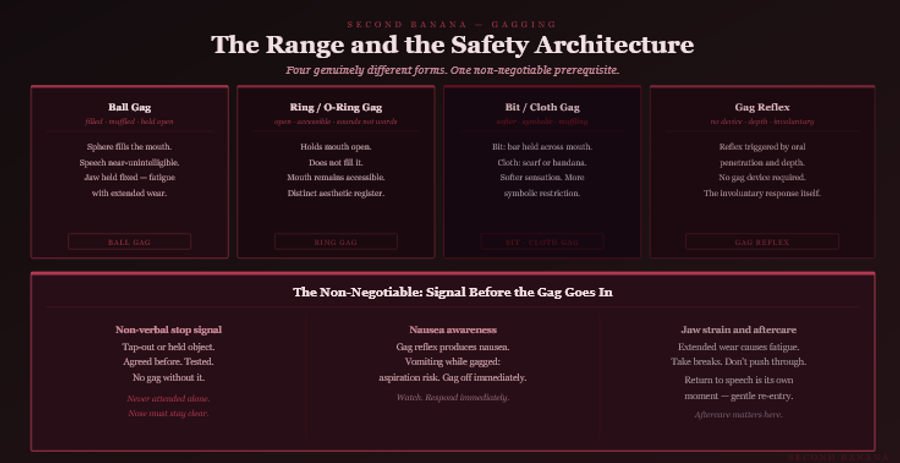
The most visually iconic gag form: a sphere, typically silicone or rubber, held in the mouth by a strap that buckles behind the head. Ball gags fill the mouth substantially, muffle speech to near-unintelligibility, and produce a specific sensation of sustained oral fullness. The jaw is held open at a fixed position, which means extended wear produces jaw fatigue and ache — session length should be calibrated accordingly, and practitioners with TMJ issues or jaw tension should approach ball gags cautiously.
Ring Gags / O-Rings
A ring gag holds the mouth open without filling it, which produces a different experience from the ball gag: the mouth is open and accessible rather than full, speech is replaced by sounds rather than muffled, and the specific vulnerability of the open mouth is a distinct aesthetic and psychological register from the filled-mouth experience of a ball gag. Ring gags are frequently used in scenarios that incorporate oral accessibility as part of the dynamic.
Bit Gags and Cloth Gags
Bit gags — a rod or bar held horizontally in the mouth, fastened at the sides — produce a different sensation again: pressure across the mouth rather than filling it, with the visual and physical quality of a horse’s bit. Cloth gags — bandanas, scarves, or dedicated cloth tied in or over the mouth — are softer and less intense but produce muffling and symbolic restriction rather than strong physical sensation. These vary considerably in their practical effectiveness and comfort.
The Gag Reflex and Deep Throat
The activation of the gag reflex through oral penetration — deep throat, or the deliberate triggering of the reflex through positioning and depth — is a distinct form of gagging that does not necessarily involve a gag device. The specific experience of the gag reflex activating, the involuntary physical response, the drooling and tearing that typically accompany it, carry the psychological dimensions described above without the jaw-holding element of a physical gag. For many practitioners this is the primary or preferred form.
Safe Practice: What Cannot Be Skipped
The specific safety requirements of gagging flow directly from its defining feature: the gagged person’s verbal communication is deliberately reduced or removed. This means the ordinary verbal safety mechanisms that most kink practice relies on must be replaced before the gag goes in.
- Establish a non-verbal signal before beginning — a tap-out system (tapping a partner’s body twice), dropping a held object, or another agreed non-verbal signal that means stop. This signal must be agreed, tested, and understood by both partners before any gag is applied. It is not optional.
- Nausea awareness: the gag reflex produces nausea as well as the gag response itself. If a gagged person is about to vomit, the gag must come off immediately. Vomiting while gagged is an aspiration risk. The gagging partner must be watching for signs of nausea and must respond immediately.
- Never leave a gagged person unattended — this is an absolute rule. The inability to call for help is precisely the design of a gag; a gagged person left alone cannot signal distress.
- Jaw strain from extended gag wear is real and cumulative. Ball gags in particular should not be worn for extended periods. Take breaks, check in, and do not push through jaw discomfort.
- Nose-breathing must be possible — any gag that also obstructs the nose creates a genuine breathing emergency. If a gagged partner has a blocked nose for any reason, the gag comes off.
- Aftercare: the return to verbal communication after an extended gagging scene can itself be a specific experience — a moment of re-entry that benefits from attentive, gentle aftercare rather than immediate return to ordinary interaction.
What This Has to Do With Second Banana
Gagging’s specific matching requirements — a partner who understands the non-verbal signal requirement, who has the attentiveness to read signs of nausea or distress accurately, who is drawn to this specific form of oral control rather than to breath play or other adjacent dynamics — make the post-first model genuinely useful.
Being specific about which form of gagging is primary (physical gag vs gag reflex activation, ball gag vs ring gag, restraint vs sensation) and about what the dynamic around it involves (pure sensation, D/s control, the involuntary response dimension) finds the right partner rather than the nearest approximate.
The Second Banana tag system gives gagging practitioners specific vocabulary:
- Gagging — the broad practice
- Ball gag — for those drawn to the filled-mouth form specifically
- Ring gag / O-ring — for the open-mouth form
- Gag reflex — for those whose primary draw is the reflex activation
- Oral control — for those framing this within D/s authority
- Not breath play — explicit clarifying signal
- Non-verbal signals established — explicit safety signalling