Furries: The Psychology of Fursonas, Identity, and Why the Sexual Dimension Isn’t What Most People Think | Second Banana
Furries:
The Psychology of Fursonas, Identity, and Why the Sexual Dimension Isn’t What Most People Think
The Most Common Misrepresentation
The furry fandom — a large, well-organised community centred on anthropomorphic animal characters, art, and identity — is one of the most consistently mocked and misrepresented communities in mainstream culture, almost always through a single reductive framing: that being a furry is fundamentally a sexual fetish involving costumes. This framing is inaccurate in a way that matters, and getting it right is the necessary first step to discussing the genuine sexual dimension that exists for a meaningful subset of furries honestly and without distortion.
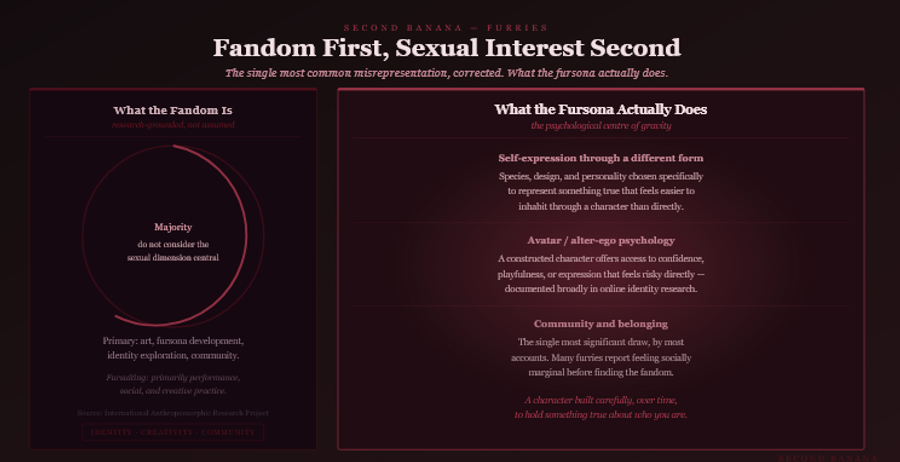
Research on the furry fandom — including large-scale survey work conducted by the International Anthropomorphic Research Project, an ongoing academic collaboration studying furry demographics and psychology — consistently finds that the majority of furries do not consider the sexual dimension central to their involvement in the fandom. For most furries, the fandom is primarily about creativity, art, fursona development, identity exploration, and a genuinely strong sense of community and belonging. The costume element specifically — fursuiting — is itself primarily a performance, social, and creative practice, worn at conventions and social gatherings, and the overwhelming majority of fursuit-related activity has no sexual dimension whatsoever.
This piece treats the fandom’s primary identity and community dimension with the seriousness it deserves, and then treats the genuine sexual dimension — real for a meaningful subset of furries — with equal honesty and seriousness, including how it specifically differs from pet play, with which it is frequently and inaccurately conflated.
Most furries are not having sex in costumes. Most furries are drawing, building characters, going to conventions, and finding a community that takes their creative self-expression seriously. The sexual dimension, where it exists, is a separate and more specific thing.
The Fursona: Identity Exploration as the Primary Thread
A fursona — the anthropomorphic animal character a furry creates to represent themselves within the fandom — is the central creative and psychological object of furry fandom involvement, and understanding what a fursona actually does for the person who creates it is the key to understanding the fandom’s genuine psychology.
Self-Expression Through a Different Form
For many furries, the fursona offers a way to explore and express aspects of personality, identity, or self-presentation that feel difficult or constrained to express through an ordinary human social identity. A fursona’s species, design, and personality traits are often chosen specifically because they represent something the person feels is true about themselves but finds easier to inhabit through an anthropomorphic character than through direct self-presentation. Confidence, playfulness, particular physical or social qualities, even gender expression — all of these can be explored and inhabited through a fursona in ways that some furries find more accessible than direct self-expression.
This connects to broader psychological patterns around avatar and alter-ego identity exploration, which research on online identity and gaming avatars has documented extensively: people often use a constructed character to access aspects of self-expression that feel risky or unavailable in their unmediated identity. The fursona functions similarly, with the specific addition of the furry community’s shared visual and narrative language of anthropomorphic characters.
Community and Belonging
The furry fandom’s community dimension is, by most research and most furries’ own accounts, the single most significant draw of involvement. The fandom has an unusually strong and durable sense of mutual belonging, in part because many furries report having felt socially marginal or different prior to finding the fandom, and the experience of finding a community that takes their specific creative interests and self-expression seriously is, for many, genuinely significant. Furry conventions, which draw tens of thousands of attendees at major events, are organised primarily around art, costume craft, social connection, and shared creative culture — the sexual dimension is, at most major conventions, a peripheral and clearly demarcated element rather than a defining one.
The Sexual Dimension: Honest Treatment
For a meaningful subset of furries, there is a genuine sexual or erotic dimension connected to their fursona or to anthropomorphic characters more broadly, and this deserves the same honest, unembarrassed treatment that this series gives every other erotic orientation it covers.
Attraction to Anthropomorphic Design
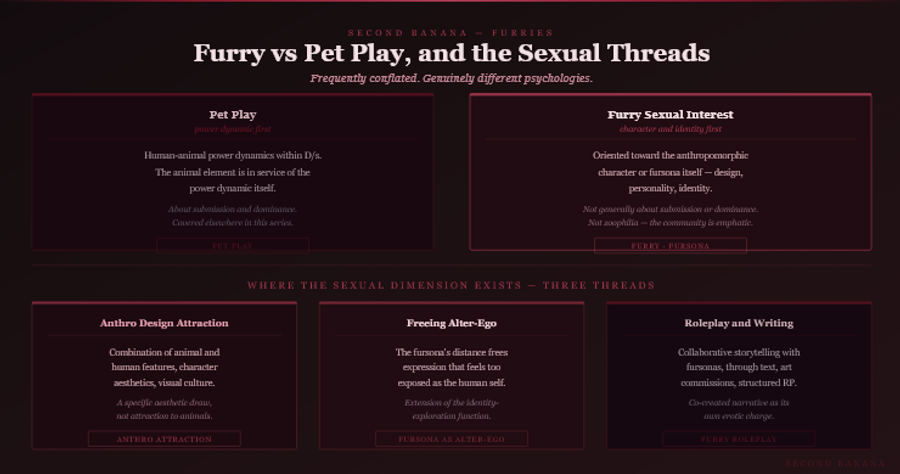
For some furries, the erotic interest is specifically in anthropomorphic character design itself — the combination of animal and human features, character aesthetics, and the visual and narrative culture of anthropomorphic art. This attraction operates similarly to other specific aesthetic attractions: a genuine and specific visual and conceptual draw to a particular character design tradition, rather than an attraction to animals as such. The distinction matters — furry sexual interest is not zoophilia and the research and the community are both unambiguous and emphatic about this distinction.
The Fursona as Freeing Alter-Ego
For others, the erotic dimension connects specifically to the fursona’s function as an alter-ego — a character through which sexual expression that feels difficult or inhibited as one’s direct human self becomes more accessible. This connects to the broader identity-exploration psychology of the fursona generally, extended into the erotic domain: the fursona offers a layer of distance and characterisation that some furries find frees them to express desires or engage in roleplay that would feel more exposed without that layer.
Furry Roleplay and Erotic Writing
A significant portion of furry erotic content and practice involves roleplay and writing — collaborative storytelling involving fursonas or anthropomorphic characters, conducted through text, art commissions, or structured roleplay. This connects the furry sexual dimension to broader patterns in erotic roleplay and fan-fiction-adjacent creative sexuality: the specific erotic charge of co-created narrative and character work, which research on erotic fan fiction and online roleplay communities has documented as a genuine and widespread form of erotic engagement distinct from direct physical encounters.
Furry vs Pet Play: A Clear and Important Distinction
Furry sexual interest and pet play are frequently and inaccurately conflated, and the distinction is worth stating clearly because the two connect to genuinely different psychologies and serve genuinely different practitioners.
Pet play, covered elsewhere in this series, is fundamentally about human-animal power dynamics within a D/s context — a human partner inhabiting an animal role specifically as an expression of submission, with the appeal centred on the specific psychology of the power exchange and the role’s relationship to dominance and submission. The animal element in pet play is in service of the power dynamic.
Furry sexual interest, where it exists, is primarily oriented toward the anthropomorphic character or fursona itself — the character’s design, personality, and identity — rather than toward a power-exchange dynamic structured around animal-human roles. A furry’s sexual interest in their own or another’s fursona is not generally about submission or dominance in the way pet play is; it is about the character and the identity the character represents.
There is some overlap — some practitioners are drawn to both, and some furry-adjacent dynamics incorporate D/s elements — but treating furry sexuality and pet play as the same thing misrepresents both. A furry whose interest is in fursona identity and anthropomorphic character design is not necessarily interested in pet play’s power dynamics, and a pet play practitioner whose interest is in the submission dynamic is not necessarily a furry.
What This Has to Do With Second Banana
Furries seeking partners who share or are open to the specific combination of identity exploration, fursona connection, and (where relevant) the erotic dimension of furry interest face a particular challenge on general dating platforms: widespread cultural mockery makes many furries cautious about disclosing this interest at all, and the conflation with pet play or with sexual interest in animals means that even honest disclosure is often misread.
The post-first model and the anonymous posting option are particularly valuable here: furries can describe their actual interest — fursona connection, anthropomorphic attraction, furry roleplay interest — accurately and specifically, before having to manage a potential partner’s misconceptions in person.
The Second Banana tag system gives furry practitioners specific vocabulary:
- Furry — the community and identity
- Fursona — for those who want to connect specifically around fursona identity
- Anthro attraction — for the specific aesthetic and design-based draw
- Furry roleplay — for those drawn to collaborative character-based erotic writing or roleplay
- Fursuit — for those whose interest connects to costume and performance specifically
- Not pet play — explicit clarifying signal for furries tired of the conflation
- Furry curious — for those exploring the community or interest