
Lingerie: The Visual, the Tactile, the Performance, and Why Fine Fabric Against Skin Is Its Own Specific Erotic Territory | Second Banana
Lingerie:
The Visual, the Tactile, the Performance, and Why Fine Fabric Against Skin Is Its Own Specific Erotic Territory
More Than One Thing
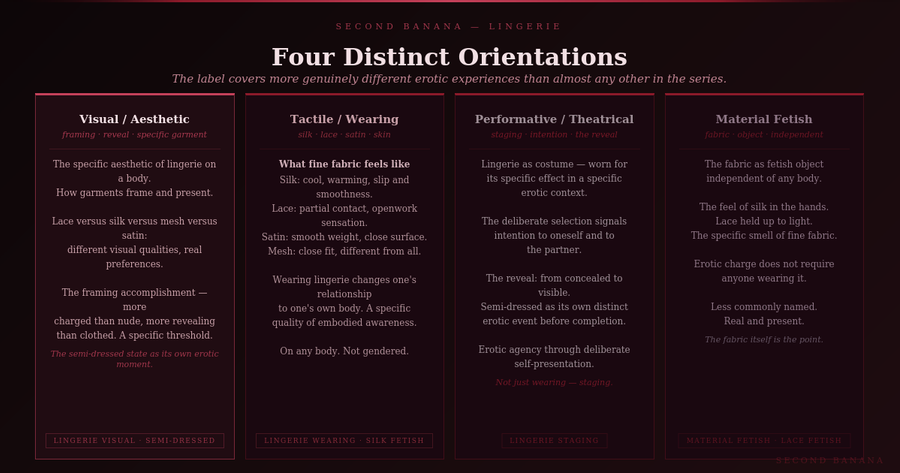
Lingerie as an erotic interest covers more genuinely distinct orientations than the single label suggests. The person aroused by the sight of a partner in fine lace is having a different experience from the person aroused by wearing silk against their own skin. The person drawn to the theatrical staging of an undressing — the semi-dressed state as its own specific erotic moment — is oriented differently again from the person for whom the fabric itself, independent of any body, is the primary fetish object.
These distinctions matter because they determine what a practitioner is actually looking for in a partner or an encounter. Knowing someone has a lingerie interest tells you relatively little until you know which dimension of it is primary for them. This piece maps all four orientations — visual, tactile/wearing, performative/theatrical, and material fetish — and treats each with the specificity it deserves, including addressing the gender dimension in a way that most lingerie content declines to.
Fine fabric against skin is a specific sensory experience. The sight of a specific kind of lace or silk on a specific kind of body is a specific aesthetic experience. These are not the same thing, even when they occur together. The piece maps which one is yours.
The Visual and Aesthetic Dimension
For many lingerie practitioners, the primary draw is explicitly visual: the specific aesthetic of lingerie on a body, the way particular garments frame and present the body within them, the specific quality of lace against skin or silk draped over a particular form. This visual aesthetic is specific and genuine — the same way any visual erotic preference operates — and practitioners in this orientation often have strong and specific preferences about what specifically they find compelling.
What Specifically Draws the Eye
The visual appeal of lingerie is not generic. Practitioners with a primary visual orientation often have very specific preferences: particular garments (bra and brief sets versus bodysuits versus suspender sets versus chemises), particular fabrics (the specific sheen of satin versus the delicate openwork of lace versus the close-fitting transparency of mesh), particular colours and the way they interact with particular skin tones. These preferences are as specific as any other visual aesthetic preference and practitioners who can articulate them clearly find much better matches than those who default to vague descriptions.
The framing quality of lingerie is a significant part of the visual appeal for many practitioners: the way a well-fitting garment defines and presents the body within it, emphasising specific areas while partially concealing others, producing a specific visual relationship between fabric and body that neither fully dressed nor undressed produces. This framing is the specific aesthetic accomplishment of lingerie as a category of garment, and it is distinct from the appeal of nudity on the one hand and ordinary clothing on the other.
The Body Beneath and the Reveal
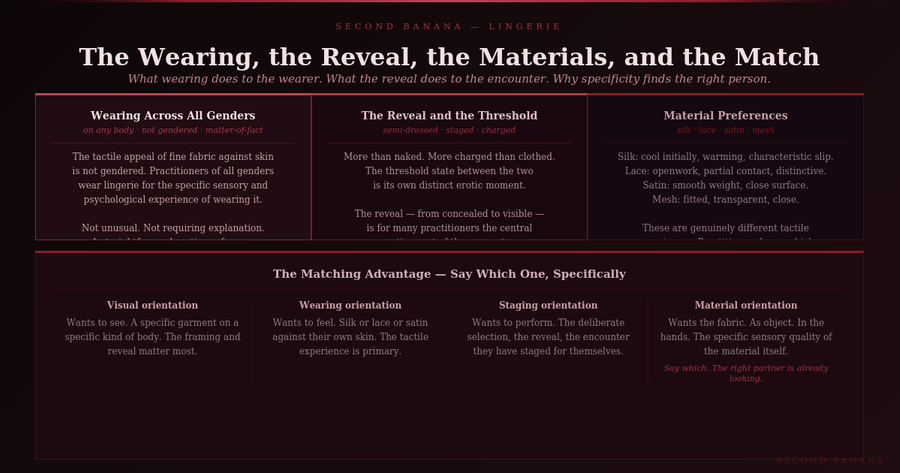
The specific erotic charge of the semi-dressed state — more than naked, more charged than clothed — is one of the most consistently reported dimensions of lingerie’s visual appeal. Lingerie is by design a threshold garment: it signals the erotic without completing it, presents the body within a frame that is simultaneously revealing and concealing. The specific charge of this threshold state — of a body presented rather than simply visible — is what distinguishes lingerie’s visual appeal from the visual appeal of nudity and gives it its particular quality.
The Tactile Dimension: Wearing It
The experience of wearing fine lingerie — of having silk or lace or satin against one’s own skin — is its own distinct erotic orientation that is separate from the visual dimension and often from the performative dimension as well. For practitioners whose primary draw is tactile, what they are seeking is the specific sensory experience of the material against their body: what it feels like to wear, how it moves, the specific quality of contact between fabric and skin.
What Fine Fabric Actually Feels Like
The tactile specificity of lingerie fabrics is real and significant. Silk against skin has a specific quality — cool initially, warming to body temperature, with a characteristic slip and smoothness that is genuinely distinct from other fabrics. Lace has its own specific tactile character: the openwork pattern produces a specific partial contact that is different from full-surface fabrics, a combination of pressure at the thread points and absence in the openings that has its own distinctive sensation. Satin has a specific smoothness and weight. Mesh is close-fitting in a different way from silk. Practitioners who are primarily tactile often have very clear preferences between these that are not about appearance at all but about specific sensation.
For many practitioners across all genders, the specific experience of wearing fine lingerie changes one’s relationship to one’s own body in a way that ordinary clothing does not. The deliberate, careful quality of fine lingerie — its fit, its material, its intention — produces a specific kind of awareness of one’s own body within it. Many practitioners describe wearing fine lingerie as a form of self-attention: the fabric’s quality drawing continuous low-level attention to the body surface it covers, producing a specific quality of embodied awareness that is itself erotically relevant.
The Wearing Dimension Across Genders
Lingerie has been historically coded as women’s wear, but the tactile appeal of fine fabric against skin is not gendered. Practitioners of all genders wear lingerie for the specific sensory and psychological experience of wearing it, and this is worth naming directly rather than treating as unusual. The specific experience of silk or lace against any body is a specific sensory experience that appeals to practitioners regardless of gender identity or expression, and the piece treats this as what it is: a straightforward erotic preference that some people have.
The Performative and Theatrical Dimension
Lingerie is a costume in the specifically theatrical sense — a garment worn not primarily for warmth or coverage but for its specific effect in a specific erotic context. The performative dimension of lingerie involves the staging of the erotic encounter: the deliberate selection of a specific garment for a specific moment, the specific ritual of putting on lingerie before an encounter, the way wearing specific lingerie changes one’s own internal experience of oneself as an erotic agent.
The Staging of the Encounter
Many lingerie practitioners describe a specific quality of preparation and intention that wearing lingerie gives to an erotic encounter: the garment signals to oneself and to the partner that the encounter is specifically staged, that there has been deliberate choice and intention invested in this moment. This staging quality is a specific kind of erotic investment — the deliberate creation of a specific erotic context rather than the default arrival at one — and it produces its own particular quality of anticipation and presence in the encounter itself.
The reveal — the moment at which lingerie is seen by a partner, the transition from concealed to visible, the specific dynamics of undressing within an encounter that begins with lingerie — is for many practitioners the central erotic event. The specific charge of this reveal, the way the semi-dressed state exists as its own distinct erotic moment before completion, is one of the most commonly reported specific appeals of the performative dimension.
Self-Presentation and Agency
The performative dimension of lingerie is often fundamentally about erotic agency: the specific experience of choosing to present oneself in a particular way, of using garments to actively shape the erotic encounter rather than simply entering it. For many practitioners, particularly those for whom lingerie has been complicated by gender or by body image, wearing fine lingerie is an act of deliberate self-possession — the choice to inhabit one’s own erotic self in a specific and active way rather than simply showing up and hoping for the best.
The Material Fetish Dimension
For some practitioners, lingerie — or specific lingerie materials — functions as a fetish object in the fuller psychological sense: an object or material with its own erotic charge independent of any specific body or context. The specific feel of silk in the hands, the specific visual quality of lace held up to light, the specific smell of fine fabric — these can be erotic triggers for practitioners with a material fetish orientation toward lingerie that are independent of whether anyone is wearing the garment.
This material fetish orientation is less commonly named in lingerie content than the visual and performative dimensions but is real and worth representing. Practitioners who are primarily oriented toward the material rather than the garment-on-a-body are looking for something different from those whose primary draw is visual or tactile, and they deserve tags and language that allow them to represent this accurately.
What This Has to Do With Second Banana
The four-orientation structure of lingerie fetishism means that two people who both identify with a lingerie interest may be seeking experiences with very little overlap. A practitioner primarily drawn to the visual aesthetic of lingerie on a specific kind of body, who wants to see, is looking for something different from one who wants to wear, which is different again from one primarily interested in the staging and theatrical dimension.
The post-first Second Banana tag model lets lingerie practitioners be specific about which dimension is primary for them and what they are looking for from a partner or an encounter. This specificity is particularly important for the wearing dimension, where many practitioners — across all genders — have historically felt that their interest required more social management than it deserves.
The tag system gives lingerie practitioners specific vocabulary:
- Lingerie — the broad orientation
- Lingerie wearing — for those whose primary draw is wearing it themselves
- Lingerie visual — for those whose primary draw is seeing it on a partner
- Silk fetish / lace fetish / satin fetish — for material-specific orientations
- Lingerie staging — for those drawn to the performative and theatrical dimension
- Semi-dressed — for those specifically drawn to the threshold state
- Lingerie on any body — for those who are explicitly inclusive about who wears it
- Material fetish — for those whose primary orientation is to the fabric itself