Nipple Play: Sensation, Sensitivity, and the Erotic Range of Breast and Chest Stimulation | Second Banana
Nipples:
Sensation, Sensitivity, and the Full Erotic Range of Breast and Chest Stimulation
Why Nipple Play Has Its Own Place in This Series
Nipple stimulation is one of the most genuinely variable erotic experiences available to people — variable in sensitivity between individuals, variable in preferred intensity within individuals, and variable across body types and genders in ways that cut against most assumptions about who responds to what. It is also one of the erotic territories where the range from gentle to extreme is widest and where the choice of intensity is most genuinely personal, making it a space where explicit communication about preference matters more than usual.
This piece treats nipple play as a full erotic practice: its anatomy and why sensitivity varies so dramatically, its range from light touch to sensation play to body modification, the specific dynamics it creates in partnered encounters, and what people with a particular focus on it are looking for when they name it as a preference. It belongs in this series because it is a named erotic focus for many people — not an incidental element of other sexual activity but something people specifically seek out, specifically communicate about, and specifically value.
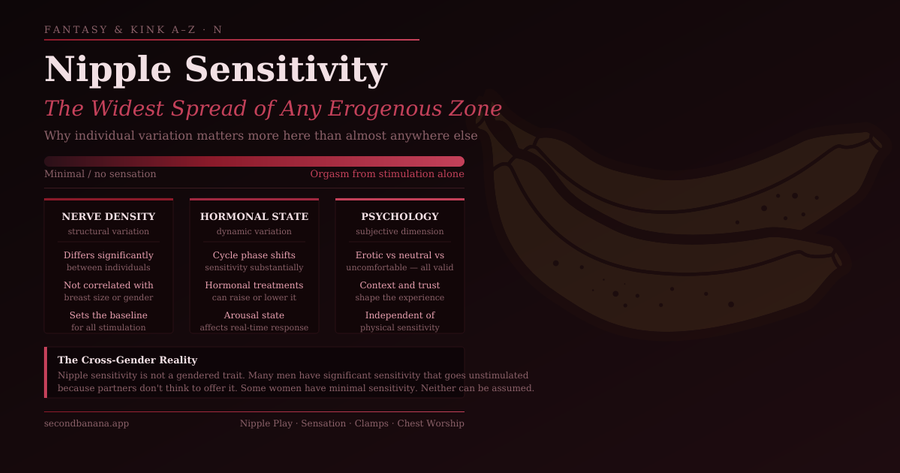
The spread of nipple sensitivity across people is wider than almost any other erogenous zone. Some people feel almost nothing. Some people can orgasm from it alone. Both are normal, and neither can be assumed.
The Anatomy of Nipple Sensitivity
Why Sensitivity Varies So Much
Nipple sensitivity varies more dramatically between individuals than almost any other erogenous zone. The variation has several sources. Nerve density in nipple tissue differs significantly between individuals — more so than in most comparable tissue. Hormonal environment affects sensitivity, sometimes dramatically: sensitivity can increase substantially during certain phases of the menstrual cycle, during pregnancy and lactation, and in response to hormonal treatments. Psychological factors — whether nipple stimulation feels erotic, neutral, or uncomfortable — also shape subjective response independently of physical sensitivity.
The result is a genuine range. At one end, individuals for whom nipple stimulation produces minimal sensation regardless of technique or intensity. At the other, individuals for whom nipple stimulation is among the most intensely pleasurable sensations available — up to and including orgasm from nipple stimulation alone, without genital contact, which is a documented and not uncommon experience for a subset of individuals across genders. Most people fall somewhere in the middle, with nipple stimulation as one pleasurable element in a broader erotic context rather than a primary focus or an absence.
Cross-Gender Sensitivity
One of the more persistent and mistaken assumptions about nipple sensitivity is that it is primarily or exclusively relevant to people with breasts — specifically, to women. The actual distribution of nipple sensitivity across genders is far less tidy than this. Many men and non-binary people have significant nipple sensitivity and specific erotic engagement with nipple stimulation, while some women have minimal nipple sensitivity or find stimulation uncomfortable. The anatomy of nipple tissue — its nerve supply and its responsiveness to stimulation — does not differ substantially based on whether the person has substantial breast tissue, and assuming otherwise leads to missed communication and missed experience on all sides.
The cultural tendency to frame breast and nipple play as something done to women, by partners who have breasts as the focus of their attention, flattens a considerably more varied reality. Men with significant nipple sensitivity frequently receive less nipple attention in partnered encounters than their sensitivity would justify, precisely because partners do not think to offer it. Naming nipple sensitivity explicitly and specifically, regardless of one's gender, is the most reliable solution to this problem.
The Range of Nipple Play
Light and Gentle
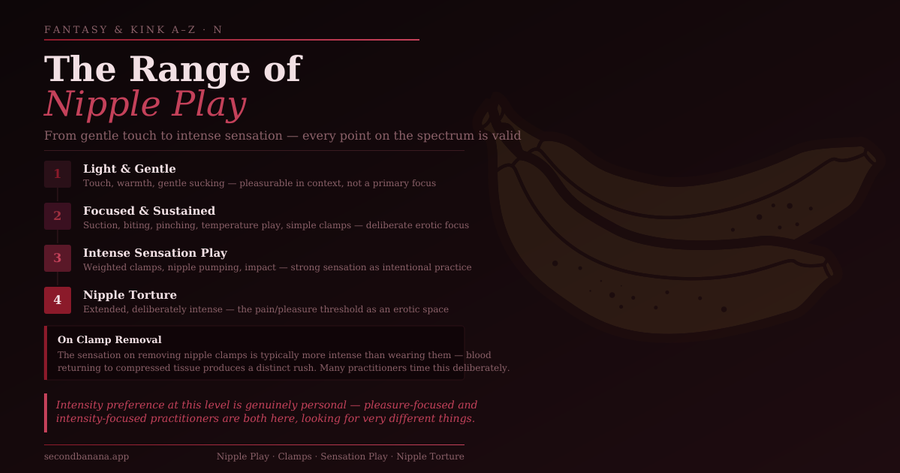
At the gentler end of the range, nipple play involves light touch, gentle sucking, warmth, and the kind of attention that many people with moderate nipple sensitivity find pleasurable in the context of broader sexual activity. For many people this is the full range of what they want — gentle stimulation that contributes to overall arousal without being a focus in itself. For some people with high sensitivity, even this level of stimulation is intense, making 'gentle' a relative term that requires calibration for each person.
Intermediate and Focused
Further along the range, nipple play becomes a deliberate focus: more sustained attention, more varied technique, more intentional engagement with the specific sensations nipple stimulation produces. This includes suction, biting (from light to significant), pinching, twisting, and the sustained rhythmic stimulation that some practitioners find most reliably pleasurable. Temperature play — ice and heat applied to the nipple — is a common element at this level, as is the use of simple clamps that maintain pressure without requiring sustained manual attention.
At this range, the distinction between pleasure and intensity becomes relevant. Some practitioners at this level are primarily pleasure-focused — seeking the kind of stimulation that produces the most reliably pleasurable response. Others are intensity-focused — specifically interested in the heightened sensation that comes from stimulation that edges toward pain or overwhelm, finding the intensity itself erotic independently of whether it reads as purely pleasurable. Both orientations are valid and both require communication, but they are looking for different things.
Sensation Play and Nipple Torture
'Nipple torture' is the term used in kink contexts for nipple stimulation at the more intense end — sustained, strong, or specifically painful nipple stimulation as an intentional erotic practice. The 'torture' framing is, as with most kink terminology, descriptive of intensity rather than of genuine harm: practiced safely and with explicit negotiation, nipple torture involves consensual stimulation at intensities that produce strong sensation, pain, or a blurred threshold between the two.
Common elements at this end of the range include more intense clamps (weighted, toothed, or applied for extended periods), suction devices, nipple pumping (which temporarily increases size and sensitivity through sustained suction), and impact play specifically on the nipple and breast area. The erotic appeal here is often layered: the physical sensation itself, the power dynamic inherent in one person administering intense sensation to another, and the psychological dimension of surrendering a particularly sensitive body part to a partner's control.
Nipple Clamps: A Specific Note
Nipple clamps are common enough in this space to deserve specific treatment. The relevant variables are pressure (how tightly the clamp grips), duration (how long it is worn), and the specific sensation on removal — which, for most types of clamp, is significantly more intense than wearing, because blood return to tissue that has been compressed produces a distinct rush of sensation. Many practitioners specifically seek this removal sensation, timing it deliberately within an encounter.
Clamp types range from simple clothespeg-style clamps to adjustable clamps that allow precise pressure setting to weighted clamps that add traction and movement sensation to sustained pressure. Clover clamps, which tighten automatically when pulled, are specifically sought by practitioners who want a clamp that responds to body movement and partner interaction.
Piercing and Permanent Modification
Nipple piercing occupies a specific position in the nipple play space — it is both a body modification that many people find aesthetically significant and an alteration that changes the sensory profile of nipple stimulation, usually increasing it during healing and settling into a distinct new baseline afterward. For some people with nipple piercings, the rings or bars themselves become a focus of play: pulling, tugging, and the specific sensation of jewellery moving through pierced tissue. For others, the piercing is primarily aesthetic and the erotic dimension is secondary or absent.
The intersection of nipple piercing with the erotic practice of nipple play is not universal — pierced nipples do not automatically mean a person wants focused nipple play — but it is common enough that people who actively want nipple-focused play frequently have or want piercings, and people with piercings frequently find that partners assume a nipple focus. As always, the assumption is the problem: the preference is worth naming explicitly in either direction.
Nipple Play in Partnered Encounters
Communication and Calibration
Nipple play is one of the erotic territories where the spread of individual preference and sensitivity is widest, making communication more important than usual. The person who wants only the gentlest attention and the person who wants sustained, intense, deliberate stimulation are both in this space, and the distance between them is significant enough that partner assumptions frequently miss. Explicit communication about what one wants — not just 'I like nipple play' but 'I like this kind of nipple attention at this intensity for this duration' — is the reliable path to actually getting it.
This is also a space where feedback during an encounter matters: sensitivity and preference can shift with arousal state, and stimulation that felt good five minutes ago may feel too intense or not intense enough now. Practitioners with a developed nipple play practice often have established signals for more, less, harder, softer that allow real-time calibration without interrupting the encounter.
The Giving Side
The person administering nipple play is often as invested in it as the person receiving it. For many practitioners, giving nipple attention — through any of its forms — is itself erotically charged: the specific intimacy of sustained attention to a sensitive body part, the responsiveness of nipple tissue to stimulation, and the partner's response to that stimulation all contribute to an erotic experience for the giver that is not reducible to the power dynamic or the physical mechanics.
People who specifically enjoy giving nipple attention are looking for partners who want to receive it — which is a more specific compatibility than it might appear, given how much variation exists in whether people want nipple focus at all, and in what form. Naming it explicitly is the only way to find the match.
Nipple Focus and Second Banana
Second Banana's tag-based matching is particularly well-suited to a preference with as much internal variation as nipple play, because 'I like nipple play' is not a sufficient description to produce compatible matching. The tag system allows people to signal both the direction of their interest and the intensity range:
- Nipple play — general signal of interest in giving or receiving
- Nipple clamps — specific interest in clamp-based sensation
- Nipple torture — interest in the more intense end of the range
- Chest/breast worship — focus on sustained, worshipful attention
- Pierced / piercing positive — relevant to the modification dimension
- Sensation play — for those whose nipple interest is part of a broader intensity focus
- Nipple orgasm — for those who experience or seek to facilitate this specific response
The community Second Banana builds — where preferences are named specifically rather than assumed — is where the full range of nipple play interest can be expressed and matched. Whether the preference is for gentle sustained attention or for intense, deliberate, extended sensation, the right partner is looking for exactly that.