First Date Safety: How Second Bananas Meet IRL | Second Banana
The Fun Part Is Coming: A Second Banana Guide to First Date Safety
Because Getting There Safely Is Part of the Adventure
Here's the thing about first dates: the butterflies are real, the anticipation is real, and the possibility of something genuinely extraordinary is real. Second Banana was built so that by the time you're meeting someone in person, you already know quite a bit about them — you've read their post, you've exchanged messages, you have a sense of who they are and what they're looking for.
That's a better foundation than most dating platforms offer. And it still doesn't mean you skip the safety basics.
Not because strangers are presumptively dangerous. Most of the time, a first date is exactly what it looks like: two people who met online, sitting across a table, figuring out whether the connection translates. But "most of the time" isn't the same as "always," and the stakes of the exceptions are high enough that it's worth taking this seriously.
Think of first date safety the way you think of a seatbelt. You don't put it on because you expect to crash. You put it on because the cost of wearing it is low and the cost of not wearing it, in the one case where it matters, is not.
This guide covers everything: what to do before you meet, how to handle the meeting itself, considerations specific to ENM dating that other guides don't address, and how Second Banana's own architecture supports your safety before you've even said hello in person.
Let's get into it.
Before You Meet: Digital Safety Starts Here
The conversation that happens before a first date is where your safety foundation gets built — or doesn't. Here's what that foundation looks like.
Guard Your Personal Information Until You're Ready
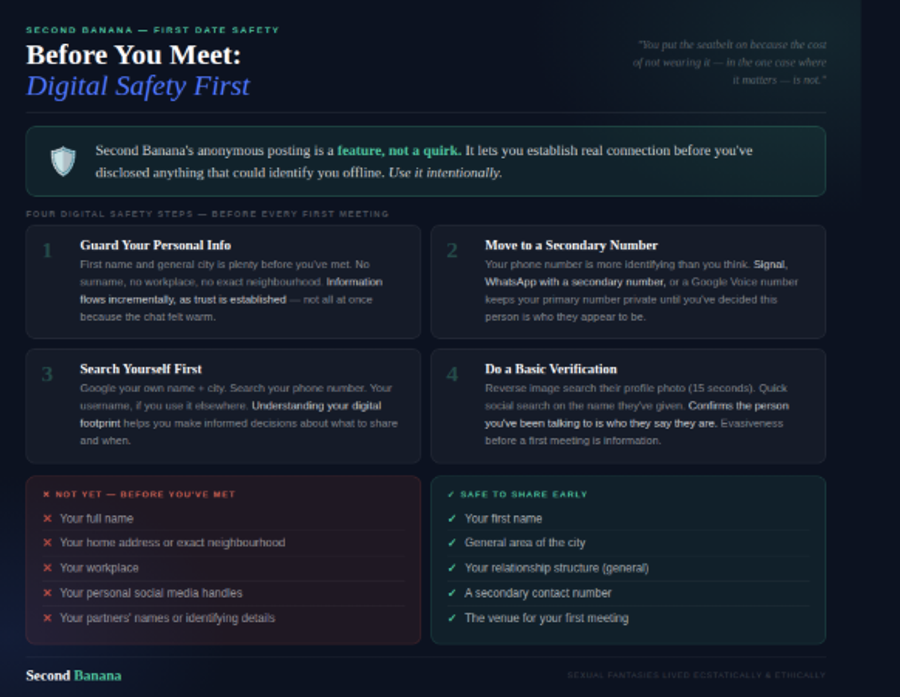
Second Banana's anonymous posting model is a feature, not a quirk. It lets you establish connection, share your desires and personality, and find genuine compatibility before you've disclosed anything that could identify you offline. Use this intentionally.
Before you've met someone in person and established real trust, you don't need to share your surname, your exact neighbourhood, your workplace, your social media handles, or anything else that would allow someone to find you outside the platform. A first name, a general area of the city, and a way to communicate through the app is plenty. Everything else can come later — after the first date, after you've decided this person is who they appear to be.
This isn't paranoia. It's the same logic that applies to any situation where you're meeting someone new: you give information incrementally, as trust is established, rather than all at once because the conversation felt warm.
Move to a Separate Communication Channel Carefully
At some point before a first date, most people move from in-app messaging to texting or another messaging platform. That's fine and normal — but do it with your eyes open.
Your phone number is more identifying than you might think. It can be searched. It can connect back to other accounts. Consider using a secondary number or a messaging app that doesn't require sharing your primary number (Signal, WhatsApp with a secondary number, or similar) for early communication with new connections. This is especially relevant if you're navigating a complicated social situation — if your dating life needs to stay compartmentalised for personal or professional reasons, this layer of separation is worth maintaining until you're confident about who you're talking to.
Do a Basic Background Check on Yourself First
Before you worry about vetting someone else, run a quick search on yourself to understand what's publicly findable. Your name plus your city. Your phone number. Your email address. Your username, if it's one you use elsewhere. What comes up? What would come up for someone who knew your first name and approximate location?
Understanding your own digital footprint helps you make informed decisions about what to share and when.
Verify Before You Meet
You've been talking to someone for a couple of weeks. You feel like you know them. You might — but it's worth a basic check before committing to a meeting.
A reverse image search of their profile photo takes about fifteen seconds and can tell you whether the image belongs to someone else entirely. A quick social media search on the name they've given you (if they've shared it) can confirm that a real person with that history exists. This isn't about digging into someone's life — it's about confirming that the person you've been talking to is who they say they are.
If someone is resistant to any form of verification before a first meeting — unwilling to do a brief video call, evasive about basic biographical details — that's worth noting.
Planning the First Meeting
Always Meet in a Public Place First
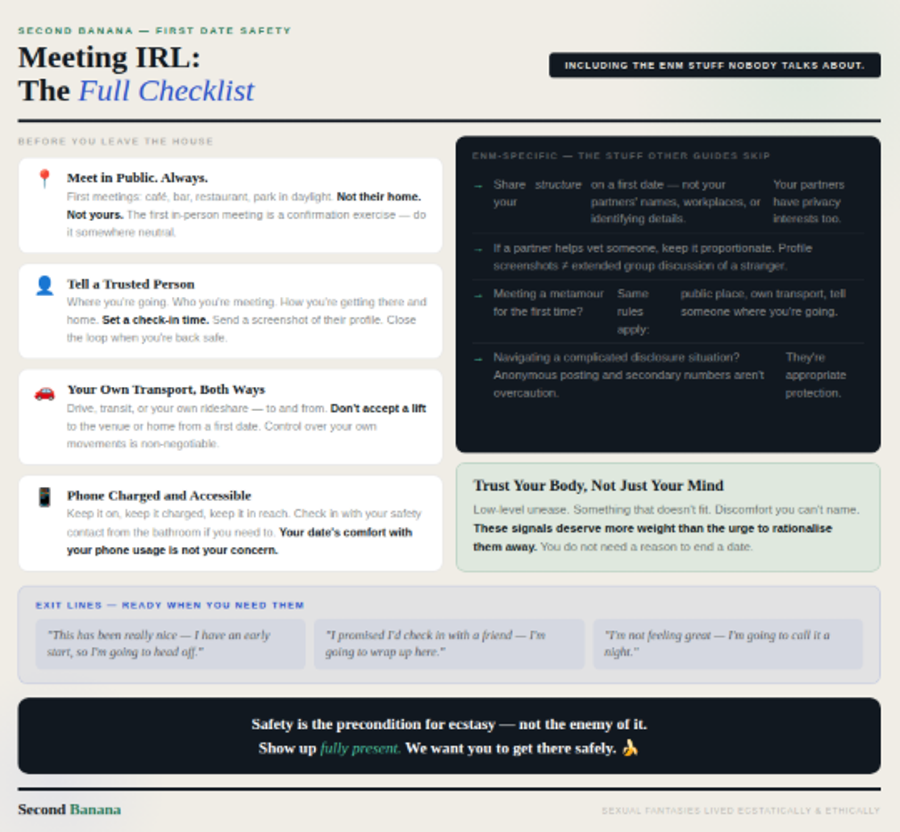
This is the rule, not the suggestion. First meetings should happen in public spaces: a café, a bar, a restaurant, a park during daylight hours. Not your home. Not their home. Not anywhere that gives one person structural power over the other.
This applies regardless of how long you've been talking, how much you feel you know them, how strong the connection seems, or how inconvenient a public meeting place might be logistically. The first in-person meeting is a data-collection exercise as much as it's a date — you're confirming that the person in front of you matches the person you've been talking to. Do that somewhere neutral.
If someone pushes to meet somewhere private for a first meeting, or is dismissive of your preference for a public location, that's information.
Choose a Location You're Comfortable With
Comfortable means: you know how to get there and get home independently, you're not reliant on your date for transport at any point, and you're in an area where you'd feel okay if the date ended abruptly and you needed to leave.
Your own neighbourhood is often a good choice for exactly this reason — you know the area, you know your exit routes, and you're not navigating somewhere unfamiliar in a potentially uncomfortable situation. The counterargument is that meeting close to home reveals where you live, which is also valid. Middle ground: a public area you know well but that isn't immediately adjacent to your home.
Tell Someone Where You're Going
Before every first date, tell a trusted person: where you're going, who you're meeting, how you'll be getting there and getting home, and what time they should expect to hear from you.
Send them a screenshot of your date's profile or messages. Share the restaurant or venue name and address. Give them a check-in plan: "If you haven't heard from me by 10pm, text me." This person doesn't need to do anything with this information in all likelihood — but they have it, and you both know they have it, which matters.
If you don't have someone in your life you trust with this information, consider using a dedicated safety app (see below). But ideally, this is a human being who will notice if they don't hear from you.
Use a Safety App If You Want an Extra Layer
Several apps are designed specifically for exactly this situation: they share your real-time location with designated contacts, and some have features where you can set a timer that triggers an alert to your contacts if you don't check in. bSafe, Kitestring, and Noonlight are among the better-known options. Some have features that allow a contact to discreetly call you with a fake emergency if you text a code word — useful if you're on a date that's going poorly and you need an exit.
These apps are worth having set up before you need them, not scrambling to install when you're already on your way out the door.
Have Your Own Transport Plan
Drive yourself, take public transport, or arrange your own cab or rideshare — both to and from the date. Do not accept a lift from your date to the venue for a first meeting, and do not get into their car at the end of the date unless you've made a deliberate, fully uncoerced decision to do so.
This is about maintaining control over your own movements at a point in a new connection where you haven't yet established the level of trust that warrants otherwise.
During the Date
Trust Your Body, Not Just Your Mind
This is the most important piece of advice in this guide, and the hardest to act on.
Your body often knows something is off before your conscious mind has caught up. A feeling of low-level unease. A sense that something doesn't quite fit. Discomfort you can't immediately name. These signals are worth taking seriously.
The social pressure to dismiss these signals — to not be rude, to give people the benefit of the doubt, to not make a scene — is real. So is the tendency to rationalise: "I'm probably just nervous," "they're probably fine," "I don't want to seem paranoid." These are understandable responses, and sometimes they're correct. But when your gut is telling you something and your mind is explaining it away, your gut deserves more weight than it typically gets.
You do not need a reason to end a date. "I'm not feeling well" is sufficient. "I have somewhere to be" is sufficient. "I need to head off" is sufficient. You don't owe anyone an explanation, and you certainly don't owe anyone the continuation of an evening that doesn't feel right.
Watch Your Drink
Don't leave your drink unattended. If you do leave it unattended — to use the bathroom, to take a call — don't continue drinking it when you return. Order a new one. This is a standard precaution in any social situation involving strangers and alcohol; it doesn't require your date to be acting with bad intent, just a baseline of self-care.
Similarly: stay within a level of intoxication where you can make clear decisions about how you want the evening to go. The beginning of a new connection is not the moment to drink more than you're comfortable with.
Keep Your Phone Accessible
Keep your phone charged, on, and accessible throughout the date. If you want to check in with your safety contact during the date — a quick bathroom text — do it. If you want to step out to make a call, do it. Your date's comfort with you having a phone and using it is not your concern.
Know Your Exit Lines
Having a few prepared exit lines means you're not scrambling to improvise when you want to leave. Some reliable options:
"This has been really nice — I have an early start tomorrow, so I'm going to head off."
"I promised I'd check in with a friend — I'm going to wrap up here."
"I'm not feeling great — I'm going to call it a night."
None of these require elaboration. None of them invite debate. If someone responds to a polite exit line with pressure to stay, that itself is information.
ENM-Specific Safety Considerations
This is the section that most generic dating safety guides don't cover — and for Second Banana's community, it matters.
Disclosing Your Relationship Structure Safely
If you're non-monogamous, you've likely already signalled that on your Second Banana profile via your tags and post. The person you're meeting knows. But first dates sometimes involve deepening that conversation — sharing more about your specific structure, your partners, your household situation.
Be thoughtful about how much of this you disclose before you've established that this person is trustworthy with the information. Details about your living situation, your other partners' names and workplaces, the specific shape of your polycule — these are private not just for your own sake but for the sake of the other people in your life. Your partners have their own privacy interests in not being identified to strangers.
A general sense of your structure ("I'm solo poly," "I'm in an established relationship and looking for additional connections," "I'm new to ENM and figuring it out") is plenty for a first date. The details come later, with trust.
If Your Partner or Metamour Is Involved in Vetting
Some poly people — particularly those in kitchen-table structures — involve partners or metamours in the vetting process before a first date. This might look like sharing profile screenshots for a second opinion, or a partner knowing in detail who you're meeting and why.
This is a healthy and reasonable practice, but it comes with its own privacy consideration: the person you're going to meet hasn't consented to having their profile and messages shared with people they don't know yet. Keep this in proportion — sharing enough for your safety is different from making someone's information a topic of extended group discussion before they've even met you.
Meeting a New Partner's Existing Partners
If a first date evolves into a second or third, and the question of meeting metamours arises, apply the same basic principle: meet in public, give information incrementally, and trust your instincts. Just because someone is pre-vetted by a partner you trust doesn't mean they're automatically safe to you specifically — people are complex, and your own assessment of a new person matters regardless of who vouches for them.

If You're Navigating a Complicated Disclosure Situation
Some Second Banana members are exploring ENM while still managing complicated personal situations — a partner who is aware but not fully on board, a professional context where being out as non-monogamous would create problems, a social network where this part of their life needs to stay private. If that's you, the digital safety steps at the beginning of this guide are especially important. Anonymous posting, secondary contact channels, and careful information management aren't overcaution — they're appropriate protection for a situation that has real stakes.
After the Date
Tell your safety contact you're home. Not just because they're waiting to hear — though they are — but because the habit of closing the loop normalises the whole system. Safety check-ins only work if they're consistent enough that a missed one actually triggers concern.
If the date went well: great. Take a moment before the next meeting to revisit whether your sense of this person has changed now that you've met them in person. Usually it confirms what you expected. Occasionally it shifts things — in either direction — and that's information worth sitting with before proceeding.
If the date went poorly, or if something happened that made you uncomfortable: you're allowed to block, to disengage, to report to the platform if something crossed a line. You don't owe anyone a detailed explanation of why you're not proceeding. Second Banana's community standards exist to protect members, and using them is not an overreaction.
The Bottom Line
Safety isn't the opposite of fun. It's the precondition for it.
The most ecstatic, most connected, most genuinely extraordinary experiences happen when you feel safe enough to be fully present. A date where you're anxious about your transport home, or uncertain whether anyone knows where you are, or carrying the low-level hum of an instinct you've been pushing down — that date cannot be its best self.
The steps in this guide take a small amount of time and practically no enjoyment away from the experience. What they give back is the ability to show up fully — to be actually, completely present for whatever extraordinary thing might be about to happen.
That's what you're here for. We want you to get there safely. 🍌
Second Banana: Sexual Fantasies Lived Ecstatically and Ethically. A sex-positive, inclusive community for adults of every relationship structure — built for connection that starts with honesty and keeps everyone safe.*