You're Not Alone: LGBTQ+, Autism, ADHD, and Kink | Second Banana
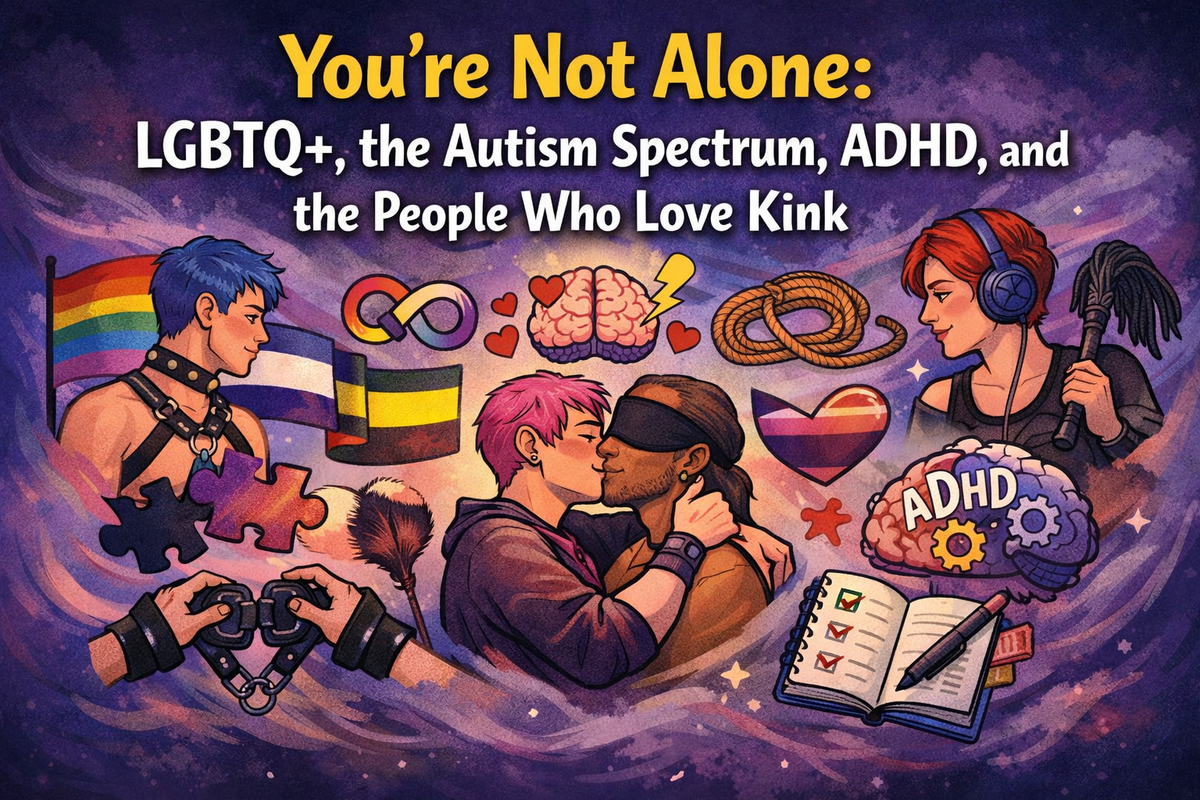
You're Not Alone:
LGBTQ+, the Autism Spectrum, ADHD, and the People Who Love Kink
The Pattern That Keeps Appearing
Here is something the research has been quietly establishing for a while now, and that anyone who spends time in kink communities tends to clock pretty quickly: the people who show up are not a random cross-section of the population.
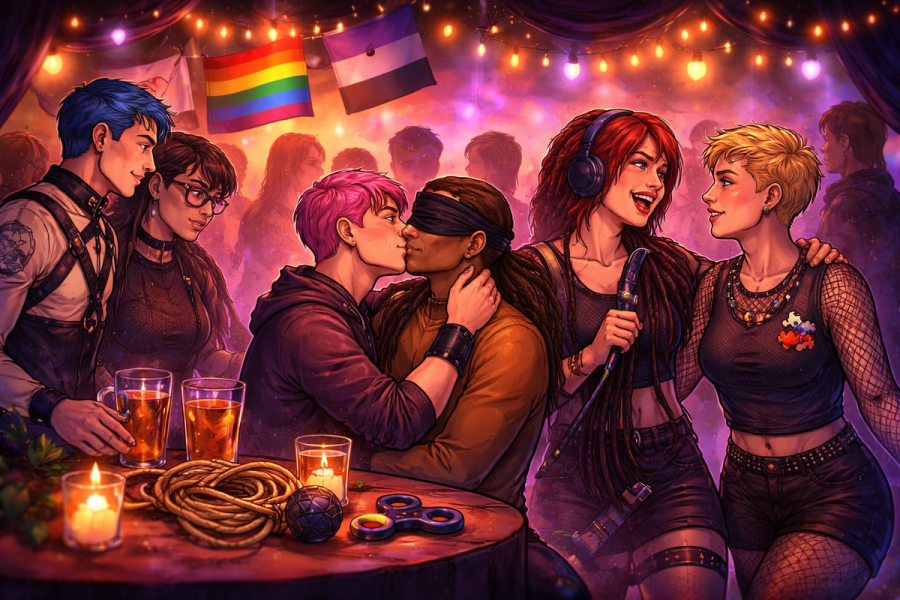
They skew queer. They skew neurodivergent. The overlap between LGBTQ+ identity, autism spectrum traits, ADHD, and kink interest is not coincidental — it shows up consistently enough across enough different studies that it's worth taking seriously, talking about honestly, and understanding properly.
Not as pathology. Not as a set of deficits that happen to drive people toward the same place. But as a genuine convergence of people whose relationship with desire, sensation, identity, and communication tends to work differently from the mainstream — and who have found, in one another and in kink communities, something that mainstream sexual culture persistently fails to provide.
This piece is about why. It's also about why Second Banana was built for exactly the people this data describes.
What the Data Actually Shows
Let's start with the numbers, because they're striking.
Autism and Kink
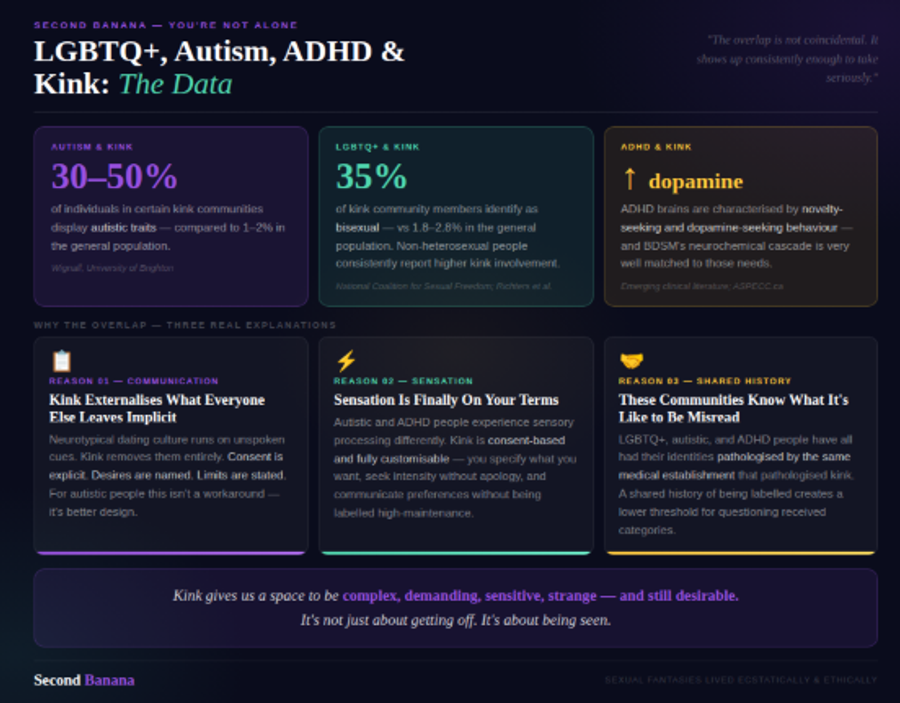
Research by Dr Liam Wignall at the University of Brighton — one of the most cited researchers on kink and neurodivergence — found that 30–50% of individuals in certain kink communities display autistic traits, compared to roughly 1–2% in the general population. That's not a rounding error. That's a signal.
A 2024 peer-reviewed study published in Autism Adulthood interviewed autistic adults about their engagement with BDSM and kink and found three consistent themes: the structured communication and explicit consent culture of kink made participants feel safe in ways that mainstream sexual contexts didn't; the sensory dimensions of kink gave them a controlled way to explore sensory experience; and kink spaces gave them room to be authentically themselves in ways they rarely found elsewhere.
The paper's title — "Comforting, Reassuring, and... Hot" — is doing a lot of work. The researchers weren't describing a community of people who stumbled into kink despite being autistic. They were describing people for whom kink's particular architecture made profound sense precisely because of how their minds and nervous systems work.
ADHD and Kink
The ADHD-kink connection is less researched but just as consistent in the anecdotal and emerging clinical literature. ADHD brains are characterised by dopamine-seeking behaviour, novelty preference, and sensation-seeking — and BDSM, with its intensity, variety, and the neurochemical cascade of subspace, is very well-matched to those needs.
Subspace — the altered state many submissives experience during intense BDSM play — involves a significant release of endorphins, adrenaline, and dopamine. For brains that chronically underfire on dopamine, this isn't just enjoyable. It's regulatory. It's one of the few experiences that reliably cuts through the static.
ADHD's executive dysfunction also manifests in decision fatigue — the exhaustion of constantly managing choices and self-regulation across a day. The submissive role in a BDSM dynamic offers a structured, consensual release from that constant management. For some ADHD people, relinquishing control in a safe, negotiated context isn't an indulgence. It's a specific and effective form of relief.
Conversely, the dominant role can offer a different but equally appealing experience: a focused, high-stakes scenario that demands full presence and rewards the kind of intense, single-pointed attention that ADHD brains can sustain far more easily than diffuse, low-stakes tasks.
LGBTQ+ and Kink
The data here is consistent across multiple national surveys. LGBTQ+ people report involvement in kink and BDSM at significantly higher rates than heterosexual people. One well-cited figure: 35% of kink community members identify as bisexual, compared to roughly 2% in the general population. A 2008 nationally representative Australian survey found significant differences in BDSM participation across sexual orientation, with bisexual people at the highest levels, followed by gay and lesbian people.
A 2023 review in Current Sexual Health Reports confirmed that non-heterosexual people are more likely to report kink involvement across multiple datasets, and that for LGBTQ+ people in particular, kink communities frequently offer something specific: safety, acceptance, and autonomy in a context where their identities are treated as unremarkable rather than exceptional.
The genderqueer and non-binary data is especially notable. Multiple studies have found that genderqueer and non-binary people show higher role fluidity in BDSM than binary-identified people, and are significantly more likely to identify as switches — playing both dominant and submissive roles. For people whose relationship with gender already involves actively refusing binary categories, the permission to be fluid within a sexual practice feels less like a novelty and more like a natural extension.
Why the Overlap — Three Real Explanations
1. Kink Externalises What Most People Leave Implicit
Neurotypical people navigating mainstream sexual culture are expected to read a vast array of unspoken cues — to know without being told what's wanted, to communicate desire through implication and subtext, to manage the entirely unspoken negotiation of a sexual encounter in real time.
For autistic people, this is not a minor inconvenience. It is a genuine barrier to safe, satisfying intimacy. Kink removes it entirely. Consent negotiation is explicit and expected. Desires are named rather than implied. Limits are stated rather than guessed at. Safewords provide a clear, agreed-upon mechanism for communication that doesn't require reading tone or expression in the heat of a moment.
This isn't a workaround. It's better design. The explicit communication culture of kink is better for everyone — but for autistic people specifically, it's the difference between an environment that works and one that doesn't.
2. Sensation Is Finally on Your Terms
Sensory processing differences are a core feature of both autism and ADHD. Autistic people commonly experience hypersensitivity (certain textures, sounds, or pressures that are overwhelming or painful) and hyposensitivity (seeking intense sensory input because lighter sensation doesn't register clearly). ADHD involves its own sensory seeking, particularly for stimulation intense enough to hold attention.
Kink's approach to sensation is fundamentally consent-based and customisable. You can specify exactly what kind of touch you want and don't want. You can seek intense sensation in a context where intensity is expected and welcomed, rather than having to explain yourself. You can communicate sensory preferences without them being treated as high-maintenance demands.
The 2024 Autism Adulthood study found that participants described sensory experiences in kink as a form of "sensory joy" — not just tolerable or acceptable, but genuinely delightful in ways that mainstream physical intimacy often wasn't. The ability to be intensely, specifically present in physical sensation, on your own terms, in a context designed to accommodate that, is not incidental to kink's appeal. It's central to it.
3. These Communities Already Know What It's Like to Be Misread
LGBTQ+ people, autistic people, and people with ADHD share something that doesn't show up in the kink statistics but underlies all of them: a lifetime of having their desires, their identities, and their ways of being in the world pathologised, minimised, or misunderstood by mainstream culture.
The LGBTQ+ community has spent decades fighting the clinical establishment's insistence that their orientation or gender identity was a disorder. Autistic people are still fighting the medical establishment's deficit-based framing of autism as something to be fixed. ADHD adults are still fighting the cultural assumption that their neurology is a character flaw.
Kink practitioners have fought the same battles. The DSM only removed BDSM from its list of paraphilic disorders in its most recent revision, and only conditionally. Kink practitioners have been fired, lost custody of their children, and faced discrimination because of their sexual practices — experiences that parallel LGBTQ+ experiences of stigma in ways that are not accidental.
What this shared history of being labelled creates, among other things, is a lower threshold for questioning received categories. People who already know the mainstream is wrong about one thing they are tend to be more open to the possibility that it might be wrong about others. Coming out as kinky, for someone who has already come out as queer or autistic, is a different — and often easier — experience than it would be for someone whose identity has never been challenged in this way.
Kink gives us a space to be complex, demanding, sensitive, strange — and still desirable. It's not just about getting off. It's about being seen.
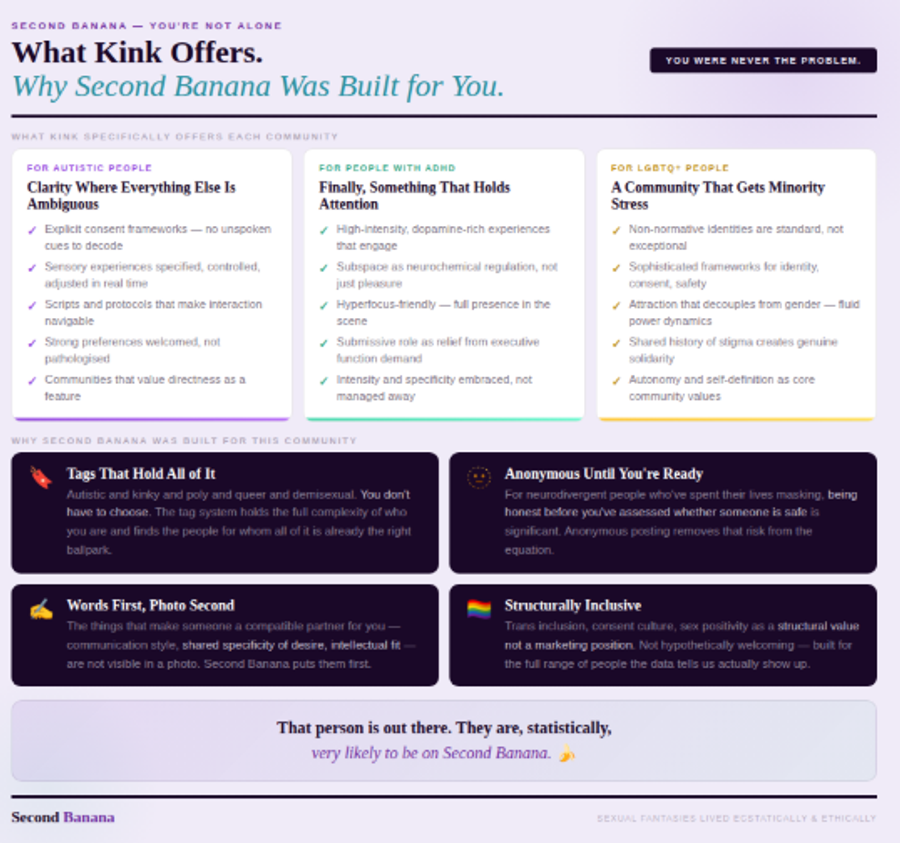
What Kink Specifically Offers These Communities
For Autistic People
- Explicit, pre-negotiated consent frameworks that remove the ambiguity of implicit social cues
- Sensory experiences that can be specified, controlled, and adjusted in real time
- Community spaces that value directness and specificity in communication
- Permission to have strong preferences and communicate them without social penalty
- Scripts and protocols that make social interaction navigable rather than exhausting
For People with ADHD
- High-intensity, dopamine-rich experiences that engage rather than bore
- Subspace as a regulatory neurochemical experience, not just a sexual one
- The hyperfocus that BDSM scenes can induce — finally, full presence
- Consensual power exchange that provides relief from constant executive function demands
- Community cultures that embrace intensity, specificity, and unconventional engagement styles
For LGBTQ+ People
- Communities where non-normative identities are standard rather than exceptional
- Spaces that have developed sophisticated frameworks for identity, consent, and safety
- Kink's tendency to decouple attraction from gender — pansexual engagement with power dynamics rather than bodies specifically
- A community that has its own experience of stigma and discrimination, and therefore a particular kind of solidarity
- Autonomy and self-definition as core community values, not optional extras
What This Means in Practice
If you are LGBTQ+, autistic, have ADHD, or any combination of these, and you find yourself drawn to kink — you are not broken. You are not "too much." You are not unusual in some clinical sense that needs explaining away.
You are part of a pattern that researchers are increasingly documenting, that kink communities have long understood, and that makes very good sense once you understand the reasons behind it.
That said, knowing you're not alone is only part of what matters. The other part is finding the community that actually makes you feel that way. And this is where the practical reality diverges from the statistical one.
Many kink communities — despite everything we've said about their structural advantages for neurodivergent and LGBTQ+ people — reproduce other forms of exclusion. They skew white, as multiple researchers have noted. They skew toward binary gender expression despite the data showing high participation from non-binary people. They can reproduce ableism even while providing structural accommodations for neurodivergent people. Online kink spaces have their own dynamics, not all of them healthy.
What the research describes is kink's potential. Realising that potential requires intentional community-building — the kind that centres the people the data tells us are disproportionately present, treats their specific needs and preferences as features rather than edge cases, and builds platforms and spaces that reflect the full diversity of who actually shows up.
Why Second Banana Was Built for You
Second Banana's community is not hypothetically welcoming to LGBTQ+ people, neurodivergent people, and kink practitioners. It is built specifically for the full range of people these identities describe — including, crucially, the significant overlap between them.
The tag system gives you language for the full complexity of who you are and what you're looking for. You don't have to choose between your kink identity and your neurodivergent identity, or between your queer identity and your relationship structure. The tags hold all of it. You can describe yourself as autistic and kinky and poly and queer and demisexual and whatever else is true about you, and find the people for whom all of those things are already in the right ballpark.
The anonymous posting model matters here in a specific way. For neurodivergent people who have spent their lives masking — performing neurotypicality to manage social situations — the ability to be honest about who you are before you've had to assess whether a specific person is safe to be honest with is significant. For LGBTQ+ people navigating complicated disclosure contexts, it provides a layer of protection that mainstream platforms strip away by default.
The post-first, photo-second structure is particularly well-suited to communities for whom the primary connection isn't physical appearance but communication style, intellectual compatibility, and shared specificity of desire. The things that make someone a genuinely compatible partner for an autistic kinkster, or an ADHD person seeking a structured dynamic, or a queer person looking for community as much as connection — these are not visible in a photo. They are visible in how someone writes about who they are.
And the platform's explicit commitments — consent culture, trans inclusion, sex positivity as a structural value rather than a marketing position — are not separate from its suitability for this community. They are exactly what that community needs in order to be fully itself.
You Were Never the Problem
The kink community has a phrase that captures something important: "your kink is not my kink, but your kink is okay." It's usually invoked to defend individual preferences. But for LGBTQ+ people, autistic people, and people with ADHD, it gestures at something bigger — a community culture that has, however imperfectly, genuinely tried to make room for people whose desires and identities don't fit the default template.
You were not broken before you found this community. You were not broken before you found the language for what you wanted. You were not broken when you couldn't make mainstream dating culture work for you, because mainstream dating culture is not built for how you connect.
The data doesn't just show that you're not alone. It shows that there is a reason for all of this — a structural logic to why kink makes sense for people who are wired the way you are, who have navigated the world the way you have, who have desires that are specific and strong and deserve to be met with someone who actually understands them.
That person is out there. They are, statistically, very likely to be on Second Banana.
That's what we're here for. 🍌
Second Banana: Sexual Fantasies Lived Ecstatically and Ethically. A sex-positive, inclusive community for adults of every relationship structure — built for connection that starts with honesty and keeps everyone safe.*