New Relationship Energy (NRE): What It Is, Why It Fades, How to Use It Well | Second Banana
New Relationship Energy:
What It Is, Why It Fades, and How to Use It Well
You Know This Feeling
You are, to your mild embarrassment, thinking about them again. For roughly the forty-seventh time today. You have replayed the last conversation in your head with a fidelity that would be impressive if it weren't slightly deranging. You are not entirely in your body when you are doing other things. You are writing a message and deleting it and rewriting it and wondering if two exclamation marks is too many and you are a grown adult who is behaving like this.
This is NRE. New Relationship Energy. The intoxicating, slightly dizzying, occasionally all-consuming high that arrives with new connection — particularly the romantic and erotic kind — and that makes the person across from you feel like the most interesting, attractive, singular human being who has ever existed in the history of interesting, attractive, singular human beings.
NRE is real. It is neurochemically grounded. It is, in moderate doses, one of the most pleasurable experiences available to a human nervous system. It is also temporary, not always a reliable indicator of long-term compatibility, capable of producing poor decisions when trusted too completely, and — in ENM contexts specifically — a source of significant complication for existing relationships if it isn't understood and managed with some intentionality.
This piece covers all of it: what NRE actually is and what's happening in your brain, the difference between NRE and limerence, how long it lasts, what happens when it fades (and what this does and doesn't mean), how NRE affects existing relationships in ENM contexts, and how to use NRE well — extracting its considerable gifts without letting it make your decisions for you.
What NRE Actually Is
The term "new relationship energy" was coined in alternative relationship communities in the 1990s — one of the many useful pieces of vocabulary that emerged from the polyamory community's practical need to name experiences that mainstream relationship culture left unlabelled. It refers to the heightened emotional, erotic, and psychological state that typically accompanies the early stages of a new romantic or sexual connection.
The neurochemistry of NRE is well-studied, because it turns out that falling for someone produces a brain state that has been of considerable scientific interest. Several systems are involved:
Dopamine
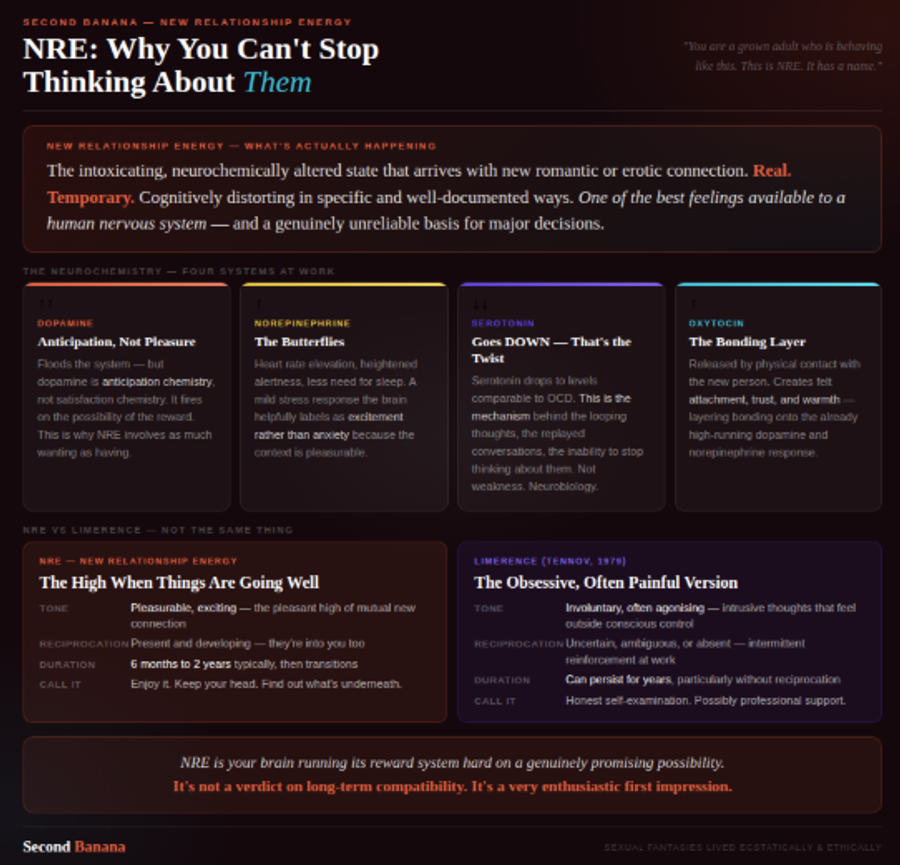
Dopamine — the neurotransmitter most associated with reward, motivation, and anticipation — floods the system in the early stages of new romantic connection. The key thing about dopamine is that it is not primarily a pleasure chemical — it is an anticipation chemical. Dopamine fires in response to the possibility of reward, not the reward itself. This is why NRE involves as much anticipation and wanting as it does satisfaction: the brain is running its reward system hard on the prospect of this person, on the uncertainty about how they feel, on the delicious anticipation of the next message, the next meeting, the next moment.
This dopamine surge is also why NRE can feel somewhat addictive. The variable reinforcement schedule of early romantic connection — sometimes they respond quickly, sometimes they take hours, sometimes you see them, sometimes you don't — is precisely the pattern that keeps dopamine systems most highly activated. Slot machines work the same way. This is not a flaw in your character. It is your reward system doing exactly what reward systems do.
Norepinephrine
Norepinephrine — a stress hormone that also functions as a neurotransmitter — contributes to the physical experience of NRE: the heart rate elevation, the heightened alertness, the slight tremor of excitement, the fact that you can function on less sleep than usual because your nervous system is slightly activated all the time. This is the "butterflies" component — a mild stress response that the brain helpfully labels as excitement rather than anxiety, because the context is pleasurable.
Serotonin — Notably, This One Goes Down
Here is the counterintuitive one: serotonin levels actually decrease during the early stages of romantic infatuation — dropping to levels comparable to those observed in OCD. This is the mechanism behind the intrusive quality of NRE thinking: the looping replays of conversations, the inability to stop thinking about the person, the way they occupy cognitive space without being invited. Low serotonin is associated with repetitive, intrusive thought patterns. NRE hijacks this system in the service of romantic fixation.
Oxytocin and Vasopressin
Physical contact with the new person releases oxytocin — the bonding hormone — which creates a felt sense of attachment and trust and emotional warmth. Vasopressin, similarly, is associated with pair-bonding. These systems are activated by the touch, proximity, and physical intimacy of new connection, layering attachment onto the already high-running dopamine and norepinephrine response.
The sum of all this neurochemistry is a state that is genuinely altered. You are, in a measurable sense, not in your ordinary cognitive state during peak NRE. Perception is distorted toward the positive. Attention is selectively focused. Risk assessment is impaired in favour of the new connection. Memory is reconstructive in ways that emphasise the appealing and de-emphasise the concerning. This is not a character failing. It is neurobiology.
NRE vs Limerence — An Important Distinction
NRE and limerence are related but distinct, and confusing them leads to confusion about what's actually happening in a given situation.
Limerence is a term coined by psychologist Dorothy Tennov in her 1979 book Love and Limerence. It describes an intense, involuntary, and often agonising state of obsessive romantic preoccupation — typically characterised by an intense need for reciprocation, extreme emotional dependency on the object of the limerence, and intrusive, unwanted thoughts about them that feel outside conscious control. Limerence can persist for years. It often involves significant suffering, particularly when reciprocation is uncertain or absent.
NRE is broader and generally more functional. It includes the pleasant parts of limerence — the dopamine surge, the heightened attention, the erotic charge — without necessarily including the obsessive, painful, involuntary quality of full limerence. NRE is the positive high of a new connection that is, broadly, going well. Limerence is what can develop when that connection is unrequited, ambiguous, or characterised by intermittent reinforcement — the pattern that keeps the dopamine system most activated.
In practice: if you are excitedly preoccupied with someone new and they are excited about you back and things are developing well, that's NRE. If you are consumed by someone who is ambiguous or unavailable, thinking about them compulsively in ways that feel involuntary and are causing you distress, that's moving toward limerence. The treatment is different. The first calls for enjoying the ride with some intentionality. The second calls for honest self-examination and possibly some professional support.
NRE is your brain running its reward system hard on a genuinely promising possibility. It's not a verdict on long-term compatibility. It's a very enthusiastic first impression.
How Long Does It Last — And What Happens Next
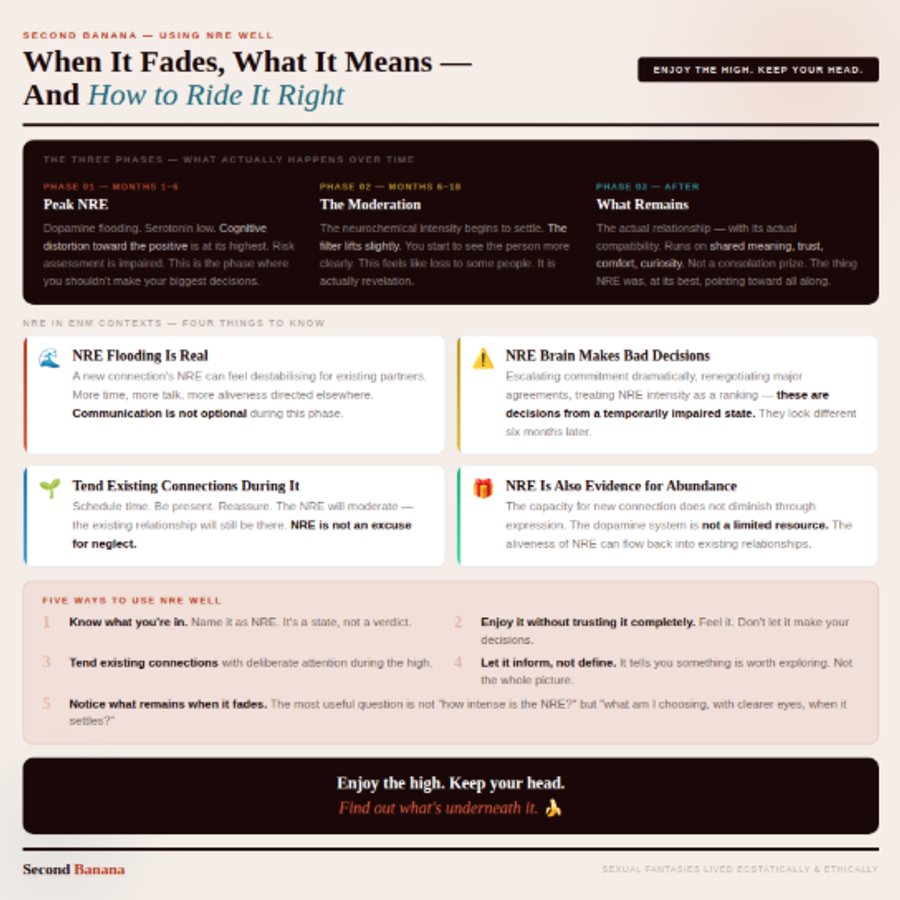
The research on the duration of the early romantic high is reasonably consistent: the intense NRE phase typically lasts somewhere between six months and two years. Helen Fisher's neuroimaging research on people in early romantic love found that the brain activations characteristic of this state begin to moderate around the twelve to eighteen month mark for most couples. Tennov's research on limerence found that it typically resolves within two to three years when the connection is sustained.
What this means practically: the version of this person that NRE is presenting you with is a real person, but seen through a filter that emphasises their positive qualities and softens or obscures the less compelling ones. This is not deception — the filter is neurological, not intentional. But it does mean that early-connection decisions made purely on the basis of NRE intensity are decisions made on incomplete information.
What Happens When NRE Fades
NRE doesn't end relationships. What it does is reveal them. When the dopamine settles and the intrusive preoccupation softens and you start to see the person with something closer to ordinary perception, what remains is the actual relationship — with its actual compatibility, its actual dynamic, its actual capacity for the deeper forms of connection that sustain something long-term.
For many people, the ending of NRE feels like a loss, because the high was genuinely pleasurable and its absence feels like something has gone wrong. It hasn't. The brain is returning to baseline after an extended period of altered chemistry. The relationship isn't dying — it's maturing into something that runs on different fuel.
The fuel that long-term connection runs on includes: shared meaning, genuine curiosity about the person, comfort, trust, laughter, complementary values, and what researchers call "companionate love" — the warm, stable, chosen attachment that doesn't produce the fireworks of NRE but that produces something more durable and, for many people, ultimately more nourishing. This is not a consolation prize. It is the thing that early NRE is, at its best, pointing toward.
When Connection Ends Specifically When NRE Ends
Some connections do dissolve when NRE fades — and this is useful information rather than a failure. If what two people had was primarily a neurochemical event, its natural conclusion is the conclusion of that chemistry. A relationship that dissolves when the early high moderates was telling the truth about itself: it was an NRE connection, not a long-term one, and there is nothing wrong with that. The problem only arises when people mistake NRE intensity for a prediction of long-term compatibility and make significant life decisions accordingly.
NRE in ENM Contexts — The Complications
New relationship energy is complicated enough in monogamous contexts. In ENM contexts, it introduces several specific dynamics that are worth understanding clearly.
NRE and Existing Partners
When someone in an established ENM relationship develops a new connection, their NRE for that connection can create a difficult dynamic for existing partners — sometimes called "NRE flooding." The person in NRE is experiencing a genuine neurochemical high. They may be spending more time than usual with the new person, talking about them extensively, and showing the kind of heightened aliveness that NRE produces. For existing partners, this can activate jealousy and insecurity — a felt sense of comparison that is uncomfortable even for people with secure attachment and well-developed compersion.
This is one of the places where communication is not optional. A partner in NRE who is fully absorbed in the new connection and neglecting to tend the existing one is not doing ENM well — regardless of how genuine the NRE is. NRE is not an excuse for reduced attention to existing relationships. It is, if anything, a signal to be more intentional about maintaining them.
NRE and Decision-Making
The cognitive distortions of NRE — the positive filter, the impaired risk assessment, the difficulty thinking clearly about anything except the new person — make early NRE a poor time to make major relationship decisions. This includes: escalating commitment dramatically, making significant changes to existing relationship agreements under NRE's influence, and treating the intensity of NRE as evidence that this new connection is more significant than existing ones.
The ENM community has a phrase for what happens when someone allows NRE to override their existing commitments and judgment: "new relationship crazy" or, less charitably, "NRE brain." It is not a compliment. The person in NRE who suddenly decides that their existing long-term partner is less important than this new connection, or who renegotiates major agreements under the influence of NRE intensity, is making decisions from a temporarily impaired state. Most of those decisions look different six months later.
The Gift Side of NRE in ENM
NRE is not only a complication in ENM contexts. It also provides something genuinely valuable: evidence that the capacity for new connection, new desire, new excitement, does not diminish through expression. For people for whom the theoretical case for the abundance model feels abstract, NRE is the experiential evidence. The feeling of falling for someone new does not take anything from existing connections. The dopamine system is not a limited resource. The heart's capacity for new love is, as the first ENM book in the language put it, not a zero-sum game.
This is one of the ways NRE can be a gift to existing relationships rather than a threat to them. The aliveness, the heightened attention, the renewed access to one's own desirability and desire — these can flow back into established connections rather than only flowing toward the new one. People who navigate NRE well often report that new connection makes them better partners to existing ones: more present, more joyful, more available to the full range of what intimacy can be.
How to Use NRE Well
Know What You're In
The single most useful thing you can do in NRE is recognise it for what it is: a neurochemical state, not a verdict. It is your brain responding to genuine promise and genuine pleasure. It is real. It is also temporary and cognitively distorting in specific ways. Knowing this doesn't diminish the enjoyment — it prevents the enjoyment from making your decisions for you.
Enjoy It Without Trusting It Completely
NRE is one of the best feelings available to a human being. It is worth enjoying. The mistake is not in having NRE — it's in letting NRE's intensity become the primary basis for consequential decisions. Let yourself feel it. Revel in it, even. And also: notice when it's influencing a decision that deserves more than NRE-filtered judgment. Those two things can coexist.
Tend Your Existing Connections During It
If you are in an ENM relationship and you are experiencing NRE for a new person: be deliberate about maintaining your existing connections during this period. Schedule time. Be present for it. Communicate about what's happening — not in a way that asks your existing partners to manage your NRE for you, but in a way that keeps them informed and reassured that they are seen and valued. The NRE will moderate. The existing relationship will still be there when it does. Treat it accordingly.
Let It Inform, Not Define
NRE tells you something real: that there is genuine chemistry, genuine interest, genuine pleasure in this new connection. What it cannot tell you reliably is whether this person is a good long-term match, whether the connection will sustain depth once the high moderates, or whether the values and life contexts are actually compatible. Use NRE as information about the existence of something worth exploring. Don't use it as the whole picture.
Notice What Remains When It Fades
The most useful question about any connection is not "how intense is the NRE?" but "what am I choosing, with clearer eyes, when the NRE settles?" Some connections are worth choosing then. Some were primarily neurochemical events that served their purpose. Both are fine. The second category is not a failure — it's a connection that was exactly what it was.

NRE and Second Banana
Second Banana is, by design, a context where NRE begins on a more informed footing than most.
When connections start with a specific, honest post — when the person you're messaging has already read what you're actually looking for and responded to that specifically, rather than to a curated surface presentation — the early connection is already built on something more substantial than a photograph and a clever bio. This doesn't prevent NRE. Nothing prevents NRE. But it means that the person you're experiencing NRE about is closer to the actual person than a conventional app's first impression allows.
The specificity that Second Banana's format encourages also means that the relationship structure context is usually established early. You know, before the dopamine gets going, something about what kind of connection this might be: whether it's a casual arrangement or a potential for something deeper, whether this person has existing partners, what they're actually looking for. This information is not a mood-killer. It is the scaffolding that lets NRE be enjoyed without being naive.
Enjoy the high. Keep your head. Find out what's underneath it. 🍌