Orgasm: What It Actually Is, Why the Gap Exists, and What Actually Helps | Second Banana
The Orgasm.
What It Actually Is,
Why the Gap Exists,
and What Actually Helps.
The physiology, the psychology, the orgasm gap, anorgasmia, faking it, and why pleasure is the better goal anyway
The Thing That Gets Treated as the Point
Orgasm has a complicated relationship with sex in the culture. It is simultaneously treated as the entire purpose of sex — the goal everything else builds toward, the metric by which a sexual encounter’s success is measured — and as something that a substantial number of people either rarely experience, experience inconsistently, or feel anxious about in ways that make it less rather than more likely to happen.
The research on orgasm is more interesting than its cultural treatment suggests. The gap between men and women in orgasm frequency during partnered sex is real, large, and largely explicable by factors that are more cultural and relational than anatomical. Anorgasmia — difficulty reaching orgasm or absence of orgasm — is common, frequently treatable, and almost never what people fear it might mean about them. Faking orgasm is widespread, costly in ways that go beyond the individual encounter, and serving a set of social functions that deserve honest examination. And orgasm itself, as a neurological and physiological event, is considerably more variable and more interesting than the cultural script around it acknowledges.
This piece is the honest treatment: what orgasm actually is at the level of physiology and neuroscience, what the gap research shows, what anorgasmia is and isn’t, what the costs of faking are, and why treating pleasure rather than orgasm as the goal tends to produce better outcomes for everyone involved.
What Orgasm Actually Is
Orgasm is a reflex. This is the most useful and most frequently missed piece of basic physiology in the cultural conversation about it. It is a complex neuromusculoskeletal reflex involving a characteristic pattern of rhythmic contractions in the pelvic floor, uterus (in people who have one), and associated musculature, along with a specific neurological event in the brain that produces the subjective experience of intense pleasure, altered consciousness, and release.
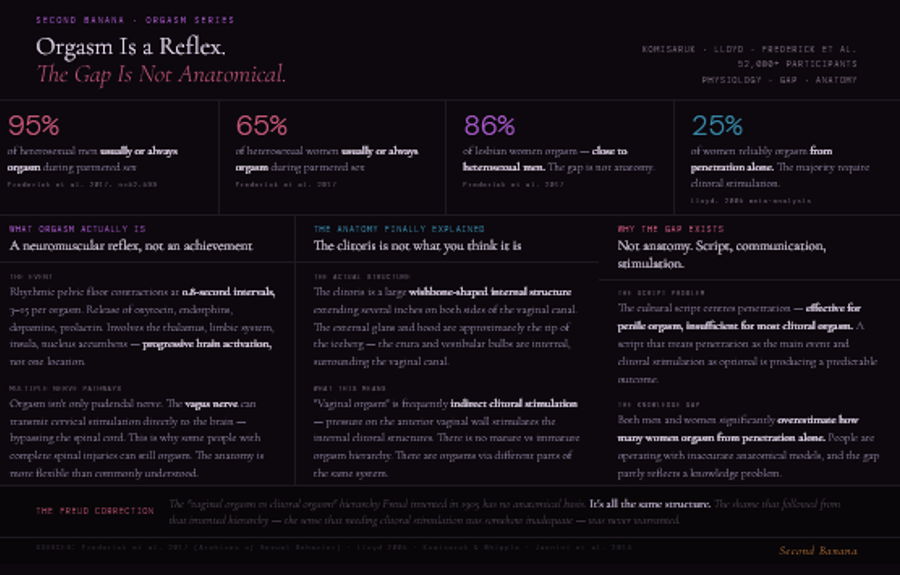
The physiological event has a reasonably consistent signature across genders: rhythmic contractions at approximately 0.8-second intervals, typically 3-15 contractions per orgasm (more contractions for stronger orgasms), accompanied by release of oxytocin, endorphins, dopamine, and prolactin. The prolactin spike is what produces the post-orgasmic refractory period in people with penises (and, to a lesser extent, in some people with vulvas) — the period of reduced sexual response and satiation that follows climax.
The Neuroscience: What’s Actually Happening in the Brain
Brain imaging studies of orgasm — most notably the work of Barry Komisaruk and Beverly Whipple at Rutgers University, who have conducted the most systematic fMRI research on orgasm to date — have found that orgasm involves progressive activation across the brain, not a single localised event. The genital cortex activates during stimulation. As orgasm approaches, the thalamus, hypothalamus, and limbic system become increasingly activated. At orgasm itself, the pattern spreads to include the anterior cingulate cortex, the insula, the nucleus accumbens, and multiple regions associated with reward, emotion, and altered states.
Komisaruk’s work also found something more surprising: orgasms can be achieved through stimulation of multiple different nerve pathways, not only the pudendal nerve (which carries sensation from the external genitalia). The vagus nerve — which bypasses the spinal cord entirely — can transmit cervical and uterine stimulation directly to the brain, which is why some people with complete spinal cord injuries can still experience orgasm. This finding has significant implications for understanding why orgasm is more variable and anatomically flexible than the standard model suggests.
Clitoral, Vaginal, Blended: The Anatomy Finally Explained
The debate about “clitoral vs vaginal” orgasm has been a source of both confusion and unnecessary shame since Freud declared the vaginal orgasm “mature” and the clitoral orgasm a kind of developmental failure in 1905. The anatomical research of the last three decades has substantially resolved this debate, though the cultural conversation hasn’t fully caught up.
The clitoris is not the small external nub that’s visible at the top of the vulva. It is a large, wishbone-shaped internal structure that extends several inches internally on both sides of the vaginal canal. What’s visible externally is roughly the equivalent of the tip of an iceberg — the glans and hood — while the bulk of the clitoral body, crura, and vestibular bulbs are internal and surround the vaginal canal.
This anatomy means that “vaginal” stimulation is frequently indirect clitoral stimulation — pressure on the anterior vaginal wall stimulates the internal clitoral structures. The 2014 model proposed by Jannini and colleagues of the clitourethrovaginal complex — which we also referenced in the squirting piece — treats the clitoris, urethra, and anterior vaginal wall as an integrated functional system rather than separate anatomical structures.
What this means practically: there is not a clitoral orgasm and a vaginal orgasm as two categorically different things. There are orgasms produced by stimulation of the external clitoris, orgasms produced by stimulation of the internal clitoral structures (which can be reached through the vaginal wall), orgasms produced by stimulation of the cervix via the vagus nerve, and blended orgasms involving multiple pathways simultaneously. The variation in what works for different people — and for the same person at different times — reflects variation in anatomy, neurological wiring, and arousal state, not a hierarchy of maturity or adequacy.
The Orgasm Gap: What the Research Shows
The orgasm gap is the well-documented disparity in orgasm frequency between men and women during partnered heterosexual sex. It is one of the most consistently replicated findings in sex research.
A 2017 study by Frederick and colleagues published in Archives of Sexual Behavior, surveying over 52,000 Americans across sexual orientations, found that 95% of heterosexual men reported usually or always orgasming during sex with a partner, compared to 65% of heterosexual women. The same study found that lesbian women orgasmed at a rate of 86% — significantly higher than heterosexual women, and close to the rate for heterosexual men.
The gap is not primarily anatomical. The data makes this clear: women orgasm with similar frequency to men during masturbation. The gap is largest in casual heterosexual encounters and narrows considerably in long-term relationships. It is significantly smaller in lesbian relationships. And heterosexual women who receive more oral sex, more manual stimulation, and more explicit communication about what they want report substantially higher orgasm rates.
Why the Gap Exists
The gap exists for several intersecting reasons, none of which are about what women’s bodies can or cannot do:
- The cultural script for sex centres penetration, which is highly effective for penile orgasm and significantly less effective for clitoral orgasm. Research by Lloyd (The Case of the Female Orgasm, 2005) reviewing decades of data found that only approximately 25% of women reliably orgasm from penetration alone. The majority require direct clitoral stimulation. A script that treats penetrative intercourse as the main event and everything else as optional is a script that systematically excludes the stimulation most necessary for female orgasm.
- The knowledge gap: multiple surveys find that both men and women significantly overestimate the proportion of women who orgasm from penetration alone, and underestimate the importance of clitoral stimulation. This isn’t simply about technique. It is about what people believe about female anatomy — and many people, including many women, have been operating with inaccurate models.
- Communication asymmetry: women in heterosexual encounters are significantly less likely than men to explicitly communicate what they need to orgasm, and significantly more likely to monitor their partner’s experience rather than advocate for their own. Research by Armstrong and Hamilton found that college-age women in casual encounters were far more likely to perform sexual labour for their partners than to ask for what would produce their own pleasure.
- The orgasm as goal paradox: anxiety about whether orgasm will happen — whether in the person wanting to orgasm or in a partner wanting to produce it — directly suppresses orgasm. The spectatoring dynamic identified by Masters and Johnson, in which a person observes their own sexual performance from outside rather than being present in it, reliably inhibits the parasympathetic nervous system activity that orgasm requires. Treating orgasm as the goal, and therefore as something that can be failed at, creates the conditions most likely to prevent it.
The Lesbian Orgasm Advantage — and What It Tells Us
The fact that lesbian women orgasm at rates close to heterosexual men — substantially higher than heterosexual women — is one of the most instructive data points in the orgasm gap literature. It suggests several things simultaneously: that female anatomy is capable of producing orgasm reliably when the sexual script is organised around it; that partner knowledge of female anatomy matters; that explicit communication about pleasure is more common in lesbian encounters; and that encounters not structured around penetration as the default sexual activity produce substantially better orgasm outcomes for women.
The lesbian orgasm rate doesn’t tell us that heterosexual sex is inherently broken. It tells us that the heterosexual sexual script — the assumed sequence, the assumed goal, the assumed distribution of whose pleasure is centred — is producing a predictable and changeable outcome.
Anorgasmia: What It Is and Isn’t
Anorgasmia — the difficulty reaching orgasm or the consistent absence of orgasm — is more common than is widely acknowledged, significantly more treatable than many people believe, and rarely the catastrophic sign people fear it might be.
Primary and Secondary
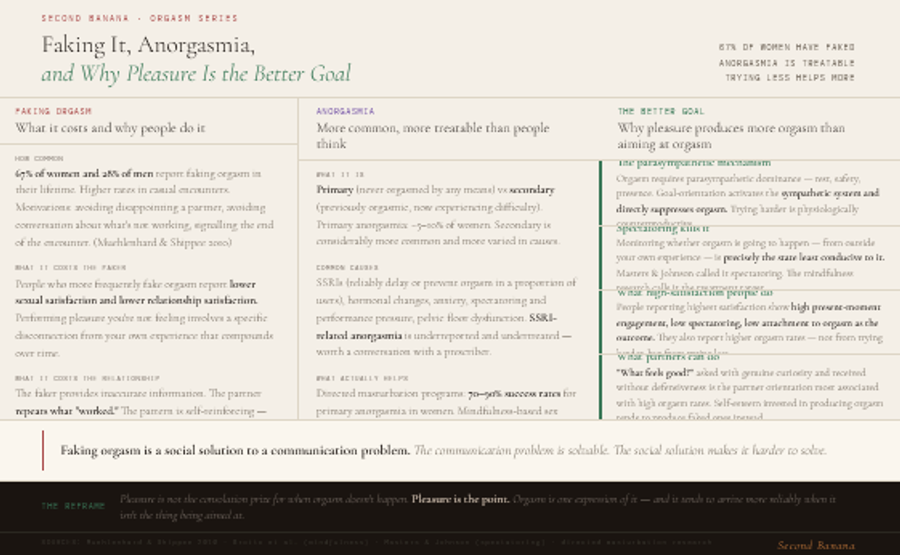
Clinicians typically distinguish between primary anorgasmia (never having experienced orgasm by any means) and secondary anorgasmia (having previously been orgasmic but experiencing difficulty now). Primary anorgasmia is present in approximately 5-10% of women and is significantly less common in men. Secondary anorgasmia is considerably more common and more variable in its causes.
Common causes of secondary anorgasmia include antidepressant medications (particularly SSRIs, which reliably delay or prevent orgasm in a proportion of users), hormonal changes (particularly menopause), relationship factors, anxiety and depression, pelvic floor dysfunction, and the accumulated inhibitory effects of spectatoring and performance anxiety around orgasm itself.
What Actually Helps
The evidence-based treatments for anorgasmia depend on the underlying cause but consistently include several common elements:
- Directed masturbation programs — structured self-exploration that removes partner and performance pressure and builds familiarity with one’s own arousal and response — are the most consistently effective intervention for primary anorgasmia in women. Success rates of 70-90% are reported in multiple studies, making this one of the more reliably effective interventions in all of sex therapy.
- Mindfulness-based approaches — specifically, cultivating present-moment sensory awareness during sexual activity rather than monitoring or evaluating performance — are effective for the spectatoring variant of anorgasmia. Research by Lori Brotto and colleagues has found mindfulness-based sex therapy to be effective for women with orgasm difficulties associated with anxiety and self-monitoring.
- Medication review — for SSRI-related anorgasmia specifically, options include dose reduction, medication switch, adding bupropion, or timing sexual activity relative to medication dosing. This conversation deserves to happen with a prescriber; it often doesn’t, because patients assume the sexual side effect is the price of the medication.
- Explicit communication with partners about what stimulation is needed and in what sequence. This sounds simple. The research suggests it is genuinely difficult for many people — particularly women in heterosexual encounters — and that the difficulty is not primarily about shyness but about the social norms that make advocating for one’s own pleasure feel presumptuous or demanding.
Faking Orgasm: What It Costs
Faking orgasm is widespread. A 2019 survey by Muehlenhard and Shippee found that 67% of women and 28% of men reported faking orgasm in their lifetime. The rates in casual encounters are higher than in long-term relationships. The motivations are consistent across studies: avoiding disappointing a partner, avoiding conversation about what’s not working, signalling that the encounter is over, or maintaining the partner’s self-esteem.
These are all entirely understandable social motivations. They are also, collectively, producing a dynamic that deserves honest examination.
Faking orgasm provides the faker’s partner with inaccurate information about what is working. The partner who believes their approach has produced orgasm is likely to repeat it. The faker who has indicated that penetration alone produces orgasm has told their partner something that is, for most women, not true, and has done so in the most convincing possible way. The pattern, once established, is self-reinforcing: faking becomes easier than correcting the misinformation, and the gap between what the faker is experiencing and what the partner believes they are providing widens over time.
The individual cost to the faker is also real. Research by Muehlenhard and Shippee found that women who more frequently faked orgasm reported lower sexual satisfaction and lower relationship satisfaction than those who didn’t — a correlation that is likely bidirectional, since both dissatisfaction and faking are probably responding to underlying unmet needs. The act of performing pleasure you’re not feeling is not neutral. It involves a specific form of disconnection from one’s own experience that, over time, compounds.
Faking orgasm is a social solution to a communication problem. The communication problem is solvable. The social solution makes it harder to solve.
Orgasm vs Pleasure: The Better Goal
Here is the most clinically and experientially supported piece of guidance on orgasm that the research offers, and the one that most contradicts the cultural script: treating orgasm as the goal of sex tends to make orgasm less likely, and treating pleasure as the goal tends to make both pleasure and orgasm more available.
The mechanism is physiological. Orgasm requires parasympathetic nervous system dominance — the rest-and-digest state associated with relaxation, safety, and present-moment absorption. Anxiety, monitoring, performance pressure, and goal-orientation activate the sympathetic nervous system (the stress response), which directly suppresses the parasympathetic state orgasm requires. The person who is monitoring whether orgasm is going to happen is in precisely the neurological state least conducive to it happening.
Reorienting toward pleasure — toward what feels good in the moment, toward sensory engagement with what is happening rather than evaluation of whether it’s working — creates the parasympathetic conditions that orgasm needs. Not as a trick to produce orgasm. As a genuine shift in what sex is for.
The research on this is consistent: people who report higher sexual satisfaction tend to be people who report high levels of present-moment engagement during sex, lower levels of spectatoring, and lower attachment to orgasm as the specific outcome. They also, not coincidentally, tend to report higher orgasm rates — not because they were trying harder, but because they were trying less.
What This Means for Partners
The partner orientation that the research most consistently associates with high orgasm rates and high satisfaction in the people they sleep with is not particularly mysterious: genuine curiosity about what the other person finds pleasurable, explicit rather than assumed communication, willingness to prioritise stimulation that isn’t the standard penile-vaginal script when that’s what the other person needs, and freedom from the ego investment in orgasm-as-proof-of-skill that makes honest communication feel risky.
The partner who can ask “what feels good?” and receive the answer without defensiveness is the partner most likely to be in encounters where orgasm happens. The partner whose self-esteem depends on their partner’s orgasm is the partner most likely to be in encounters where orgasm is performed.
Multiple Orgasms: Who Can Have Them and How
Multiple orgasms — sequential orgasms within a single sexual encounter — are physiologically more accessible to people with vulvas than to people with penises, for reasons that map to the differences in refractory period. In people with penises, the prolactin spike following ejaculation produces a refractory period of varying length (shorter in younger people, longer with age) during which orgasm is not possible. Ejaculation and orgasm are, however, separate physiological events that are usually but not necessarily coupled.
Non-ejaculatory multiple orgasms in people with penises — achieved by withholding ejaculation while allowing the orgasmic contraction sequence to proceed — are documented in both the sexological literature and in tantric traditions (covered in the tantra piece). The technique involves developing awareness of the point-of-no-return and reducing stimulation before that threshold to allow the orgasmic reflex without ejaculation. This is learnable but requires practice and self-knowledge.
For people with vulvas, multiple orgasms are available to a substantial proportion of people but are not universal. Estimates of the percentage of vulva-owners who can achieve multiple orgasms vary widely across studies, from around 10% to over 50%, depending on methodology and definition. What is consistent is that the capacity for multiple orgasms tends to increase with age and experience, and is more accessible with the right kind of continued stimulation after initial orgasm rather than cessation of stimulation.
Second Banana and Orgasm
The conversation about orgasm — what you need, what produces it for you specifically, what hasn’t worked and why — is exactly the kind of conversation that Second Banana’s architecture is built to enable. The post-first model means you can specify what you need from sexual encounters before any particular person is in the position of being told they’re not providing it. The tag system gives you vocabulary: “clitoral stimulation,” “curiosity about my body,” “slow build,” “I need time,” “explicit communication.”
The partners most likely to produce orgasm are the partners most likely to be curious, communicative, and not invested in a single script. The Second Banana community, which has self-selected toward explicit desire communication and away from the default assumptions of the standard sexual script, is disproportionately composed of exactly those partners.
You don’t have to fake anything here. The people who want to know what you actually need are here too.
Know your body. Say what it needs. Find the person who wants to know. 🍌