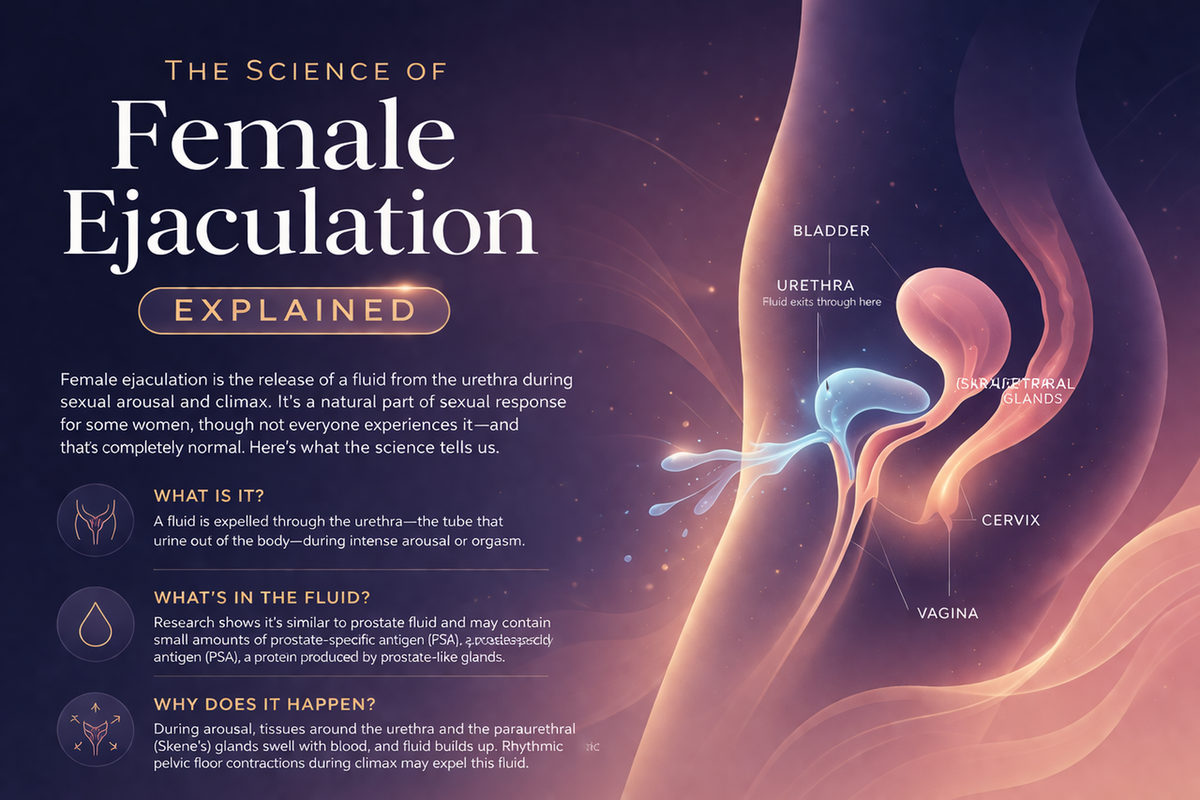
What Is Squirting, Really? The Science — And Why It's Fine | Second Banana
Let's Just Say the Thing
You've had the thought. Maybe during, maybe after, maybe in the slightly awkward quiet that follows. The thought that goes: was that... pee?
And then, depending on how the people in the room handled it, you either felt fine about it or you felt mortified. You may have spent the rest of the evening slightly dissociated from your own body. You may have quietly resolved to never let that happen again. You may have successfully suppressed it for years — trading what was, for many people, an expression of profound arousal and pleasure, for the anxiety management of not doing the embarrassing thing.
The research suggests you're not alone. A 2024 study found that among women who squirt, 58% had tried to avoid it at some point, predominantly because of worries about what it was. A separate large US probability sample published the same year found that "I was scared I was peeing" was reported as a concern by over 40% of women who had experienced squirting.
The shame around squirting is real, widespread, and — once you look at the actual science — almost entirely unwarranted.
This piece is the thing you should have been told a long time ago. What squirting actually is, what's actually in the fluid, why the composition matters a lot less than you think, and why Second Banana is a place where none of this is something you need to manage in secret.
First: Squirting and Female Ejaculation Are Not the Same Thing
Before we get into the chemistry, there's a foundational distinction that most people — including most sex education — have gotten wrong for decades. Squirting and female ejaculation are two different physiological phenomena that happen to exit the body in roughly the same place.
Female Ejaculation
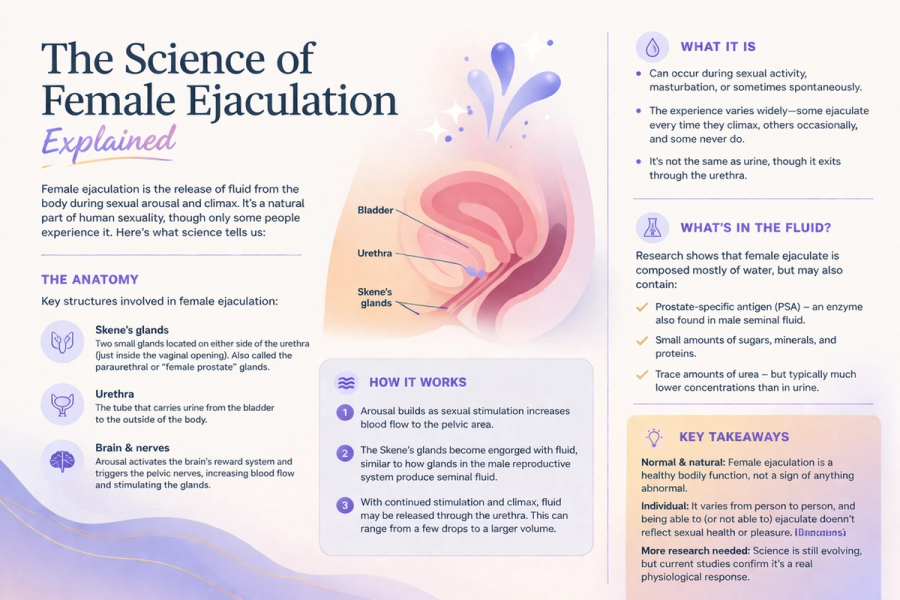
True female ejaculation is a small volume of thick, whitish fluid — typically around a millilitre or less — produced by the Skene's glands, which are also known as the female prostate. It contains high concentrations of prostate-specific antigen (PSA), prostatic acid phosphatase, and other markers biochemically similar to components of male semen. It looks milky. It does not look like urine. Most people who experience it probably do so in modest quantities they may not notice.
Squirting
Squirting — the thing being described when people talk about large volumes of clear, watery fluid — is a different mechanism entirely. It involves transurethral expulsion of fluid that originates in the bladder. Volumes range from around 10 millilitres to well over 100 millilitres. The fluid is clear or very lightly coloured. And its biochemical composition, as we'll get into, does resemble diluted urine — because that is, essentially, what it is. With an important caveat.
The reason the two have been conflated is partly because they can happen simultaneously — the Skene's gland secretions mix with the bladder-derived fluid in the urethra on the way out, producing a blend. And partly because the people doing the categorising have, historically, not been especially rigorous about it. But they are distinct enough that a 2022 review in Clinical Anatomy described them as "similar but completely different phenomena."
This distinction matters because the shame questions mostly attach to squirting, not female ejaculation. Nobody is particularly worried that the small quantity of milky prostatic fluid is embarrassing. It's the larger volume of clear fluid — the one that soaks sheets and that people joke about — that has attracted the anxiety. And that fluid is the one whose composition we need to actually look at honestly.

What the Research Actually Found
The Salama Study (2015)
The most frequently cited research on squirting composition is a 2015 study by Salama and colleagues, published in The Journal of Sexual Medicine. Seven women who regularly experienced large-volume fluid emission during sex participated. The design was methodical: each woman voided completely, underwent pelvic ultrasound to confirm an empty bladder, then engaged in sexual stimulation until they squirted. Ultrasound was performed again during arousal, immediately before squirting — and again after.
The ultrasound results were unambiguous. The bladder was empty before stimulation. It had refilled noticeably during arousal. It was empty again after squirting. The fluid came from the bladder.
Biochemically, the squirting fluid contained urea, creatinine, and uric acid — urinary markers — at concentrations comparable to the participants' own pre-stimulation urine. However, PSA was detected in the squirting fluid of five out of the seven women — despite being absent from their pre-stimulation urine in six out of seven cases. The fluid was primarily bladder-derived and frequently contained a prostatic contribution mixed in.
The study's conclusion was careful: squirting is "essentially the involuntary emission of urine during sexual activity, although a marginal contribution of prostatic secretions to the emitted fluid often exists." That word — essentially — is doing a lot of work. The fluid is not pure urine. It is primarily bladder-derived, mixed with prostatic secretion of varying amounts.
The Blue Dye Confirmation (2022)
If the Salama study left any room for doubt about the bladder origin, a 2022 study by Inoue and colleagues in the International Journal of Urology removed it with characteristic Japanese procedural thoroughness. Five women had indigo carmine blue dye injected directly into their emptied bladders via catheter, then engaged in sexual stimulation until they squirted.
The expelled fluid was blue. In every case. The bladder origin of squirting fluid was confirmed as definitively as such things can be confirmed.
Importantly, PSA was present in four out of the five participants' squirting fluid — again indicating the Skene's glands' contribution even in a model designed specifically to track bladder-derived fluid. The two phenomena co-occur even when you're primarily trying to study one.
The Dilution Question — This Is Where It Gets Interesting
Here is where the "it's pee" conclusion is technically accurate but substantively misleading.
The 2011 case study by Rubio-Casillas and Jannini, which first clearly identified the dual-origin composition, measured the squirting fluid's urea content at 417 mg/dL and creatinine at 21.37 mg/dL. Normal, concentrated urine contains roughly 1,200 to 2,400 mg/dL of urea and 100 to 300 mg/dL of creatinine. The squirting fluid was three to six times more dilute for urea, and five to fourteen times more dilute for creatinine.
Why so diluted? Because the bladder refills with remarkable speed during arousal — within minutes of confirmed emptiness, according to the Salama ultrasound data. The fluid spends very little time in the bladder before being expelled. It is, in a technical sense, newly produced urine that has barely had time to concentrate. It is not the dark, concentrated urine of someone who forgot to drink water all day. It is a rapidly formed, highly diluted fluid that contains some of the same markers as urine because it passed through the same system.
The composition varies considerably between individuals and between sessions. Hydration status, the length of arousal before squirting, individual anatomy, and the Skene's gland contribution all affect the final chemistry. Some people's squirting fluid is closer to urine; some is more diluted; some contains enough PSA to indicate a meaningful prostatic component. None of this is pathological. All of it is a natural variation of a normal sexual response.
The Female Prostate Is Real — And It Matters
Here is a piece of anatomy that most people were never taught in school because — like a lot of female-specific anatomy — it was considered unremarkable until relatively recently.
The Skene's glands, also called the paraurethral glands, are located along the anterior vaginal wall surrounding the distal urethra. They share the same embryological origin as the male prostate — both develop from the same embryonic tissue. They express the same biochemical markers: PSA and prostatic acid phosphatase. They can develop the same conditions as the male prostate: prostatitis, hyperplasia, and, very rarely, adenocarcinoma. In 2001, the Federative International Committee on Anatomical Terminology formally recognised them as the female prostate — prostata feminina.
The most detailed anatomical work on the female prostate was conducted by Milan Zaviacic, a Slovak pathologist who spent decades examining the organ in autopsy and biopsy specimens from over 150 women. His 1999 monograph established that the glands are present in most women but vary enormously in size and development. The well-developed meatal type appears in roughly two-thirds of women; a smaller posterior type, corresponding to the area typically called the G-spot, appears in about 10%. Mean glandular weight is approximately 5.2 grams — small, but present, and functional.
These glands produce the true female ejaculate: a thick, PSA-rich fluid that constitutes the milky secretion some women notice during or after orgasm. The degree of glandular development varies between women — which is why some produce noticeable ejaculate and others don't, and why, for some, the prostatic contribution to squirting fluid is detectable, while for others it isn't.
The anatomical model that best explains all of this was proposed by Jannini and colleagues in 2014: the clitourethrovaginal complex, in which the clitoris, urethra, Skene's glands, and anterior vaginal wall function as an integrated system rather than discrete structures. The G-spot, in this model, is not a separate anatomical entity but the vaginal surface expression of the posterior female prostate and the internal clitoral structure. Stimulation of this area simultaneously engages multiple tissues that contribute to both pleasure and fluid production.
Even If It Is Pee: The Argument You Actually Need
Let's stipulate, for the sake of argument, the most alarming version of the facts: that squirting fluid is essentially urine with some prostatic secretion mixed in. That it came from the bladder. That it contains urea and creatinine and the other markers of urinary chemistry.
Here is the question: so what?
Everything Else You Do in Bed Contains Body Fluids Too
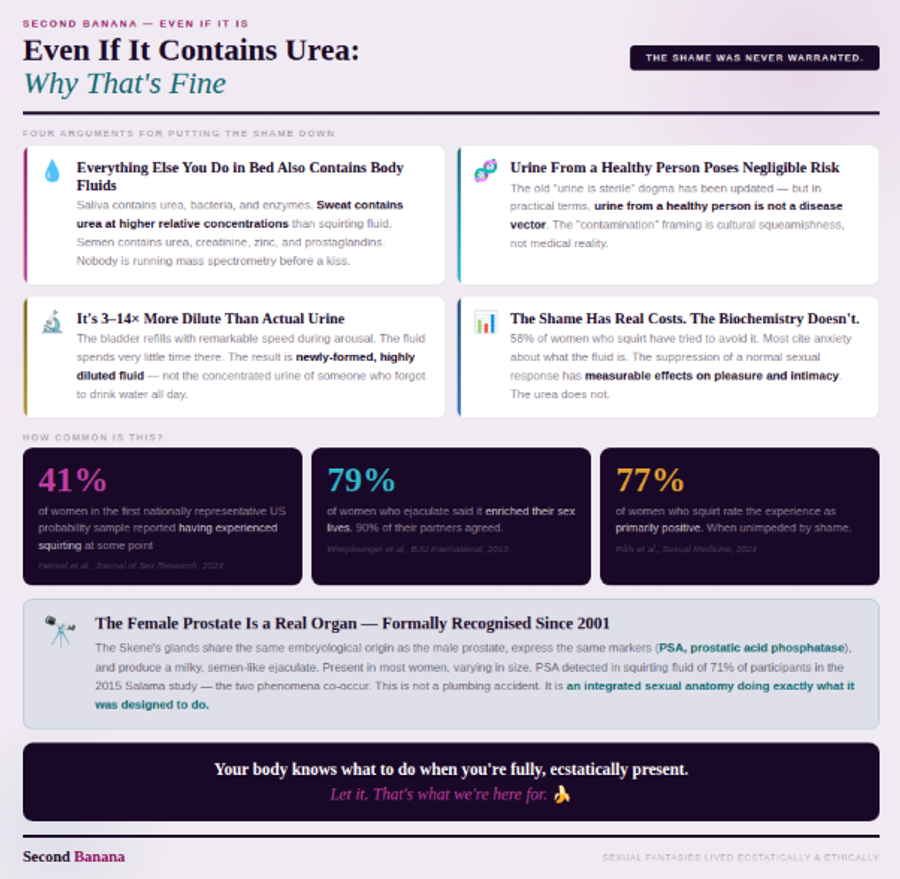
During sex, people exchange saliva — which contains bacteria, enzymes, urea, and a microbiome of hundreds of species. They exchange sweat — which, biochemically, contains urea at higher relative concentrations than squirting fluid. Research has found uric acid and urea in sweat at concentrations that, per unit volume, exceed many measurements of squirting fluid. They exchange vaginal secretions, which have their own chemistry. They exchange semen, which contains urea, creatinine, zinc, fructose, prostaglandins, and a catalogue of other compounds. Nobody is performing mass spectrometry on saliva before a kiss.
The bodily fluids exchanged during sex are diverse and biochemically complex. Squirting fluid — primarily water, dilute urinary markers, and prostatic secretions — fits entirely within that spectrum. The presence of urea is not a distinguishing characteristic that places it in a different category. It is a molecule present in almost every fluid the human body produces.
Urine From a Healthy Person Poses Negligible Risk
The old dogma that urine is sterile has been qualified by more recent research showing a bladder microbiome in healthy women — but the practical implication is the same. Urine from a healthy person is not a disease vector. It is not something that poses meaningful health risk in the context of consensual sexual activity between partners who are otherwise safe together. The biochemical framing of squirting as "contaminated" by urine is an artefact of cultural squeamishness, not medical reality.
The Fluid Passes Through the Same Anatomy as Everything Else
The squirting fluid exits via the urethra — the same anatomical passage through which the Skene's gland secretions travel, the same passage that is stimulated by and adjacent to sexual activity. The architectural concern about "contamination" collapses when you consider that the entire regional anatomy is involved in the experience regardless of whether fluid is expelled.
The Shame Has Real Costs. The Biochemistry Doesn't.
Research makes clear that the suppression of squirting has measurable effects on women's sexual experience and on their relationships. The 2024 Påfs et al. Swedish cross-sectional study found that the majority of women who had tried to avoid squirting did so primarily because of concerns about the fluid's composition or excessive wetness — not because squirting itself was unpleasant, but because of anticipated judgment. Women in the qualitative research described systematically monitoring their arousal to prevent squirting with new or unfamiliar partners, effectively limiting the depth of their own sexual experience.
This is the actual cost of the shame. Not anything in the biochemistry of the fluid. The shame itself, and what it does to people's capacity to be fully present in their own sexuality.
The presence of urea in squirting fluid is not a scandal. The suppression of pleasure because of it is.
How Common Is This, Actually?
Common. Considerably more common than the relative silence around it suggests.
The first nationally representative US probability sample on vaginal squirting, published in the Journal of Sex Research in 2024, surveyed 3,017 women aged 18 to 93. 41% reported having experienced squirting at some point. Among those, 20% reported it occurring always or usually during sex. Women who had experienced squirting were significantly more likely to report higher levels of sexual satisfaction. Swedish cross-sectional data from the same year found similar figures in a European context.
The international online survey by Wimpissinger and colleagues, published in BJU International in 2013, found that among women who ejaculate, 78.8% reported that it enriched their sex lives, and 90% of their partners agreed. Whatever the chemistry, the subjective experience — when unimpeded by shame — is overwhelmingly positive.
Prevalence estimates have varied widely across studies — from under 10% to over 50% — because of methodological differences in how squirting is defined and asked about, who is surveyed, and what cultural context the questions are embedded in. What's consistent is that it is not rare, it is not unusual, and it is strongly associated with positive sexual experience when people aren't spending their energy managing anxiety about it.
What This Has to Do With Second Banana
Second Banana is a community built on the premise that your desires — including the ones that have attracted the most cultural discomfort — deserve to be met honestly and without apology.
That premise extends to bodies. To what bodies do during sex. To the fact that human sexuality is wet and warm and biochemically complicated, and that the cultural attempt to make it clean and contained and non-embarrassing has produced a great deal of shame and very little actual cleanliness.
The people on Second Banana are here because they take their erotic lives seriously — seriously enough to name what they want, seriously enough to communicate honestly, and seriously enough to not pretend that the things that happen in their bodies are problems to be managed rather than expressions to be accepted.
If you have spent years quietly suppressing a natural response because you were anxious about what it meant or what a partner might think: this is the piece of information you were owed a long time ago. The fluid is what the research says it is. The chemistry is unremarkable. The suppression has cost you something. And you are, by any sensible accounting, allowed to stop.