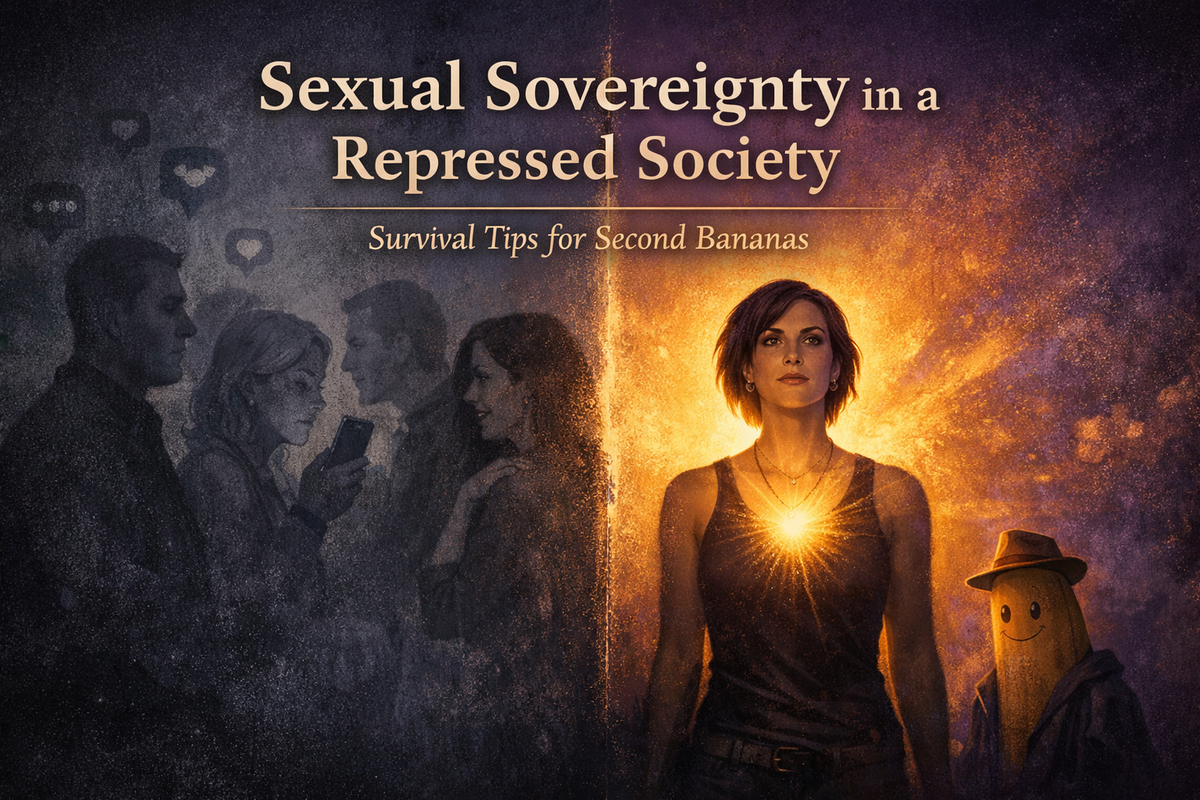
Sexual Sovereignty in a Repressed Society: Survival Tips for Second Bananas | Second Banana
Survival Tips for Second Bananas
The Culture You're Swimming In
Nobody is born into a neutral environment when it comes to sex and desire. You arrived in a culture with fully formed opinions about what kind of wanting is acceptable, which bodies are appropriate objects of attraction, which relationship structures are legitimate, and which desires deserve a quiet room and a lot of shame.
That culture is complicated. It is simultaneously more sexually explicit than it has ever been — advertising, entertainment, social media awash with bodies and suggestion — and more deeply conflicted about actual sexuality than you might expect from all the surface noise. Explicit images are everywhere. Honest conversations about what people actually want, how they actually feel, what would genuinely make them feel alive and connected? Much rarer.
The result is a particular kind of repression that doesn't always look like repression. It doesn't require a Victorian parlour or a religious authority figure. It operates through embarrassment, through the implied smirk, through the cultural shorthand that treats sexual seriousness as pretension and sexual honesty as either TMI or a red flag. It operates through dating platforms that funnel everyone into the same model regardless of who they are. Through the assumption that if you're into something outside the mainstream, that's your secret to carry, not something you get to talk about freely.
Second Banana was built as a direct response to that culture. Not as a place to ignore reality, but as a place that takes a different reality as its starting point — one where desire is legitimate, pleasure is good, and the complexity of who you actually are is a feature rather than something to apologise for.
But you still have to live in the wider world. You have to navigate a society that hasn't caught up to where you are. And that navigation, when you do it well, is one of the defining skills of a Second Banana.
This is a guide to doing it well.
What Sexual Sovereignty Actually Means
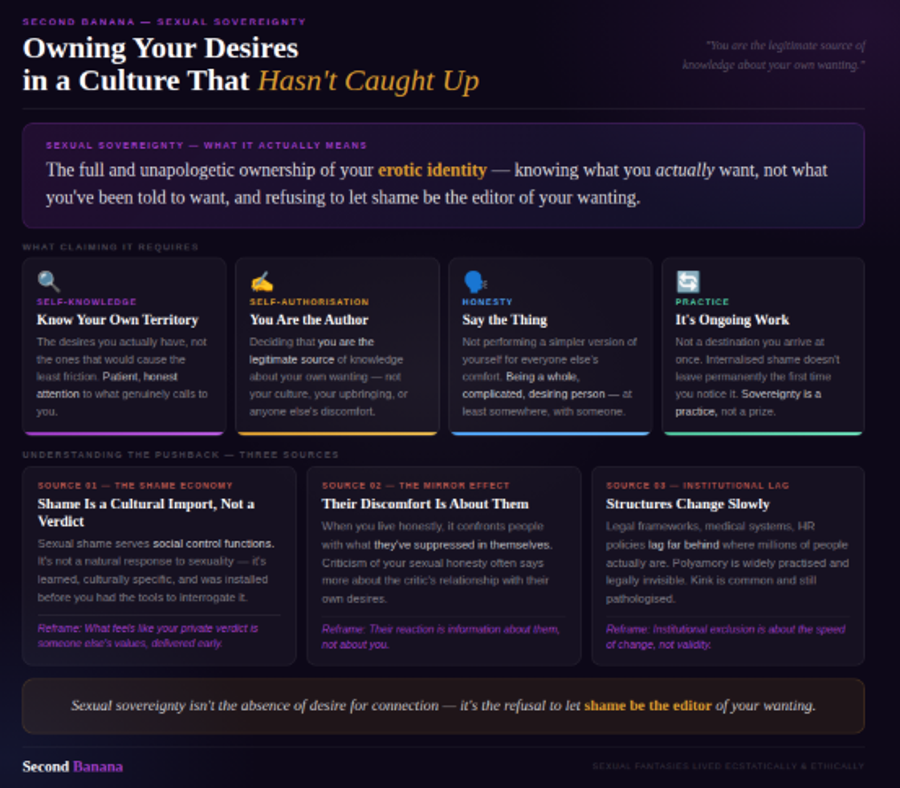
Sexual sovereignty is, at its core, the full and unapologetic ownership of your erotic identity. It means knowing what you want — not what you've been told you should want, not what would be convenient to want, not the watered-down version that would cause the least friction — but what actually, genuinely, specifically calls to you.
It means being the author of your own sexual life rather than a character in someone else's script.
That sounds straightforward. In practice, for most people, it takes time and deliberate work to get there. Because the script you've been handed — the cultural narrative about what you should want, how you should want it, who you're supposed to be in the context of sex and desire — is long, detailed, and was delivered very early, before you had the critical capacity to interrogate it.
Sexual sovereignty isn't the absence of desire for connection — it's the refusal to let shame be the editor of your wanting.
For some people, claiming sexual sovereignty means accepting desires they've spent years trying to suppress or talk themselves out of. The kink that keeps surfacing. The attraction pattern that doesn't fit the expected template. The relationship structure that makes complete sense from the inside but that nobody in their immediate life seems to recognise.
For others, it means something quieter: simply deciding that pleasure matters, that their experience of their own erotic life is worth taking seriously, that they are allowed to be a whole, complicated, desiring person rather than performing a simpler version of themselves for everyone else's comfort.
For others still, it means coming out — in whatever form that takes. As queer, as kinky, as polyamorous, as non-binary, as any of the many identities that a more honest relationship with one's own desire might surface.
What all of these have in common is the act of self-authorisation: deciding that you are the legitimate source of knowledge about your own wanting, and that this knowledge matters and deserves to be acted on.
That's a political act as much as a personal one. Which is why the culture pushes back.
Understanding the Pushback
If you've started living more honestly according to your actual desires — whether that's exploring non-monogamy, naming a kink, living as your authentic gender, being out about your orientation, or simply refusing to perform sexual blandness for other people's benefit — you've likely encountered pushback.
It helps to understand where the pushback comes from. Not because understanding it makes it less annoying, but because understanding it stops you from internalising it as information about whether your desires are legitimate.
The Shame Economy
Shame around sex serves social functions. It regulates behaviour, maintains certain power structures, and provides a mechanism for social enforcement that doesn't require formal authority. When people are ashamed of their desires, they're easier to control — they police themselves. They self-censor. They perform normalcy at the cost of authenticity.
Sexual shame is not a natural response to sexuality itself. It is a learned response, delivered in culturally specific ways. Different cultures shame different things; what's taboo in one context is unremarkable in another. This means that what feels like your private sense that your desires are wrong is actually a cultural artefact — someone else's values, installed in you early enough that they feel like your own.
Recognising this doesn't immediately dissolve the feeling. But it does mean you can examine it from the outside, which is the beginning of not being governed by it.
The Discomfort of the Mirror
Some of the pushback you receive from people in your life when you live more honestly isn't about you at all. It's about them. When someone lives openly according to desires that others have suppressed in themselves, it can create discomfort in those others — a confrontation with what they've given up or never let themselves have.
This doesn't make the pushback any more comfortable to experience. But it does mean that criticism of your sexual honesty sometimes says more about the critic's relationship with their own desires than it does about anything actually problematic about yours.
Institutional Lag
Society's formal structures — legal frameworks, medical systems, HR policies, family law — typically lag considerably behind where a significant portion of the population actually is in their private lives. Polyamory is widely practised and nowhere near legally recognised in most jurisdictions. Kink is common and still pathologised in many clinical frameworks. Non-binary gender is lived by millions of people and understood by very few institutions.
This lag is frustrating, but it's worth understanding as a structural reality rather than a personal verdict. The fact that a legal or institutional framework doesn't accommodate your relationship structure or identity is information about the speed at which institutions change, not about whether your structure or identity is valid.
Practical Survival: Navigating the World as a Second Banana
Sexual sovereignty in a repressed society requires a degree of practical navigation that people living within the default template don't have to think about. Here is what that navigation looks like at its most effective.
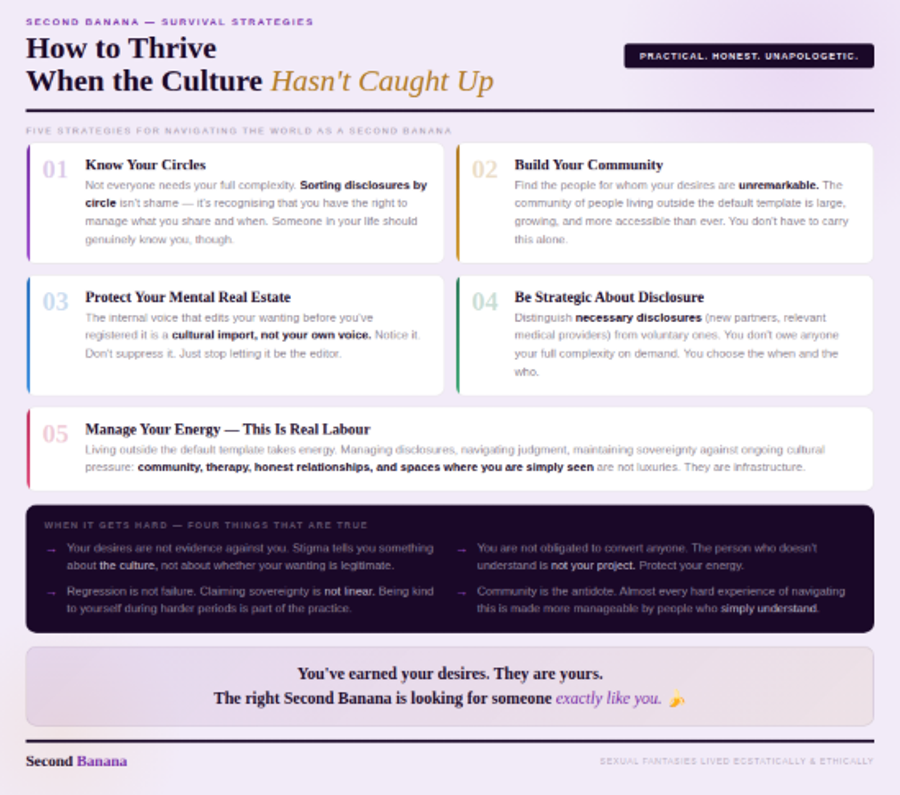
Know Your Circles
Not every relationship in your life needs to hold your full complexity. This isn't hypocrisy — it's practical wisdom. The colleague you see twice a week at team meetings doesn't need your relationship structure disclosed to them. The acquaintance at a party doesn't need to know your kink interests. The family member who would respond with distress or judgment is not obligated to be your confidant.
Sorting your social world into circles — the people who get the full picture, the people who get a partial picture, and the people who get the standard social surface — is not the same as being ashamed. It's recognising that you have the right to manage your own disclosures, and that selectively sharing is not the same as hiding.
The people in your innermost circle should genuinely know you. If no one in your life knows who you actually are, that's worth examining — not because you owe anyone disclosure, but because being entirely invisible in your own life has a cost.
Build Your Community
This is, in the long run, the most important survival strategy: finding the people for whom your desires are unremarkable. The people who don't need you to explain or justify or hedge. The people for whom your relationship structure or kink or orientation is just part of who you are, and who are more interested in you as a person than in performing judgment about the specifics.
These people exist. In significant numbers. The community of people living outside the default sexual template is large, growing, and more accessible than it has ever been — through platforms like Second Banana, through ENM and kink communities online and in person, through queer and trans community spaces, through the increasingly broad mainstream conversation about relationship diversity.
Finding community doesn't require fully coming out publicly. It requires finding at least some people with whom you can be yourself, which is the minimum viable condition for not carrying your full complexity entirely alone.
Protect Your Mental Real Estate
Sexual shame, once internalised, doesn't only respond to external input. It generates its own commentary — the internal voice that edits your wanting before you've even fully registered what you want, that scans your desires for social acceptability before they've had a chance to be desires rather than liabilities.
Protecting your mental real estate means noticing that voice and declining to let it be the editor. Not suppressing it — suppression doesn't work and has its own costs — but recognising it as a cultural import rather than your own authentic assessment of your desires. "That voice is shame talking," is different from "that voice is true."
Regular practices that reconnect you with your actual desires — therapy with a sex-positive therapist, journalling, time in communities where your desires are normalised, or simply regular honest self-reflection — build the capacity to hear your own wanting clearly rather than through the distorting filter of internalised shame.
Be Strategic About Disclosure
There is no universal rule about when and how to disclose your relationship structure, orientation, or kink interests in new contexts. What there is: a useful distinction between disclosures that are necessary for your safety or the integrity of a relationship, and disclosures that are voluntary expressions of authenticity.
Necessary disclosures: telling a potential partner that you are non-monogamous before developing a connection that presumes otherwise. Telling a relevant medical provider about your sexual practices if it affects your care. Telling a therapist what you actually need help with.
Voluntary disclosures: everything else. These are yours to make on your own timeline, in contexts you choose, with people you've assessed as capable of receiving them well. You don't owe anyone your full complexity on demand. You are allowed to choose when and whether to be visible.
On Second Banana, disclosure is structured into the platform itself. Your tags and post communicate who you are and what you're looking for to people who are already operating in a context of openness. The anonymous posting option means you can be honest about your desires before you've decided whether to be visible as yourself — which is the platform's way of giving you the choice of disclosure rather than making it for you.
Manage Your Energy
Living outside the default template in a society that hasn't fully made room for you takes energy. Not an overwhelming amount, for most people, most of the time — but a real amount. The management of disclosures, the navigation of judgment, the occasional necessity of educating people who respond with confusion or resistance, the internal work of maintaining sovereignty over your own desires against the ongoing cultural pressure to doubt them: all of this is real labour.
Taking care of yourself as a person who is doing this labour is not indulgence. It is maintenance. Community, therapy, honest relationships, time in spaces where you are simply seen rather than explained — these are not luxuries for people outside the mainstream. They are infrastructure.
When It Gets Hard
Even people with strong communities, well-developed self-knowledge, and good disclosure strategies have hard patches. Relationships end badly. Family members say painful things. Workplaces are less safe than hoped. The internal work of maintaining sovereignty gets harder in the face of accumulated pressure.
A few things that are true in those moments:
- Your desires are not evidence against you. The fact that your desires are stigmatised tells you something about the culture, not something about whether your desires are legitimate. These are separate things, and in hard moments it is very easy to conflate them.
- You are not obligated to convert anyone. The person who doesn't understand, the family member who responds with distress, the friend who needs you to be simpler than you are — none of them are your project. You can choose to engage with curiosity and education. You can also choose to protect your energy and let some people stay in their confusion.
- Regression is not failure. The process of claiming and maintaining sexual sovereignty is not linear. There will be periods of more confidence and periods of less. Internalised shame doesn't leave permanently the first time you notice it. Being kind to yourself during the harder periods is part of the practice, not an interruption of it.
- Community is the antidote. Almost every difficult experience of navigating sexual sovereignty in a resistant culture is made more manageable by the presence of people who simply understand. Finding those people is the single most effective thing you can do — which is part of why Second Banana exists.

What Second Banana Offers
Second Banana isn't only a dating platform. It's a community built on the premise that the people within it deserve to be fully themselves — in their desires, their identities, their relationship structures, and their complexity.
The tag system gives you language for who you are that doesn't force you into preset categories. Anonymous posting lets you lead with your desires and personality before you've decided whether to be visible as yourself. The platform's explicit commitments — to consent, to trans inclusion, to sex positivity as a value rather than a marketing position — are structural rather than decorative.
For people navigating sexual sovereignty in a culture that doesn't always make room for it, Second Banana offers something specific: a space where the navigation can stop for a while. Where you can be seen as you actually are, find the people who were already looking for someone exactly like you, and experience — perhaps for the first time, perhaps again after a break — what it feels like to be fully, unapologetically present as yourself.
That experience matters. Not because it replaces the work of living with integrity in the wider world, but because it refuels the capacity to do that work. A dating app is not therapy. A community is not a political movement. But genuine belonging — even in small doses, even in a specific context — is one of the most powerful things a human being can experience.
The best Second Bananas aren't the ones who have it all figured out. They're the ones who show up honestly, with their full complexity, and trust that the right person is already looking.
You've earned your desires. They are yours. No cultural script, no inherited shame, no well-meaning person who just doesn't understand — none of them get to be the final word on whether your wanting is legitimate.
You are. And there are people out there who have been waiting for exactly you.
That's what we're here for. 🍌
Second Banana: Sexual Fantasies Lived Ecstatically and Ethically. A sex-positive, inclusive community for adults of every relationship structure — built for connection that starts with honesty and keeps everyone safe.*