Trauma, Desire, and the Body: Healing Through Intentional Sex | Second Banana
The Body Keeps the Score in the Bedroom:
Trauma, Desire, and Healing Through Intentional Connection
A note before we begin: This piece discusses trauma and its relationship to sexuality in a thoughtful, non-clinical way. It is not a substitute for therapy. If you are working through significant trauma, a trauma-informed therapist is an essential resource, not an optional one. This piece is intended to offer context, language, and perspective — not treatment.
The Body Remembers
Bessel van der Kolk's 2014 book The Body Keeps the Score gave mainstream culture its most accessible account of something that trauma researchers and somatic therapists had understood for decades: that trauma is not primarily a story the mind tells about the past. It is a state the body continues to live in the present.
Trauma, in this understanding, is not what happened to you. It is what happens inside you as a result of what happened — the dysregulation of the nervous system that can persist long after the originating event has ended. The body that braced itself, that froze, that went somewhere else in order to survive, can keep doing those things in contexts that trigger the same neural pathways, long after the original threat is gone.
Nowhere is this more true, and more often unspoken, than in sexuality.
The sexual body is among the most vulnerable the human being has. It carries the history of how it has been touched and not touched, wanted and not wanted, seen and not seen, safe and not safe. For many people — a great many, not a small minority — that history includes experiences that left marks in the nervous system: boundary violations, unwanted experiences, relationships that weaponised desire, early messages that connected sex with shame or danger. These marks shape sexual response in ways that are real, often confusing, and rarely addressed directly by the mainstream culture that purports to be talking about sex.
This piece is about that. About how trauma lives in the sexual body. About the difference between re-enactment and reclamation. About why intentional, consent-forward, specifically negotiated sexual connection can be part of healing — and the important caveats that go with that claim. And about why Second Banana, with its architecture of specificity, honesty, and care, is a context in which that kind of intentional connection is possible.
How Trauma Shapes Sexual Response
The nervous system's response to threat is not a choice. The fight, flight, and freeze responses are subcortical — they happen beneath the level of conscious decision-making, faster than thought, driven by a part of the brain whose primary concern is survival rather than nuance. When something in the current environment activates a neural pathway associated with past threat, the body responds as if the threat were present, because as far as the nervous system is concerned, the pattern is the same.
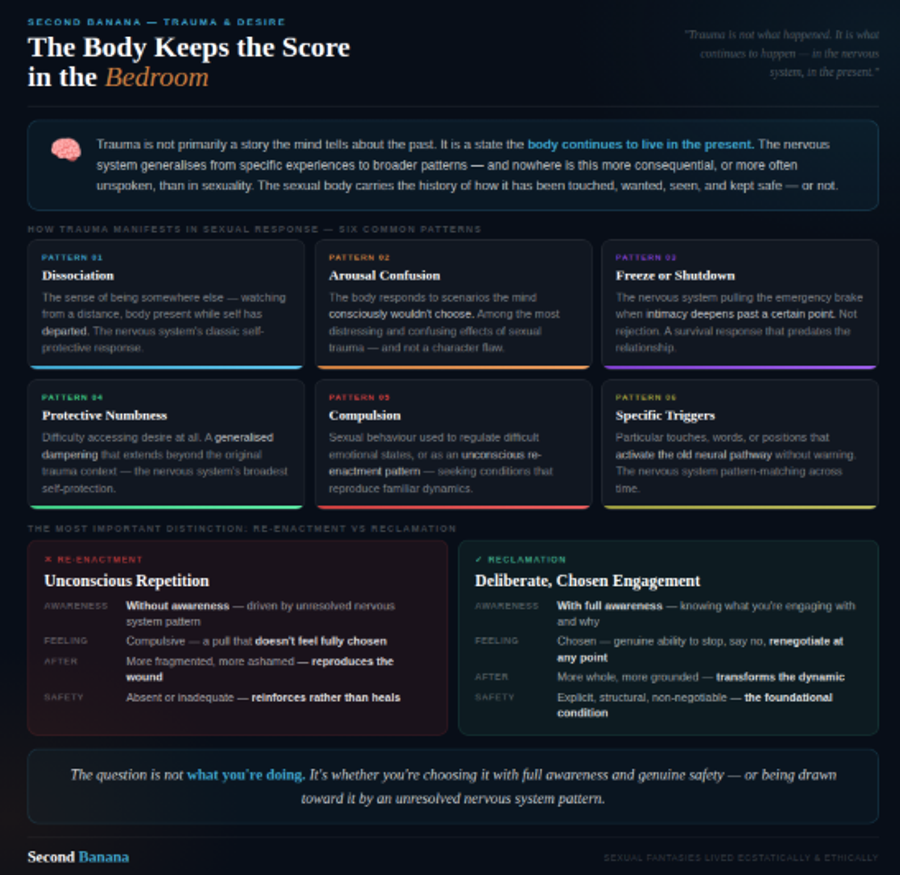
In sexual contexts, this can manifest in a remarkable range of ways, not all of them obviously connected to trauma in the moment:
- Dissociation during sex — the sense of being somewhere else, of watching from a distance, of the body being present while the self has departed
- Arousal in response to scenarios that are consciously unwanted — the gap between what the body responds to and what the mind would choose, which is one of the most distressing and confusing effects of sexual trauma
- Shutdown or freezing when intimacy deepens past a certain point — the nervous system pulling the emergency brake
- Compulsive sexual behaviour as a way of regulating difficult emotional states, or as a re-enactment pattern
- Difficulty accessing desire at all — a kind of protective numbness that extends beyond the specific context of the original trauma
- Heightened sensitivity to particular triggers — specific touches, words, positions, or relational dynamics that activate the old neural pathway without warning
What all of these have in common is that they are the nervous system doing its job — protecting the organism from what it has learned is dangerous. The problem is that learning is not always accurate. The nervous system generalises from specific experiences to broader patterns, and it can get the categories wrong, flagging as dangerous things that share surface features with past threat but are actually safe.
Peter Levine, whose somatic experiencing approach is one of the most widely practised trauma therapies, describes trauma as "thwarted defensive responses" — energy that the body mobilised in response to threat and never fully discharged. Healing, in his framework, involves completing those responses in safety: allowing the body to finish what it started, to move through the freeze and the brace and the flight impulse in a context that is genuinely safe, so that the nervous system can update its threat assessment.
This is a physical process, not just a cognitive one. And it has implications for sexuality that are both hopeful and complicated.
The Difference Between Re-enactment and Reclamation
Here is one of the most important distinctions in the intersection of trauma and sexuality — and one that is frequently muddled, both in clinical discourse and in popular conversation.
Re-enactment
Trauma re-enactment in sexual contexts refers to the unconscious repetition of dynamics related to the original trauma — seeking out relationships or scenarios that reproduce the conditions of past harm, not from genuine desire but from the nervous system's attempt to master an experience it never fully processed. Re-enactment typically happens without awareness, without intention, and without the control and consent that distinguish it from genuine exploration.
Re-enactment tends to feel compulsive rather than chosen. It tends to leave people feeling worse rather than better. It tends to reproduce the relational dynamic of the original trauma — the powerlessness, the objectification, the absence of genuine care — rather than transforming it. And it tends to happen in contexts where safety and consent are absent or inadequate, which means it reinforces rather than heals the original wound.
Reclamation
Reclamation is something different. It is the deliberate, conscious, consented engagement with difficult material — including power dynamics, vulnerability, intense sensation, or emotional exposure — in a context of genuine safety, genuine choice, and genuine care. It is bringing the nervous system into contact with something that resembles past threat, but under conditions that are fundamentally different: where the person is in control of what happens, where consent is explicit and ongoing, where the dynamic is designed to serve their wellbeing rather than to exploit their vulnerability.
Reclamation can look, from the outside, like exactly what it isn't. A survivor of coercive control who engages in consensual D/s dynamics, deliberately exploring submission in a context where she has full agency, is doing something categorically different from a person who is unconsciously seeking relationships that repeat the coercive dynamic. The external behaviour may overlap. The internal reality — awareness, choice, consent, safety, the direction of power — is opposite.
The question is not what you're doing. It's whether you're choosing it with full awareness and genuine safety — or being drawn toward it by an unresolved nervous system pattern.
How to Tell the Difference
The honest answer is that the line is not always clear, and that the same behaviour can contain elements of both at different times or in different contexts. Some markers that tend to distinguish reclamation from re-enactment:
- Reclamation involves awareness — knowing what you're engaging with and why, even if that understanding is still developing
- Reclamation involves choice — the genuine ability to stop, to say no, to renegotiate, to leave, without significant psychological cost for doing so
- Reclamation tends to leave people feeling more whole, more grounded, more themselves afterward — not more fragmented or more ashamed
- Re-enactment tends to feel compulsive — a pull toward the scenario that doesn't feel entirely chosen, a sense of being driven rather than deciding
- Re-enactment tends to reproduce the original conditions — the absence of real safety, real consent, real care — rather than transforming them
Therapy is enormously useful here, not as a gatekeeper but as a sounding board: a space in which to develop the awareness that distinguishes reclamation from re-enactment, to understand what the nervous system is doing and why, and to build the internal resources that make genuine reclamation possible.
Why Intentional, Consent-Forward Sex Can Be Part of Healing
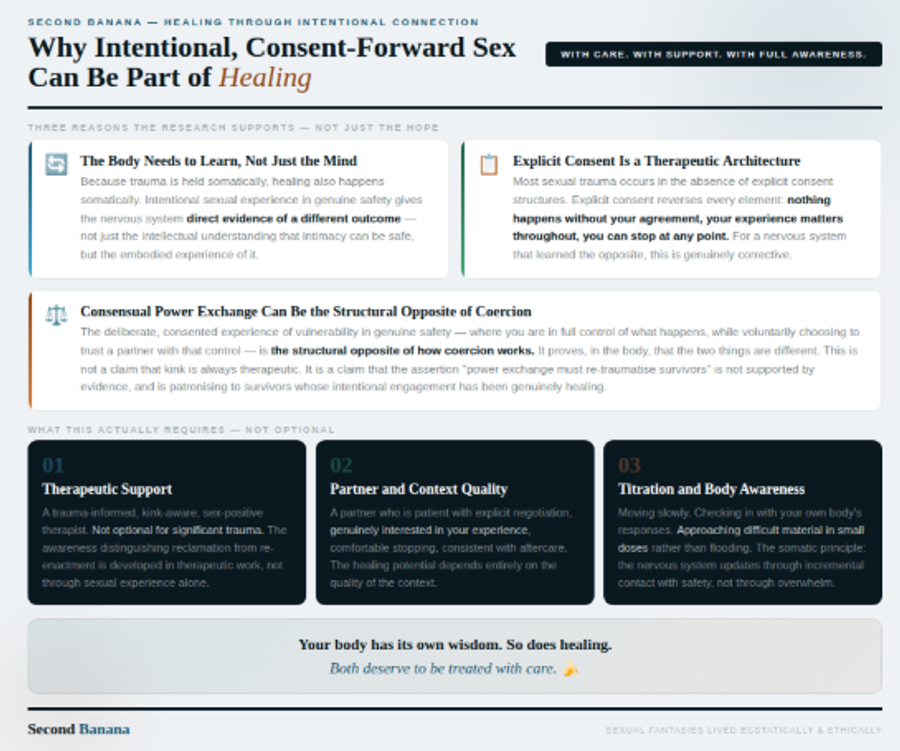
The claim that sexual experience can be part of healing trauma is not fringe. It is grounded in the same somatic understanding of trauma that has become increasingly mainstream in clinical psychology: that because trauma is held in the body, healing also happens in the body, through experiences that help the nervous system update its threat assessment in the context of genuine safety.
Sexual experience that is intentional, negotiated, and genuinely safe offers something that purely cognitive work cannot: the body's direct experience of a different outcome. Not just understanding intellectually that intimacy can be safe, but experiencing it — in the nervous system, in the skin, in the places where the original trauma was encoded.
Why Explicit Consent Structures Matter
The consent culture of BDSM communities is, in this context, not merely an ethical nicety. It is a therapeutic architecture. When the entire dynamic of an encounter — who does what, how much, what the signal is to pause or stop, what happens afterward — is explicitly negotiated in advance, it creates conditions that are fundamentally different from the conditions in which most trauma occurs.
Most sexual trauma occurs precisely in the absence of explicit consent structures: in contexts where the other person assumes rather than asks, where the person harmed feels unable to say no or has their no overridden, where there is no mechanism for checking in, no agreed signal, no understanding that both people's wellbeing matters equally throughout. Explicit consent structures reverse all of this. They say: nothing happens without your agreement. Your comfort matters throughout. You can stop this at any point. Your experience of this is as important as mine.
For a nervous system that learned the opposite, this is not just pleasant. It is genuinely corrective. Not in a single encounter, and not without therapeutic support for deeper work — but as part of a broader practice of healing, intentional sexual experience in explicit-consent contexts can help the body learn that intimacy does not have to mean powerlessness.
Why Power Exchange Can Be Healing
This is the part that is most frequently misunderstood, and most requires careful framing.
Power exchange — the consensual, negotiated exploration of dominance and submission — is sometimes assumed to be inherently harmful for trauma survivors, particularly those whose trauma involved coercion or control. In some contexts, this concern is valid. Re-enactment of coercive dynamics in a context that lacks genuine safety and consent is harmful, regardless of whether it is nominally framed as kink.
But the opposite can also be true. For some survivors, consensual power exchange — approached with full awareness, explicit negotiation, and genuine safety — offers a specific kind of healing that other forms of intimacy do not. The controlled, consented experience of vulnerability in a context that is genuinely safe can help discharge the frozen energy of past violations. The experience of being fully in control of what happens, while voluntarily choosing to relinquish moment-to-moment control to a trusted person, is the structural opposite of coercion. It proves, in the body, that the two things are different.
Similarly, a person who has experienced being dominated against their will may find that taking a dominant role — deliberately, consciously, with full consent from a partner who genuinely wants that dynamic — is deeply healing. Not because it reverses the past, but because it reclaims agency that was taken. The body that was powerless is now the body that holds the power, and that is a different neurological experience.
None of this is automatic or guaranteed. All of it requires awareness, care, good communication, and ideally therapeutic support alongside. But the claim that kink is inherently harmful for trauma survivors — that power exchange must reproduce rather than transform past harm — is not supported by the evidence, and it is patronising to survivors whose intentional engagement with these dynamics has been genuinely healing.
What This Requires — Practically
Therapeutic Support
The most important practical recommendation in this piece is also the least comfortable for a culture that has outsourced its understanding of mental health to self-help. For significant trauma, and for using intentional sexual experience as part of healing, a trauma-informed therapist is not optional. Not because sexuality requires clinical supervision, but because the awareness and internal resourcing that distinguish reclamation from re-enactment are developed through therapeutic work, not through sexual experience alone.
A trauma-informed therapist — ideally one who is also kink-aware and sex-positive, as not all therapists are — can help you understand what your nervous system is doing and why, develop the capacity to stay present during triggering experiences rather than dissociating, distinguish compulsion from genuine choice, and build the internal resources that make healing sexual experience possible.
Choosing Partners and Contexts With Care
The healing potential of intentional sexual experience depends entirely on the quality of the context. A partner who is impatient with explicit negotiation, dismissive of limits, or unreliable in their care for your experience is not a healing context. They are a risk. The same applies to communities and platforms: not all BDSM spaces are equally safe or trauma-informed.
What to look for in a healing-supportive partner or context: genuine interest in your experience as well as their own, patience with explicit and thorough negotiation, comfort with the idea of stopping if you need to stop, consistent aftercare, and an understanding that your nervous system may respond in ways neither of you fully anticipated. This is not a checklist for every casual encounter. It is a description of the relational conditions under which healing sexual experience is actually possible.
Moving Slowly and Attending to the Body
Somatic approaches to trauma healing share an emphasis on titration — approaching difficult material in small, manageable doses rather than flooding the system with more than it can process. The same principle applies in sexual contexts. Moving slowly, checking in with your own body's responses, noticing what feels genuinely safe versus what feels like managed dissociation — these are the practices of someone using intentional sexual experience as healing rather than as re-enactment.
This is difficult to do well without developing body awareness — the capacity to notice what your nervous system is actually doing in a given moment. Somatic practices like yoga, bodywork, breathwork, and somatic experiencing therapy all build this capacity. It is worth investing in.
Second Banana and Trauma-Informed Connection
Second Banana is not a therapy platform. It is a sex-positive community, and it holds that distinction honestly.
But the architecture of Second Banana — its emphasis on specificity, on explicit communication about what each person is looking for, on anonymous posting that allows honesty before vulnerability, on a community built around consent as a structural value — creates conditions that are considerably more trauma-informed than most alternatives.
When connections begin with an honest post about what someone is actually looking for, including the relational conditions they need — the pace, the communication style, the kind of care they want around the experience — they are beginning in a mode of self-knowledge and self-advocacy that is itself healing for many people whose past experiences involved having their needs ignored or overridden. The act of naming what you want and finding that someone is genuinely interested in providing exactly that is not a small thing.
The tag system allows people to signal what they need without having to explain their history. The anonymous posting option allows honesty about desire without requiring the vulnerability of full disclosure before trust is established. And the community's values — sexual fantasies lived ecstatically and ethically — position care for both people's experience as non-negotiable, which is the foundational condition for any sexual experience that serves healing rather than harm.
Your body has its own wisdom. So does healing. Both deserve to be treated with care. 🍌