Bondage Kink: The Psychology of Restraint and Why It Works | Second Banana
Bondage Kink:
The Psychology of Restraint, Why It Works, and What Both Roles Actually Experience
The Kink That Brings Most People In
If there is a single kink that functions as a gateway — a first encounter with erotic power exchange that opens a door many people then spend years exploring further — it is bondage. Not because it is the mildest or the simplest — rope bondage done well is neither — but because restraint touches something so fundamental about the human relationship to control, vulnerability, and trust that even people who would never describe themselves as kinky find themselves drawn to the idea of being held, or of holding.
The research bears this out. Bondage consistently ranks among the most commonly reported sexual interests across large-scale surveys. Lehmiller’s 2018 study found that restraint and bondage themes appeared in the fantasies of the majority of respondents regardless of gender or sexual orientation. It is not niche. It is, in some form or another, one of the most widely distributed erotic interests in the human population.
And yet the popular account of bondage is almost universally thin. The word calls up images from mainstream pornography — tied wrists, blindfolds, a generalised sense of captivity — without conveying anything of the specific psychological experience on either side of the dynamic, the neuroscience of what restraint actually does to the nervous system, the genuine intimacy that develops between a skilled rigger and their partner, or the full range of what bondage actually encompasses from a soft silk scarf to elaborate Shibari suspension.
This piece is the fuller account. The psychology of restraint from both positions. The neuroscience of helplessness and sensory alteration. The spectrum of practice from light to intensive. The safety architecture that makes the dynamic trustworthy. And how Second Banana’s tag system gives bondage practitioners the vocabulary to find each other.
Being held is one of the most fundamental human experiences. Bondage makes it erotic. The psychology of why is more interesting than most accounts suggest.
What Bondage Actually Is
Bondage is the consensual practice of restraining a partner — physically limiting their movement, either partially or completely, through rope, cuffs, fabric, tape, chains, or other materials. The restraint can be simple — wrists bound behind the back, ankles tied together — or elaborate, covering significant portions of the body in structured patterns that take hours to apply. It can be static, holding the restrained person in a single position, or dynamic, allowing movement within limits. It can be combined with other forms of erotic or D/s engagement, or it can be the entire content of the scene.
What all forms of bondage share is the deliberate, consensual limitation of the restrained person’s physical freedom. The restraint is real — not mimed or metaphorical — and this reality is central to why bondage produces the psychological effects it does. A person who is genuinely unable to move their hands is having a qualitatively different experience from a person who is merely asked to keep them still. The physical fact of the restraint changes the experience at a neurological level.
The Spectrum of Bondage Practice
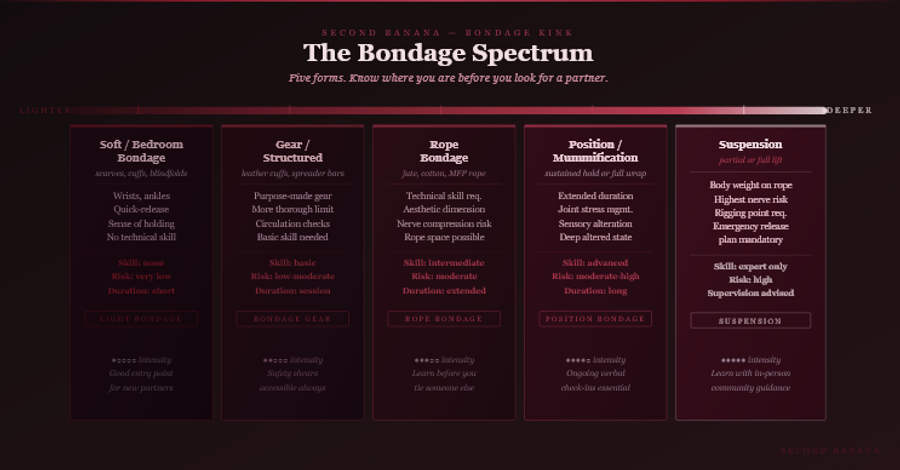
Bondage covers an enormous range, and locating oneself on that range before looking for a partner is among the most useful things a practitioner can do. At the lightest end: a scarf used to loosely bind wrists during sex, a blindfold that removes visual information without any physical restraint, soft cuffs that could be released easily but create the sense of being held. These entry-level forms require minimal technical skill and carry minimal physical risk.
Moving along the spectrum: more structured restraint using purpose-made bondage gear — leather cuffs, spreader bars, under-bed restraint systems — that limits movement more thoroughly. Rope bondage, which introduces both greater technical complexity and greater aesthetic possibility. Position bondage, in which the restrained person is held in a specific pose that may be maintained for an extended period. Mummification, in which the body is wrapped extensively, severely limiting movement and sensory input. Suspension bondage, in which the restrained person is lifted partially or fully off the ground, requiring high technical skill and careful safety management. Some forms of bondage can even include CNC components.
Each position on this spectrum has its own specific appeal, its own specific risks, and its own specific community of practitioners with knowledge to share. Understanding where you are on the spectrum is the first step to finding the right partner and the right scene.
The Neuroscience of Restraint
What Happens When You Cannot Move
Physical restraint produces specific neurological effects that go beyond the psychological experience of being held. When movement is genuinely limited, the proprioceptive system — the body’s sense of its own position and movement in space — is altered. The restrained person becomes acutely aware of their body as an object in space, fixed rather than fluid. This heightened proprioceptive awareness often produces a quality of physical presence and body-consciousness that practitioners describe as distinctly different from unrestrained states.
Simultaneously, the restriction of movement activates the autonomic nervous system in ways that parallel the primal play response described earlier in this series — a degree of sympathetic activation, with associated adrenaline release and heightened sensory acuity. When this activation is within the context of a genuinely safe and trusted dynamic, the result is an altered state of heightened physical awareness that has its own specific erotic charge.
The restraint also alters the body’s relationship to touch. When movement is limited, the skin becomes more sensitive to external stimulation because the normal option of responding to or avoiding touch through movement is removed. A touch that might be ignored when free becomes impossible to ignore when restrained. This heightened tactile sensitivity is one of the reasons bondage is so frequently combined with sensation play — the restraint amplifies the effect of every other stimulus.
Sensory Deprivation and the Blindfold Effect
Blindfolding — removing visual input — is one of the most commonly used adjuncts to bondage, and its effects are worth understanding separately because they operate through a different neurological mechanism. When vision is removed, the brain compensates by heightening the acuity of other senses. Touch becomes more immediate, sound becomes more significant, and the awareness of the restrained person’s own body becomes more acute.
The removal of visual information also removes the restrained person’s ability to anticipate what is coming — which produces its own specific psychological effect. Anticipation is itself an altered state, particularly when the person cannot see and therefore cannot prepare. Every moment becomes an encounter with genuine uncertainty about what will happen next, and this uncertainty heightens both the arousal response and the quality of attention.
The Deep Pressure Effect
Research on deep pressure touch — firm, encompassing physical pressure applied to the body — consistently finds that it activates the parasympathetic nervous system, reducing cortisol levels and producing a calming, grounding effect. This is the same mechanism exploited by weighted blankets for anxiety management. Snug bondage, particularly rope bondage that applies consistent pressure across multiple points of the body, produces a version of this effect: a paradoxical combination of the sympathetic activation of restraint and the parasympathetic calming of deep pressure.
Practitioners who engage in more intensive bondage frequently report a specific quality of altered state that they describe as simultaneously alert and calm — heightened awareness without heightened anxiety. This state, sometimes called bondage space or rope space, is the specific neurological product of this combined activation. It is not identical to subspace in other D/s contexts, though it shares features with it, and it is part of what makes sustained bondage scenes specifically attractive to the people who seek them.
The Psychology: What Each Role Actually Experiences
Being Restrained
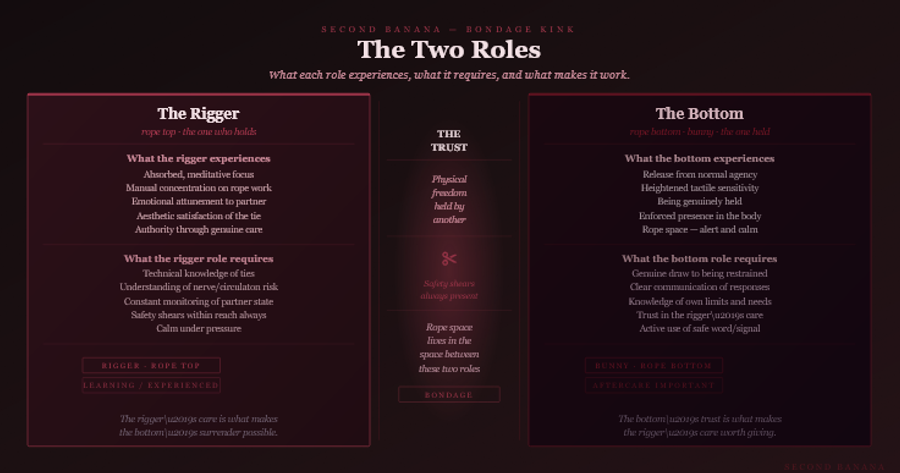
The psychological experience of being restrained is built around several interlocking mechanisms that together explain the specific appeal of bondage from the submissive or bottom position. The most fundamental is the release from agency — the experience of having the normal requirement to manage one’s own body and actions temporarily suspended. The restrained person cannot move; therefore, they are not responsible for what happens. This release from the burden of self-management is itself pleasurable for many people, in the same way that other forms of consensual submission are pleasurable: it is a chosen and bounded surrender of the cognitive load that ordinary agency requires.
A second mechanism is the experience of being held. Human beings are profoundly social animals with deep attachment needs, and the experience of being physically contained by another person — surrounded, held, unable to get away — touches something in attachment psychology that goes beyond the explicitly erotic. The rigger or dominant who ties their partner is physically enclosing them, and this enclosure carries an emotional weight that many practitioners describe as among the most intimate experiences the dynamic provides.
A third mechanism is the heightened presence that restraint enforces. When normal motor activity is limited, attention turns inward and toward sensation in a way that ordinary erotic engagement does not always produce. The restrained person cannot be distracted by what they are doing with their hands or where their body is going. They can only be present to what is being done to them and what they are feeling. This enforced presence is itself a form of erotic intensification.
Holding Someone
The psychological experience of being the one who restrains is less often explored in popular accounts of bondage, partly because the submissive’s experience is more counterintuitive and therefore more interesting to explain. But the experience of tying, holding, and managing a restrained partner is specific and rich in its own right.
The dominant or rigger who ties a partner holds something profound: the other person’s physical freedom. This is a specific form of responsibility and authority that is quite different from other D/s dynamics. The restrained person is genuinely dependent on the rigger’s care — not just for their pleasure but for their physical safety. The rigger must monitor circulation, joint stress, emotional state, and readiness to release. This sustained attentiveness to another person’s wellbeing is demanding and, for people drawn to this role, specifically rewarding.
Skilled riggers frequently describe the experience of tying as meditative — a form of focused, absorbed attention to another person’s body and responses that produces a specific quality of presence. The rope work itself requires manual concentration; the partner’s responses require emotional attunement. Both together create an experience of absorbed engagement that practitioners describe as distinct from anything else they do.
There is also a specific quality of aesthetic satisfaction in bondage from the rigger’s perspective that is absent from most other kink practices. Rope bondage in particular is a visual art form as well as an erotic one, and the experience of creating something beautiful and structurally precise on another person’s body is part of what draws people to the rigger role in a way that transcends the explicitly D/s dimension.
Safety: The Architecture That Makes It Possible
Bondage carries genuine physical risks that are absent from purely verbal or psychological kink practices, and taking these risks seriously is not optional. This is not a disclaimer — it is the reason why bondage has developed such an extensive community knowledge base and why the consent and safety architecture of bondage practice is among the most developed in the kink landscape.
Circulation and Nerve Compression
The most significant physical risks in bondage are circulation restriction and nerve compression. Rope or other restraints applied to the wrong location, at the wrong tension, or left in place too long can restrict blood flow or compress nerves in ways that cause injury. The classic bondage injury is radial nerve damage from rope applied to the upper arm — producing a temporary or, in severe cases, lasting numbness or weakness in the hand and wrist. This is entirely preventable with correct technique and is the reason that bondage education is so strongly emphasised in practitioner communities.
The practical implications: restraints should not be applied directly over joints or across bony prominences where nerves run close to the surface. Circulation checks — pressing the fingernail or toenail of a restrained limb and confirming that colour returns quickly — should be performed regularly throughout any scene. Any tingling, numbness, or skin colour change in a restrained limb is an immediate signal to release that limb.
Positioning and Joint Stress
Sustained bondage positions can place stress on joints that normal voluntary movement would avoid. A person who would never voluntarily hold their arms behind their back for thirty minutes may find themselves in exactly that position in a bondage scene, and the joint stress accumulates in ways that are not immediately apparent. Positions that involve the shoulders, in particular, require careful monitoring because the shoulder joint is vulnerable to strain when the arms are held in extended or behind-back positions for any length of time.
The practitioner community has developed extensive positional guidance through decades of collective experience. The single most important general principle is to never apply more bondage or more intensive positions than necessary, and to check in verbally with the restrained person about comfort and sensation throughout the scene.
Safe Words and Release
Bondage safe words require special consideration because, depending on the scene, the restrained person may be gagged, may be in an altered state that reduces their ability to monitor their own distress accurately, or may be physically incapable of making the sounds or gestures that a standard safe word requires. This is why bondage practitioners use non-verbal safe signals — typically an object held in the restrained person’s hand that, when dropped, signals an immediate stop — as a standard complement to verbal safe words.
The rigger’s responsibility to monitor the restrained person’s genuine state is heightened in bondage precisely because the restrained person’s ability to signal distress may be compromised. Reading physical cues — changes in breathing, skin colour, muscle tension, and non-verbal vocalisations — is a skill that experienced riggers develop through practice and that beginners should actively seek to learn.
The Shears Rule
One of the most widely shared principles in bondage communities is the shears rule: always have bondage safety shears — designed to cut rope or fabric without the pointed tip that can injure skin — immediately accessible during any bondage scene. Not in the next room, not in the kit bag across the floor, but within reach of the rigger throughout the scene. Emergency release must be possible in seconds, not minutes. This is non-negotiable in serious bondage practice, and any partner who is reluctant to observe it is a partner who is not yet ready to hold someone in bondage.
Rope Bondage and Shibari: A Note on the Distinction
Rope bondage and Shibari are not synonyms, though they are often used interchangeably in popular content. Shibari — also called Kinbaku — is a specific Japanese tradition of rope bondage with its own aesthetic principles, specific knot and tie vocabulary, and a relational philosophy that extends beyond the erotic into the meditative and the artistic. It is a practice with a tradition, teachers, and a community of practitioners who take the distinction between Shibari and generic rope bondage seriously.
Generic rope bondage is bondage using rope, without necessarily drawing on the Shibari tradition. It can be beautiful, intimate, effective, and entirely valid without being Shibari. Many Western rope bondage practitioners draw on Shibari influences while practicing something that is hybrid rather than traditional. The distinction matters primarily to people who want to engage with the Shibari tradition specifically — its history, its community, and its specific relational philosophy — rather than simply to those who want to use rope.
A dedicated Shibari piece is coming in this series. For practitioners who are drawn to rope bondage as a starting point, the current piece provides the psychological and safety foundation; the Shibari piece will cover the tradition, the aesthetic philosophy, and the specific rigger/bunny dynamic in full.
What This Has to Do With Second Banana
Bondage requires a partner with specific qualities that general dating platforms cannot help you identify. For the person being restrained: a rigger or dominant who is technically competent, genuinely attentive, calm under pressure, and able to hold both the physical and emotional dimensions of a scene simultaneously. For the rigger: a partner who is genuinely drawn to being restrained rather than merely accommodating, who can communicate their responses clearly, who takes safety seriously, and who brings the specific quality of trust that makes intensive bondage possible.
The post-first model gives bondage practitioners the ability to represent what they’re looking for before anyone responds. A person seeking a rigger can describe what level of bondage experience they’re looking for, what their experience level is, what they’re drawn to in the dynamic, and what they need from a partner in terms of attentiveness and safety awareness. A rigger seeking a partner can describe their experience, their approach, what kinds of scenes they find compelling, and what they’re looking for in the person they’ll be holding.
The tag system gives bondage practitioners specific vocabulary:
- Bondage — the orientation itself
- Rigger / rope top — the tying role
- Bunny / rope bottom / restrained — the restrained role
- Light bondage / bedroom bondage — entry-level restraint
- Rope bondage — specifically rope rather than cuffs or other gear
- Shibari — Japanese rope bondage tradition specifically
- Suspension — for practitioners seeking or offering this advanced form
- Sensation play welcome / sensation play not included — clarifying what accompanies the bondage
- Learning rigger / experienced rigger — skill level signalling
- Safety shears always present — signalling seriousness about safety practice
- Aftercare important — for the specific emotional transition after intensive bondage
These tags allow practitioners to match on skill level, specific form of bondage, and what they’re looking for in the dynamic — which prevents the most common bondage matching failures: an experienced rope bottom connecting with a nervous novice rigger who isn’t ready for what they’re being asked to hold, or a light bondage beginner inadvertently seeking someone whose practice is at a level of intensity they’re not ready for.