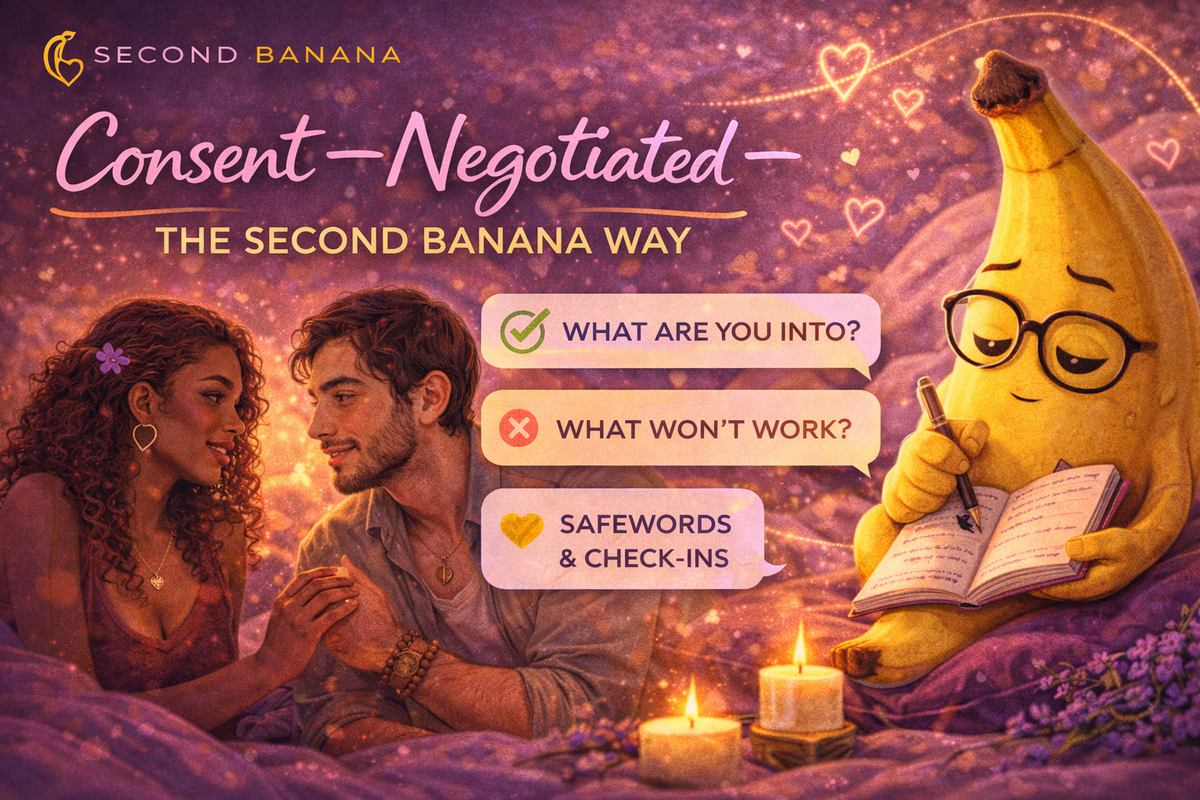
Consent — Negotiated — The Second Banana Way
Let's Start With What Consent Actually Is
Not what you learned in a health class. Not the bare legal minimum. Not the whispered reassurance that someone didn't say no loudly enough to count.
Real consent — the kind that Second Banana is built around, the kind that actually makes extraordinary things possible — is something considerably richer than any of that. It is active, ongoing, specific, and enthusiastic, and deeply tied to the sexual sovereignty that lies at the heart of Second Banana's mission. It is something that two (or more) people arrive at together, through actual conversation, with full information and genuine freedom on all sides.
It is, in other words, negotiated.
That word — negotiated — tends to make people nervous the first time they encounter it applied to sex and desire. It sounds clinical. Transactional. Like you need a conference room and a term sheet before anyone gets to have a good time.
But here's what consent negotiation actually is, stripped of the jargon: it's the conversation where two people who want to connect find out exactly what they're both excited about, what they're curious about, what they're not into, and what they need in order to feel safe enough to be fully present. It's honesty in advance. It's the thing that turns a potentially awkward encounter into one where everybody knows what they signed up for and signed up enthusiastically.
That's not a buzzkill. That's foreplay.
Beyond "No Means No"
"No means no" was progress. Real progress, hard-won, important. But it set the bar at the floor — at the minimum required to not be doing something wrong — and left enormous amounts of space between the floor and where genuinely good sexual connection actually lives.
The problem with "no means no" as a complete framework is that it puts the entire burden of protection on the person who might be harmed, requires them to actively refuse in a moment that might be frightening or uncomfortable, and treats the absence of refusal as equivalent to the presence of desire. It mistakes silence for consent. It mistakes compliance for enthusiasm. And it does nothing to help anyone actually figure out what they want and how to ask for it.
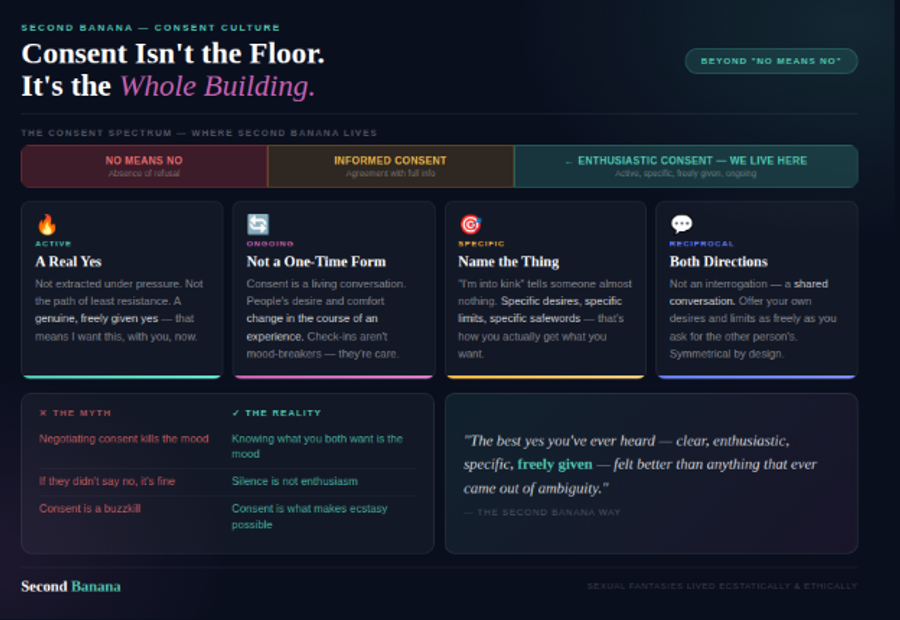
Enthusiastic consent goes further. It says: not only should "no" always be heard and respected, but "yes" should be something that's genuinely, freely, actively given. Not extracted under pressure. Not performed to smooth things over. Not the path of least resistance. A real yes — the kind that means I want this, specifically, with you, now, and I'm telling you so.
That's the Second Banana standard. Not because it's the morally correct box to tick, though it is. But because it's what makes the experience worth having.
Think about it. The most memorable, most genuinely satisfying, most ecstatically rewarding sexual experiences you've had or can imagine — were they the ones where someone was tolerating you? Going along with it? Giving a vague, uncommitted, fine-whatever kind of consent? Or were they the ones where the other person was there, fully, completely, enthusiastically choosing to be exactly where they were?
The difference between those two experiences is consent. Specifically, enthusiastic consent. Which is why on Second Banana, it's not a rule appended to the fun — it's the engine of the fun itself.
What Negotiation Actually Looks Like
Consent negotiation sounds formal. In practice, at its best, it sounds like two people who are genuinely curious about each other having an honest, sometimes funny, occasionally surprising conversation about what they're into.
It doesn't have to happen all at once. It doesn't require a script. But it does require some version of these things:
Starting before you're in the moment. The best consent conversations happen before either person is in a situation where the pressure to say yes feels high. This is one of the reasons Second Banana's approach — where people post their desires, tag what they're looking for, and have real conversations before meeting — is structurally consent-positive. By the time two people meet, they've already had some version of the negotiation. They already have a map of each other's territory.
Being specific. "I'm into kink" tells someone almost nothing. "I'm interested in power exchange, specifically the dynamic where I'm in a submissive role, I enjoy restraint but I don't enjoy pain, and I want to establish a safeword before anything starts" — that's a negotiation. Specificity is not a mood-killer. It's the thing that allows another person to actually show up for what you want, rather than guessing.
Naming the yes as clearly as the no. Consent negotiation isn't only about limits and hard stops, though those matter enormously and should always be named. It's also about naming the things you actively want — the things that would make you feel lit up, met, delighted. Desire has a positive vocabulary, and using it is part of negotiation. "I really want X" is just as important as "I don't want Y."
Agreeing on how to communicate in the moment. Safewords. Check-ins. The understanding that anyone can pause or stop at any point without it being a failure or a rejection. These are not bureaucratic additions to a sexual encounter. They are the architecture that allows the encounter to go further, with more trust, than it otherwise could.
Checking in as things evolve. Consent is not a one-time form you fill out and file. It's an ongoing conversation — because people's comfort, desire, and capacity change in the course of an experience. A check-in mid-scene isn't a mood-breaker; it's a sign that someone cares enough to make sure you're still as into this as you were five minutes ago. That care is itself erotic, when you're with the right person.
Consent and Kink: Where Negotiation Really Shines
And here's the thing about kink that sometimes surprises people who are new to it: kink communities — particularly BDSM communities — tend to have considerably more sophisticated consent cultures than mainstream hookup culture. The reason is structural. When the activities being negotiated involve power exchange, restraint, pain, intense sensation, or psychologically charged dynamics, the stakes of getting consent wrong are higher and the importance of getting it right is correspondingly clearer. Nobody stumbles into good BDSM. It requires conversation.
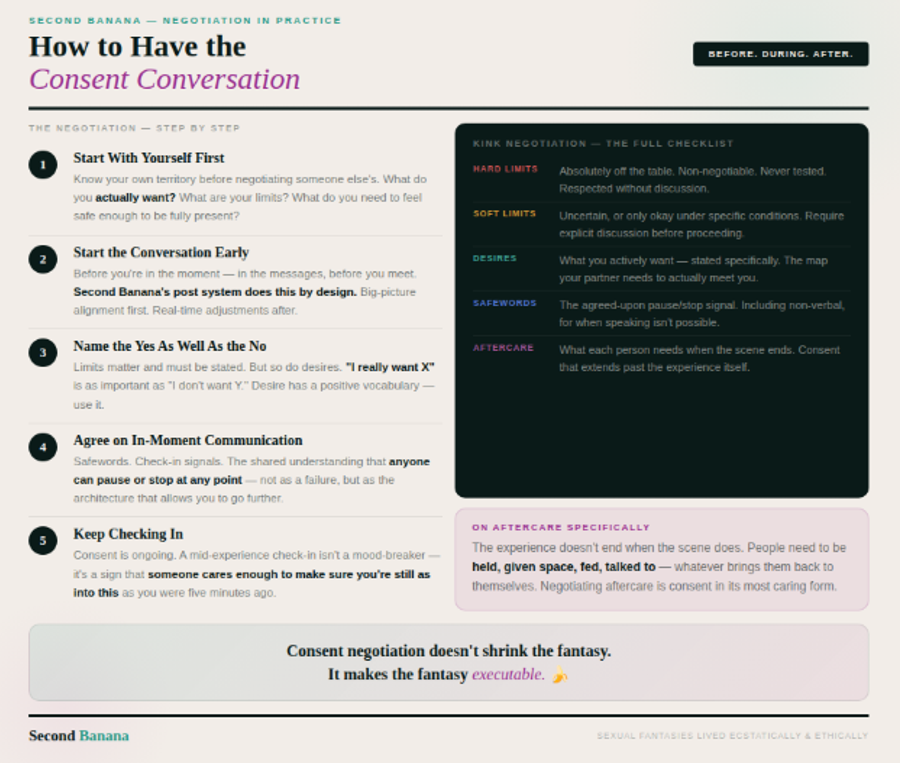
The consent negotiation in kink contexts typically covers:
Hard limits — things that are absolutely off the table, no matter what. These are non-negotiable, respected without question, and never tested.
Soft limits — things you're not sure about, or things that might be okay under specific circumstances. These require explicit discussion before proceeding.
Desires and fantasies — what you actually want to happen, in as much detail as you can articulate.
Safewords and signals — the agreed-upon way to pause or stop, including non-verbal signals for situations where speaking might be difficult or where breaking character would disrupt the dynamic.
Aftercare — what each person needs after an intense experience. This is consent in its most caring form: the recognition that the experience doesn't end when the scene does, and that people need to be held, or given space, or fed a snack, or whatever it is they need in order to come back to themselves.
All of this conversation, done well, doesn't diminish the fantasy. It makes the fantasy executable. It turns the scene from a vague approximation of what you wanted into the thing itself — specific, chosen, mutually created.
The Second Banana Approach: Consent Built Into the Architecture
One of the ways Second Banana is different from conventional dating platforms is that consent-forward communication isn't a bolt-on feature — it's baked into how the platform works.
When you post what you're looking for on Second Banana, you're already doing a form of consent communication. You're naming your desires, your interests, your context. When someone responds to your post, they're doing the same. Before a conversation even starts, both people have a working map of each other's territory. The negotiation begins before the first message.
The tag system extends this further. Tags aren't just categories — they're a vocabulary for desire. Selecting the tags that represent your erotic world is an act of self-disclosure that makes the consent conversation considerably easier when it happens. If your tags and someone else's tags overlap, you're already partway through the negotiation before you've said a word.
Anonymous posting matters here too. One of the reasons consent conversations don't happen in mainstream dating culture is that people don't feel safe enough to be honest about what they want. The fear of judgment, of misinterpretation, of being seen as too much or not enough, keeps desires unspoken and negotiations from happening. Second Banana's anonymous option removes some of that risk. When you can name what you want without exposing your full identity, you're more likely to name it honestly. And honest desire, stated clearly, is the beginning of a real consent conversation.
What Consent Does for Everyone Involved
Let's make this concrete.
When consent is properly negotiated, the person who said yes gets to be fully present in an experience they actually chose. Not performing. Not managing. Not quietly hoping it goes the way they wanted. In it — because they know what they signed up for, they trust the person they're with, and they can relax into the experience rather than monitoring it.
That quality of presence — the ability to be completely, unguardedly in an experience — is the thing that separates good sex from extraordinary sex, a connection from a profound one, a nice time from a story you're still telling a decade later.
It is also, of course, what consent gives the other person. When your partner is fully present, freely choosing, actively engaged — that's the experience. That's what you came for. The hollow version of what you wanted, obtained through pressure or assumption or someone else's reluctant compliance, doesn't actually deliver what desire is reaching for. The real thing does. And the real thing requires consent.
This is why Second Banana says consent is not a restriction on ecstasy. It is what makes ecstasy possible. Not metaphorically. Literally. The best experiences are the chosen ones.
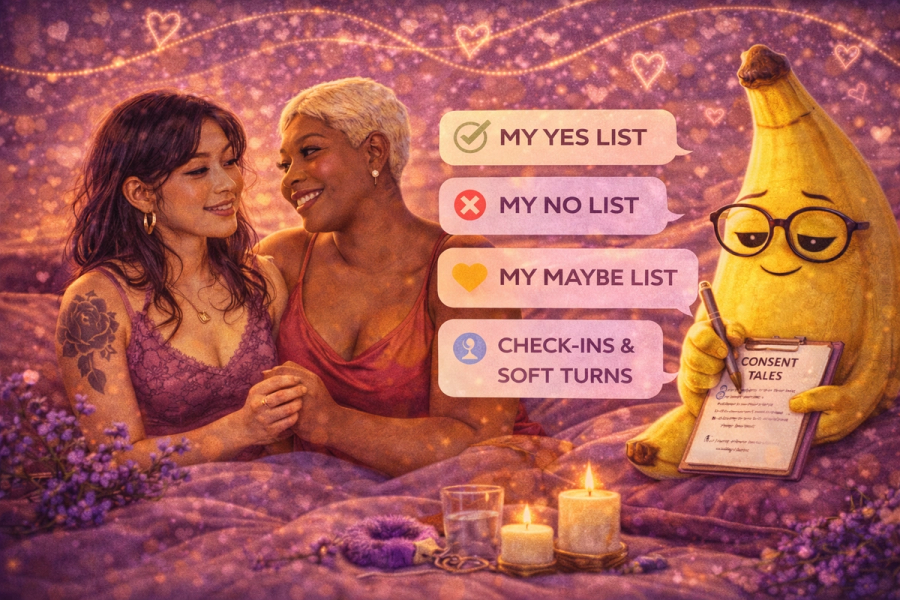
Having the Conversation: A Practical Starting Point
If consent negotiation is new territory for you — or if you've been doing it informally for years and want a more intentional framework — here are some places to start.
Start with yourself. Before you can negotiate with someone else, you need to know your own territory. What do you want? What are your limits? What do you need to feel safe? Spending time with these questions isn't a detour — it's the preparation that makes the conversation possible.
Use Second Banana's tools. Your post is a consent document in miniature. Your tags are a map. Write them thoughtfully. Be specific about what you're looking for and what you're not. The more clearly you represent yourself, the easier the negotiation becomes.
Start the conversation early. Don't wait until you're in the moment to start talking about the moment. Before you meet, in the messages that precede an encounter, is where the substantive negotiation happens. By the time two people are together, the big-picture alignment should already be established. What remains is real-time check-ins and adjustments — which are considerably easier when the foundation is already laid.
Normalise asking. "What are you excited about?" "What do you need?" "What's off the table for you?" These are not intrusive questions. They are the questions that people who take each other seriously ask each other. On Second Banana, they're baseline.
Make it reciprocal. Consent negotiation isn't an interrogation. You're not extracting information — you're sharing it, on both sides. Offer your own desires, limits, and needs as freely as you ask for the other person's. The conversation is symmetrical.
The Bottom Line
Consent, negotiated fully and practised with genuine care, is not the responsible adult version of desire. It is the fullest, most honest, most pleasure-generating version of desire.
It is what allows you to be fully yourself in an encounter — to show up with your actual desires intact, knowing they'll be met with genuine enthusiasm, knowing the other person is equally present and equally choosing.
It is what turns a fantasy into an experience. A potential connection into a real one. A moment into a memory.
This is the Second Banana way. Not consent as a reluctant concession to contemporary norms. Consent as the thing that makes everything else worth doing.
The best yes you've ever heard — clear, enthusiastic, specific, freely given — felt better than anything that ever came out of ambiguity. Didn't it?
That's what we're building here. One negotiated, ecstatic, fully consensual encounter at a time. 🍌
Second Banana: Sexual Fantasies Lived Ecstatically and Ethically. An inclusive, sex-positive community built on the understanding that the most pleasurable experiences are always the chosen ones.