New Orleans Kink & Fantasy Dating | Find Your Match | Second Banana
SECOND BANANA · NEW ORLEANS
New Orleans Has Always Known That Pleasure Is Serious Business.
Other cities have to construct permission. They build their sex-positive reputations through deliberate community effort, through activism and education and the slow work of changing what the culture considers acceptable. Portland did it. Austin is doing it. Boulder did it while calling it something else.
New Orleans didn't build permission. It inherited it.
The city that gave America Mardi Gras, jazz, the blues, and an unbroken tradition of carnival excess going back three hundred years does not need a consent workshop to understand that desire is legitimate. It does not need a political framework to justify pleasure. The body's appetites — for sensation, for spectacle, for the particular electricity of transgression that is only possible when there are actually rules being transgressed — have been central to New Orleans's identity for longer than most American cities have existed.
What the city has needed is what every city needs: a platform that matches the sophistication of the community it's supposedly serving. That platform is here now.
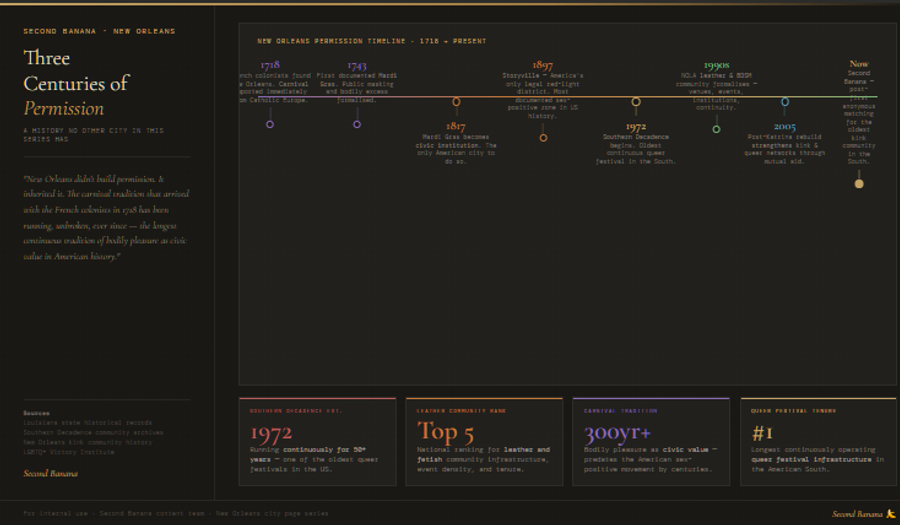
Three Centuries of Permission
The history matters because it shapes the present in ways that are not obvious until you spend time here. New Orleans's culture of permissiveness is not the result of a progressive political movement. It is older and stranger than that — a product of the city's particular colonial history, its Catholic inheritance of carnival and Lent, its long tradition of interracial mixing in a society that enforced racial categories everywhere else, its position as a port city where the social rules of inland America were perpetually loosened by contact with the wider world.
The result is a city that has a different relationship to the body than almost anywhere else in the country. Nudity on Bourbon Street is legal. Public drinking is legal. The city's relationship to its own excess is cheerful and unsentimental — pleasure is not something to be apologised for or justified or wrapped in a theoretical framework. It is simply part of what the city is and what the city does.
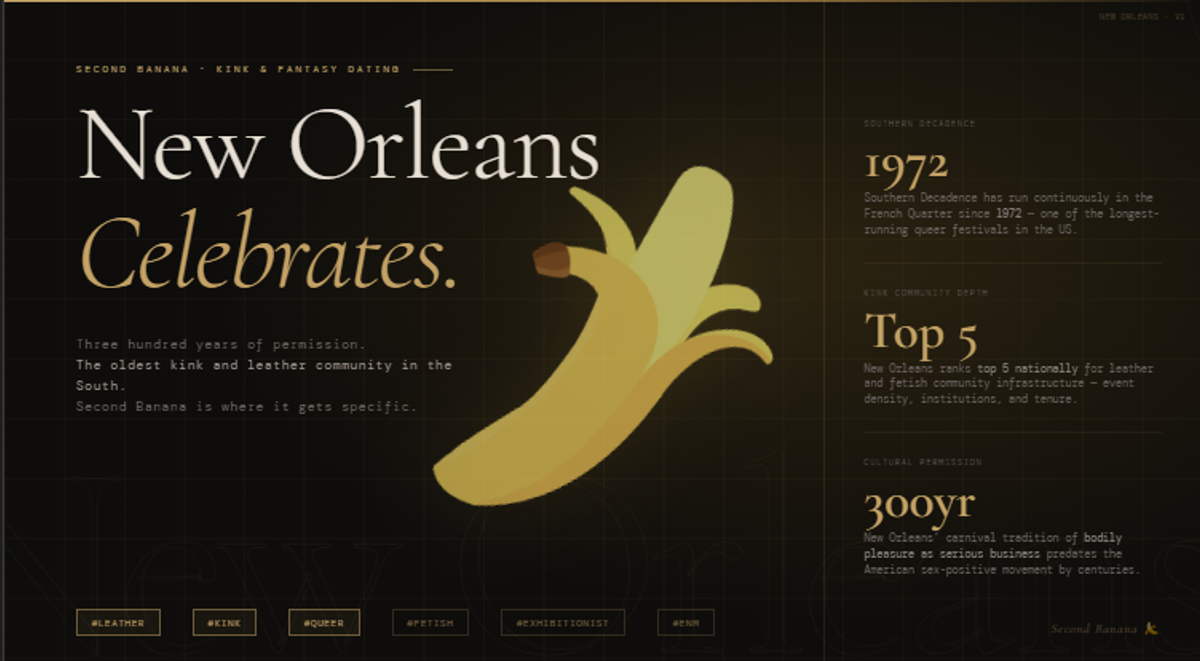
The kink and BDSM community here did not arrive at this understanding recently. Southern Decadence — the annual queer festival that has been running in the French Quarter since 1972 — predates most of the country's formal consent education movement by decades. The city's leather and fetish communities are among the oldest and most established in the South, with infrastructure and institutional memory that most comparable communities elsewhere are still building.
Southern Decadence has been running in the French Quarter since 1972. New Orleans's kink and leather communities didn't need the mainstream to catch up — they built their own world and kept it running.
The French Quarter Is Not The Whole Story
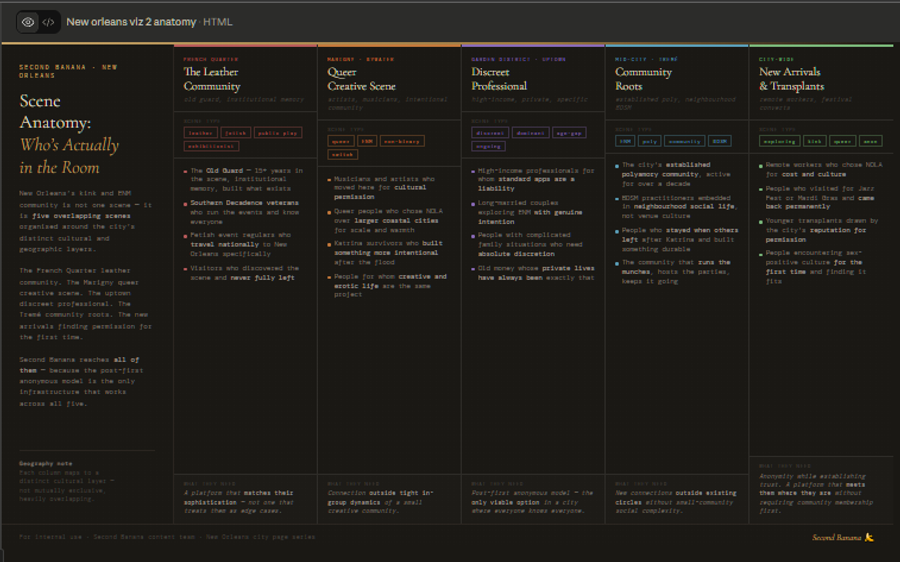
If you know New Orleans only through Bourbon Street — through the beads and the hurricanes and the performative excess marketed to tourists — you know the city's surface and none of its depth. The kink and ENM and queer community that lives here is not on Bourbon Street. It is in the Marigny and the Bywater and the Irish Channel and Tremé. It is in the bars that don't have signs and the houses that host parties and the networks of people who have been here long enough to know that the real New Orleans is always one degree removed from the thing the tourists are looking at.
This matters for Second Banana in a specific way. The community you're looking for is not the one performing for an audience. It is the one that has already moved past performance — that finds the theatrics of the tourist quarter mildly amusing and is more interested in the specific, honest, negotiated pleasure that happens between people who actually know what they want. The gap between New Orleans's public face and its private life is larger here than in almost any other city in this series, and navigating it requires exactly what Second Banana provides: a way to find the real community without having to wade through the performance.
→ Post on Second Banana — find the New Orleans that isn't on Bourbon Street.
Carnivalesque Is Not The Same As Casual
There is a misreading of New Orleans that confuses its permissiveness with shallowness — that assumes a city comfortable with public excess must be a city uncomfortable with depth. This is exactly wrong. The carnival tradition that New Orleans inherited from its French and Spanish colonial roots is not a tradition of meaningless pleasure. It is a tradition of pleasure taken seriously — of the body's experience treated as genuinely important, of sensation and spectacle given the same weight that other cultures give to productivity and propriety.
The kink community here reflects this. New Orleans's BDSM and leather practitioners are not, in aggregate, people who stumbled into their interests because the city made it easy. They are people who take those interests seriously — who have thought carefully about what they want, who invest in their community's infrastructure, who treat consent and negotiation with the same rigour that the city's musicians treat their craft. The permissive environment makes honesty easier. It does not make intentionality unnecessary.
Second Banana's post-first model fits this community well precisely because it asks for that intentionality up front. Write what you want. Be specific. Tag your actual interests. The people here have been specific about their desires for long enough that they have very little patience for anything less.
New Orleans doesn't confuse permissiveness with shallowness. The city takes pleasure seriously. So does Second Banana.
Who You'll Find Here
It also draws the people who arrive for Mardi Gras or Jazz Fest or Southern Decadence and find that they don't want to leave — who discover in New Orleans a culture that fits them in ways their home city never did and start making plans accordingly. The city has always attracted people whose desires were bigger than where they came from. Second Banana is how those people find each other once they've arrived.
The Second Banana tags that index well in New Orleans are worth noting. Leather, fetish, exhibitionist, voyeur, public play, group, hotwife, cuckolding, dominant, submissive, rope — but also ENM, polyamory, queer, trans-inclusive, non-binary. The city's sexual culture is broad enough to hold all of it, and the community sophisticated enough that none of it requires explanation. You post what you want. You find who shares it. New Orleans makes the rest easy.
→ Write your first Second Banana post — New Orleans already understands.
The City That Invented Laissez Les Bons Temps Rouler
Let the good times roll. It is the most famous phrase in Louisiana French, and it means exactly what it says. Not let the good times happen eventually, after sufficient deliberation and political organisation and community education. Not let the good times roll within the limits of what is currently considered acceptable. Let them roll. Now. With the full weight of a three-hundred-year cultural tradition behind the permission.
The sexual fantasy you have been keeping to yourself — the one that requires a partner who doesn't need it explained, who meets your specificity with their own, who brings the same seriousness to pleasure that this city has always brought — is not unusual here. It is, in the oldest possible sense of the word, normal. New Orleans normalised it before the concept of sex-positivity had a name.
→ Find your Second Banana. New Orleans has been ready for a long time. 🍌