Polyamory & Ethical Non-Monogamy: A Beginner's Guide | Second Banana
Here, Everywhere, and Ethically: A Beginner's Guide to Polyamory and Ethical Non-Monogamy
You're Probably Not Alone in This
Maybe you've been quietly wondering for a while. Maybe a conversation, a podcast, a friend's offhand mention planted something that you haven't quite been able to stop thinking about. Maybe you've known for years, and you're just now looking for the language to match what you've always felt. Maybe you're in a relationship and something about its current shape doesn't quite fit anymore. Or maybe you've been living this way for a decade and you've landed here because you're looking for a community that gets it.
Wherever you're starting from: you're in the right place, and you're not alone. You have sexual sovereignty!
Ethical non-monogamy, the practice of having more than one romantic or sexual relationship, openly and with the knowledge and consent of everyone involved, has gone from subcultural curiosity to something approaching mainstream conversation in a remarkably short time. Roughly one in five Americans has practised some form of it at some point. A 2024 survey found it's the preferred relationship style among millennials and Gen X. The vocabulary — polyamory, ENM, solo poly, relationship anarchy, metamours, compersion — has moved from specialty forums into ordinary dinner conversation.
But even as the conversation has grown, the confusion hasn't fully cleared. What's the difference between polyamory and an open relationship? What makes non-monogamy "ethical" in the first place? What are all these different relationship structures, and do you have to pick one? And where does a platform like Second Banana fit into all of this?
This piece answers those questions — practically, warmly, without jargon overload.
Let's Start With the Word "Ethical"
It might seem like "ethical" is doing some defensive work in the phrase "ethical non-monogamy" — as if to say this kind, unlike the other kind, is the good version. And there's some truth to that framing. The word is there to distinguish consensual multiple relationships from cheating: from situations where at least one person doesn't know, hasn't agreed, and would be hurt to find out.
But "ethical" does more than just mean "not cheating." It carries a positive claim, not just a negative one.
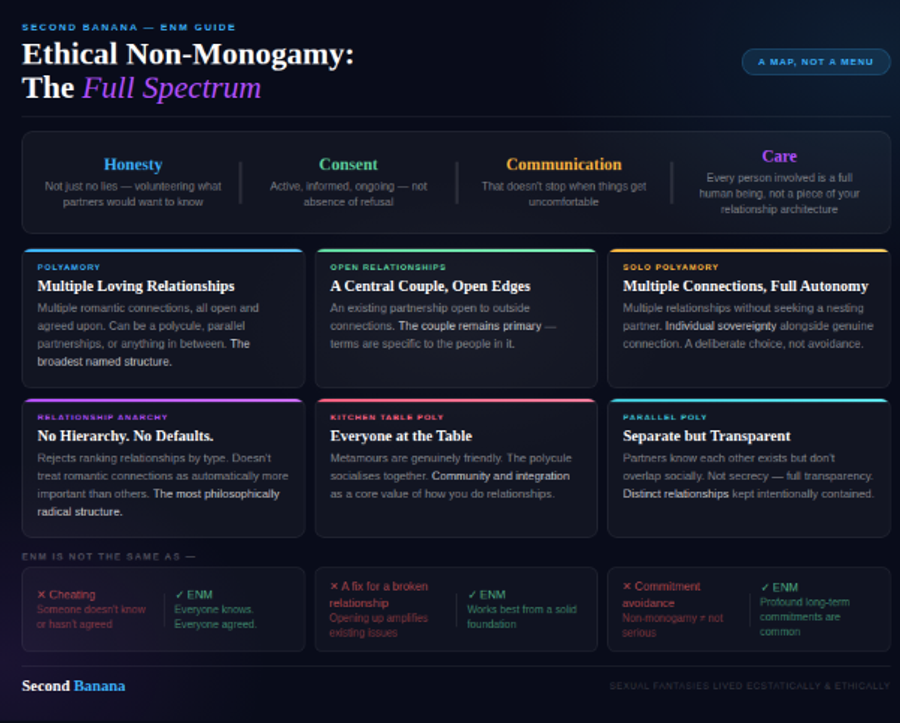
Ethical non-monogamy is built on a set of values — honesty, communication, consent, and genuine care for everyone involved — that have to be actively practised, not just agreed to in principle. It's not enough that your partners technically know about each other if they're being pressured, misled about the details, or having their feelings systematically dismissed. The ethics aren't a checkbox. They're the ongoing work of treating every person in your life as a full human being whose experience matters.
This is why the word has stuck. It's not perfect — nothing in this conversation is — and some practitioners prefer "consensual non-monogamy" (CNM) because it centres the consent piece most directly. But "ethical" keeps the moral weight visible. It says: this is a practice with obligations, not a loophole.
The obligations are real and worth naming upfront: honesty about your other relationships and their structure, genuine ongoing consent from everyone involved, care for your partners' emotional wellbeing, and communication that doesn't stop when things get uncomfortable. If you're not willing to do those things, what you're describing isn't ethical non-monogamy. It's just non-monogamy.
Second Banana was built for people who want to do it right.
What Polyamory Actually Is (And What It Isn't)
"Polyamory" combines the Greek poly (many) and the Latin amor (love). It means, literally, many loves — and it refers specifically to having multiple romantic relationships simultaneously, with the knowledge and agreement of everyone involved.
That specificity matters, because "polyamory" is often used as a catch-all for any form of non-monogamy, and it isn't that. There are important distinctions.
Polyamory vs. an open relationship. An open relationship typically means a committed couple who are open to sexual connections outside their partnership — but who aren't necessarily seeking additional emotional or romantic relationships. Polyamory explicitly includes the possibility of multiple loving relationships. The distinction isn't always sharp in practice, but it matters: someone who wants deep romantic connection with multiple partners is describing something different from someone who wants their primary partnership to remain central while allowing for casual sexual encounters on the side.
Polyamory vs. swinging. Swinging is a social and recreational sexual practice, typically (though not exclusively) practised by couples. It's primarily about sexual experience rather than romantic relationship-building. Many swingers consider themselves monogamous in the emotional sense. Many polyamorous people wouldn't identify with swinging at all. The communities overlap but are not the same.
Polyamory vs. cheating. This one's the simplest. Polyamory is consensual. Cheating is not. Full stop. The defining feature of ethical non-monogamy in all its forms is that everyone involved knows and has genuinely agreed. If someone doesn't know, you're not practising ethical non-monogamy. You're deceiving them.
What polyamory shares with all forms of ethical non-monogamy is the foundational premise that it's possible to love or be meaningfully connected to more than one person, that doing so honestly is better than doing so secretly, and that relationships can be designed to fit the actual people in them rather than defaulting to a single cultural template.
The ENM Spectrum: A Practical Map
Ethical non-monogamy is an umbrella term, not a single relationship structure. Under it sit a range of approaches, each with its own emphasis and logic. You don't have to pick one and commit to it forever — many people move between structures or combine elements — but understanding the landscape helps you figure out what you're actually looking for.
Polyamory
The broadest of the named structures. Polyamory can look like a lot of different things: a person with two long-term romantic partners who don't know each other well; a group of four people who are all connected to each other in various ways (a "polycule"); a couple who have each developed additional romantic partnerships; a single person building multiple meaningful relationships simultaneously. What they share is the presence of multiple loving relationships, all operating openly.
Open Relationships
As described above: typically an existing couple who are open to outside sexual or romantic connections, but whose primary partnership remains the central unit. Sometimes the "openness" is limited to sex; sometimes it extends to romance; the terms of each open relationship are specific to the people in it.
Solo Polyamory
Solo poly people have multiple relationships but prioritise their own autonomy and independence. They typically don't seek to build a cohabiting domestic partnership or a "primary" partner in the hierarchical sense. They maintain their own household, finances, and life architecture — and they pursue connections based on genuine mutual desire rather than on meeting a conventional relationship checklist. Solo poly isn't loneliness or commitment-avoidance; it's a deliberate, considered way of relating that centres individual sovereignty alongside genuine connection.
Relationship Anarchy (RA)
Relationship anarchy rejects the idea that relationships should be ranked or categorised. A relationship anarchist doesn't distinguish between "romantic" and "platonic" connections in ways that assign more value to one over another, doesn't treat any relationship as automatically more important than others, and doesn't accept that connection should come with standardised obligations or escalation expectations. RA is perhaps the most philosophically radical of the ENM structures — it challenges not just monogamy but the entire framework of how we typically think about relationships.
Kitchen Table Polyamory
This is the style where everyone in a polycule is comfortable enough with each other to sit together at the kitchen table — where metamours (partners of partners) are genuinely friendly, where the extended network socialises together, where everyone's relationship with everyone else is warm and acknowledged. Kitchen table poly emphasises integration and community.
Parallel Polyamory
The counterpoint to kitchen table: parallel poly means maintaining separate relationships that don't overlap much, if at all. Partners may know each other exists but don't socialise together. This isn't secrecy — everyone knows the overall structure — but it prioritises keeping relationships relatively contained and distinct. Some people find this more comfortable, especially early in their ENM journey or when managing complex social dynamics.
Hierarchical vs. Non-Hierarchical Polyamory
Some poly people use terms like "primary" and "secondary" to describe the relative priority of their relationships — with a primary partner typically sharing a home, finances, or long-term planning, and secondary partners having a differently-scaled level of integration. Others actively reject this hierarchy, arguing that categorising partners as "secondary" devalues them and creates structural unfairness. The debate between hierarchical and non-hierarchical poly is one of the livelier ongoing conversations in ENM communities.
Why Ethics Is the Load-Bearing Word
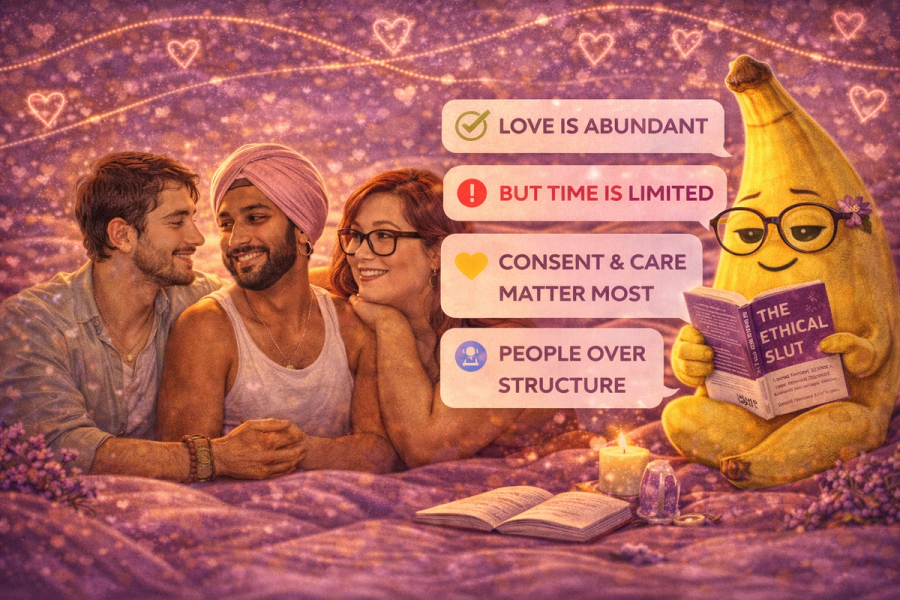
It's worth sitting with what "ethics" actually requires in practice, because it's more demanding than it sounds — and understanding those demands is what separates genuinely ethical non-monogamy from its less savoury imitators.
Honesty. Not just "not lying outright" but the kind of honesty that volunteers relevant information, that doesn't strategically omit things partners would want to know, and that continues even when the truth is uncomfortable to say or hear. In ENM, this means being clear about your other relationships, your intentions, your changing feelings, and your limits.
Informed consent. Everyone involved needs to actually understand what they're agreeing to — not just in the abstract ("yes, we're open") but in the specific ("my other partner and I see each other every Wednesday, we sometimes travel together, and our relationship has been deepening over the past six months"). Consent based on incomplete information isn't really consent.
Ongoing communication. Agreements made at one point in a relationship may need revisiting as circumstances, feelings, and connections evolve. A commitment to keep communicating — even when it's easier to let something quietly drift — is part of the ethical practice.
Care. Genuine care for the wellbeing of everyone involved: partners, metamours, yourself. This doesn't mean managing everyone's feelings or taking responsibility for things outside your control. It means keeping the people in your life in mind as full human beings, not just as pieces of your personal relationship architecture.
These aren't platitudes. They're the actual work. And they're the reason why people who practise ethical non-monogamy well often describe their relationships as among the most honest, communicative, and genuinely caring connections of their lives — because the relationships are built on those values from the start, rather than arriving at them after years of accumulated avoidance.
What ENM Is Not
A few things that sometimes get confused with ethical non-monogamy, and aren't:
It's not a solution to a broken relationship. Opening a relationship that's already in distress rarely fixes the distress — it usually amplifies it. ENM works best when it's an addition to a life that already has solid relational foundations, not a last-ditch attempt to save something that isn't working.
It's not a phase or a sign of commitment-avoidance. Polyamorous people often make profound, long-term commitments to their partners. Some have been in multi-partner configurations for decades. The association between non-monogamy and unwillingness to commit is a cultural assumption, not a fact.
It's not the same as having no standards or limits. Having multiple partners doesn't mean having no preferences, no emotional depth, no capacity for jealousy, or no needs. ENM people experience all of these things. The practice isn't about bypassing human emotion — it's about navigating it honestly. Doing it any other way is unethical.
It's not inherently more evolved or enlightened than monogamy. Monogamy is a valid relationship structure for people who genuinely choose it. The problem isn't monogamy — it's compulsory monogamy, the cultural assumption that everyone should want it and that wanting something different is pathological. ENM advocates for choice and honesty, not for a particular outcome.
How Second Banana Holds Space for All of It
Here's the practical problem that most mainstream dating platforms create for people interested in ENM: they were designed for monogamy. Their architecture — the profile, the match, the progression toward exclusivity — reflects a single relationship model. Navigating ENM on those platforms requires constant work against the grain: explaining your relationship structure in a bio that wasn't built for it, finding the right person to disclose to and when, managing the assumptions that come with apps optimised for coupling.
Second Banana was built differently.
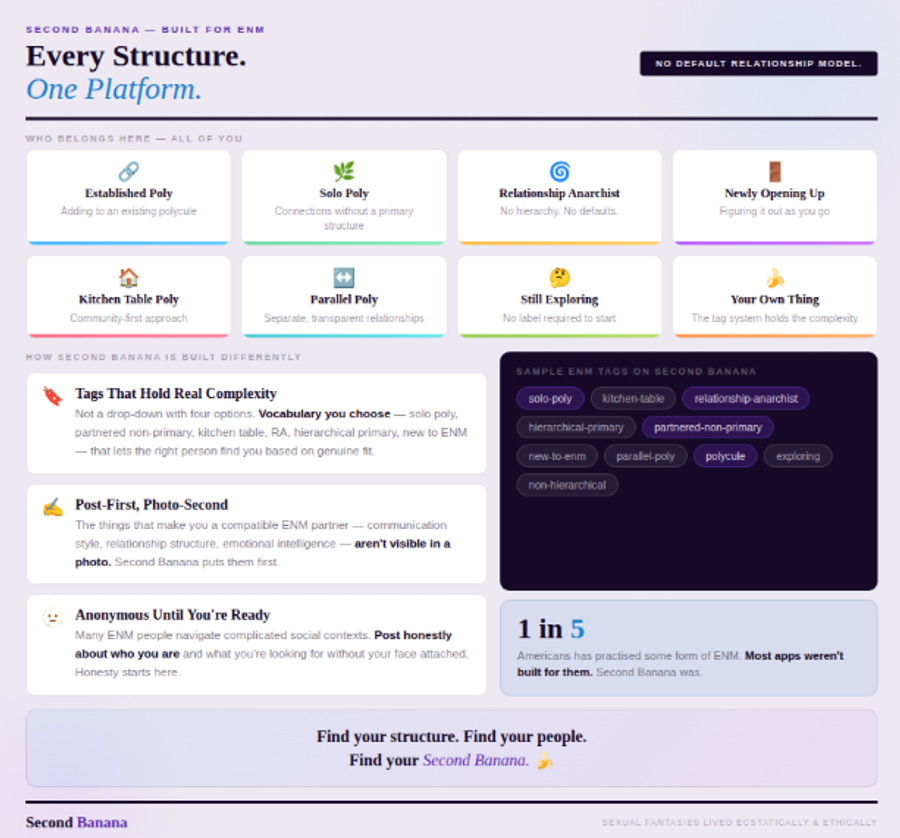
The platform doesn't have a default relationship model. Whether you're a solo poly person looking for a deep, independent connection with someone who respects your autonomy; a member of an existing polycule looking for a new connection; someone exploring ENM for the first time; someone in a traditional relationship structure who's simply kinky and curious; or someone who doesn't quite fit any of the named categories — all of these are legitimate starting points on Second Banana.
The tag system is where this comes to life concretely. Rather than forcing you into a pre-set relationship type, tags let you describe your actual situation and what you're actually looking for. "Solo poly." "Partnered non-primary." "Kitchen table poly." "Hierarchical primary." "Relationship anarchist." "New to ENM." "Exploring." These aren't labels imposed on you — they're vocabulary you choose and can change, and they let people find you based on genuine compatibility rather than surface-level category matching.
Anonymous posting matters here in a specific way for ENM. Many people exploring ethical non-monogamy are doing so while navigating complicated social contexts — partners who are aware but may not be fully on board, professional environments where disclosure would be complicated, family situations where being out as non-monogamous carries real risk. The ability to post honestly about your desires and situation without your face and full identity attached gives people the freedom to be real about where they are, which is the beginning of any genuine connection.
The post-first model — where you lead with words about who you are and what you're looking for, rather than leading with photos — is particularly well-suited to ENM in all its forms. The things that make you a compatible partner for someone else in an ENM context are often not visible in a photo: your communication style, your relationship structure, your level of experience, your emotional intelligence, what you're actually seeking. Second Banana's format puts those things first.
And across all of this: Second Banana explicitly welcomes all relationship structures. Solo poly. Kitchen table. Parallel. Hierarchical. Non-hierarchical. People who are firmly established in their ENM practice and people who are brand new to it and still figuring out what they want. The community isn't optimised for one kind of non-monogamy over another. It's optimised for honesty, intentionality, and genuine connection — which are the values at the heart of all of them.
Starting Where You Are
If you're new to all of this, the most useful thing you can do is spend time with the questions before you spend time with the answers.
What is it that you're actually looking for? Not "what's the correct relationship structure for someone like me" — there's no such thing — but what do you genuinely want in your connections? What does fulfilment look like for you? What are you missing in your current situation? What are you afraid of losing? What does your gut tell you when you imagine different versions of your relational life?
These questions don't have quick answers, and they don't need to. Ethical non-monogamy is not a destination you arrive at once and then you're done — it's an ongoing practice of knowing yourself and communicating that knowledge to the people you care about. The destination keeps moving, which is the whole point.
Second Banana is here for wherever you are in that process — not just for people who have it figured out, but for people who are still working it out, with the care and honesty and intention that working it out deserves.
Find your structure. Find your people. Find your Second Banana. 🍌
Second Banana: Sexual Fantasies Lived Ecstatically and Ethically. A sex-positive, inclusive community for adults of every relationship structure — built for connection that starts with honesty.