
Age Gap Dynamics: The Psychology of Why It Works | Second Banana
Age Gap Dynamics:
The Psychology of Why It Works, What Both Sides Are Actually Seeking, and Why the Cultural Conversation Gets It Wrong
The Attraction the Culture Can’t Quite Handle
Age gap attraction occupies a strange position in contemporary sexual culture. It is, by almost any measure, extremely common — surveys consistently find that both men and women report attraction to people significantly older or younger than themselves, and the fantasy of an age gap encounter is among the more frequently reported sexual scenarios across demographic groups. And yet the cultural conversation around it has become increasingly hostile, treating age gap attraction as inherently suspect, as necessarily involving exploitation, as something that requires justification or explanation in a way that same-age attraction does not.
This piece is not a defence of exploitative relationships. Power imbalances that operate through coercion, financial dependency, or the manipulation of someone who lacks the maturity or resources to give genuine consent are real and harmful, and no serious account of age gap dynamics should minimise that. But the cultural tendency to treat all age gap attraction through this lens — to assume that any significant age difference implies exploitation, that the older party is necessarily predatory and the younger necessarily victimised — collapses a genuine diversity of experience and psychology into a single narrative that serves almost no one well.
The people who are drawn to age gap dynamics — both the older and the younger partners — are, in the overwhelming majority of cases, consenting adults who are drawn to specific psychological and experiential qualities that an age gap provides. Understanding what those qualities are, and why they are attractive, is the beginning of treating these people as the complex, self-determining individuals they are rather than as characters in a morality tale.
Age gap attraction is not a symptom of damage. It is a specific orientation toward qualities — experience, energy, authority, vitality — that happen to correlate with age. The correlation is not the pathology.
The Two Directions: Not Mirror Images
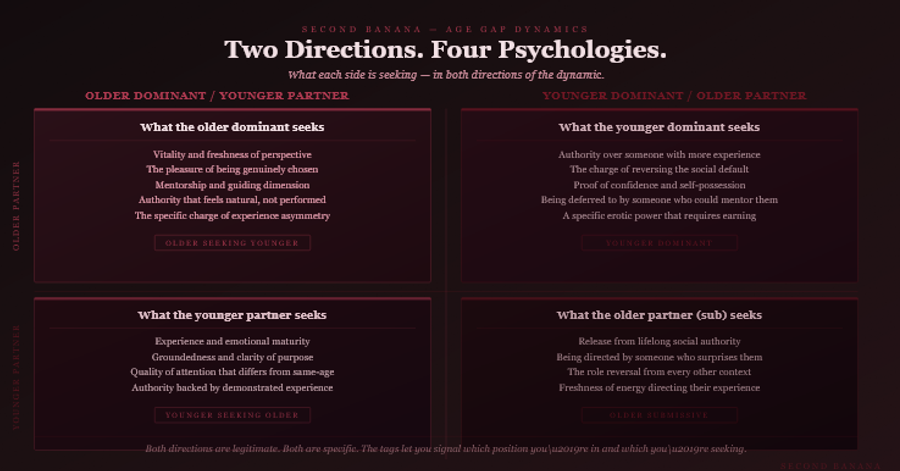
Age gap dynamics come in two directions that are often discussed as though they are symmetric but are psychologically quite distinct. The older dominant/
younger partner dynamic and the younger dominant/older partner dynamic attract different people for different reasons, produce different relationship textures, and carry different cultural baggage. Treating them as mirror images of each other misses what is specific and interesting about each.
Older Dominant / Younger Partner
This is the direction the cultural conversation fixates on, and it is the one most frequently pathologised. The older partner — typically but not exclusively male — is assumed to be seeking control, validation of their attractiveness, or a partner who can be managed. The younger partner is assumed to be seeking financial security, a parental substitute, or to be insufficiently mature to understand what they’re getting into.
The research does not support this caricature. Studies of age gap couples consistently find that younger partners in these relationships report high levels of relationship satisfaction, and that the factors they identify as attractive in older partners are primarily psychological and experiential rather than financial: emotional maturity, confidence, clarity of purpose, experience in navigating life’s complications, and a quality of attention and presence that younger partners often describe as qualitatively different from what they find in same-age relationships.
For the older partner, the appeal is equally psychological: the energy, curiosity, and openness of a younger partner; the specific pleasure of being genuinely desired by someone whose desirability is at its peak; the experience of approaching familiar things with fresh eyes through a younger partner’s perspective; and, in some cases, a genuine mentorship or guiding dimension that is satisfying rather than controlling.
The power dimension in this dynamic is real but is not inherently exploitative. Older partners typically have more life experience, more financial stability, and more social authority. These are genuine asymmetries. What determines whether those asymmetries are exploitative or generative is not their existence but what is done with them — whether the older partner uses their position to constrain or to genuinely support the younger partner’s autonomy, development, and wellbeing.
Younger Dominant / Older Partner
The reverse dynamic — in which the younger partner holds the dominant or directive position and the older partner is in the submissive or following role — receives almost no cultural attention and carries almost no cultural framework, which means the people in it are largely navigating without maps.
This dynamic is not rare. It appears across genders and orientations, and it attracts both parties for specific reasons that are worth naming clearly. The older partner in a submissive position often describes the appeal in terms of release — the experience of surrendering the authority and responsibility that their age and position in life routinely assigns them. Someone who has spent decades being the person others defer to, the person who makes decisions, the person whose experience is treated as the reference point, may find the experience of being directed by someone younger specifically and profoundly releasing in a way that other D/s dynamics don’t quite replicate.
The younger dominant in this dynamic is often drawn to the specific quality of authority over someone with more life experience — the particular charge of being deferred to by someone who could, in any other context, be their parent or mentor. This is a specific form of erotic power that requires and demonstrates a quality of confidence and self-possession that is itself part of the appeal.
This dynamic also frequently involves a genuine role reversal from the social default that is part of its erotic charge for both parties. The younger person who is normally expected to defer to older authority gets to hold authority; the older person who is normally expected to be the authority gets to release it. That reversal is not accidental — it is often precisely the point.
What Each Side Is Actually Seeking
What Younger Partners Are Often Seeking
The most consistent theme in younger partners’ accounts of age gap attraction is experience — not primarily financial experience but life experience, emotional experience, the specific quality of presence that comes from having navigated more of what life contains. Younger people are frequently in a phase of life characterised by uncertainty about identity, direction, and what they actually want. An older partner who has moved through some of that uncertainty — who knows who they are, what they value, and how they want to engage with the world — can offer a quality of groundedness and clarity that is genuinely distinctive and genuinely appealing.
A second theme is the quality of attention. Younger partners frequently report that older partners pay a different kind of attention — more deliberate, less distracted by the performance anxieties that characterise many younger people’s romantic and sexual relationships. The experience of being seen and attended to by someone who brings focused, experienced, confident attention to the encounter is specifically appealing in a way that is distinct from the energy of same-age connections.
A third theme, particularly in explicitly kinky age gap dynamics, is the authority dimension. For younger people with submissive orientations, an older partner’s authority has a specific quality that differs from a same-age dominant’s: it is backed by demonstrated experience rather than just claimed, which can make it feel more genuine and more earning of deference. The older dominant hasn’t just decided to be in charge — they have the track record, the calm, and the knowledge that makes authority feel natural rather than performed.
What Older Partners Are Often Seeking
The most consistent theme in older partners’ accounts is vitality — the specific energy of someone who is earlier in life, for whom many things are still fresh, who brings a quality of enthusiasm and openness that is genuinely invigorating to be around. This is not about older partners trying to recapture their own youth or avoid confronting their age. It is about genuine attraction to a quality of engagement with the world that tends to be more available earlier in life and genuinely appealing to people who have moved past it.
A second theme is the specific pleasure of being genuinely desired by someone whose desirability is at a different phase of its arc. Older partners frequently describe a specific quality of validation in being chosen by a younger partner — not vanity, but the genuine experience of being seen and wanted by someone who could be with many other people and is choosing them.
A third theme is the mentorship or guiding dimension that appears in many age gap dynamics. This is not inherently controlling — at its best, it is a genuine investment in a younger partner’s development and flourishing that is satisfying to the older partner in ways that go beyond the erotic. The experience of contributing meaningfully to another person’s growth is genuinely rewarding, and in the best age gap dynamics this contribution is welcomed and appreciated rather than imposed.
The Daddy/Mommy Dynamic: Adjacent but Distinct
The daddy/mommy dynamic — encompassing DD/lg (Daddy Dom/little girl), MD/lb (Mommy Dominant/little boy), and their many variants — is frequently conflated with age gap attraction but is psychologically quite distinct and deserves its own treatment. The connection point is that daddy and mommy dynamics often involve age gap elements, and age gap attraction often has flavours of the daddy/mommy dynamic. But they are not the same thing.
Age gap attraction is primarily about the qualities that correlate with age difference — experience, authority, vitality, groundedness. The daddy/mommy dynamic is primarily about a specific caretaking and nurturing dimension that is present regardless of the actual ages involved. A thirty-year-old can be a Daddy Dom to a twenty-eight-year-old; a twenty-five-year-old can be a Mommy Dominant to a forty-year-old. The dynamic is about roles and psychological orientations rather than chronological age.
The regression dimension of DD/lg and MD/lb — the ‘little’ partner accessing a childlike state of dependence, play, and care-receiving — is its own specific psychology that goes well beyond age gap dynamics. That psychology, and the full complexity of the caretaking dynamic, deserves its own dedicated piece.
What’s worth noting here is that age gap attraction and the daddy/mommy dynamic frequently coexist and reinforce each other — an older partner’s authority and experience can feel particularly genuine and grounding in a DD/lg dynamic, and the caretaking dimension can feel more natural with an actual age gap behind it. But the two are separable, and many people who are drawn to age gap dynamics have no interest in the regression elements of the daddy/mommy dynamic, while many people who are deeply invested in those dynamics are not particularly interested in actual age gap.
The Psychology: What the Research Says
Evolutionary Psychology and Age Gap Attraction
Evolutionary psychology offers one account of age gap attraction that, like sperm competition theory in the cuckolding piece, explains some of the intensity without exhausting the full complexity. The theory is relatively straightforward: mate selection has historically been influenced by cues to fertility and resource provision, which tend to peak at different points in the lifespan for men and women. The attraction of older men to younger women, and younger women’s responsiveness to older men, has an evolutionary account that is well-supported in the cross-cultural literature.
David Buss’s research across 37 cultures found consistent patterns in mate age preferences that align with this account: men tend to prefer younger partners, and women tend to prefer older partners, with these preferences showing up across cultures with very different social norms about gender and relationships. The effect sizes are not massive — culture and individual variation matter enormously — but the cross-cultural consistency is notable.
What the evolutionary account doesn’t explain is the reverse dynamic — younger dominant/older submissive — which suggests that something more than evolutionary programming is at work. And it doesn’t explain the specific psychological qualities that people on each side of the dynamic identify as attractive, which go well beyond fertility and resource cues into more complex territory: the specific pleasure of deference, the specific pleasure of authority, the specific charge of the experience gap.
The Experience Gap as Erotic Charge
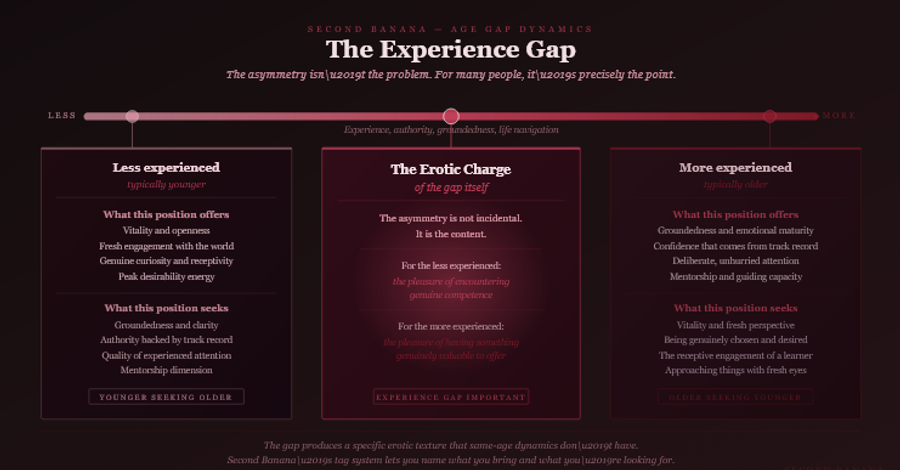
One of the most consistently reported features of age gap attraction — from both sides — is the erotic charge of the experience gap itself. This is something different from and more specific than the evolutionary account. The experience gap is the asymmetry in what each person has lived through, what they know, what they can offer, what they need — and this asymmetry creates a specific erotic texture that same-age dynamics simply don’t have.
For the less-experienced partner, the experience gap produces a specific quality of learning and discovery — of being introduced to things, shown things, given access to perspectives and capabilities that are genuinely new. This is not infantilising — it is the specific pleasure of encountering genuine competence and experience that one doesn’t yet possess, and finding that encounter erotic rather than threatening.
For the more-experienced partner, the experience gap produces the pleasure of contribution — of having something genuinely valuable to offer, of seeing the effect of that offering on someone who is receptive to it. This is different from the pleasure of dominance in a conventional D/s sense. It is more like the pleasure of a genuinely experienced teacher with a genuinely engaged student — except that the context is erotic rather than academic, which changes everything about the quality of the engagement.
What the Research Says About Outcomes
Research on age gap relationships has produced a more nuanced picture than the cultural conversation suggests. A 2019 study published in the Journal of Population Economics found that while age gap couples do face specific challenges — including divergent life stage priorities and the social disapproval that affects all non-normative relationship structures — they do not show systematically worse relationship outcomes than same-age couples when controlling for other factors. Some studies have found higher initial relationship satisfaction in age gap couples, though this tends to decline more over time than in same-age couples.
The consistent finding is that what predicts relationship success in age gap dynamics is the same as what predicts it everywhere else: genuine mutual respect, clear communication, compatible values and life goals, and both partners’ autonomous choice of the relationship rather than either partner feeling constrained or coerced into it. Age gap per se is not predictive of either success or failure. The values and communication quality underneath the relationship are.
The Shame, and the Specific Form It Takes Here
The shame around age gap attraction is different in character from the shame around most of the other dynamics in this series. It is not primarily personal shame — the feeling that one’s desire is abnormal or damaged. It is social shame: the awareness that others will interpret the relationship through a lens of exploitation or inadequacy, and the exhaustion of constantly having to defend something that feels, from the inside, entirely genuine and freely chosen.
Younger partners in age gap dynamics frequently describe a specific form of this shame: the assumption that they cannot have genuinely chosen this, that they must be motivated by something other than actual attraction — financial security, unresolved parental issues, low self-esteem, naïveté. The denial of their authentic desire, and the implied insult that they are not capable of knowing what they want, is itself a form of the condescension the cultural narrative claims to be protecting them from.
Older partners face a different form: the assumption of predation, of having engineered a relationship with someone who can’t quite see through them, of using their position and resources to obtain something they couldn’t otherwise attract. The experience of being attracted to someone younger and being told that this attraction is inherently suspect — regardless of how the relationship actually functions, regardless of the younger partner’s own account of their experience — is a specific and wearing form of social judgment.
Neither of these shame experiences reflects the reality of most age gap dynamics. They reflect the cultural tendency to reduce complex human experience to simple narratives about power — narratives that are occasionally accurate and frequently not, and that in either case fail to honour the autonomy and complexity of the people involved.
The younger partner knows what they want. The older partner knows what they’re offering. The culture’s assumption that it knows better than either of them is its own form of condescension.
What This Has to Do With Second Banana
The practical challenge of age gap attraction is finding people who are genuinely drawn to the dynamic rather than merely open to it. There is a significant difference between someone who would not be opposed to an age gap and someone for whom the age gap itself is part of the appeal — who finds the experience asymmetry specifically attractive, who is drawn to the particular texture that a significant age difference produces in an encounter. Finding the latter on a platform that organises matching around photographs and demographic checkboxes is largely a matter of chance.
The post-first model changes this. A person who finds age gap dynamics compelling can write about what specifically draws them — the experience gap, the authority dimension, the specific quality of presence they’re looking for — in enough detail that the people who respond are already aligned on what the dynamic actually involves. The matching is not by age range but by orientation toward what the age difference means and provides.
The Second Banana tag system gives age gap communities specific vocabulary:
- Age gap — the orientation itself
- Older seeking younger / younger seeking older — the direction of the dynamic
- Experience gap important — signalling that the asymmetry is part of the appeal
- Mentor dimension / guiding dynamic — for dynamics with that texture
- Younger dominant / older submissive — for the reverse dynamic
- DD/lg adjacent / MD/lb adjacent — where relevant, with link to that dedicated content
- No daddy/mommy dynamic — for those who want age gap without the caretaking register
- Casual / ongoing / relationship-oriented — the relational intention
These Second Banana tags mean that the responses to an age gap post come from people who already understand what the dynamic involves and are drawn to it for the right reasons — who find the experience gap specifically appealing rather than merely acceptable, and who can bring genuine enthusiasm to a dynamic they actually want rather than one they’re being accommodating about.
The anonymous posting option has a specific value for age gap dynamics that’s worth naming: the social judgment around this orientation is real enough that many people who are genuinely drawn to it are reluctant to attach their name to that attraction before they’ve established that they’re in a context where it will be understood rather than judged. Second Banana’s architecture provides that context.
And the community that Second Banana attracts — people who have thought carefully about their desires, who communicate specifically, who understand that attraction is more nuanced than demographic matching — is the community where age gap attraction is most likely to be met with the understanding and genuine interest it deserves. People who are here because they take their erotic lives seriously enough to write about them honestly are people who are capable of engaging with the full complexity of what age gap dynamics actually involve.