Alpha Kink: The Psychology of Dominance, Presence, and Why Unperformed Authority Is So Erotic | Second Banana
Alpha:
The Psychology of Dominance, Presence, and Why Unperformed Authority Is the Most Erotic Kind
First: Clear Away the Nonsense
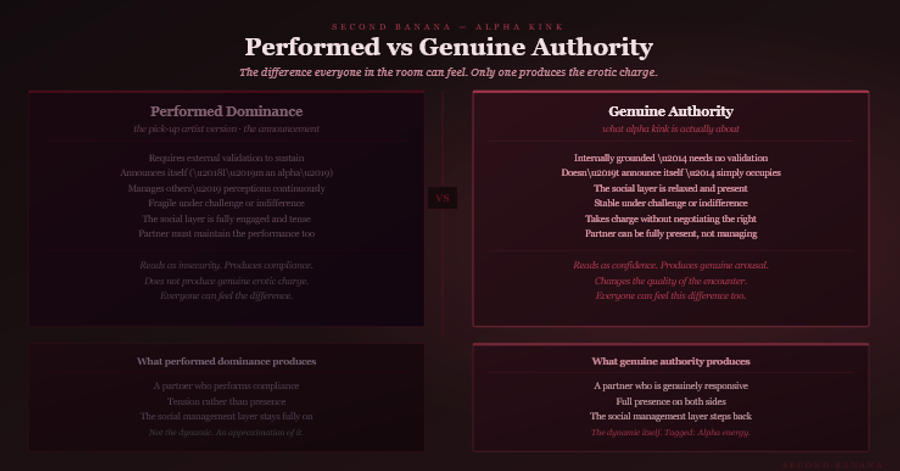
The term ‘alpha’ has acquired a layer of cultural debris that needs to be acknowledged and set aside before we can get to what alpha kink is actually about. The pick-up artist community adopted the alpha/beta framework from a now-discredited account of wolf social behaviour, and used it to construct a set of performance instructions for men who wanted to project dominance without actually having any. The result is a well-documented cultural pathology — men performing characteristics they believe are attractive rather than developing qualities that are actually compelling. This is the opposite of what alpha kink is about.
The wolf hierarchy research it was based on has been publicly repudiated by its original author, David Mech, who spent decades trying to get his 1970 book pulled from print because its central claims were wrong. Wild wolves don’t form hierarchies enforced through dominance — they live in family groups where the ‘alpha’ pair are simply the parents. The dominance-hierarchy model was an artefact of studying captive, unrelated wolves forced together in artificial conditions.
None of this matters to alpha kink, which has nothing to do with wolves or pseudoscientific social hierarchy. What it has to do with is a specific quality of human presence — genuine, unperformed confidence and authority — that is erotically compelling in ways that the biology myth cannot explain and that the pick-up artist performance cannot produce. Alpha kink is about that quality and what it does to the people who encounter it.
Performed dominance reads as insecurity. Genuine authority doesn’t need to announce itself. The erotic charge is in the difference — and everyone in the room can feel it.
What Alpha Kink Actually Is
At its core, alpha kink describes the erotic charge that some people locate in encountering a partner who embodies a specific quality of presence: certainty, physical and social confidence, the capacity to take charge without negotiating that capacity, and a specific kind of authority that does not require external validation. This quality is not gender-specific — it can be embodied by any person, and it is sought by partners of any orientation. It is not about social status, physical size, or any of the external markers that the pick-up artist tradition mistakes for the thing itself.
The alpha in kink is defined by their relationship to their own authority rather than by their relationship to other people’s deference. They do not need acknowledgment of their dominance in order to occupy it. They are not performing confidence — they have it, in the specific sense of being genuinely at ease with their own authority and with taking charge in an erotic context. This quality of settled, unperformed certainty is what practitioners who seek alpha partners are actually seeking.
It is distinct from BDSM dominance in its formal sense, which involves negotiated power exchange, explicit protocols, and the structured framework of a D/s dynamic. Alpha kink can coexist with explicit D/s — many practitioners use both frameworks simultaneously — but it can also operate in more naturalistic contexts where the structure is less explicit and the authority is expressed through attitude and presence rather than through formal role designation.
The Alpha/Beta Dynamic
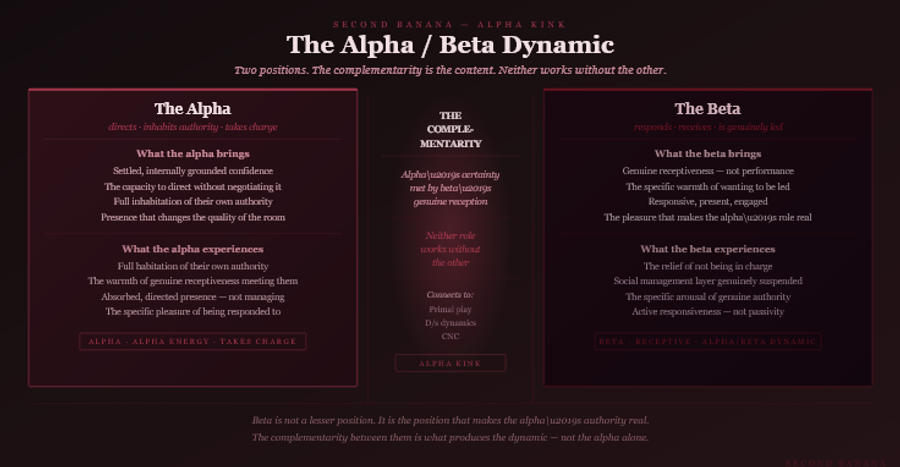
Many practitioners frame their orientation explicitly in alpha/beta terms, and this framing is worth taking seriously as a description of a genuine dynamic rather than dismissing as borrowed pseudoscience. In kink usage, the beta position is not a deficiency or a lesser state — it is a specific relational orientation that finds its fulfilment in complement to the alpha. The beta who genuinely wants to be led, who finds the presence of someone certain and authoritative specifically arousing, who experiences the relief of not having to be in charge as one of the most pleasurable erotic states available — this is not a person who has failed to become alpha. It is a person whose erotic orientation is toward the specific pleasure of the beta position.
The dynamic between a genuine alpha and a genuinely beta-oriented partner produces a specific quality of erotic encounter that neither party can replicate alone or with a mismatched partner. The alpha’s certainty is met by the beta’s genuine receptiveness; the beta’s pleasure in being led is met by the alpha’s genuine capacity to lead. The complementarity is the content. It is not incidental to the dynamic — it is the dynamic.
The Psychology: What Makes It Work
The Erotic Charge of Genuine Confidence
The research on human attraction consistently finds that confidence — genuine, not performed — is among the most reliably attractive qualities across genders, orientations, and cultural contexts. This is not a trivial observation. Confidence signals competence, which in evolutionary terms signals the capacity to provide and protect. But in the erotic context, the appeal of genuine confidence goes beyond evolutionary signalling to something more immediately psychological: the person who is genuinely certain of themselves provides a specific quality of presence that changes the quality of the encounter.
When you are with someone who is genuinely confident — not performing confidence but actually inhabiting their authority — the social management layer that most interactions require is reduced. You do not have to manage their insecurity. You do not have to maintain their self-image. You can simply be present to the encounter itself, because the person you are with is doing the same. This reduction in social management load is itself pleasurable, and in an erotic context it enables a quality of presence and engagement that is distinct from encounters where social management is required throughout.
The Relief of Not Being in Charge
For practitioners who are drawn to the beta position in an alpha/beta dynamic, the experience of being with a genuinely alpha partner carries a specific quality of relief that is central to the appeal. Many people whose daily lives involve sustained high-level authority — professional responsibility, care for others, management of complex situations — find the erotic encounter with someone who simply, confidently takes charge to be one of the most intensely pleasurable experiences available to them.
This is the same mechanism that drives submission in other D/s dynamics — the specific pleasure of the cognitive management layer being suspended in degradation and praise play. But in alpha kink, the mechanism operates through presence rather than through explicit structure. The alpha’s confidence is not negotiated or declared — it is simply present, and the beta-oriented partner responds to it in a way that produces the specific relief of genuinely not being responsible for the direction of the encounter.
This is not passivity. The beta-oriented partner in an alpha/beta dynamic is intensely present and engaged — but their engagement is responsive rather than directive, receptive rather than leading. Many practitioners describe this as one of the most active forms of erotic engagement available to them, precisely because the responsiveness requires genuine presence to what is happening rather than cognitive management of where things are going.
The Alpha’s Experience
The alpha’s experience of the dynamic is less often described in popular accounts of this orientation, but it is equally specific and worth naming. Being in the alpha position in an erotic encounter — genuinely taking charge, directing the encounter from a place of genuine confidence, holding the space for a partner who has yielded direction to you — produces its own specific quality of engaged, absorbed presence.
The specific pleasure of the alpha position is not the pleasure of imposing on someone who resists. It is the pleasure of a partner who genuinely wants to be led, meeting that want with genuine capacity to lead. The alpha who is with a genuinely receptive partner — who encounters the specific warmth and responsiveness of someone who finds their authority specifically compelling — is having a qualitatively different experience from the person who performs dominance for a partner who is merely compliant.
Many people who identify as alpha in erotic contexts describe the experience as one of the most fully inhabited they access — being entirely in their own authority, entirely present to the encounter, not managing anyone’s needs or insecurities but simply being the confident, directing presence that the dynamic calls for. This quality of full habitation of one’s own authority is specifically pleasurable, and it requires a partner who genuinely responds to it.
Alpha Kink and Related Dynamics
Alpha kink overlaps with several other dynamics in this series, and understanding the connections helps practitioners locate their specific orientation within the broader landscape.
Alpha and Primal Play
The connection between alpha kink and primal play is the closest in the series. The primal dynamic — in which the social management layer is suspended and both parties operate from a more instinctual, physical register — is frequently the context in which alpha/beta dynamics are most fully expressed. The alpha in a primal scene is not performing dominance through protocol or structure; they are embodying it through physical presence, through the quality of their pursuit or their authority in the catch. The predator/prey dynamic of primal play and the alpha/beta dynamic of alpha kink are often the same dynamic described from different angles. [internal link: Primal Play]
Alpha and Dominance/Submission
Alpha kink is related to but distinct from formal D/s. The formal D/s dynamic involves explicit negotiation, protocol, and structure — the roles are defined and maintained through agreed-upon frameworks. Alpha kink can operate within this structure, and many practitioners who identify as alpha or as dominants in D/s contexts use the same underlying quality of settled confidence. But alpha kink can also operate outside formal D/s, in more naturalistic encounters where the authority is present through attitude rather than through declared role. The distinction is not about the presence or absence of consent — both require it — but about the formality of the structure through which the dynamic is expressed.
Alpha and CNC
The consensual non-consent dynamic frequently involves an alpha figure — the person who takes charge in the CNC scene typically embodies the quality of settled, unperformed authority that alpha kink describes. For practitioners who are drawn to CNC specifically because of the specific quality of the dominant’s presence rather than because of the non-consent framing per se, alpha kink is often the more precise description of their orientation. [internal link: Consensual Non-Consent]
What This Has to Do With Second Banana
Alpha kink presents a specific matching challenge: the quality of presence that defines genuine alpha energy cannot be signalled by claiming it. The person who writes ‘I’m an alpha’ in their profile has already provided evidence that they may not be — genuine confidence does not typically require announcement. The person who writes specifically about how they engage, what they bring to an encounter, what the dynamic looks like when it works — that writing is itself a demonstration of the quality being described.
The post-first model is particularly well-suited to alpha kink for this reason. A post is an extended act of self-description, and the quality of someone’s self-description is itself evidence of their presence, their certainty, and their capacity for the kind of engaged, directed attention that genuine alpha energy produces. A person writing confidently and specifically about who they are and what they bring is already demonstrating something about the quality of their presence. A person who is responsive, specific, and clear about what they seek is demonstrating the receptive quality that the beta position in this dynamic requires.
The tag system gives practitioners specific vocabulary:
- Alpha — the orientation itself
- Alpha energy — for those whose primary expression is through presence rather than explicit D/s structure
- Beta / receptive — for those oriented toward the receiving position
- Alpha/beta dynamic — for those seeking the specific complementarity
- Natural dominance / unstructured — for those whose alpha expression doesn’t require formal D/s framework
- Primal alpha — for those whose alpha energy manifests in the primal register
- Takes charge — practical signal about how encounters tend to go
- Confident and specific — for those who want a partner who knows what they want