Degradation and Praise Kink: Two Sides of the Same Erotic Charge | Second Banana
Degradation and Praise Kink:
Two Sides of the Same Erotic Charge, and the Psychology That Explains Both
The Shared Mechanism
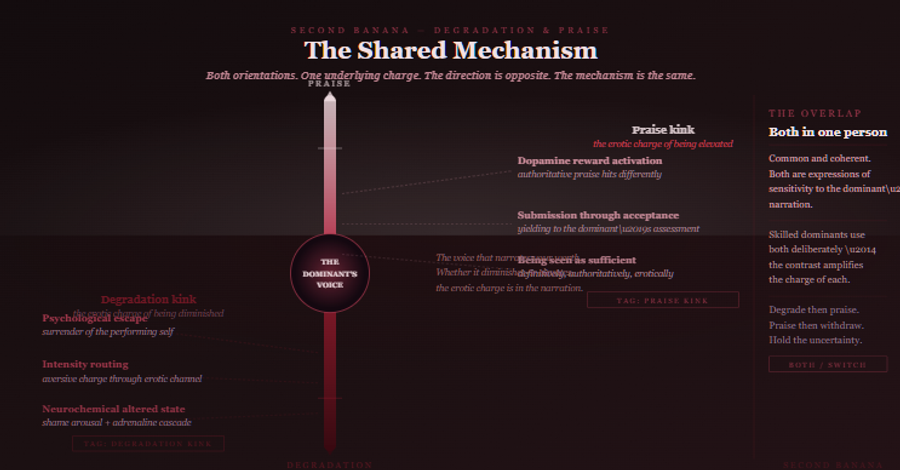
Degradation kink and praise kink appear, at first glance, to be opposite orientations — one organised around the erotic charge of being diminished, the other around the erotic charge of being elevated. They attract different people, carry different cultural baggage, and produce very different scene textures. And yet they are, at the level of underlying psychology, expressions of the same fundamental mechanism: the specific and powerful erotic charge of having one’s worth narrated by another person.
This is the insight that makes the pairing worth examining together rather than separately. Both degradation and praise kink locate a significant portion of their erotic energy in the experience of being evaluated — of having someone else’s assessment of your value, your performance, your desirability, your worth become the thing that matters in the moment. In degradation kink, that assessment is lowering: you are worthless, you are pathetic, you are nothing. In praise kink, it is elevating: you are perfect, you are good, you did so well. The direction is opposite. The mechanism — the erotic weight of the other person’s voice defining who you are — is identical.
Understanding this shared mechanism is the beginning of understanding why both orientations are psychologically legitimate, why they so frequently coexist in the same person, and why the shame that attaches to degradation kink specifically is so consistently misplaced. If we accept that the erotic charge of being affirmed by a trusted person is comprehensible and reasonable — and praise kink attracts almost no cultural criticism — then we need a more careful argument than simple disgust to explain why the erotic charge of being diminished by a trusted person in a consensual context is different in kind rather than just in direction.
Both orientations are organised around the same thing: the erotic charge of being seen and defined by someone who matters. The direction of the definition is opposite. The mechanism is the same.
Degradation Kink: The Psychology of Erotic Diminishment
What It Actually Is
Degradation kink — also called humiliation kink, verbal humiliation, or simply degredation play — is the erotic charge derived from being verbally, psychologically, or physically diminished within a consensual context. The degradation can take many forms: verbal insults and demeaning language, being called names that would be deeply offensive outside the scene, being treated as less than — as an object, as a pet, as something beneath the dignity usually accorded to a person. The erotic charge is in the diminishment itself: in the experience of being reduced, and finding that reduction arousing rather than merely painful.
The range of degradation practice is wide. At the lighter end: demeaning pet names, mild objectification, instructions that emphasise the submissive’s subordinate position. At the more intense end: explicit verbal abuse, elaborate humiliation scenarios, public degradation within agreed-upon kink contexts, the use of deeply offensive language that would be wholly unacceptable outside the consensual frame. What all of these share is the fundamental dynamic: one person’s deliberate reduction of another, with the reduced person’s erotic engagement with that reduction being the point.
The word ‘consensual’ is doing essential work here, as it does in CNC. A degradation kink scene is organised around thorough prior negotiation: exactly what language will be used and what is off-limits, what scenarios are on the table, what the limits of physical as well as verbal degradation are, what the safe word mechanism is, and what aftercare will follow. The apparent absence of respect within the scene is made possible by, and exists entirely within, a framework of profound mutual respect outside it.
Why This Is Arousing: The Psychology
The psychological literature on humiliation and degradation kink identifies several intersecting mechanisms that together explain the erotic charge. The most fundamental connects directly to the cuckolding psychology explored earlier in this series: the same mechanism by which humiliation and comparison become arousing in cuckolding operates here — the capacity to engage with an intense, aversive psychological experience and route that intensity through an erotic channel rather than a painful one.
The key insight, borrowed from the BDSM psychology literature, is that this capacity is not a sign of psychological damage or low self-esteem. Research by Wismeijer and van Assen (2013) found that BDSM practitioners including those engaged in humiliation and degradation play score higher on measures of psychological wellbeing than matched non-practitioners — including higher conscientiousness, lower neuroticism, and higher subjective wellbeing. The person who can engage with degradation kink is not someone whose sense of self is fragile enough to be destroyed by demeaning language. They are someone whose sense of self is robust enough to hold that language within a clearly bounded erotic frame without being destabilised by it.
A second mechanism is what researchers call ‘psychological escape’ — the specific relief of temporarily surrendering the social self that is normally required to present as capable, competent, and worthy of respect. The submissive in a degradation scene is permitted, for the duration of the scene, to be nothing — to have the constant social performance of adequacy completely removed. This is not the same as believing oneself to be worthless. It is the specific pleasure of not being required to be worthy, for a defined and chosen period, with a person who is trusted to hold the frame safely.
A third mechanism is the intensity itself. Degradation kink produces a specific neurochemical response — the combination of shame arousal, adrenaline, and the physiological stress response triggered by social threat — that creates an altered state with its own erotic charge. The brain’s response to being socially diminished is intense; when that intensity is routed through an erotic channel within a consensual context, it produces an experience that is qualitatively different from and often more intense than less extreme forms of erotic engagement.
The Language Question
Language is the primary vehicle of degradation kink and the aspect of it that most requires careful negotiation. The words that are arousing in a degradation context are, almost by definition, words that would be deeply offensive or harmful outside it. This creates a specific negotiation challenge: both people need to know precisely which words are in play and which are not, because the same word can be intensely arousing in a well-negotiated scene and genuinely damaging in the wrong context.
The negotiation of language in degradation kink is therefore more specific than in most other BDSM contexts. It is not sufficient to agree to ‘degradation’ in the abstract — the specific vocabulary needs to be mapped out in advance. Words that connect to genuine insecurities or past trauma may need to be explicitly off-limits even if other equally offensive language is permitted. Words that have racial, ethnic, or other identity-based dimensions require particular care and explicit discussion.
This specificity is not a burden. It is the mechanism by which genuinely transformative degradation scenes become possible — because the submissive can fully inhabit the diminishment knowing exactly what the language will and won’t contain, and the dominant can degrade with full commitment knowing exactly what they’re working with.
Praise Kink: The Psychology of Erotic Affirmation
What It Actually Is
Praise kink — also called affirmation kink, or captured in the specific vocabulary of ‘good girl’ and ‘good boy’ dynamics — is the erotic charge derived from being affirmed, validated, and praised within a sexual or D/s context. The arousal is located in the praise itself: in being told that you are good, that you did well, that you are exactly what the dominant wants, that you have pleased them. The specific language of praise — ‘good girl,’ ‘perfect,’ ‘that’s exactly right,’ ‘you’re so well-behaved’ — carries erotic weight that extends well beyond its literal content.
Praise kink is sometimes dismissed as a simpler or less interesting dynamic than degradation kink — as the vanilla end of the verbal kink spectrum. This misunderstands it. Praise kink is specific, demanding, and psychologically rich in its own right. The submissive in a praise dynamic is not simply being complimented. They are receiving a particular kind of authoritative affirmation from a person whose judgment they have invested with erotic weight — and that investment is what makes the praise land differently from ordinary compliments.
The difference between ‘you look nice’ from a stranger and ‘good girl’ from a trusted dominant in an agreed erotic context is not primarily in the words. It is in the entire relational architecture that gives the words their specific erotic charge. Praise kink requires the same structural elements as degradation kink — a dominant whose assessment carries weight, a submissive who has invested that assessment with erotic significance, and a consensual context that makes the dynamic safe to fully inhabit.
Why This Is Arousing: The Psychology
The psychology of praise kink overlaps significantly with what is known about positive reinforcement and reward circuits in the brain. Praise from someone whose opinion matters activates the dopamine reward system in ways that are measurable and significant — and in an erotic context, that dopamine activation is layered on top of the physiological arousal already present, producing a specific neurochemical combination that many practitioners describe as profoundly pleasurable.
But the psychology of praise kink is not simply about dopamine. It is also about the specific erotic quality of being seen and evaluated as sufficient — as meeting and exceeding a standard set by someone whose judgment you’ve chosen to hold as important. For people who live in contexts where their adequacy is frequently questioned or where external validation is not readily available, the experience of being definitively and authoritatively told that they are good — in a context that is safe and consensual and erotically charged — can be genuinely transformative.
There is also a submission dimension to praise kink that is sometimes overlooked. The person who is aroused by being praised is also, implicitly, the person who has accepted that the dominant’s judgment is the relevant one — who has submitted to being evaluated in the first place. The pleasure of receiving praise from a dominant is inseparable from the submission involved in accepting their assessment as authoritative. This is why praise kink is firmly in the D/s family rather than simply a preference for positive feedback: the power dynamic is constitutive of why the praise lands the way it does.
The ‘Good Girl / Good Boy’ Vocabulary
The specific language of praise kink — and particularly the ‘good girl’ and ‘good boy’ formulations — carries a specific charge that is worth naming. These phrases operate simultaneously as praise, as diminishment (the implication of child-to-adult or pet-to-owner dynamics), and as possession (the ‘good’ implies belonging to a standard set by the dominant). The combination of all three in two words is part of what makes them so erotically loaded for the people who respond to them.
The age/authority dimension of this vocabulary connects praise kink to the age gap and daddy/mommy dynamics explored elsewhere in this series, though praise kink does not require an actual age gap kink any more than DD/lg requires one. The vocabulary borrows the authority structure of those dynamics and applies it in an explicitly erotic context where the power differential is the point rather than the background.
The Overlap: When Both Live in the Same Person
One of the most striking features of degradation and praise kink is how often they coexist in the same person. The submissive who is most aroused by being degraded is frequently also highly responsive to being praised — and the dominant who excels at degradation is often also skilled at strategic praise, using both within a single scene to manage the submissive’s experience with precision.
This coexistence is not contradictory. It follows directly from the shared mechanism: both orientations are expressions of sensitivity to the dominant’s narration of the submissive’s worth. Someone who is erotically charged by that narration — who has invested the dominant’s voice with the power to define them within the scene — will respond to that voice whether it is diminishing or elevating. The power of the voice is the constant; the direction it applies that power is variable.
Skilled dominants in degradation and praise dynamics use this coexistence deliberately. A scene that moves between degradation and praise — that degrades and then suddenly, unexpectedly elevates; that praises and then withdraws that praise; that holds the submissive in uncertainty about which assessment is coming next — is engaging the erotic charge of the dominant’s voice more completely than either pure degradation or pure praise could alone. The contrast between the two states amplifies both.
The submissive who responds to degradation and the submissive who responds to praise are responding to the same thing: the specific erotic weight of the dominant’s voice. The direction it moves in is secondary to the fact that it moves them at all.
The Dominant’s Side: What It Requires and What It Offers
Degradation and praise kink are discussed primarily from the submissive’s perspective in most accounts, partly because the submissive’s psychology is the more counterintuitive side. But the dominant’s experience of these dynamics is specific and worth examining.
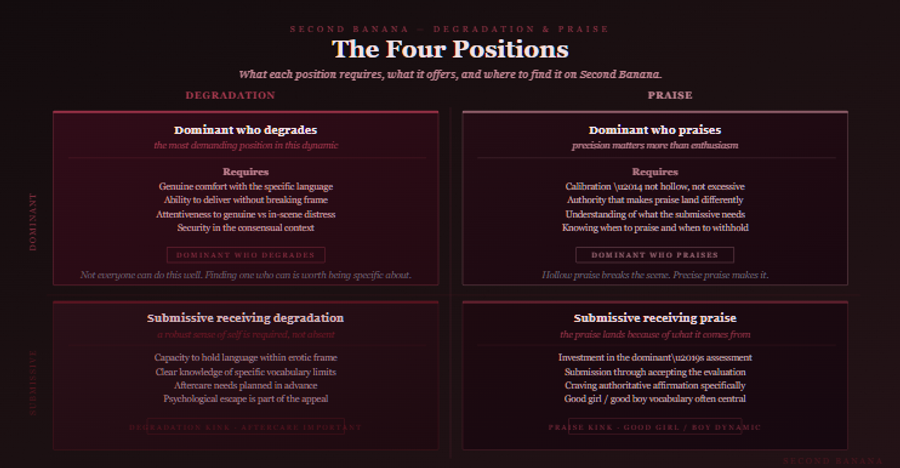
Degradation requires a dominant who can deliver diminishing language with genuine commitment — who can say things that would be deeply offensive in any other context and deliver them in a way that lands with erotic weight rather than as empty performance. This is more demanding than it sounds. The dominant must be sufficiently comfortable with the language to use it without breaking the scene’s frame, sufficiently attentive to the submissive to monitor genuine distress versus in-scene response, and sufficiently secure in the consensual context to deliver full-force degradation without their own anxiety about the language undermining the dynamic.
Many people who are comfortable with D/s find degradation specifically uncomfortable from the dominant position — not because of their submissive’s distress (which, in a well-functioning scene, is not actual distress) but because of their own relationship with the language they’re being asked to use. This is a genuine and valid boundary that deserves the same respect as any other limit. A dominant who is not comfortable delivering degradation should not be pressured into it, and a submissive whose degradation kink requires language their dominant is not comfortable with needs a partner who can genuinely deliver what they need.
Praise, from the dominant’s position, requires a different but equally specific capacity: the ability to calibrate affirmation precisely, to deliver praise that lands as authoritative rather than hollow, and to understand exactly what the submissive needs to hear and when. Hollow or excessive praise can undermine a praise kink scene as thoroughly as poor degradation can undermine a humiliation scene. The dominant in a praise dynamic is not simply saying nice things; they are exercising precise erotic authority through carefully calibrated affirmation.
The Shame Around Degradation, and Why It Is Misplaced
Praise kink attracts essentially no cultural shame. The idea that someone might be erotically charged by being told they did well, that they are good, that they are pleasing — this is widely comprehensible and widely unremarkable. Whatever mild eyebrow-raising it produces is quickly resolved by the observation that positive feedback being rewarding is simply how human psychology works.
Degradation kink attracts a very different response. The idea that someone might be erotically charged by being told they are worthless, pathetic, or degraded — that they might genuinely want and seek this experience — produces a cultural response that ranges from confusion to active hostility. The assumption is that the person must be damaged: that they have been taught to see themselves as worthless and are re-enacting that damage in their erotic life, or that they lack the self-respect necessary to refuse this treatment.
This assumption does not survive contact with the research. As noted above, degradation kink practitioners do not show lower psychological wellbeing than non-practitioners. They show higher wellbeing on several measures. The person who has negotiated a careful, specific degradation scene with a trusted partner has exercised considerable agency, self-knowledge, and communicative skill. They are not a person who believes they are worthless. They are a person who can explore what it feels like to be treated as worthless, in a context they have carefully constructed to make that exploration safe, and who finds that exploration specifically and intensely pleasurable.
The distinction that matters is between the content of the scene and the beliefs and self-perception of the person outside it. A person who is treated as worthless within a degradation scene and who fully inhabits that treatment during the scene is not a person who believes themselves to be worthless. They are a person who has, for the duration of the scene, chosen to experience that treatment as an erotic rather than a devastating event. That choice, and the psychological capacity it requires, is a form of agency rather than its absence.
The shame is misplaced for the same reason all sexual shame is misplaced when it attaches to consensual adults doing something that harms no one: it substitutes a cultural narrative about what the experience means for the actual experience of the people having it. The people in degradation kink scenes know what the experience means for them. The cultural narrative does not.
What This Has to Do With Second Banana
Degradation and praise kink both require a specific quality of partner that is not adequately captured by photographs and demographic data. For degradation, the requirements are precise: a dominant who is genuinely comfortable with the specific language and scenarios involved, who can deliver them with real commitment rather than tentative half-measures, who understands the consent architecture that makes the scene safe, and who can monitor the submissive’s genuine state throughout. For praise, the requirements are equally specific: a dominant whose affirmation the submissive can invest with genuine erotic weight, who calibrates praise with precision rather than simply being enthusiastic, and who understands the D/s architecture that makes the praise land differently from ordinary compliments.
Finding these partners on platforms that ask you to represent yourself through appearance and demographics is largely chance. The post-first Second Banana tag model changes this because it selects for exactly what both dynamics require: the ability to write specifically and honestly about what you want, what you can offer, and what the dynamic actually involves. A submissive who can describe their degradation kink in specific terms — the vocabulary they need, the scenarios that work for them, what they’re looking for in a dominant’s approach — has already demonstrated a quality of self-knowledge and communicative clarity that is itself a signal of the kind of practitioner they are.
The Second Banana tag system gives these dynamics specific vocabulary:
- Degradation kink / humiliation kink — the orientation itself
- Praise kink / affirmation kink — the orientation itself
- Both orientations / switches between — for people who hold both
- Verbal degradation / verbal praise — the primary vehicle
- Language negotiation important — signalling that vocabulary specifics matter
- Scene-based / ongoing dynamic — whether this is a single encounter or a structured relationship
- Dominant who degrades / dominant who praises — what’s being sought
- Aftercare important — particularly for intense degradation scenes
- Good girl / good boy dynamic — for the specific praise vocabulary
These tags do the filtering before the conversation starts. A post tagged with ‘degradation kink’ and ‘language negotiation important’ signals a level of self-knowledge and preparation that attracts the right kind of dominant — one who understands what they’re being asked to hold and who can hold it. A post tagged with ‘praise kink’ and ‘good girl dynamic’ signals a specific orientation that will resonate immediately with dominants who find that dynamic genuinely appealing rather than merely acceptable. It is the Second Banana community that makes this possible.
The anonymous posting option matters for degradation kink specifically. Of all the dynamics in this series, this is one of the most likely to produce judgment if attached to a person’s professional or social identity. Being able to write honestly about wanting to be degraded, with the specific vocabulary and scenarios that actually work, before attaching one’s name to that honesty — is the condition under which honest self-representation becomes possible.