Primal Play: The Kink That’s About Where You Play From | Second Banana
Primal Play:
The Kink That’s About Where You Play From, Not What You Do
Below the Social Layer
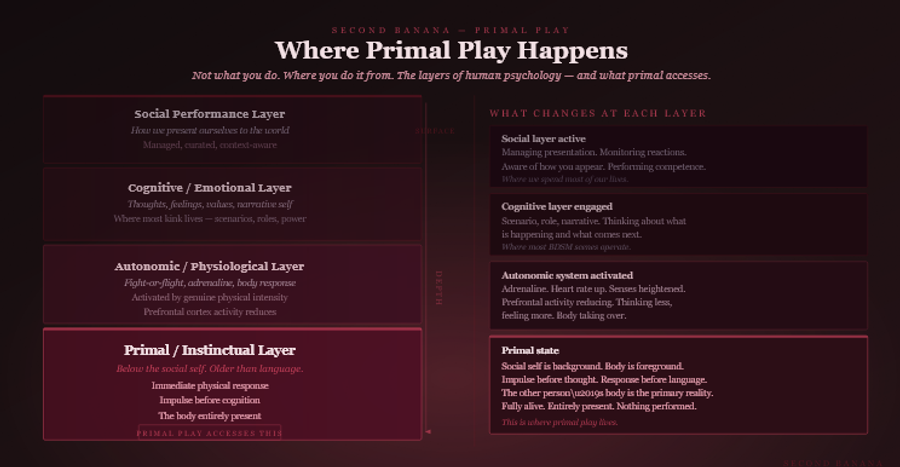
Most kinks are about specific acts, specific roles, or specific scenarios. Primal play is different. It is not primarily about what you do in a scene but about the state of consciousness from which you do it — a state that exists below the social self, below the cognitive management layer that normally governs how we present ourselves and engage with the world, in the part of the psyche that is older, more physical, and less mediated by language and social convention.
This is what makes primal play philosophically distinct from almost everything else in this series. CNC, cuckolding, degradation kink — all of these are about specific scenarios or dynamics that produce intense experiences. Primal play is about accessing a different mode of being altogether. The specific acts that happen within primal play are secondary to the quality of consciousness that characterises it: the heightened physical awareness, the intensity of the instinctual response, the specific pleasure of being entirely in one’s body rather than in one’s head.
This piece covers the full territory. What primal play actually is, how it relates to and differs from adjacent dynamics, the neuroscience of the instinctual state it accesses, the predator/prey structure that is its most common configuration, what each role involves and why people are drawn to it, and how Second Banana’s tag system gives primal practitioners the vocabulary to find each other.
Primal play is not a scenario. It is a state. The body takes over. The social self steps back. Everything that happens, happens from there.
What Primal Play Actually Is
Primal play describes erotic and D/s practice that is organised around accessing and inhabiting the instinctual, pre-cognitive layer of human psychology — the layer that operates through physical impulse, immediate sensation, and direct response rather than through the deliberate, managed engagement that characterises most social interaction. In a primal scene, the normal cognitive overlay is deliberately relaxed or suspended, allowing both people to engage at a more fundamental level.
The physical expression of primal play is varied and often intense: wrestling, chasing, biting, scratching, growling, grabbing, pinning. The specific acts are not the point — they are expressions of the instinctual state rather than choreographed scenarios. Two primal players in a scene are not following a script. They are responding to each other in real time, physically, instinctually, with the cognitive filtering that normally manages social interaction turned down.
What practitioners consistently describe is a specific quality of presence — a heightened physical awareness in which sensation is more immediate and more vivid, in which the partner’s body and responses are the primary reality, in which thought is replaced by impulse and response. This state is sometimes described as subspace-adjacent but it is its own distinct experience: not the passive surrender of deep submission but the active, physical, fully-present engagement of two people operating below their social selves.
What Primal Play Is Not
Primal play is frequently confused with petplay, and the two do overlap in some community spaces. But they are psychologically distinct and the distinction matters to practitioners of both. Petplay involves the performance or adoption of an animal persona — a specific character with its own behaviours, psychology, and relationship to the handler. Primal play does not involve animal personas. It involves accessing the instinctual layer of human psychology, which is not the same thing as performing as an animal. A primal player is not pretending to be a wolf or a cat. They are accessing the part of themselves that is not managed by social performance at all.
Primal play also sits adjacent to CNC in the predator/prey configuration — the chase, the catch, the physical overpowering of one person by another has obvious surface similarities to consensual non-consent scenarios. The distinction is again one of emphasis. CNC is organised around a specific scenario of apparent non-consent and its psychological charge. Primal play is organised around the instinctual state that the physical engagement produces. The former is about the scenario; the latter is about the consciousness. Many primal scenes have CNC elements, and many CNC scenes have primal elements, but the dynamics are separable and are sought by different practitioners for different reasons.
The Neuroscience: What the Body Is Actually Doing
The specific intensity of primal play has a neurological account that is worth understanding, because it explains both why the experience feels qualitatively different from other kink practice and why the instinctual state that primal play accesses has the particular character it does.
The Autonomic Nervous System and the Fight-or-Flight Response
The physical engagement of primal play — particularly in predator/prey dynamics that involve genuine physical effort, the activation of the chase response, or the experience of being physically overpowered — activates the autonomic nervous system’s sympathetic branch: the fight-or-flight system. Adrenaline and cortisol are released. Heart rate and respiration increase. Peripheral blood vessels dilate for increased oxygen delivery to muscle. Sensory processing becomes more acute and more focused on immediate physical reality. Non-essential cognitive functions — including the social management layer — are deprioritised.
This is, neurologically, the same system that activates in genuine physical threat situations. In a primal scene, this system is activated within a consensual context — which means the physiological intensity is real while the genuine danger is not. The body responds as if the threat or pursuit is real; the person’s knowledge that it is not is what keeps the experience within the safe container. The result is a neurological state of high physical activation — heightened sensation, reduced cognitive filtering, acute physical presence — that is genuinely altered from normal consciousness.
This altered state is part of what makes primal play distinct from other forms of intense physical engagement. It is not merely vigorous. It is physiologically different in character from relaxed sexual activity: more immediate, more animal, more entirely in the body. Practitioners describe it as one of the most fully embodied experiences they access — a state in which the body is entirely the point and the mind is entirely in service of the body’s responses.
The Prefrontal Cortex and the Social Self
The neurological mechanism that makes the ‘below the social layer’ description accurate is the temporary downregulation of prefrontal cortex activity that intense physical and emotional engagement produces. The prefrontal cortex is the seat of executive function, social reasoning, self-monitoring, and the management of social performance. When the body is fully activated — when physical intensity is high and the autonomic nervous system is engaged — prefrontal activity is reduced relative to its resting state.
This reduction is what practitioners of primal play are describing when they talk about the social self stepping back. It is not a metaphor. The neurological mechanism by which social management is produced is genuinely less active during states of high physical activation. The result is the specific quality of primal consciousness: more immediate, less mediated, more purely responsive, less oriented toward social performance and more oriented toward physical reality.
The consent architecture of primal play is established before the scene, in the prefrontal-dominant state of calm negotiation, so that when the scene is underway and prefrontal activity is reduced, the safe container is already in place. This is why pre-scene negotiation is more important in primal play than in many other dynamics — because during the scene itself, the cognitive capacity to establish or modify that container is reduced.
The Predator and the Prey
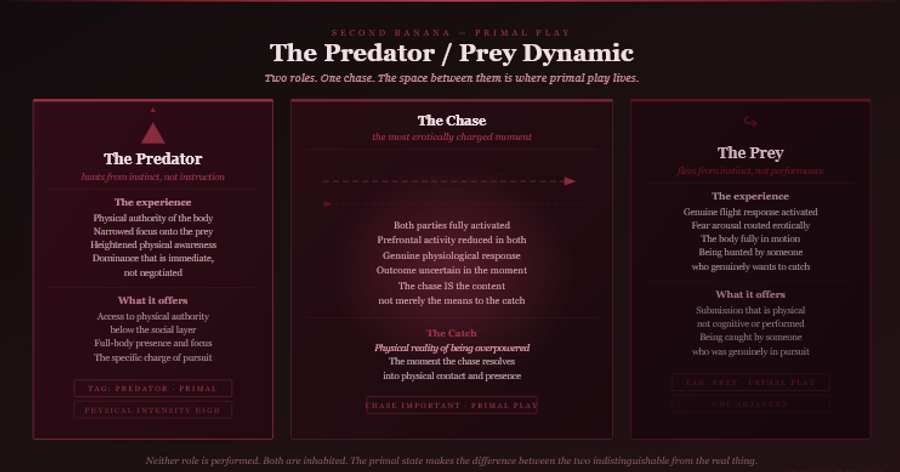
The predator/prey dynamic is the most common configuration in primal play and the one that most clearly expresses the instinctual logic of the practice. It maps directly onto one of the most ancient structures of animal life — the pursuit, the capture, the physical dominance of one creature over another — and in doing so accesses a register of experience that goes deeper than any constructed scenario.
The Predator Role
The predator in a primal scene is not playing a dominant in the conventional D/s sense. They are not in the role because of negotiated authority or an agreed power structure. They are in the role because they are, in the moment of the scene, the one who pursues, the one who overpowers, the one whose physical presence commands the encounter. The authority is immediate and physical rather than structural and social.
What the predator role offers practitioners who are drawn to it is a specific quality of physical authority that D/s in its more structured forms does not always provide: the authority of the body in motion, of genuine physical capability expressed directly rather than through role and rule. The predator doesn’t give orders. They hunt. The distinction is not merely semantic — it is experiential. The predator’s dominance is animal rather than social, immediate rather than negotiated.
Practitioners who are drawn to the predator role frequently describe a specific quality of focus that it produces: a narrowing of attention onto the prey, a heightened physical awareness of the other person’s body and movement, a specific pleasure in the pursuit that is distinct from anything in their everyday life. The primal scene gives them access to a quality of focused, physical presence that the managed surface of ordinary life does not provide.
The Prey Role
The prey role is psychologically rich and genuinely distinct from conventional submission. The prey is not yielding to authority or accepting a dominant’s direction. They are being hunted, and their response to being hunted — the flight impulse, the genuine physical engagement of the chase, the specific quality of being caught — is itself the content of the experience rather than a prelude to it.
The prey’s experience in a primal scene typically involves genuine fear arousal — the fight-or-flight system activating in response to the predator’s pursuit — and the routing of that arousal through an erotic channel within the safe context of a consensual scene. This is the primal specific version of the mechanism that CNC also uses — genuine physiological response to a genuine stimulus, experienced as erotic because of the safe container rather than despite the genuine physiological intensity.
What the prey role offers practitioners is an experience of being genuinely, fully hunted — of having a real physiological response to a real stimulus within a context that is safe enough to fully inhabit that response. The specific quality of being caught — the moment when the chase ends and the physical reality of being overpowered by the predator becomes the dominant experience — is described by many practitioners as among the most intense and complete experiences they access in any erotic context.
The Chase
The chase itself — the period between the scene’s beginning and the eventual catch — is often the most erotically charged element of the predator/prey dynamic, and it deserves specific treatment because it is frequently underestimated in accounts that focus on the catch as the goal.
In the chase, both parties are fully activated. The predator is in full pursuit focus; the prey is in full flight response. Both are physically engaged, physically present, physically responding to each other in real time. The cognitive overlay is reduced for both. This is primal play at its most fully realised — two people operating below their social selves, in genuine physical engagement, with the outcome genuinely uncertain in the moment even if the safe container is established in advance.
The erotic charge of the chase is not about winning or losing. It is about the quality of engagement itself: the physical aliveness, the full-body presence, the specific pleasure of being entirely in one’s body and in direct physical relation with another person’s body. Many practitioners report that scenes in which the prey successfully evades for an extended period are more satisfying than scenes in which the catch is quick — because the chase itself is the experience, not merely the means to it.
Primal Without Predator/Prey
Not all primal play follows the predator/prey structure. The instinctual state can be accessed and inhabited in configurations that are less hierarchical and more mutual — two people in a primal scene together, both accessing the below-social layer, both responding to each other in real time, without the specific hunter/hunted structure.
This more mutual form of primal play has its own character: the intensity of two instinctual presences meeting without predetermined hierarchy, the specific quality of physical negotiation that happens when neither person is in the predator role but both are fully primal. Wrestling that is genuinely exploratory rather than aimed at capture. Physical engagement that is responsive to the moment rather than structured by role.
Primal play also appears as a register within other dynamics rather than as a standalone practice. A D/s scene that has been running for some time may tip into a primal register when both people drop below the social management layer. A breeding kink encounter may have a strongly primal character without being organised around primal play specifically. The instinctual state is available within many contexts; primal play is the practice that deliberately seeks and cultivates it.
Consent and Safety in Primal Scenes
Primal play requires particularly thorough pre-scene negotiation for reasons that follow directly from its neurological character. The scene itself is designed to reduce the cognitive filtering that makes real-time renegotiation possible. The consent architecture therefore needs to be more thoroughly established before the scene begins than in dynamics where cognitive engagement remains higher throughout.
The specific things that require explicit negotiation in primal play: the physical intensity level and specific acts that are and are not acceptable, including biting, scratching, and physical restraint through strength rather than restraints. The safe word mechanism, which in primal scenes needs to be either extremely simple — a single word that will cut through even high physical activation — or supplemented by a physical signal for moments when vocalisation is difficult. The limits on actual physical injury: primal play can produce bruising, bite marks, and scratches that last days, and both people need to know in advance what level of marking is acceptable.
Aftercare in primal scenes has a specific character that is worth planning in advance. The return from the primal state — from the high physical activation of the scene to ordinary social consciousness — can involve a significant emotional and physiological transition. Both predator and prey may need specific support in that transition: physical warmth and contact, time to re-establish social language and social self, acknowledgment of the intensity of what just happened. The specific aftercare needs vary between practitioners and between scenes, and planning them before the scene is part of the care that makes the scene possible.
What This Has to Do With Second Banana
Primal play requires a partner who can access the same register — who can actually drop below their social self and engage at the instinctual level rather than performing an approximation of it. This is more difficult to find than it might seem. Many people are interested in primal play in theory and find, in practice, that they cannot quite release the cognitive management layer enough to fully inhabit the primal state. The partner who can genuinely go there is specifically valuable, and finding them on a platform that asks for photographs and demographic data is largely a matter of chance.
The Second Banana post-first tag system model gives primal practitioners the vocabulary to represent what they’re looking for before anyone responds. Someone seeking a predator for a primal scene can write about what that means to them: the physical intensity they’re drawn to, the specific quality of pursuit and catch they want, what they need from a predator in terms of physical presence and genuine engagement versus performance. Someone who identifies as primal can describe the register they operate in and what they’re looking for in a scene partner.
The tag system gives primal practitioners specific vocabulary:
- Primal play — the orientation itself
- Predator / prey — role in the dynamic
- Mutual primal — for non-hierarchical primal scenes
- Chase important — signalling that the pursuit itself is the content
- Physical intensity high — for scenes involving genuine physical engagement
- Biting / scratching / marking — specific acts that need explicit agreement
- Primal register within D/s — for practitioners who want primal as a mode within a broader dynamic
- Aftercare important — for the specific transition back from the primal state
- CNC adjacent / not CNC — clarifying the relationship to consensual non-consent
These tags allow practitioners to find each other based on orientation and capacity rather than just interest. Someone who responds to a post tagged ‘primal play’ and ‘predator’ and ‘chase important’ already understands the register they’re entering. They know this is not performance. They know the physical intensity is real. They know the social overlay comes off.
The Second Banana anonymous posting option matters for primal practitioners for the same reason it matters across the series: the ability to be fully honest about what you want — including the visceral, physical, below-social-layer honesty that primal play requires — before attaching your face and professional identity to that honesty is the condition under which genuinely specific self-representation becomes possible in the Second Banana Community.