Anime Kink: The Psychology of 2D Attraction, Character Archetypes, and Why This Aesthetic Register Is Erotically Specific | Second Banana
Anime Kink:
The Psychology of 2D Attraction, Character Archetypes, and Why Drawn Idealization Produces Real Erotic Charge
An Aesthetic Register That Deserves Serious Treatment
Anime as an erotic orientation is one of the most reliably condescended to interests in the kink landscape — and one of the most poorly understood. The cultural position of the anime fetishist — somewhere between figure of fun and object of mild contempt — is almost entirely disconnected from the actual psychology of what is happening when someone finds the anime aesthetic specifically erotic, when a drawn character produces genuine arousal and attachment, or when the character archetypes that anime has developed over decades of genre refinement map onto someone’s deepest erotic preferences.
This piece is the serious treatment. It covers the psychology of visual idealization and why drawn aesthetics can produce erotic charge that photographic realism cannot. It covers the specific character archetypes that have been developed in anime and why they map onto genuine erotic orientations. It covers 2D attraction — the genuine phenomenon of primary or significant attraction to drawn rather than real people — with the seriousness it deserves. And it covers cosplay as the bridge between animated fantasy and embodied reality, and what the psychology of that bridge looks like from both sides.
The question is not why someone would find a drawn character attractive. It is why we assume that only photographic realism is a legitimate substrate for erotic charge. The assumption doesn’t survive examination.
The Psychology of Visual Idealization
Why Drawn Aesthetics Produce Real Arousal
The human brain processes visual information for erotic relevance through systems that do not fundamentally distinguish between photographic and drawn images — both activate the same neural pathways for visual processing and erotic response. The distinction between ‘real’ and ‘drawn’ that ordinary consciousness draws is a cognitive categorization, not a feature of the erotic response system. This is why pornographic drawings have existed since humans could draw, and why the specific aesthetic of any given erotic visual tradition — Shunga, Art Nouveau illustration, mid-century pin-up art, contemporary hentai — can produce genuine arousal regardless of its relationship to photographic realism.
What drawn aesthetics offer that photography cannot is idealization without the social complexity of a real person. A drawn character can be precisely what they are — every visual feature calibrated to produce a specific aesthetic effect, every facial expression carrying exactly the emotional charge the artist intended, the entire visual presentation consistent and controlled in a way that no real person can be. For people whose erotic response is strongly visual and who are specifically attracted to particular aesthetic features or emotional registers, this precision of idealization is not a poverty of the stimulus but a specific and valued quality of it.
The Anime Aesthetic Specifically
The anime visual aesthetic has developed over decades of genre refinement into one of the most precisely calibrated erotic visual traditions in the world. The characteristic features — large expressive eyes that communicate emotional states with unusual clarity, exaggerated features that amplify specific physical characteristics, character designs that code specific personality types through visual shorthand — are not arbitrary stylistic choices. They are the accumulated result of a tradition explicitly optimizing for emotional and erotic response in its audience.
Large eyes in particular are a visual cue that activates the same neural responses as infant features — producing feelings of warmth, protectiveness, and emotional connection. Combined with the erotic charge of adult bodies and the precise expression of erotic or romantic emotion, this creates a specific combination of emotional warmth and erotic arousal that the anime aesthetic is uniquely effective at producing. This is not an accidental feature of the aesthetic. It is the aesthetic’s specific achievement.
The Character Archetypes
Anime has developed an elaborate taxonomy of character types — personality archetypes coded through consistent visual, behavioural, and narrative signals — that map onto genuine erotic orientations with considerable precision. Understanding these archetypes is useful for practitioners because they provide vocabulary for erotic preferences that general culture lacks, and because the specificity of the archetype is part of what makes the attraction specific and identifiable.
The Major Archetypes
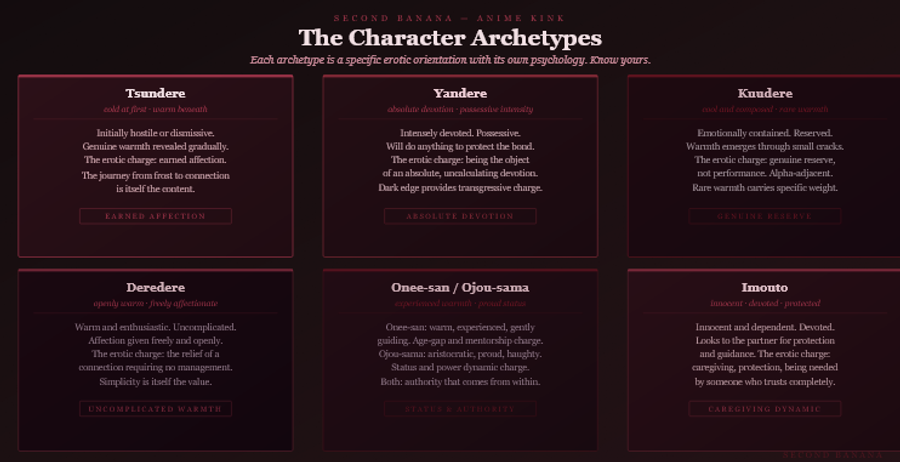
The tsundere — initially cold, hostile, or dismissive, gradually revealing warmth and genuine attachment — is one of the most consistently popular archetypes, and its appeal maps directly onto the erotic charge of earned affection: the specific pleasure of a partner whose warmth is not freely given and must be won. The emotional journey from frost to genuine connection is itself the erotic content, not merely the destination.
The yandere — intensely devoted, possessive to the point of instability, willing to do anything to protect or maintain the attachment — connects to the attachment and intensity dynamics that other pieces in this series have covered from different angles. The appeal of the yandere is the appeal of being the specific object of an absolute devotion that does not calculate cost. The dark edge of the archetype — the instability, the possessiveness — provides the transgressive charge.
The kuudere — cool, composed, emotionally contained, occasionally revealing genuine warmth through small cracks in the composure — is the anime version of the alpha dynamic covered elsewhere in the series: the appeal of someone whose emotional reserve is genuine rather than performed, and whose moments of warmth carry specific weight because of their rarity.
The deredere — openly warm, affectionate, entirely enthusiastic about the object of their attachment — is the archetype of uncomplicated, freely given affection. Its appeal is the relief of a connection that does not require management, anxiety, or uncertainty. The deredere loves you simply and openly, and this simplicity is itself valuable in a relational landscape where most connections are more complicated.
The onee-san (older sister type) — warm, experienced, slightly maternal, gently guiding — connects to the age gap and mentorship dynamics covered elsewhere. The imouto (younger sister type) — innocent, dependent, devoted — connects to caregiving and protection dynamics. The ojou-sama — aristocratic, proud, occasionally haughty — connects to status and power dynamics. Each archetype is a specific erotic orientation packaged in a consistent visual and narrative grammar.
Why Archetypes Matter Erotically
The erotic significance of character archetypes is not that practitioners confuse drawn characters with real people. Most practitioners are entirely clear-eyed about the distinction. It is that the archetypes provide vocabulary for erotic preferences that ordinary social life does not supply. A person who knows they are specifically attracted to the tsundere archetype knows something specific and useful about their erotic orientation that they may not have been able to articulate before encountering the term. The archetype gives the preference a name and a shape.
This is why anime practitioners who are looking for real partners, and who tend to be demisexual, often describe their preferences in archetype terms — not because they want a person who literally is a drawn character, but because the archetype vocabulary captures something specific about the personality type, emotional register, and relational dynamic they are drawn to in ways that ordinary language does not.
2D Attraction and Fictosexuality
For a subset of anime practitioners, the attraction to drawn characters is not merely an aesthetic preference or a vocabulary for real-partner preferences. It is a genuine primary or significant erotic and emotional orientation toward fictional characters — sometimes called 2D attraction, 2D complex, or fictosexuality.
Fictosexuality describes the experience of genuine erotic and sometimes romantic attachment to fictional characters — characters who are drawn, animated, or otherwise non-real. This is distinct from using fictional characters as fantasy material — most people do this to some degree. Fictosexuality describes cases where the attachment to fictional characters is primary, sustained, and constitutive of one’s erotic identity rather than incidental to it.
The psychology of fictosexuality is not well-studied, but practitioners' accounts are consistent on several points. The fictional character offers a relationship whose terms are entirely controllable by the person forming the attachment — the character does not have bad days, does not change in unwanted ways, does not introduce the social complexity and unpredictability of real relationships. For people whose erotic and emotional experience is strongly shaped by sensory sensitivity, social anxiety, or a preference for the precision and control of imagined over real relationships, this quality of the fictional relationship is not a deficiency — it is a feature.
Fictosexuality is sometimes framed as an inability to form real relationships, but this framing is inaccurate for most people who identify with it. Many fictosexual practitioners do form real relationships and value them; their attachment to fictional characters coexists with, rather than substituting for, real connections. The experience is better understood as a specific erotic and emotional orientation toward idealized figures — an orientation that happens to attach to drawn characters rather than real people.
Cosplay: The Bridge
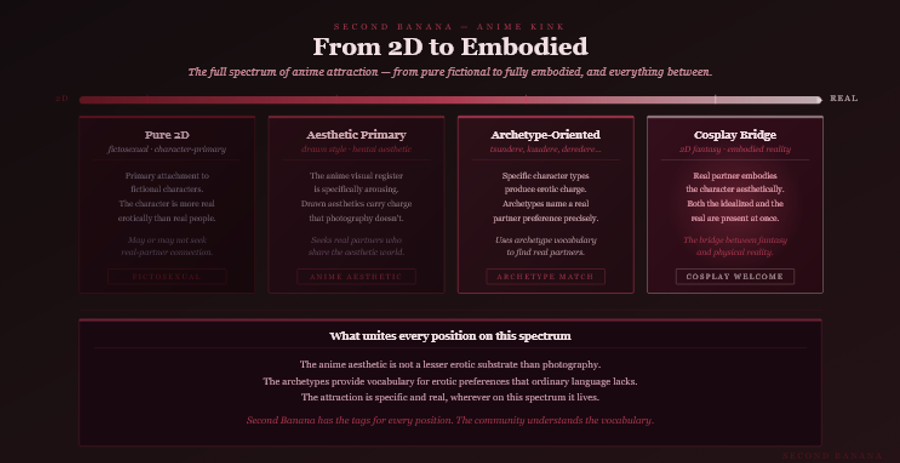
Cosplay — the practice of embodying a character through costume, performance, and sometimes persona adoption — is the point where anime aesthetic attraction and real-person erotic engagement meet. For practitioners who are drawn to specific anime characters or archetypes, cosplay by a real partner represents a specific form of erotic encounter: a real person bringing the aesthetic and character qualities of the fictional figure into embodied reality.
The erotic charge of cosplay in this context is not simply that someone is wearing a costume. It is that the costume, the character performance, and the persona adoption together create a specific quality of encounter that holds both the idealized qualities of the fictional figure and the real, physical presence of the person doing the cosplay. The partner is simultaneously themselves — genuinely present, genuinely there — and the character, bringing the aesthetic and personality qualities that the practitioner finds specifically compelling.
For the cosplayer, the experience has its own specific character: inhabiting a persona that they know their partner finds specifically appealing, performing the character’s aesthetic and personality qualities with varying degrees of completeness, and occupying the position of being the embodied bridge between their partner’s fantasy and physical reality. Many cosplay practitioners describe this as among the more intimate and specifically pleasurable sexual experiences available to them, precisely because the performance is so specifically desired and so specifically received.
What This Has to Do With Second Banana
Anime kink is one of the interests in this series that carries the most unfair social stigma relative to its actual character. The cultural condescension toward people who are erotically invested in anime aesthetics, character archetypes, or fictional characters is disproportionate to anything that actually characterises the orientation — it is a form of cultural gatekeeping about which aesthetic traditions are acceptable as erotic substrates, and it has no more legitimate basis than other forms of aesthetic snobbery.
Second Banana’s post-first Tag model gives anime practitioners the ability to represent their orientation specifically and honestly before anyone responds. A practitioner who is drawn to the tsundere archetype, or who is specifically attracted to the anime aesthetic, or who is interested in cosplay as a form of erotic engagement, or who identifies as fictosexual — each of these can be represented clearly in a post and will find responses from people who understand and share or complement the orientation.
The Second Banana tag system gives anime practitioners specific vocabulary:
- Anime aesthetic — attraction to the visual register itself
- Specific archetypes: tsundere, yandere, kuudere, deredere, onee-san, imouto, ojou-sama
- Cosplay welcome / cosplay offered — the bridge between 2D and embodied
- 2D attraction / fictosexual — for those whose orientation is primarily toward fictional characters
- Hentai aesthetic — for those specifically drawn to animated erotic content
- Anime fan / fandom important — for those for whom shared cultural investment matters
- Character play / persona welcome — for those interested in character-based erotic engagement