Crossdressing: The Full Range of Why People Do It, What It Feels Like, and What It Means — and Doesn’t Mean | Second Banana
Crossdressing:
The Full Range of Why People Do It, What Each Experience Is, and What Crossdressing Does — and Doesn’t — Mean
One Word, Many Experiences
Crossdressing — the wearing of clothing conventionally coded for a gender other than one’s own — is among the most culturally visible and most misunderstood sexual and gender-related practices. The misunderstanding operates in both directions: in popular culture, crossdressing is either pathologised (the fetishistic crossdresser as object of mockery or clinical concern) or collapsed into transgender identity (the assumption that everyone who crossdresses is on their way to transitioning). Both framings miss most of what is actually happening.
The reality is that crossdressing encompasses a genuinely wide range of distinct experiences, motivations, and relationships to gender and identity. Some people crossdress because they find the physical sensation of gender-nonconforming clothing specifically erotic. Some do it because it connects to gender dysphoria or genuine gender exploration. Some are transgender people for whom crossdressing was how they first understood something about themselves. Some are drag performers for whom it is artistic expression. Some do it in the context of a D/s dynamic where the crossdressing is directed by a partner. Some do it in private, some publicly, some occasionally, some as a sustained part of their identity.
These are meaningfully different experiences and a piece that tries to explain them all with a single mechanism would be dishonest. This piece differentiates them. It also states clearly something that popular content frequently fails to state: crossdressing as erotic play is a legitimate experience in its own right, does not imply anything about gender identity, and is experienced by many people who are comfortably cisgender and have no interest in transitioning.
What you wear when you’re fully yourself and what that wearing means about you are two separate questions. The clothing comes first. The meaning, if there is one, follows from the experience — not the other way around.
The Erotic Dimension: What the Kink Is
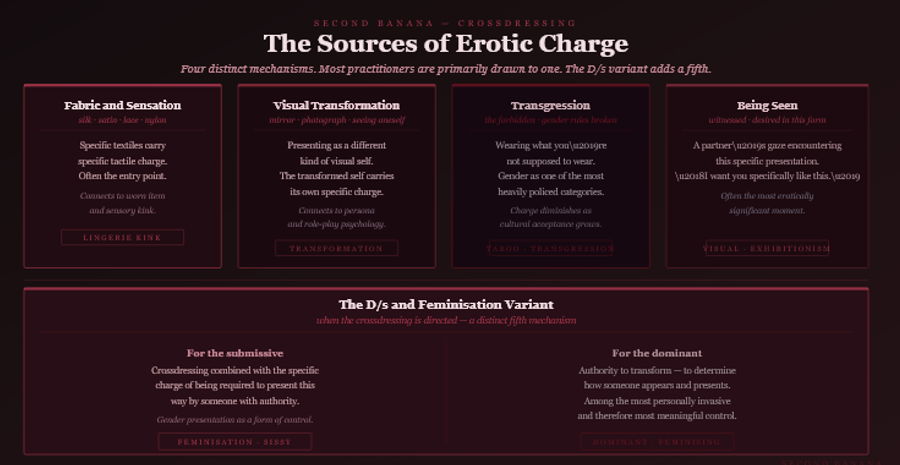
For many people, crossdressing is primarily or entirely an erotic experience — the wearing of gender-nonconforming clothing is sexually arousing, full stop, and the erotic charge does not derive from or connect to any particular feelings about gender identity. This is a real, specific, and legitimate erotic orientation that sits within the broader landscape of clothing fetishism, sensory kink, and visual arousal.
The Fabric and Sensation Dimension
Certain textiles associated with femininely coded clothing — silk, satin, lace, nylon stockings, soft cotton — have specific tactile properties that are erotically charged for many crossdressing practitioners. The texture of satin against skin, the specific sensation of stockings, the feel of lace — these are sensory experiences that many practitioners find specifically arousing in ways that have more in common with the worn item fetish or general sensory kink than with gender identity.
The sensation dimension of crossdressing is often the entry point: the first experience of wearing gender-nonconforming clothing frequently has a strong tactile quality, and the erotic charge attaches initially to the specific sensation before elaborating into other dimensions. For some practitioners, the tactile dimension remains primary throughout their crossdressing experience. For others it becomes one element among several.
The Visual Transformation
The visual dimension of crossdressing — seeing oneself presenting differently, inhabiting a different gender aesthetic, appearing in a way that is specifically and deliberately at odds with one’s ordinary presentation — is a distinct source of erotic charge for many practitioners. The mirror and the photograph are significant in crossdressing culture in a way that reflects this: the visual of the transformed self carries its own specific charge that is different from the tactile experience of the clothing itself.
The transformation quality is important here. The erotic charge is not merely in wearing different clothes but in being transformed by them — in the specific experience of being a different kind of visual self, briefly and deliberately. This connects to the broader kink psychology of persona adoption and role-play: the crossdressed self is a specific, deliberately constructed presentation that differs from the ordinary self, and this difference is part of what carries the charge.
The Transgression Dimension
Gender is one of the most heavily policed categories in most cultures. The deliberate violation of gender presentation norms — wearing what you’re not supposed to wear, appearing as you’re not supposed to appear — carries a specific charge of transgression that is itself erotically activating for many practitioners. The forbidden quality of gender-nonconforming presentation, in a cultural context that enforces gender conformity with real social consequences, is not incidental to crossdressing’s erotic appeal. It is, for many practitioners, central to it.
This transgression charge diminishes as cultural contexts become more accepting of gender nonconformity — a finding consistent across multiple forms of taboo-adjacent eroticism, where the erotic charge is partly constituted by the cultural prohibition. In more accepting contexts, crossdressing’s erotic charge must be sustained by other dimensions — sensation, visual transformation, D/s dynamics — rather than relying on the charge of the forbidden.
The Being Seen Dimension
Being seen crossdressed — by a partner, by a community, in a public context where the crossdressing is acknowledged and witnessed — carries a specific charge for many practitioners that private crossdressing does not. This is the exhibitionist dimension of crossdressing: the specific pleasure of being seen in this form, of having this transformation witnessed and responded to, of a partner’s gaze encountering you in this specific presentation.
For many crossdressers, the partner’s response to seeing them crossdressed is the most erotically significant moment in the experience. The partner who responds with genuine desire, with specific appreciation of this form, with the specific quality of attention that says ‘I want you specifically like this’ — this response is what many crossdressers are most specifically seeking from an erotic encounter.
Crossdressing in D/s and Feminisation Dynamics
A significant subset of crossdressing practice occurs within explicit D/s dynamics, where the crossdressing is directed, required, or chosen by the dominant partner as part of a power exchange. This is feminisation kink in its explicit form, and it has a distinct psychology from either voluntary crossdressing or gender exploration.
In feminisation dynamics, the crossdressing is a specific form of control — the dominant determines what the submissive wears, how they present, what feminine markers they adopt. The erotic charge for the submissive is the combination of the crossdressing itself (with whatever specific charge it carries for them) and the dynamic of being required to present this way by someone with authority over them. The vulnerability of gender presentation being controlled is a specific and particularly potent form of submission.
For dominants in feminisation dynamics, directing a partner’s gender presentation carries its own specific charge: the authority to transform, to determine how someone appears and presents, to direct not just behaviour but self-presentation at a level that feels particularly intimate and particularly powerful. Many dominant practitioners describe feminisation as among the most personally invasive and therefore most meaningful forms of control they exercise.
Sissy dynamics — a specific variant of feminisation in which the submissive adopts exaggerated, often caricatured feminine presentation and persona — operate within this general framework but with their own specific texture. The sissy aesthetic combines feminine presentation with an element of mockery or exaggeration that some practitioners find specifically charged — the combination of the feminine presentation with its deliberate excess or absurdity producing a humiliation dimension that is, for practitioners drawn to it, an important element of the dynamic.
Crossdressing and Gender Identity
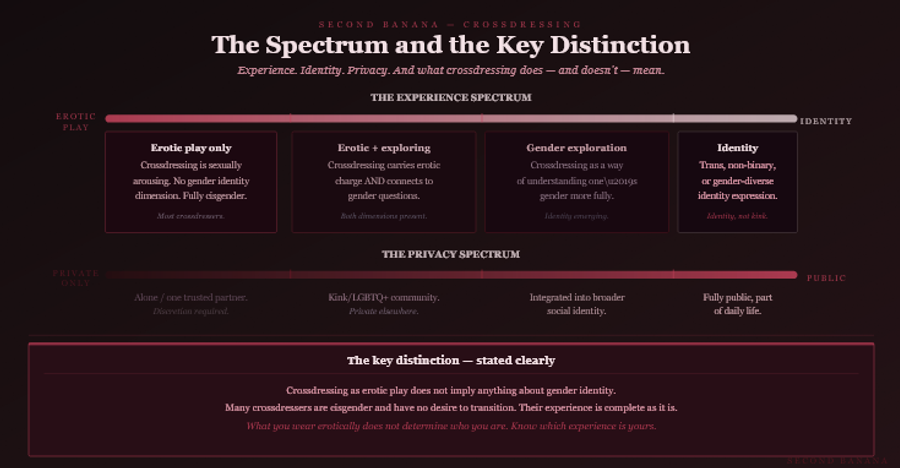
Here is the statement that popular content most frequently fails to make clearly: crossdressing as erotic play does not imply anything about gender identity. Many people who crossdress, including many who find it intensely erotically charged, are cisgender and have no desire to present differently in their non-erotic lives or to transition. The erotic charge of crossdressing does not require gender dysphoria, does not indicate latent transgender identity, and does not mean that the person ‘really’ wants to be a different gender.
This is important to state because the conflation of crossdressing with transgender identity causes harm in two directions. It causes crossdressers whose experience is purely erotic to feel pathologised or pressured toward an identity that does not fit their experience. And it causes transgender people whose experience involves genuine gender dysphoria and genuine identity to have their identity conflated with a kink, which many transgender people find reductive and offensive.
These are different experiences. They are not mutually exclusive — some transgender people did begin with crossdressing as a form of gender exploration, and some people who began crossdressing as erotic play have discovered over time that it connects to something deeper about their gender. But many crossdressers never arrive at this second category, and their experience is not incomplete or on its way somewhere. It is what it is: an erotic orientation toward gender-nonconforming presentation that does not require or imply a particular gender identity.
For Those for Whom It Connects to Gender
For some people, crossdressing does connect to gender dysphoria, gender questioning, or the gradual recognition of a transgender or non-binary identity. For these people, crossdressing may have been the first context in which they felt something closer to their authentic gender presentation, or the first practice through which they understood something about themselves that they had not previously had language for.
This piece is not the right place for an extended treatment of gender dysphoria and transgender identity — those deserve their own pieces. What can be said here is that for people who find that crossdressing connects to something beyond erotic play, the experience of being seen and accepted in this presentation — by a partner, by a community, by anyone who responds to the crossdressed self with genuine recognition — may be among the most significant and validating experiences available to them. Second Banana’s explicit commitment to trans inclusion and gender diversity makes it a genuine home for people at every point on this spectrum.
The Private vs Public Dimension
Crossdressing exists on a spectrum from entirely private to fully public, and where a practitioner sits on this spectrum is itself an important dimension of their experience and their matching requirements.
Many crossdressers crossdress only in private — alone, or with a specific trusted partner — and have no interest in crossdressing in public or in crossdressing being known about in their non-kink life. For these practitioners, discretion is not a preference but a requirement: the crossdressing exists in a specific context that is carefully bounded from the rest of their life, and a partner who would breach that boundary is not a compatible partner.
Others crossdress socially within kink and LGBTQ+ communities while maintaining different presentation in other contexts. Others crossdress more publicly and integrate their crossdressing presentation into their broader identity. And some practitioners who began crossdressing privately have over time moved toward more public expression as they have become more comfortable with this dimension of themselves.
Understanding where one sits on this spectrum, and being honest about it when seeking partners, is among the most important self-knowledge a crossdressing practitioner can have. The mismatch between someone who wants a partner who participates in their crossdressing privately and someone who wants to be publicly seen crossdressed is significant, and the post-first model gives practitioners the ability to name this specificity before any response is received.
What This Has to Do With Second Banana
Crossdressing sits at an unusual position on the Second Banana landscape because its practitioners span such a wide range of experiences, identities, and contexts. The tag system is particularly important here — not just because it gives practitioners vocabulary for their orientation but because the specificity of the tags allows practitioners to signal which of the genuinely different crossdressing experiences they are representing.
The Second Banana tag system anonymous posting option is especially significant for crossdressers who maintain careful privacy around this dimension of themselves. Being able to represent this aspect of one’s erotic identity, and to find partners who understand and share or complement it, before attaching that representation to one’s known identity — this is exactly the condition under which honest self-disclosure first becomes safe and possible for many practitioners.
The tag system gives crossdressing practitioners specific vocabulary:
- Crossdressing — the orientation itself
- CD — community shorthand
- Feminisation — for those in or seeking D/s feminisation dynamics
- Sissy — for those drawn to the exaggerated feminine / humiliation variant
- Lingerie kink — for those whose primary orientation is tactile and fabric-focused
- Visual transformation important — for those for whom being seen matters specifically
- Private only / discreet — for those whose crossdressing is bounded from their public life
- Social crossdressing welcome — for those who crossdress in community contexts
- Erotic only / gender exploration — for those who want to be specific about the dimension of their experience
- Accepting partner sought — for those looking for a partner who receives this with genuine appreciation