Cut: The Psychology of Circumcised Preference, Aesthetic Specificity, and Why This Anatomy Carries Its Own Distinct Erotic Charge | Second Banana
Cut:
The Psychology of Circumcised Preference, Aesthetic Specificity, and the Distinct Erotic Charge of This Specific Anatomy
The Companion Piece
This piece is the companion to the uncut preference guide in this series. Where that piece covered the psychology of foreskin preference — the specific erotic charge that some people locate in uncut anatomy, the rarity mechanism, the sensory specificity of foreskin engagement — this piece covers the mirror orientation: the specific erotic attraction to circumcised anatomy, what drives it, how it operates, and what the cultural geography looks like when the rarity charge runs in the opposite direction.
The two orientations are not simply the same preference pointing at different anatomies. The psychology of cut preference has its own specific texture — a stronger aesthetic dimension, a cultural familiarity element that uncut preference does not have in circumcising cultures, and a sensory profile that reflects the specific properties of circumcised anatomy rather than simply inverting the foreskin experience. Both deserve treatment on their own terms, and this piece gives cut preference that treatment.
Preference for specific anatomy is not hierarchy. It is specificity — the particular erotic charge that attaches to a particular configuration of another person’s body, for reasons that are personal, cultural, sensory, and real.
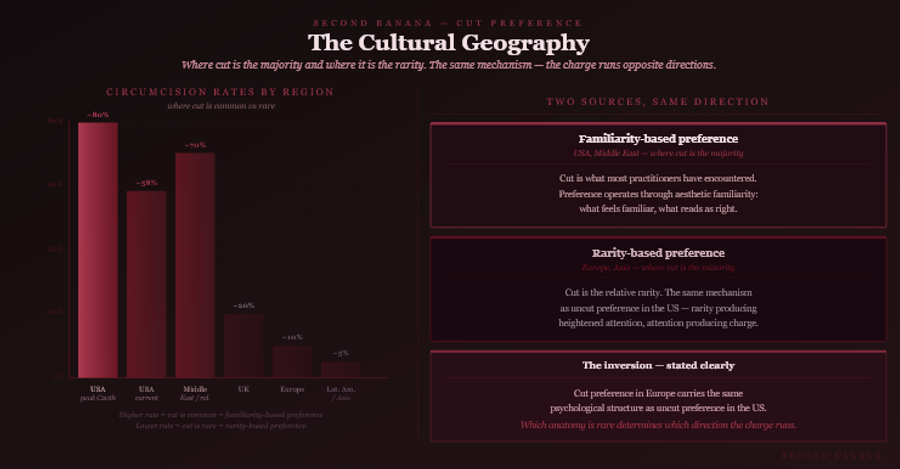
The Cultural Geography: Where Cut Is and Isn’t the Default
As the uncut piece established, circumcision rates vary dramatically by region, culture, and historical period. The United States has historically had high circumcision rates — peaking around 80-85% of male births in the mid-twentieth century and declining to approximately 58-60% by 2010. The Middle East, for religious reasons, has high rates across both Jewish and Muslim communities. Sub-Saharan Africa has high rates in many communities, also primarily for religious and cultural reasons.
In these high-circumcision contexts, cut is the majority anatomy — the familiar, the expected, the one that most practitioners have encountered most often. In these contexts, cut preference does not typically operate through rarity charge; it operates through aesthetic familiarity, through the specific visual and sensory profile of circumcised anatomy, and through the particular erotic charge that can attach to what feels familiar and right rather than unfamiliar and specific.
In the rest of the world — most of Europe, Latin America, Asia, and beyond, where non-religious circumcision is uncommon — circumcised anatomy is the relative rarity. In these contexts, cut preference operates through exactly the same rarity mechanism that uncut preference operates through in high-circumcision cultures. The anatomy is specific, less commonly encountered, visually and texturally distinct from the majority anatomy, and this distinctness produces the same heightened attention and erotic charge that rarity consistently produces.
This cultural inversion is worth holding clearly: cut preference in Europe carries roughly the same psychological structure as uncut preference in the United States. The specific anatomy is different but the mechanism — rarity producing heightened attention, heightened attention producing erotic charge — is identical. What varies between cultures is which anatomy is rare and which is familiar, and therefore which direction the rarity charge runs.
The Aesthetic Dimension
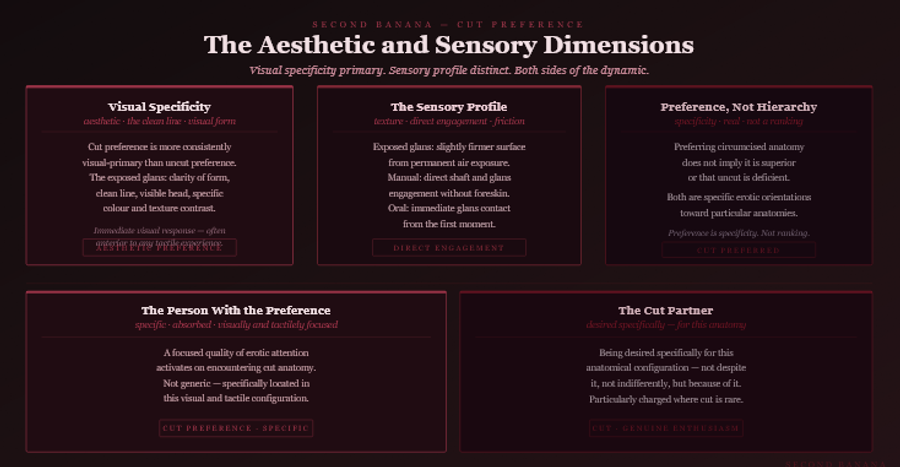
Cut preference is often more explicitly and primarily aesthetic than uncut preference — a finding consistent across accounts from practitioners with strong circumcised preferences. Where uncut preference frequently emphasises tactile sensation (the texture and mobility of foreskin, the specific feel of foreskin engagement), cut preference often centres more strongly on visual experience: the specific appearance of circumcised anatomy, the clean line of the exposed glans, the particular visual presentation that circumcision produces.
The Visual Specificity
The circumcised glans — fully exposed, visually distinct, with the specific colour and texture contrast between the glans and the shaft skin — has a particular visual aesthetic that many cut-preference practitioners describe as specifically compelling. The exposed glans produces a clarity of visual form that practitioners describe in terms that are explicitly aesthetic: the clean line, the visible head, the specific proportions that circumcision creates.
This visual dimension is part of why cut preference is often the first preference some practitioners identify in themselves: the visual component of attraction typically registers before tactile engagement, and the specific appearance of circumcised anatomy produces an immediate visual response that is anterior to any sensory experience of it. Many practitioners with strong cut preferences describe their attraction as partly constituted by this visual specificity in a way that precedes and exists independently of tactile experience.
Familiarity and Aesthetic Norm
For practitioners who grew up in circumcising cultures, circumcised anatomy is the visual norm — the anatomy that is familiar, that reads as ordinary, that formed the baseline visual reference for what penises look like. This familiarity dimension is not trivial. The erotic charge of encountering what feels familiar and right, what matches an internal aesthetic formed by cultural immersion, is real and distinct from the rarity charge of encountering something unusual.
Some practitioners with strong cut preferences describe their attraction in terms that explicitly invoke this familiarity: circumcised anatomy is what they know, what they find beautiful in part because it corresponds to an established aesthetic sense rather than being a departure from it. This is a different psychological structure from rarity-based preference, and it is worth naming as a distinct source of erotic charge rather than subsuming it under the more familiar rarity mechanism.
The Sensory Dimension
The tactile experience of circumcised anatomy is genuinely distinct from uncut, and the specific sensory properties of circumcised anatomy are valued by practitioners whose preference for it includes a significant tactile component - in terms of oral, vaginal, and anal play.
The Exposed Glans
The circumcised glans is permanently exposed rather than covered by foreskin when flaccid. This permanent exposure means the glans skin is less protected and tends to develop a slightly different texture and sensitivity profile than an uncut glans — slightly firmer, with a specific surface texture produced by constant air exposure. Many practitioners who have engaged with both anatomies describe this surface distinction as perceptible and, for those with strong cut preferences, specifically appealing.
During manual engagement, circumcised anatomy produces a different friction and movement profile than uncut. Without the mobile foreskin, manual stimulation engages more directly with the shaft skin and the glans itself, producing a different sensation profile and requiring a somewhat different technique. For practitioners who find circumcised anatomy specifically compelling, this direct engagement quality is often explicitly described as part of what they prefer.
The Oral Experience
The oral experience of circumcised anatomy has its own specific character that practitioners with strong cut preferences often describe explicitly. The exposed glans presents immediately, with the specific shape and surface texture of the circumcised head accessible from the first moment of engagement. The absence of foreskin means there is no preliminary engagement with the foreskin itself before reaching the glans — the contact is more immediately focused on the glans and the head, producing a specific quality of direct engagement that many cut-preference practitioners describe as central to their preference.
Both Sides: The Partner Who Prefers and the Cut Partner
The Person With the Preference
Practitioners with strong cut preferences describe their orientation in terms consistent with specific aesthetic attraction rather than generic physical attraction. The preference is not merely that circumcised anatomy is fine or acceptable; it is that circumcised anatomy is specifically and distinctly preferred, that encountering it produces a specific quality of erotic attention and engagement that other anatomies do not produce in the same way.
Many cut-preference practitioners describe their attraction as having both visual and tactile components that are specifically located — they are not attracted to circumcised anatomy in the abstract but to the specific visual presentation, the specific surface feel, the specific engagement experience that circumcised anatomy provides. This specificity is the hallmark of genuine preference rather than mere familiarity or absence of objection.
The Cut Partner
For circumcised men, the experience of encountering a partner who is specifically and genuinely drawn to their anatomy has its own particular quality. In high-circumcision cultures where this is the majority anatomy, the preference may feel unremarkable — most potential partners have encountered primarily circumcised anatomy and have no strong preference either way. But a partner who is specifically attracted to circumcised anatomy, who brings a quality of focused, specific appreciation to an encounter with this particular configuration, provides a qualitatively different experience from general acceptance or indifference.
In low-circumcision cultures, where circumcised men are the minority, the experience of finding a partner who specifically seeks circumcised anatomy can carry a stronger charge — the experience of being specifically desired for something that is genuinely less common in the local population, of a partner whose preference precisely fits one’s anatomy. This mirrors exactly what the uncut piece described for uncut men encountering partners with foreskin preferences: the specific pleasure of being wanted for something that is genuinely and specifically yours.
The Preference Without Hierarchy
Both the cut and uncut preference pieces in this series make the same underlying claim: anatomical preference is specificity, not hierarchy. Preferring circumcised anatomy does not imply that circumcised anatomy is superior or that uncut anatomy is deficient. Preferring uncut anatomy does not imply the reverse. Both are specific erotic orientations toward particular anatomical configurations that produce specific erotic charge for specific practitioners.
This matters to name explicitly because the cut versus uncut debate has, in some online contexts, taken on a quasi-political quality that is entirely disconnected from the erotic reality of people who have genuine preferences. Practitioners who prefer circumcised anatomy are not making an argument about circumcision as a practice or implying anything about the value of foreskins. They are describing an orientation toward a specific anatomy that is erotically compelling to them for reasons that are personal, cultural, sensory, and real.
The Second Banana tag system gives both orientations their own vocabulary precisely because both are real, legitimate, and worth naming specifically rather than leaving practitioners to navigate the preference conversation without language for it.
What This Has to Do With Second Banana
Cut preference, like uncut preference, is an orientation that is genuinely difficult to communicate in conventional dating contexts. The preference is specific enough to matter to practitioners — in terms of who they seek and how they engage — but the social context for naming it explicitly is rarely comfortable on general platforms. The post-first model gives practitioners the vocabulary to represent this preference before anyone responds.
The tag system gives cut-preference practitioners specific vocabulary that mirrors what the uncut piece offered:
- Cut preferred — the orientation itself
- Circumcised preferred — explicit naming for clarity
- Cut / circumcised — for those signalling their own anatomy
- Aesthetic preference important — for those whose orientation is primarily visual
- Specific anatomy matters — for those for whom this is a genuine preference rather than an incidental one
- Genuine enthusiasm welcome — for cut men seeking partners who are actively and specifically drawn
- Cut only — for those with a consistent, non-negotiable preference
The community Second Banana attracts — people who communicate specifically and honestly about what they want, who have thought carefully about their erotic preferences and can articulate them — is the community where both cut and uncut preferences find the partners who specifically share or match them. The post is the introduction. The tags establish the register. The right match reads both and knows immediately.