Anal Play: The Anatomy, the Psychology, and Why the Shame Outpaces the Reality | Second Banana
Anal Play:
The Anatomy, the Psychology, and Why the Shame So Drastically Outpaces the Reality
The Most Common Topic This Series Hasn’t Covered
Every other piece in this series describes something specific: a particular kink, a particular orientation, a particular dynamic that some people are drawn to and others aren’t. This piece is different, because anal play isn’t a niche interest that requires explanation of why some people are drawn to it. It is one of the most widely reported sexual interests across genders and sexual orientations — the data consistently shows that a substantial majority of people have either tried it, are curious about it, or fantasise about it, regardless of whether they identify as straight, gay, bisexual, or anything else. Anal play is a pure expression of sexual sovereignty.
And yet anal play is also one of the most poorly served topics in mainstream sexual content. It tends to be covered in one of two modes: clinical instruction that treats it as a technical problem to be solved, or nervous euphemism that signals discomfort even while attempting to be informative. What’s missing from almost all of it is a straightforward account of the anatomy that explains why this feels the way it does, combined with an honest treatment of the specific shame architecture that keeps so many curious people from ever exploring something they are, by every available measure, very likely to enjoy.
This piece is that account. The anatomy — what’s actually back there and why it produces the sensations it does. The psychology — why anal play carries the specific charge it does, beyond the purely physical. The shame — named specifically, because naming it specifically is most of what’s required to defuse it. And the practical foundation — not a technical manual, but the basic orientation that makes exploration safe and enjoyable rather than anxious.
This is one of the most common sexual interests in the human population, and one of the least discussed well. The gap between prevalence and information is almost the whole problem.
The Anatomy: Why This Feels the Way It Does
The Anus Itself
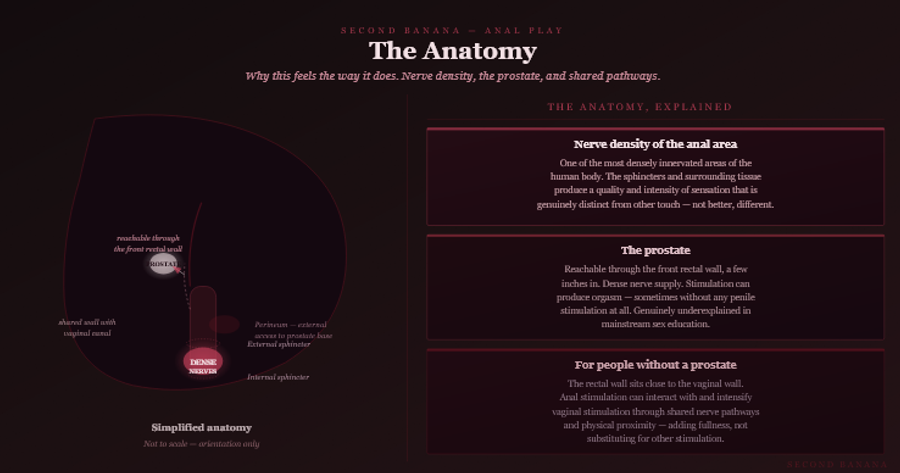
The anus is one of the most nerve-dense areas of the human body. The external anal area and the lower portion of the anal canal are richly supplied with sensory nerve endings — considerably more densely innervated than most skin elsewhere on the body. This is not incidental anatomy. The concentration of nerve endings here means that touch, pressure, and stimulation in this area produce a quality and intensity of sensation that is genuinely different from most other physical touch — not better or worse, but qualitatively distinct.
The anal sphincters — there are two, an external one under voluntary control and an internal one that operates involuntarily — are also richly innervated and play their own role in the sensation profile. The sensation of pressure against and through the sphincters, when it occurs in a relaxed and aroused state, is part of what produces the specific quality of fullness and intensity that anal play’s proponents describe. This is a genuinely different physical sensation from genital stimulation, and for many people it is valued precisely because it is different — it adds a dimension of physical experience that other forms of sexual touch don’t provide.
The Prostate
For people with a prostate, the prostate gland is reachable through the front wall of the rectum, a few inches inside, and is one of the most erotically significant structures in human anatomy that mainstream sex education almost never mentions. The prostate is sometimes called the male G-spot, though the comparison undersells it — the prostate is a gland with a dense nerve supply that, when stimulated, can produce sensations ranging from a deep, diffuse pleasure to orgasm, including orgasms that are qualitatively different from penile orgasm and that some people describe as more intense, longer-lasting, or differently located in the body.
Prostate stimulation can occur through external perineal pressure (the area between the scrotum and anus, sometimes called the taint, sits directly over the base of the prostate) or through internal stimulation via the rectal wall. For many people, prostate-inclusive stimulation adds a dimension to orgasm that is otherwise unavailable — and for some, prostate stimulation alone, without any penile stimulation at all, is sufficient to produce orgasm. This is genuinely underexplained in mainstream sex education, which tends to treat male sexual anatomy as though it begins and ends with the penis.
For People Without a Prostate
For people without a prostate, anal play’s appeal operates through the nerve density of the anal area itself, through the sensation of fullness and pressure, and — importantly — through the proximity of the rectal wall to the vaginal wall, which means that anal stimulation can produce sensations that interact with and intensify vaginal stimulation through shared nerve pathways and physical proximity. Many people describe anal stimulation during partnered sex as adding a dimension of fullness and intensity that amplifies rather than substitutes for other stimulation.
The Psychological Layer on Top of the Physical
Beyond the purely anatomical, anal play carries a psychological charge for many people that is connected to but distinct from the physical sensation. The anus is among the most private parts of the body — culturally coded as exclusively functional, never to be discussed, the subject of more taboo than almost any other body part. Sexual engagement with this specific area therefore carries a quality of vulnerability and trust that is genuinely distinct from most other sexual acts. For many people, this vulnerability is itself part of the appeal — the specific intimacy of sharing something this private with a partner, and of a partner engaging with this area with care and enthusiasm rather than reluctance.
This connects to the degradation and power exchange dynamics covered elsewhere in this series — for some people, anal play carries a charge related to vulnerability, exposure, or power dynamics. But it is worth being clear that this is one dimension among several, not the defining feature. For most people who enjoy anal play, the primary draw is straightforwardly the physical sensation — the nerve density, the fullness, the prostate where applicable — with the psychological dimension as an additional layer rather than the whole story.
The Shame Architecture, Named Specifically
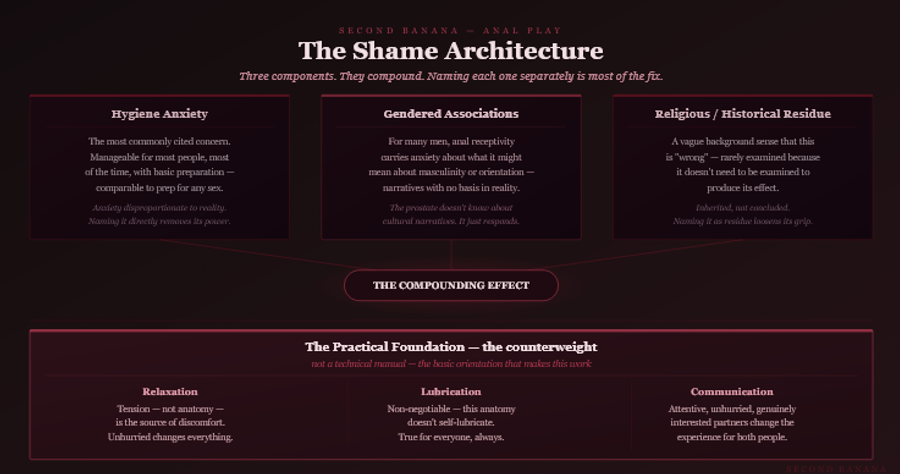
The shame around anal play is not generic kink-shame — it has a specific structure made up of several distinct components, and naming each one specifically is most of what’s needed to see it clearly.
Hygiene Anxiety
This is the most commonly cited concern, and it deserves a direct, unembarrassed answer: the rectum is not the same as the colon, and with basic preparation — going to the bathroom beforehand, allowing some time, and for some people an optional rinse — hygiene concerns during anal play are manageable for the overwhelming majority of people the overwhelming majority of the time. This is not a special or unusual level of preparation; it is comparable to the basic preparation most people do before any sexual encounter. The anxiety is frequently disproportionate to the actual practical reality, and naming this directly — rather than tiptoeing around it — removes much of its power.
Gendered Associations
For many heterosexual men, anal play — particularly receiving it — carries a specific cultural anxiety connected to ideas about masculinity and sexual orientation that have nothing to do with the actual experience and everything to do with cultural narratives about what anal receptivity is supposed to mean about a person. These narratives are not based in anything real — enjoying a specific physical sensation does not determine or reveal anything about a person’s orientation — but they are culturally powerful enough that many men who are curious about prostate stimulation never explore it because of what they fear it might mean about them, to themselves or to a partner.
This anxiety is worth naming directly because it is genuinely one of the largest barriers between a large number of people and an experience that the anatomy strongly suggests they would enjoy. The prostate doesn’t know anything about cultural narratives. It responds to stimulation the way it responds to stimulation, for everyone who has one, regardless of orientation.
Religious and Historical Residue
Much of the broader cultural taboo around anal sex specifically (as distinct from anal stimulation more broadly) carries religious and historical baggage that has nothing to do with the actual experience for the people involved. This residue operates at a background level for many people — a vague sense that this is ‘wrong’ in some way that is rarely examined explicitly because it doesn’t need to be examined to produce its effect. Naming it as residue — as something inherited rather than something concluded — is often enough to loosen its grip.
The Compounding Effect
These three sources of shame — hygiene anxiety, gendered association, and religious/historical residue — don’t operate independently. They compound. A person navigating all three simultaneously experiences a level of inhibition that is disproportionate to any one of them alone, and that inhibition often prevents the person from ever testing whether the hygiene concern is as significant as it feels, whether the gendered anxiety has any basis, or whether the residual sense of wrongness survives actual examination. The compounding is the mechanism. Naming each component separately is how the compounding gets undone.
None of these forms of shame are about the thing itself. They are about what other people might think the thing means. The thing itself is just nerve endings and anatomy, doing what nerve endings and anatomy do.
The Practical Foundation
This piece is not a technical manual — the practical specifics of anal play are well covered elsewhere and depend considerably on what specifically is being explored. But the basic orientation that makes exploration safe and enjoyable rather than anxious is worth naming.
Relaxation is the central practical fact. The anal sphincters respond to anxiety by tensing, and tension is the primary source of discomfort in anal play — not the anatomy itself, which is well-suited to this kind of stimulation when relaxed, but the involuntary tensing that anxiety produces. This is why rushing, pressure, or an anxious approach tends to produce exactly the discomfort that people are afraid of, in a self-fulfilling way. Slow, unhurried, well-lubricated exploration, with no expectation of where it leads, tends to produce a completely different experience.
Lubrication is non-negotiable in a way that it isn’t always for other forms of sexual touch — the anal area does not self-lubricate the way other tissues do, and adequate lubrication is the single most important practical factor in making anal play comfortable rather than uncomfortable. This is not a sign that something is wrong; it is simply how this anatomy works, for everyone.
Communication — about pace, about what feels good, about stopping or changing approach at any point — matters here as it does everywhere in this series, but it carries particular weight given the specific vulnerability involved. A partner who is attentive, unhurried, and genuinely interested rather than merely tolerant changes the experience considerably, in both directions: for the person receiving, and for what the giving partner is able to enjoy about the encounter too.
What This Has to Do With Second Banana
Anal play sits in an unusual position for a dating and connection platform: it is something a very large number of people are curious about or enjoy, and also something that is genuinely difficult to raise with a new partner, even a partner with whom other forms of sexual communication are easy. The specific shame architecture described above doesn’t just prevent solo exploration — it prevents the conversation that would establish whether a partner is interested, curious, experienced, or specifically enthusiastic.
The Second Banana tag system gives practitioners specific vocabulary:
- Anal play — the general orientation
- Anal curious — for those who haven’t explored but are interested
- Prostate play — for those specifically interested in this dimension
- Giving / receiving / both — role orientation
- Experienced / new to this — honest experience signalling
- Patient and unhurried — signalling the approach that makes this work well
- Open conversation about this — for those who want to discuss before meeting
The anonymous posting option matters here in a specific way: for many people, the barrier isn’t wanting anal play to be part of their sexual life — it’s never having found a way to say so without it feeling like a confession. Being able to name an interest this common, in a context built for exactly this kind of honesty, often reveals just how unremarkable the interest actually is. The person on the other end is very likely to have been thinking the same thing.