Feet: The Most Common Non-Genital Fetish, What It Actually Involves, and Why the Range Is Much Wider Than the Meme | Second Banana
Feet:
The Most Common Non-Genital Fetish, What It Actually Involves, and Why the Range Is Much Wider Than the Meme
The One at the Top of the List
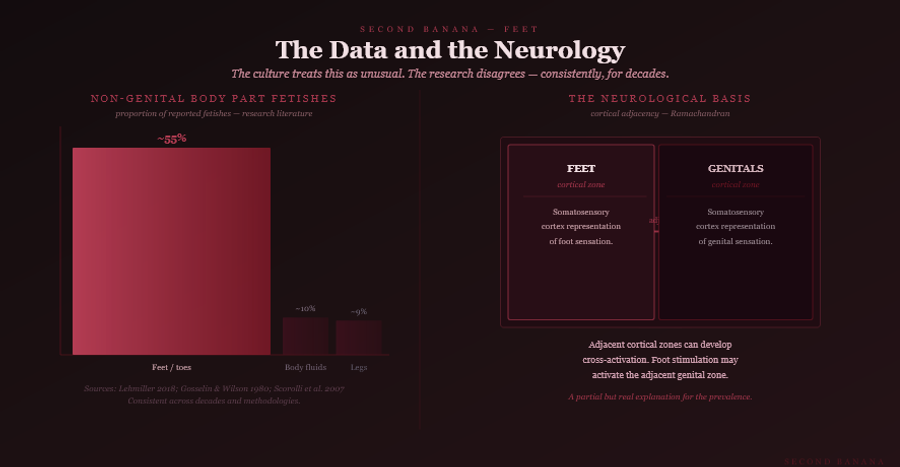
Foot fetishism — sexual attraction to feet, whether for their visual appearance, texture, smell, or as the focus of specific acts and dynamics — is, by a significant margin, the most commonly reported non-genital body part fetish in the research literature. Lehmiller’s large-scale US survey data, Gosselin and Wilson’s earlier work, and multiple national-level studies consistently place feet at or near the top of reported fetish objects. Estimates vary by methodology, but feet appear in roughly 50–60% of identified body-part fetishes in study after study.
This prevalence is worth stating clearly because foot fetishism is simultaneously one of the most common and one of the most publicly mocked erotic orientations in mainstream culture — a combination that produces a great deal of private embarrassment among practitioners who would benefit from knowing that what they experience is not unusual, not pathological, and not difficult to explain.
The mocking also tends to flatten the orientation into a single caricatured image — the man with a bizarre obsession with smelling feet — that misrepresents the genuinely wide range of what feet-oriented attraction actually involves. This piece covers that range properly, along with the neurological basis that makes the prevalence of this orientation less surprising than popular culture treats it, and the specific distinctions between sub-orientations that matter considerably for matching.
The most common non-genital fetish in the research literature, consistently, for decades. The culture treats it as unusual. The data disagrees.
The Neurological Basis
The most frequently cited explanation for foot fetishism’s prevalence is neurological, and it is genuinely interesting rather than just a convenient narrative. The somatosensory cortex — the region of the brain that maps body sensation — represents different body regions in adjacent zones. The cortical representation of the genitals is immediately adjacent to the cortical representation of the feet.
Neurologist V.S. Ramachandran’s research on phantom limb and cortical reorganisation demonstrated that adjacent cortical regions can develop cross-activation — stimulation mapped to one region influencing the adjacent region. The specific adjacency of the foot and genital representations in the somatosensory cortex provides a plausible neurological mechanism for why foot stimulation or foot imagery might generate genital response more readily than stimulation mapped to cortically distant regions.
This explanation is probably partial rather than complete — it explains why foot fetishism might be more common than, say, elbow fetishism, but it does not account for individual variation in whether this cross-activation develops, or for the specific sub-orientations within foot fetishism that have little to do with direct physical stimulation. But it provides a genuine neurological grounding that both demystifies the orientation and explains its relative prevalence without requiring pathological framing.
The Range: What ‘Feet’ Actually Covers
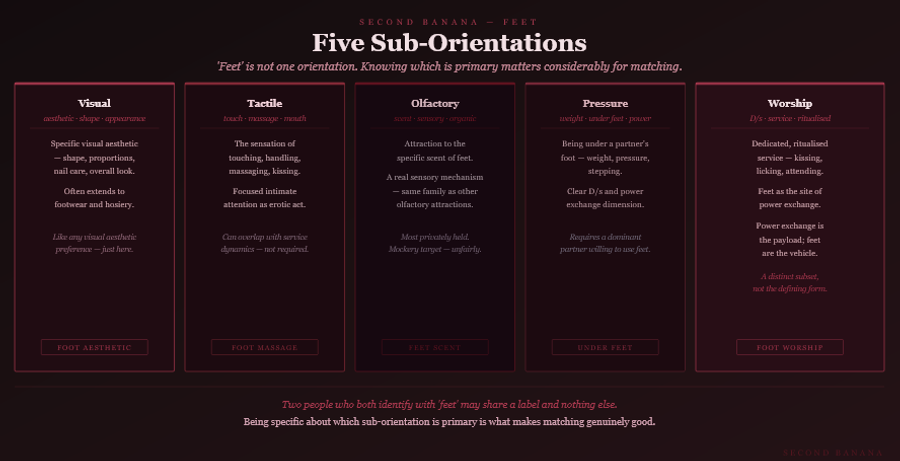
Foot fetishism is not one orientation but several, connected by their object but meaningfully different in their mechanism and what they specifically involve. Understanding which sub-orientation describes a given practitioner matters significantly for finding a compatible partner rather than simply someone who shares a label.
The Visual / Aesthetic Orientation
For many practitioners, the primary attraction is explicitly visual and aesthetic — the specific appearance of a foot, whether that involves shape, proportion, the look of toes, the presence or absence of nail care and polish, the overall aesthetic of a well-maintained or naturally appealing foot. This orientation is as specific as any visual aesthetic preference in the erotic landscape: the same way some people are specifically attracted to particular body proportions or features elsewhere on the body, foot-aesthetic practitioners have a specific and often detailed visual vocabulary for what they find compelling.
The visual orientation often extends to footwear — shoes and hosiery as aesthetic extensions of the foot itself. Stilettos, ballet flats, specific hosiery textures and sheens all carry aesthetic charge for practitioners whose primary orientation is visual, and this connects to the broader worn item fetish territory covered separately in this series.
The Tactile Orientation
For others, the primary orientation is tactile rather than visual — the specific sensation of touching feet, handling them, the texture of skin and the specific feeling of foot anatomy under the hands or mouth. Foot massage as an erotic practice, the specific sensation of kissing or licking, the feel of feet against the body — these are the primary channel of engagement for practitioners whose orientation is more tactile than visual.
The tactile orientation often connects to the giving of attention and care: the foot massage or dedicated tactile engagement as a form of focused, intimate service that happens to be specifically erotically charged. This is where foot-orientation can begin to overlap with service submission dynamics, though it does not require any D/s framing to be experienced as meaningful.
The Olfactory Orientation
Olfactory attraction to feet — the specific scent of foot skin, which carries a distinct pheromonal and organic character — is a real and specific sub-orientation that the cultural mocking tends to reduce to a punchline rather than treating as the genuine sensory orientation it is. Human olfactory response to body-specific scents is documented across multiple contexts, and the foot’s scent chemistry, produced by a specific combination of sweat glands and skin bacteria, has its own specific character that connects to broader patterns of olfactory attraction to body-specific scent.
This sub-orientation is among the most privately held and least discussed, partly because the cultural mockery specifically targets it, and partly because even among feet-oriented communities there can be a tendency to treat the scent orientation as requiring more justification than visual or tactile orientations. It does not. It is a sensory orientation with a real mechanism.
The Weight and Pressure Orientation
Some practitioners are specifically drawn to the experience of being under feet — the weight and pressure of a partner’s foot against the body, against the face, standing or stepping. This orientation carries a clear D/s and power exchange dimension: the foot as an instrument of dominance, pressed against a body that has yielded to be beneath it. This connects to both the broader Dom/sub territory and to the specific psychology of physical submission covered elsewhere in this series.
The pressure and weight dimension is one of the clearest routes from foot fetishism into explicit power exchange, and practitioners for whom this is primary are often specifically looking for a partner with a dominant orientation and an interest in using their feet expressly as an instrument of that dominance.
Foot Worship as a Distinct Subset
Foot worship — the dedicated, often ritualised service of a partner’s feet through kissing, licking, massaging, and attending — sits within the broader foot fetish landscape but carries a specific D/s character that not all foot fetishists share. The worship dynamic implies a hierarchical relationship between the worshipped partner and the worshipping one, with the feet as the specific site of that relationship’s expression.
For practitioners whose primary orientation is foot worship, the erotic charge is not exclusively or even primarily about feet as such — it is about the specific submission of dedicated, reverential service to a dominant partner’s feet. The feet are the vehicle; the power exchange is the payload. This is a genuinely different orientation from visual or tactile foot attraction, even though it involves the same anatomy, and the distinction matters for matching: a practitioner who wants to worship submissively needs a dominant partner who wants to be worshipped, not simply someone who is open to having their feet attended to.
The Partner’s Experience
For partners on the receiving end of foot-oriented attention — having their feet admired, touched, attended to, or incorporated into a dynamic — the experience varies considerably depending on where they sit relative to the attention. Some partners find the specific, focused attention to an often-overlooked part of the body genuinely pleasurable and affirming — the experience of being found attractive specifically for something they may have never considered as erotically charged. Others find it neutral but accommodating. The distinction matters because a foot fetishist who is seeking a partner who genuinely shares the orientation — who enjoys having their feet attended to rather than tolerating it as a partner’s preference — is looking for something meaningfully different from a partner who is simply willing.
The Second Banana tag system makes this distinction possible to name before the conversation begins: ‘feet receiving welcome’ or ‘foot worship welcome’ signals genuine openness or enthusiasm, which is a qualitatively different offer from the absence of explicit objection.
What This Has to Do With Second Banana
The range within foot fetishism — visual, tactile, olfactory, pressure-based, worship-oriented — means that ‘feet’ as a tag provides only the broadest matching signal. Two practitioners who both identify as having a foot fetish but whose orientations are primarily visual-aesthetic and olfactory-sensory respectively may find very little overlap in what they actually want from an encounter.
The post-first model lets foot-fetish practitioners be specific: which sub-orientation is primary, what they are looking for from a partner, and whether they are seeking someone with a genuine matching interest or openness to incorporating their orientation into an encounter. This specificity meaningfully improves match quality over a simple tag.
The tag system gives practitioners specific vocabulary:
- Feet / foot fetish — the orientation itself
- Foot aesthetic — for visual/aesthetic primary orientation
- Foot worship — for D/s service-oriented foot practice
- Foot worship welcome — for partners open or enthusiastic to receive
- Tactile / foot massage — for hands-on tactile primary orientation
- Feet smell — for those for whom olfactory is primary
- Under feet / trampling — for the pressure and weight orientation
- Footwear / hosiery — for those whose orientation extends to shoes and hosiery